Part 2 · Chapter 18
Moral Rights
What are Moral Rights?
The central idea behind the concept of “moral rights”—a term that is derived from the French phrase droit moral—is that the author of a copyrighted work has certain personal and inherent rights in relation to the work. These rights exist, so the theory goes, because the work is tied to the personality of the author. Moral rights are usually distinguished from merely economic rights.
The content of moral rights varies from jurisdiction to jurisdiction, but the two most commonly recognized moral rights are the right of attribution and the right of integrity. Other moral rights relate to disclosure, withdrawal, and resale royalties, but these are less widely recognized. An author with a right of attribution has the right to be credited as the author of their work; an author with a right of integrity has the right to prevent distortions or mutilation of her work, but usually only if, and to the extent that, this would be prejudicial to the author’s reputation.
Many civil law countries, such as France and Germany, treat moral rights as inalienable from the author (although transferable by will upon death). A number of civil law countries recognize perpetual moral rights.
Moral Rights Outside the Copyright Act
The patchwork approach
In spite of the fact that Article 6bis of the Berne Convention requires all member states to provide authors of literary and artistic works “the right to claim authorship of the work and to object to any distortion, mutilation or other modification of, or other derogatory action in relation to, the said work, which would be prejudicial to his honor or reputation,” the United States acceded to the Berne Convention effective March 1, 1989 without changing any of its substantive law with respect to moral rights. The United States position was that American law already recognized moral rights through a combination of section 43(a) of the Lanham Act (which prevents passing off), the recognition of paternity and integrity interests through the scope of the reproduction right and the right to make derivative works based on the copyrighted work, and state law causes of action in relation to privacy, the right of publicity, fraud and misrepresentation, unfair competition, and defamation. Likewise, the United States takes the position that its obligations to performers under the WIPO Performances and Phonograms Treaty are satisfied by the same patchwork of protections discussed in relation to the Berne Convention.
The insistence of the United States that moral rights should be left out of the TRIPs Agreement suggests some equivocation as to whether existing United States law really did satisfy the Berne Convention (and the WPPT, for that matter). Moreover, the Supreme Court’s 2003 decision in Dastar v. Twentieth Century Fox raised significant doubts about whether Section 43 of the Lanham Act actually satisfies the United States’ moral rights obligations.
The Dastar decision and its aftermath
Dastar v. Twentieth Century Fox 539 U.S. 23 (2003)
Justice Scalia delivered the opinion of the Court.
In this case, we are asked to decide whether § 43(a) of the Lanham Act, 15 U.S.C. § 1125(a), prevents the unaccredited copying of a work.
I
In 1948, three and a half years after the German surrender at Reims, General Dwight D. Eisenhower completed Crusade in Europe, his written account of the allied campaign in Europe during World War II. [The book was adapted into a 26-episode TV series in 1949, whose copyright Fox failed to renew in 1977, placing it in the public domain. In 1995, Dastar bought copies of the original series, edited it to about half its length, replaced credits and packaging, removed references to the book, and released it as World War II Campaigns in Europe under its own brand, selling it at a lower price than Fox’s licensees. Fox and its licensees sued, alleging copyright infringement, “reverse passing off” under the Lanham Act, and state unfair competition. The district court ruled for plaintiffs on all claims and awarded double profits under the Lanham Act; the Ninth Circuit affirmed the Lanham Act ruling, finding Dastar had “bodily appropriated” Fox’s series without attribution, and the Supreme Court granted certiorari.]
II
The Lanham Act was intended to make “actionable the deceptive and misleading use of marks,” and “to protect persons engaged in . . . commerce against unfair competition.” 15 U.S.C. § 1127. While much of the Lanham Act addresses the registration, use, and infringement of trademarks and related marks, § 43(a), 15 U.S.C. § 1125(a) is one of the few provisions that goes beyond trademark protection. As originally enacted, § 43(a) created a federal remedy against a person who used in commerce either “a false designation of origin, or any false description or representation” in connection with “any goods or services.” 60 Stat. 441. As the Second Circuit accurately observed with regard to the original enactment, however—and as remains true after the 1988 revision—§ 43(a) “does not have boundless application as a remedy for unfair trade practices,” Alfred Dunhill, Ltd. v. Interstate Cigar Co., 499 F.2d 232, 237 (1974). Because of its inherently limited wording, § 43(a) can never be a federal codification of the overall law of unfair competition, but can apply only to certain unfair trade practices prohibited by its text.
Although a case can be made that a proper reading of § 43(a), as originally enacted, would treat the word “origin” as referring only “to the geographic location in which the goods originated,” the Courts of Appeals considering the issue, beginning with the Sixth Circuit, unanimously concluded that it “does not merely refer to geographical origin, but also to origin of source or manufacture,” Federal-Mogul-Bower Bearings, Inc. v. Azoff, 313 F. 2d 405, 408 (1963), thereby creating a federal cause of action for traditional trademark infringement of unregistered marks. Moreover, every Circuit to consider the issue found § 43(a) broad enough to encompass reverse passing off. The Trademark Law Revision Act of 1988 made clear that § 43(a) covers origin of production as well as geographic origin. Its language is amply inclusive, moreover, of reverse passing off—if indeed it does not implicitly adopt the unanimous court-of-appeals jurisprudence on that subject.
Thus, as it comes to us, the gravamen of respondents’ claim is that, in marketing and selling Campaigns as its own product without acknowledging its nearly wholesale reliance on the Crusade television series, Dastar has made a “false designation of origin, false or misleading description of fact, or false or misleading representation of fact, which . . . is likely to cause confusion . . . as to the origin . . . of his or her goods.” § 43(a). That claim would undoubtedly be sustained if Dastar had bought some of New Line’s Crusade videotapes and merely repackaged them as its own. Dastar’s alleged wrongdoing, however, is vastly different: It took a creative work in the public domain —the Crusade television series—copied it, made modifications (arguably minor), and produced its very own series of videotapes. If “origin” refers only to the manufacturer or producer of the physical “goods” that are made available to the public (in this case the videotapes), Dastar was the origin. If, however, “origin” includes the creator of the underlying work that Dastar copied, then someone else (perhaps Fox) was the origin of Dastar’s product. At bottom, we must decide what § 43(a)(1)(A) of the Lanham Act means by the “origin” of “goods.”
III
The dictionary definition of “origin” is “the fact or process of coming into being from a source,” and “that from which anything primarily proceeds; source.” Webster’s New International Dictionary 1720-1721 (2d ed. 1949). And the dictionary definition of “goods” (as relevant here) is “wares; merchandise.” Id., at 1079. We think the most natural understanding of the “origin” of “goods”—the source of wares—is the producer of the tangible product sold in the marketplace, in this case the physical Campaigns videotape sold by Dastar. The concept might be stretched (as it was under the original version of § 43(a)) to include not only the actual producer, but also the trademark owner who commissioned or assumed responsibility for (“stood behind”) production of the physical product. But as used in the Lanham Act, the phrase “origin of goods” is in our view incapable of connoting the person or entity that originated the ideas or communications that “goods” embody or contain. Such an extension would not only stretch the text, but it would be out of accord with the history and purpose of the Lanham Act and inconsistent with precedent.
Section 43(a) of the Lanham Act prohibits actions like trademark infringement that deceive consumers and impair a producer’s goodwill. It forbids, for example, the Coca-Cola Company’s passing off its product as Pepsi-Cola or reverse passing off Pepsi-Cola as its product. But the brand-loyal consumer who prefers the drink that the Coca-Cola Company or PepsiCo sells, while he believes that that company produced (or at least stands behind the production of) that product, surely does not necessarily believe that that company was the “origin” of the drink in the sense that it was the very first to devise the formula. The consumer who buys a branded product does not automatically assume that the brand-name company is the same entity that came up with the idea for the product, or designed the product—and typically does not care whether it is. The words of the Lanham Act should not be stretched to cover matters that are typically of no consequence to purchasers.
It could be argued, perhaps, that the reality of purchaser concern is different for what might be called a communicative product—one that is valued not primarily for its physical qualities, such as a hammer, but for the intellectual content that it conveys, such as a book or, as here, a video. The purchaser of a novel is interested not merely, if at all, in the identity of the producer of the physical tome (the publisher), but also, and indeed primarily, in the identity of the creator of the story it conveys (the author). And the author, of course, has at least as much interest in avoiding passing off (or reverse passing off) of his creation as does the publisher. For such a communicative product (the argument goes) “origin of goods” in § 43(a) must be deemed to include not merely the producer of the physical item (the publishing house Farrar, Straus and Giroux, or the video producer Dastar) but also the creator of the content that the physical item conveys (the author Tom Wolfe, or—assertedly—respondents).
The problem with this argument according special treatment to communicative products is that it causes the Lanham Act to conflict with the law of copyright, which addresses that subject specifically. The right to copy, and to copy without attribution, once a copyright has expired, like “the right to make [an article whose patent has expired]—including the right to make it in precisely the shape it carried when patented—passes to the public.” Sears, Roebuck & Co. v. Stiffel Co., 376 U.S. 225, 230 (1964); see also Kellogg Co. v. National Biscuit Co., 305 U.S. 111, 121-122 (1938). “In general, unless an intellectual property right such as a patent or copyright protects an item, it will be subject to copying.” TrafFix Devices, Inc. v. Marketing Displays, Inc., 532 U.S. 23, 29 (2001). The rights of a patentee or copyright holder are part of a “carefully crafted bargain,” Bonito Boats, Inc. v. Thunder Craft Boats, Inc., 489 U.S. 141, 150-151 (1989), under which, once the patent or copyright monopoly has expired, the public may use the invention or work at will and without attribution. Thus, in construing the Lanham Act, we have been “careful to caution against misuse or over-extension” of trademark and related protections into areas traditionally occupied by patent or copyright. TrafFix, 532 U.S., at 29. “The Lanham Act,” we have said, “does not exist to reward manufacturers for their innovation in creating a particular device; that is the purpose of the patent law and its period of exclusivity.” Id., at 34. Federal trademark law “has no necessary relation to invention or discovery,” Trade-Mark Cases, 100 U.S. 82, 94 (1879), but rather, by preventing competitors from copying “a source-identifying mark,” “reduces the customer’s costs of shopping and making purchasing decisions,” and “helps assure a producer that it (and not an imitating competitor) will reap the financial, reputation-related rewards associated with a desirable product,” Qualitex Co. v. Jacobson Products Co., 514 U.S. 159, 163-164 (1995). Assuming for the sake of argument that Dastar’s representation of itself as the “Producer” of its videos amounted to a representation that it originated the creative work conveyed by the videos, allowing a cause of action under § 43(a) for that representation would create a species of mutant copyright law that limits the public’s “federal right to copy and to use” expired copyrights, Bonito Boats, supra, at 165.
When Congress has wished to create such an addition to the law of copyright, it has done so with much more specificity than the Lanham Act’s ambiguous use of “origin.” The Visual Artists Rights Act of 1990, provides that the author of an artistic work “shall have the right. . . to claim authorship of that work.” 17 U.S.C. § 106A(a)(1)(A). That express right of attribution is carefully limited and focused: It attaches only to specified “works of visual art,” is personal to the artist, and endures only for “the life of the author.” Recognizing in § 43(a) a cause of action for misrepresentation of authorship of noncopyrighted works (visual or otherwise) would render these limitations superfluous. A statutory interpretation that renders another statute superfluous is of course to be avoided.
Reading “origin” in § 43(a) to require attribution of uncopyrighted materials would pose serious practical problems. Without a copyrighted work as the basepoint, the word “origin” has no discernable limits. A video of the MGM film Carmen Jones, after its copyright has expired, would presumably require attribution not just to MGM, but to Oscar Hammerstein II (who wrote the musical on which the film was based), to Georges Bizet (who wrote the opera on which the musical was based), and to Prosper Mérimée (who wrote the novel on which the opera was based). In many cases, figuring out who is in the line of “origin” would be no simple task. Indeed, in the present case it is far from clear that respondents have that status. Neither SFM nor New Line had anything to do with the production of the Crusade television series—they merely were licensed to distribute the video version. While Fox might have a claim to being in the line of origin, its involvement with the creation of the television series was limited at best. Time, Inc., was the principal, if not the exclusive, creator, albeit under arrangement with Fox. And of course it was neither Fox nor Time, Inc., that shot the film used in the Crusade television series. Rather, that footage came from the United States Army, Navy, and Coast Guard, the British Ministry of Information and War Office, the National Film Board of Canada, and unidentified “Newsreel Pool Cameramen.” If anyone has a claim to being the original creator of the material used in both the Crusade television series and the Campaigns videotapes, it would be those groups, rather than Fox. We do not think the Lanham Act requires this search for the source of the Nile and all its tributaries.
Another practical difficulty of adopting a special definition of “origin” for communicative products is that it places the manufacturers of those products in a difficult position. On the one hand, they would face Lanham Act liability for failing to credit the creator of a work on which their lawful copies are based; and on the other hand they could face Lanham Act liability for crediting the creator if that should be regarded as implying the creator’s “sponsorship or approval” of the copy, 15 U.S.C. § 1125(a)(1)(A). In this case, for example, if Dastar had simply copied the television series as Crusade in Europe and sold it as Crusade in Europe, without changing the title or packaging (including the original credits to Fox), it is hard to have confidence in respondents’ assurance [at oral argument] that they would not be here on a Lanham Act cause of action.
Finally, reading § 43(a) of the Lanham Act as creating a cause of action for, in effect, plagiarism—the use of otherwise unprotected works and inventions without attribution —would be hard to reconcile with our previous decisions. For example, in Wal-Mart Stores, Inc. v. Samara Brothers, Inc., 529 U.S. 205 (2000), we considered whether product-design trade dress can ever be inherently distinctive. WalMart produced “knockoffs” of children’s clothes designed and manufactured by Samara Brothers, containing only minor modifications of the original designs. We concluded that the designs could not be protected under § 43(a) without a showing that they had acquired “secondary meaning,” so that they “identify the source of the product rather than the product itself.” This carefully considered limitation would be entirely pointless if the “original” producer could turn around and pursue a reverse-passing-off claim under exactly the same provision of the Lanham Act. Samara would merely have had to argue that it was the “origin” of the designs that Wal-Mart was selling as its own line. It was not, because “origin of goods” in the Lanham Act referred to the producer of the clothes, and not the producer of the (potentially) copyrightable or patentable designs that the clothes embodied.
Similarly under respondents’ theory, the “origin of goods” provision of § 43(a) would have supported the suit that we rejected in Bonito Boats, 489 U.S. 141, where the defendants had used molds to duplicate the plaintiff’s unpatented boat hulls (apparently without crediting the plaintiff). And it would have supported the suit we rejected in TrafFix: The plaintiff, whose patents on flexible road signs had expired, and who could not prevail on a trade-dress claim under § 43(a) because the features of the signs were functional, would have had a reverse-passing-off claim for unattributed copying of his design.
In sum, reading the phrase “origin of goods” in the Lanham Act in accordance with the Act’s common-law foundations (which were not designed to protect originality or creativity), and in light of the copyright and patent laws (which were), we conclude that the phrase refers to the producer of the tangible goods that are offered for sale, and not to the author of any idea, concept, or communication embodied in those goods. Cf. 17 U.S.C. § 202 (distinguishing between a copyrighted work and “any material object in which the work is embodied”). To hold otherwise would be akin to finding that § 43(a) created a species of perpetual patent and copyright, which Congress may not do. See Eldred v. Ashcroft, 537 U.S. 186, 208 (2003).
The creative talent of the sort that lay behind the Campaigns videos is not left without protection. The original film footage used in the Crusade television series could have been copyrighted, see 17 U.S.C. § 102(a)(6), as was copyrighted (as a compilation) the Crusade television series, even though it included material from the public domain. Had Fox renewed the copyright in the Crusade television series, it would have had an easy claim of copyright infringement. And respondents’ contention that Campaigns infringes Doubleday’s copyright in General Eisenhower’s book is still a live question on remand. If, moreover, the producer of a video that substantially copied the Crusade series were, in advertising or promotion, to give purchasers the impression that the video was quite different from that series, then one or more of the respondents might have a cause of action—not for reverse passing off under the “confusion . . . as to the origin” provision of § 43(a)(1)(A), but for misrepresentation under the “misrepresents the nature, characteristics [or] qualities” provision of § 43(a)(1)(B). For merely saying it is the producer of the video, however, no Lanham Act liability attaches to Dastar.
The judgment of the Court of Appeals for the Ninth Circuit is reversed, and the case is remanded for further proceedings consistent with this opinion.
Notes and questions
(1) In Dastar v. Twentieth Century Fox, 539 U.S. 23 (2003), a television producer brought a Lanham Act claim against a competitor based on the competitor’s release of a video set made from tapes produced by the television producer. Summarizing his reasoning (at 37), Justice Scalia wrote, for a unanimous Court, that:
reading the phrase “origin of goods” in the Lanham Act in accordance with the Act’s common-law foundations (which were not designed to protect originality or creativity), and in light of the copyright and patent laws (which were), … the phrase refers to the producer of the tangible goods that are offered for sale, and not to the author of any idea, concept, or communication embodied in those goods.
Because the defendant in Dastar was the originator of the video set it sold, as it created the video set in dispute, the court found for the defendant and held that there was no Lanham Act claim, even though the plaintiff had created the underlying television series. The Court held that reissuing a public domain television series without attribution to the original author does not violate Section 43(a)’s prohibition on false designation of origin.
(2) Many courts and commentators have read Dastar as precluding almost any use of the Lanham Act to vindicate an author’s interest in attribution or integrity. See e.g. Narrative Ark Entertainment v. Archie Comic Publications, Inc., 2017 WL 3917040, at *12 (S.D.N.Y. Sept. 5, 2017) (“Dastar’s holding barring Lanham Act claims premised on the false designation of the origin of ideas, concepts, or communications embodied in tangible goods, does not turn on whether the work is still under copyright protection or in the public domain.”); Contractual Obligation Products, LLC v. AMC Networks, Inc., 546 F. Supp. 2d 120, 130 (S.D.N.Y. 2008) (noting “district court cases following Dastar have expressly rejected the argument that Dastar does not apply where, as here, the work in issue is copyrighted” and collecting cases); Zyla v. Wadsworth, 360 F.3d 243, 251–52 (1st Cir. 2004) (concluding that Dastar was controlling barred the plaintiff’s Lanham Act claim). However, others have taken a narrower reading.
(3) In its 2019 report on moral rights, the Copyright Office concluded (at 58) that it found some of the decisions offering a narrower interpretation of the Supreme Court’s holding in Dastar persuasive, but noted that “case law on this issue will likely continue to develop.” The report offers a tentative suggestion that
Congress may consider adopting an amendment to section 43(a) that would expand the unfair competition protections to include false representations regarding authorship of communicative works. … any such an amendment should be narrowly crafted to focus on the purpose of the Lanham Act, and thus protect only against consumer confusion or mistake as to authorship or attribution, and not to provide expanded copyright protection, or afford the author any additional control over permissible uses of the underlying work. Such a limitation would mitigate against the Dastar court’s policy concerns about overlapping IP doctrines generally, and limitations on public domain uses specifically.
Should Congress amend the Lanham Act to bring false representations regarding authorship of communicative works within the ambit of Section 43(a)?
Moral Rights Under VARA
The United States recognizes moral rights for a limited class of “works of visual art” under the Visual Artists Rights Act of 1990 (VARA). The rights provided under VARA are a pale shadow of the French concept of “droit moral,” in terms of their application, scope, and duration. VARA is codified at Section 106A of the Copyright Act.
Section 106A(a) gives the author of a work of visual art certain rights of attribution and integrity that stay with the author independent of any disposition of the exclusive rights provided in Section 106.
VARA rights are personal to the author or authors of the work.
Under VARA, moral rights are personal to the author and can only be exercised by the author. If there is more than one author, those joint authors are initially co-owners of the work and are also co-owners of the moral rights provided for in Section 106A.
The author’s rights under VARA are nontransferable, but they can be waived by a written instrument signed by the author. The rights in VARA are not affected by the author’s transfer of copyright, or by the sale of the physical embodiment of the work. Any rule to the contrary would negate the entire rationale of maintaining separate economic and non-economic rights.
VARA rights are also personal in the sense that they are mostly limited to the life of the author, although for works created before VARA came into effect and whose copyright term is calculated under the 1909 Act, those rights expire with the copyright. See Section 106A(d) and the discussion of duration below.
VARA rights can only be waived with specificity. Note that under section 106A(e)(1) this agreement must specify the work and the particular uses of the work to which the waiver applies. If the work is joint work, any one author can waive VARA rights for all co-authors, with one exception. If a work was co-authored by A and B, A can’t waive B’s VARA rights and claim sole credit for their joint work. It follows therefore that an artist’s display of copyrighted photographs with a claim of sole authorship did not amount to a waiver of the alleged co-author’s right of attribution under VARA. See Grauer v. Deutsch, 2002 WL 31288937 (S.D.N.Y. Oct. 11, 2002).
In its 2019 report on moral rights, the Copyright Office argued (at 83) that allowing one author to waive the rights of another joint author “contradicts the purpose of VARA to protect personal rights and is inconsistent with the statutory prohibition against the transfer of those rights.” On the contrary, if one joint author were not allowed to waive moral rights on behalf of all the authors of a work, that joint author’s economic rights would be held hostage to the other joint authors where VARA rights were implicated. Not allowing one joint author to waive for all would be inconsistent with the American rule that any joint author may grant a license to the work without the approval of the other joint authors.
17 U.S. Code § 106A(b) Scope and Exercise of Rights.—
Only the author of a work of visual art has the rights conferred by subsection (a) in that work, whether or not the author is the copyright owner. The authors of a joint work of visual art are co-owners of the rights conferred by subsection (a) in that work.
17 U.S. Code § 106A (e) Transfer and Waiver.—
(1) The rights conferred by subsection (a) may not be transferred, but those rights may be waived if the author expressly agrees to such waiver in a written instrument signed by the author. Such instrument shall specifically identify the work, and uses of that work, to which the waiver applies, and the waiver shall apply only to the work and uses so identified. In the case of a joint work prepared by two or more authors, a waiver of rights under this paragraph made by one such author waives such rights for all such authors.
(2) Ownership of the rights conferred by subsection (a) with respect to a work of visual art is distinct from ownership of any copy of that work, or of a copyright or any exclusive right under a copyright in that work. Transfer of ownership of any copy of a work of visual art, or of a copyright or any exclusive right under a copyright, shall not constitute a waiver of the rights conferred by subsection (a). Except as may otherwise be agreed by the author in a written instrument signed by the author, a waiver of the rights conferred by subsection (a) with respect to a work of visual art shall not constitute a transfer of ownership of any copy of that work, or of ownership of a copyright or of any exclusive right under a copyright in that work.
VARA is limited to “works of visual art”
The rights in Section 106A(a) apply only to “the author of a work of visual art.” A ‘work of visual art’ is limited to paintings, drawings, prints, and sculptures that are either single copies or limited editions of 200 or fewer. Also, works made for hire and many separate classes of work are expressly excluded from the definition of a work of visual art.
17 US Code § 101 (Definitions)
A “work of visual art” is—
(1) a painting, drawing, print, or sculpture, existing in a single copy, in a limited edition of 200 copies or fewer that are signed and consecutively numbered by the author, or, in the case of a sculpture, in multiple cast, carved, or fabricated sculptures of 200 or fewer that are consecutively numbered by the author and bear the signature or other identifying mark of the author; or
(2) a still photographic image produced for exhibition purposes only, existing in a single copy that is signed by the author, or in a limited edition of 200 copies or fewer that are signed and consecutively numbered by the author.
A work of visual art does not include—
(A)(i) any poster, map, globe, chart, technical drawing, diagram, model, applied art, motion picture or other audiovisual work, book, magazine, newspaper, periodical, data base, electronic information service, electronic publication, or similar publication;(ii) any merchandising item or advertising, promotional, descriptive, covering, or packaging material or container; (iii) any portion or part of any item described in clause (i) or (ii);
(B) any work made for hire; or
(C) any work not subject to copyright protection under this title.
VARA is not a general moral rights statute: it has no application to literary works, musical works, sound recordings, or any other non-visual class of copyright subject matter. Even within the category of visual works, section 106A has no application to works made for hire, commercial art, or applied art. Some courts have also held that preparatory works and site-specific works are excluded from VARA. These exclusions are discussed in more detail below. Furthermore, VARA does not protect non-copyrightable art. See e.g. Kelley v. Chicago Park Dist., 635 F.3d 290, 306 (7th Cir. 2011).
Works made for hire:
Relatively few otherwise eligible works are excluded on the basis that they are works for hire because the kinds of single- or limited-edition visual art covered by VARA are not usually made as works for hire, but there are exceptions. See Carter v. Helmsley-Spear, Inc. (“Carter II”), 71 F.3d 77, 87–88 (2d Cir. 1995).
Note that the scope-of-employment question can still be contested even where the artist was plainly an employee of the party that destroyed the work. See note (5) following the 5Pointz extract, discussing Hock v. Franconia Sculpture Park.
Commercial art:
The Section 101 definition of a “work of visual art” also excludes what can be loosely termed commercial art, specifically, “any merchandising item or advertising, promotional, descriptive, covering, or packaging material or container.” For example, in Pollara v. Seymour, 344 F.3d 265, 269–71 (2d Cir. 2003), the majority of the Second Circuit found that the “objective and evident purpose” of a banner created as part of a lobbying effort to promote a specific message rendered the banner as promotional and advertising material and not an eligible work of visual art, despite the artistic ability and creativity inherent in the work. The hand painted banner had been installed at a public plaza without a permit and employees of New York’s Office of General Services had removed the banner. During removal, it was torn vertically into three pieces.
Banner in Pollara v. Seymour
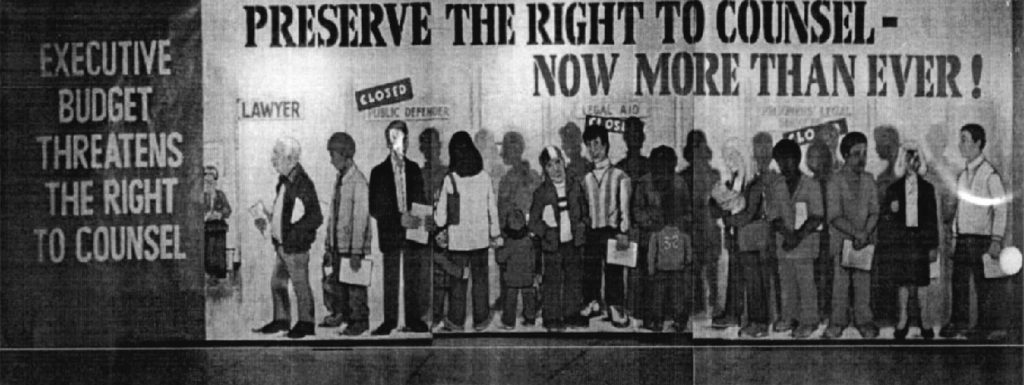
Image description: A black-and-white illustration of people standing in a long line beneath the large text “PRESERVE THE RIGHT TO COUNSEL – NOW MORE THAN EVER!” On the left side, smaller text reads “EXECUTIVE BUDGET THREATENS THE RIGHT TO COUNSEL.” Signs held by figures in line include “CLOSED Public Defender” and “Legal Aid CLOSED,” while people wait with documents in hand, suggesting limited access to legal representation.
The Copyright Office makes the following observations about the exclusion of commercial art from VARA in its 2019 report on moral rights (at 67):
The Office does not believe that Congress excluded commercial and promotional works from the definition of “work of visual art” because it believed such images to be somehow artistically less worthy than so-called “fine art.” Instead, it appears more likely that, … Congress wanted to avoid interfering with works of art that were controlled or influenced by an entity other than the artist—and hence presumably are less attached to the artist’s reputation—as well as avoid interfering with contractual freedoms. The Office accepts this apparent reasoning, but does believe that the commercial/“fine art” distinction can be drawn more narrowly than the current statute has it.
In its report, the Office recommended that Congress consider an amendment to the definition of a “work of visual art” along the lines of the definition of an eligible work similar to that used by the California Art Preservation Act. It suggested (at 68) adding the phrase “prepared under contract for commercial use by its purchaser” to the definition in Section 101 such that the proposed Section 101 would read:
a work of visual art does not include – (A) . . . (ii) any merchandising item or advertising, promotional, descriptive, covering, or packaging material or container, any of which are prepared under contract for commercial use by its purchaser.
Applied art:
VARA’s standard for a “work of visual art” also specifically excludes “applied art,” which the statute does not define. What then is a work of applied art? The case of Cheffins v. Stewart, 825 F.3d 588 (9th Cir. 2016) concerned a mobile replica of a 16th-century Spanish galleon, built from a used school bus that featured at the Burning Man festival. In Cheffins, the majority of the Ninth Circuit elaborated the concept of “applied art” as follows (at 594):
We therefore hold that an object constitutes a piece of “applied art” — as opposed to a “work of visual art” — where the object initially served a utilitarian function and the object continues to serve such a function after the artist made embellishments or alterations to it. This test embraces the circumstances both where a functional object incorporates a decorative design in its initial formulation, and where a functional object is decorated after manufacture but continues to serve a practical purpose. Conversely, “applied art” would not include a piece of art whose function is purely aesthetic or a utilitarian object which is so transformed through the addition of artistic elements that its utilitarian functions cease.
Applying this definition, the majority said (at 595):
The La Contessa began as a simple school bus — an object which unquestionably served the utilitarian function of transportation. To transform the bus into the La Contessa, Cheffins and Jones adorned it with the visual trappings of a 16th-century Spanish galleon. While the La Contessa’s elaborate decorative elements may have had many artistic qualities, the La Contessa retained a largely practical function even after it had been completed. At Burning Man, the La Contessa was used for transportation, providing rides to festival-goers, hosting musical performances and weddings, and serving as a stage for poetry and acrobatics shows. Indeed, the La Contessa often was driven about the Festival grounds and was banned from the Festival in 2004 because “its unsafe driving practices far exceeded community tolerance and out-weighed the visual contribution” it made.
Under the definition we adopt today, the La Contessa plainly was “applied art.” It began as a rudimentary utilitarian object, and despite being visually transformed through elaborate artistry, it continued to serve a significant utilitarian function upon its completion. As “applied art,” the La Contessa was not a work of visual art under the VARA and therefore not eligible for its protection. Therefore, the trial court properly granted summary judgment to Stewart on Cheffins and Jones’s VARA claim.
La Contessa (Cheffins v. Stewart)
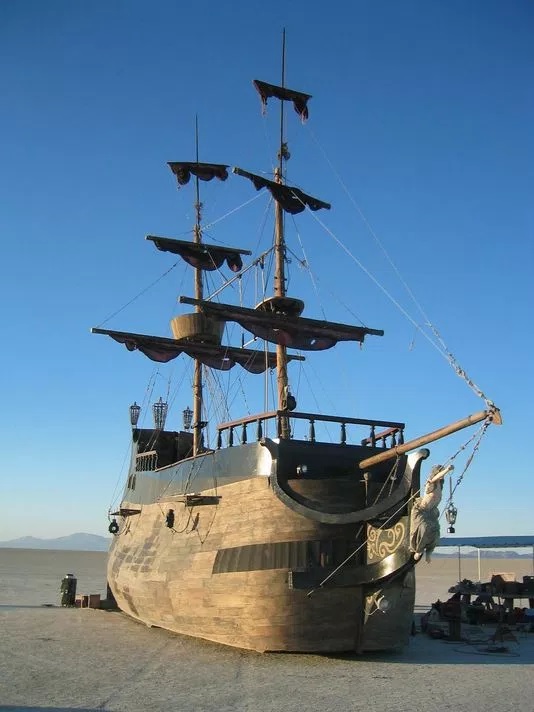
Image description: A large wooden ship styled like an old sailing vessel with three masts and black sails sits on dry land under a clear blue sky. The ship has a carved figurehead at the bow and appears stranded on a flat, desert-like surface, with small objects and people gathered nearby.
In her concurring opinion in Cheffins v. Stewart, Judge McKeown expressed concern that the majority’s focus on whether an object has or retains a utilitarian function ran “the risk of unduly narrowing the protections of artists under the Visual Artist Right’s Act of 1990 and not focusing on the work as a whole.” Judge McKeown argued that the right question to ask in determining whether a work is “applied art,” was “whether the primary purpose of the work as a whole is to serve a practical, useful function, and whether the aesthetic elements are subservient to that utilitarian purpose.” However, she found that even under this more flexible test the bus/Spanish galleon, La Contessa, was applied art outside the scope of Section 106A of the Copyright Act.
Preparatory works:
Courts have sometimes held that preparatory works do not qualify as works of visual art because they fall under the exclusion of “model[s]” in the Section 101 definition. In NASCAR v. Scharle, 184 Fed. App’x. 270 (3d Cir. 2006), the Third Circuit held that drawings for the two-dimensional design of a trophy were not works of visual art, but merely models created to “arrive at the optimal design for the trophy,” the final product. In contrast, in Flack v. Friends of Queen Catherine, Inc., 139 F. Supp. 2d 526 (S.D.N.Y. 2001) the district court held that a clay head used to cast a bronze statue was not excluded from the protection of VARA. The court relied on the art community’s acceptance and exhibition of clay sculptures as works of art in their own right to distinguish the work from the kinds of models excluded from the definition of works of visual art.
Site-specific works:
VARA does not specifically mention “site-specific works;” however, the First Circuit in Phillips v. Pembroke Real Estate, 459 F.3d 128 (1st Cir. 2006) found that VARA did not apply to a multi-element sculpture designed for a specific park. The First Circuit’s reading of the statute is difficult to square with the building exception in Section 113(d) of the Copyright Act which acknowledges potential protection for site-specific art. See Kelley v. Chicago Park Dist., 635 F.3d 290, 306–07 (7th Cir. 2011). See also Cohen v. G&M Realty LP, 320 F.Supp.3d 421 (E.D. N.Y. 2018) extracted below.
Phillips v. Pembroke Real Estate
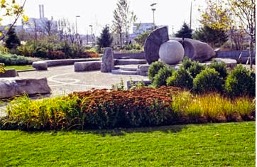
Image description: A landscaped park scene with green grass, flowering plants, and neatly trimmed bushes in the foreground. In the background, a stone sculpture installation features large geometric shapes, including a prominent spherical stone resting within curved stone forms. Trees and industrial buildings are visible in the distance.
The rights of attribution and integrity and their limits
VARA provides rights of attribution and integrity, but no rights of disclosure, withdrawal, or any right to resale royalties.
17 U.S. Code § 106A(a)
(a) Rights of Attribution and Integrity.— Subject to section 107 and independent of the exclusive rights provided in section 106, the author of a work of visual art—
(1) shall have the right—(A) to claim authorship of that work, and (B) to prevent the use of his or her name as the author of any work of visual art which he or she did not create;
(2) shall have the right to prevent the use of his or her name as the author of the work of visual art in the event of a distortion, mutilation, or other modification of the work which would be prejudicial to his or her honor or reputation; and
(3) subject to the limitations set forth in section 113 (d), shall have the right—(A) to prevent any intentional distortion, mutilation, or other modification of that work which would be prejudicial to his or her honor or reputation, and any intentional distortion, mutilation, or modification of that work is a violation of that right, and (B) to prevent any destruction of a work of recognized stature, and any intentional or grossly negligent destruction of that work is a violation of that right.
Section 106A(a)(1) and (2) protect some limited reputational interests of the author of a work of visual art. Under Section 106A(a)(1), the author of a work of visual art has the right to claim authorship of that work and to prevent being held out as the author of any work of visual art she did not create. Under Section 106A(a)(2), the author also has the right to prevent the use of her name as the author of the work of visual art if that work has been distorted, mutilated, or modified in some other way that “would be prejudicial to his or her honor or reputation.”
Section 106A(a)(3) goes beyond issues of attribution and actually vests the author of a work of visual art with two important rights in relation to the work itself. Subsection (A) gives the author the right to prevent any intentional distortion, mutilation, or other prejudicial modification of that work. This excludes any change to the work resulting from the passage of time or the inherent nature of the materials used, see Section 106A(c)(1). It also excludes any modification resulting from conservation or public presentation (including lighting and placement), unless the modification is caused by gross negligence, see Section 106A(c)(2).
Section 106A(a)(3), subsection (B) gives the author the right to “prevent any destruction of a work of recognized stature, and any intentional or grossly negligent destruction of that work is a violation of that right.” The right to prevent intentional distortion, mutilation, or prejudicial modification and the right to prevent the destruction of the work of recognized stature are both subject to limitations in Section 113(d) if the work has been incorporated in or made part of a building. These provisions are discussed in the 5Pointz case, below.
The Second Circuit addressed the outer edge of these rights in Kerson v. Vermont Law School, Inc., 79 F.4th 257 (2d Cir. 2023). In 1993 Samuel Kerson painted two murals, together entitled The Underground Railroad, Vermont and the Fugitive Slave, directly onto the sheetrock walls of a building on the law school’s campus. The work commemorates Vermont’s part in the abolitionist movement. Decades later, members of the school community objected that the murals’ depiction of enslaved people was itself demeaning caricature, and the school announced that it would erect a wall of fabric-cushioned acoustic panels that would permanently conceal them from view. Kerson sued to stop it.
The court held that concealment is neither destruction nor modification. The murals remain intact behind the panels: nothing has been distorted or mutilated, and hiding a work does not destroy it. Any degradation that the barrier might cause fell within the exception in § 106A(c)(1) for changes resulting from the passage of time or the inherent nature of the materials, there being no evidence that the school intended to damage the murals or that the panels were likely to do so. Underlying the decision is a proposition worth dwelling on: VARA confers no general right to have one’s work displayed. An owner who dislikes a work may take it down, turn it to the wall, or, as here, build a wall in front of it. Is that the right line? For Kerson the practical effect is close to destruction, since the murals are painted onto the walls and cannot be moved, even though the legal characterization is not.
The right of attribution does not apply in relation to reproductions in a significant set of situations.
17 U.S. Code § 106A(c)(3)
The rights described in paragraphs (1) and (2) of subsection (a) shall not apply to any reproduction, depiction, portrayal, or other use of a work in, upon, or in any connection with any item described in subparagraph (A) or (B) of the definition of “work of visual art” in section 101, and any such reproduction, depiction, portrayal, or other use of a work is not a destruction, distortion, mutilation, or other modification described in paragraph (3) of subsection (a).
Section 106A(c)(3) provides that the rights relating to attribution do not apply to “any reproduction, depiction, portrayal, or other use of a work” in various contexts, including maps, technical drawings, motion pictures, books, magazines, electronic publications, or advertising, to name just a few. Likewise, the reproduction of a work of visual art, or its depiction or portrayal is not considered “a destruction, distortion, mutilation, or modification” for the purposes of § 106A(a)(3). As the Copyright Office report on moral rights explains (at 75):
Under this exception, a reproduction of an artist’s visual work on a poster or in a magazine need not be accompanied by the artist’s name. Many of the attribution claims brought under VARA focus on a reproduction, not the original, work of visual art. Courts have consistently dismissed these claims under this exception.
The duration of rights under VARA
There are three different possibilities for the duration of rights under VARA, only one of which really makes sense. If moral rights protect the artist’s reputation and special personal connection with the work, it should follow that those rights exist while the artist is alive and die with the artist. This is the rule for works made after the effective date of VARA (June 1, 1991).
However, for works created but not transferred before the effective date of VARA, the artist’s rights endure for the duration of her other copyright rights, i.e., a term of life plus 70 years. Conversely, artists who transferred title to their works before June 1, 1991 have no rights under VARA. As the Copyright Office notes in its 2019 report on moral rights (at 81):
This particular provision has created certain inconsistencies regarding duration of rights. If an artist created a painting in 1985 (for which he did not transfer title before 1991) and dies in 2005, then the copyright term and the artist’s rights of integrity and attribution for that painting will last until 2075. However, if the artist created a painting in 1995 and died in 2005, then the copyright term will last until 2075 but the rights of integrity and attribution would have lasted for a shorter time, until 2005.
A case study of VARA in action
Cohen v. G&M Realty LP, 320 F.Supp.3d 421 (EDNY 2018) (February 12, 2018)
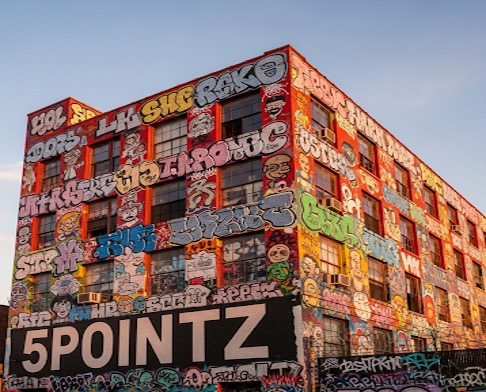
Image description: An AI produced image of a large industrial building covered in colorful graffiti murals and tags. The walls feature vibrant artwork, lettering, and characters in bold styles, with windows partially painted over. Prominently displayed across the lower section of the building is the word “5POINTZ” in large white block letters outlined in black..
Senior District Judge Block
This marks the latest chapter in the ongoing saga of what has commonly become known as the 5Pointz litigation. Plaintiffs, 21 aerosol artists, initiated this lawsuit over four years ago by seeking a preliminary injunction under the Visual Artists Rights Act of 1990 (“VARA”), 17 U.S.C. § 106A, against defendants Gerald Wolkoff (“Wolkoff”) and four of his real estate entities to prevent the planned demolition by Wolkoff of his warehouse buildings in Long Island City and consequent destruction of plaintiffs’ paintings on the walls of the buildings.
I
On November 12, 2013, after a hearing, the Court issued an order denying preliminary injunctive relief and stating that “a written opinion would soon be issued.” Rather than wait for the Court’s opinion, which was issued just eight days later on November 20th, Wolkoff destroyed almost all of the plaintiffs’ paintings by whitewashing them during that eight-day interim.
In its extensive opinion the Court initially noted that Wolkoff’s buildings “had become the repository of the largest collection of exterior aerosol art . . . in the United States” and that this litigation “marks the first occasion that a court has had to determine whether the work of an exterior aerosol artist—given its general ephemeral nature—is worthy of any protection under the law.” Cohen v. G & M Realty L.P., 988 F. Supp. 2d 212, 214 (E.D.N.Y. 2013) (“Cohen I”).
In denying the plaintiffs’ application for preliminary injunctive relief, the Court recognized that the rights created by VARA were at tension with conventional notions of property rights and tried to balance these rights. It did so by not interfering with Wolkoff’s desire to tear down the warehouses to make way for high-rise luxury condos, but cautioned that “defendants are exposed to potentially significant monetary damages if it is ultimately determined after trial that the plaintiffs’ works were of ‘recognized stature’” under VARA.
The trial has now happened. It lasted three weeks. At plaintiffs’ insistence, it was tried before a jury, but just prior to summations, plaintiffs—with defendants’ consent—waived their jury rights. Rather than summarily dismiss the jury after it had sat through the entire trial, the Court converted it to an advisory jury. During its charge, the Court carefully explained the parties’ rights and obligations under VARA, including the plaintiffs’ entitlement to substantial statutory damages if the jury determined that Wolkoff had violated plaintiffs’ VARA rights and that he had acted willfully. On a 98-page verdict sheet, the jury found liability and made various damage awards in respect to 36 of plaintiffs’ 49 works of art that were the subject of the lawsuit. In every case they found that Wolkoff had acted willfully.
Although the Court does not agree with all of the jurors’ findings, it does agree that Wolkoff willfully violated plaintiffs’ VARA rights in respect to those 36 paintings. The Court further finds that liability and willfulness should attach to an additional nine works.
Given the abject nature of Wolkoff’s willful conduct, the Court awards the maximum statutory damages under VARA for each of the 45 works of art wrongfully and willfully destroyed in the combined sum of $6,750,000.
II
A. The Relevant Statutory Framework
As the Court explained in Cohen I, “VARA amended existing copyright law to add protections for two ‘moral rights’ of artists: the rights of attribution and integrity.” Cohen I, 988 F. Supp. 2d at 215. VARA has codified the right to integrity to provide “the author of a work of visual art” the right
(A) to prevent any intentional destruction, mutilation, or other modification of that work which would be prejudicial to his or her honor or reputation, and any intentional distortion, mutilation, or modification of that work is a violation of that right, and
(B) to prevent any destruction of a work of recognized stature, and any intentional or grossly negligent destruction of that work is a violation of that right.
17 U.S.C. § 106A(a)(3).
Thus, in Cohen I, the Court held that plaintiffs’ aerosol art comes under VARA’s protection as works of “visual art”, and that, under § 106A(a)(3)(B), VARA gives the ‘author of a work of visual art’ the right to sue to prevent the destruction of the work if it is one of “recognized stature.” VARA also permits the artist to seek monetary damages under § 106A(a)(3)(A) if the work was distorted, mutilated, or otherwise modified to the prejudice of the artist’s honor or reputation.
Section 113(d)(1) of VARA provides that
In a case in which —
(A) a work of visual art has been incorporated in or made part of a building in such a way that removing the work from the building will cause the destruction, distortion, mutilation, or other modification of the work as described in section 106A(a)(3), and
(B) the author consented to the installation of the work in the building either before the effective date set forth in section 610(a) of the Visual Artists Rights Act of 1990, or in a written instrument executed on or after such effective date that is signed by the owner of the building and the author and that specifies that installation of the work may subject the work to destruction, distortion, mutilation, or other modification, by reason of its removal, then the rights conferred by paragraphs (2) and (3) of section 106A(a) shall not apply.2
Footnote 2: Paragraph (2) — not applicable in this case — protects the right of attribution by affording the artist “the right to prevent the use of his or her name as the author of the work of visual art in the event of a distortion, mutilation, or other modification of the work which would be prejudicial to his or her honor or reputation.”
Section 113(d)(2) provides, in part, that
If the owner of a building wishes to remove a work of visual art which is a part of such building and which can be removed from the building without the destruction, mutilation, or other modification of the work as described in section 106A(a)(3), the author’s rights under paragraphs (2) and (3) of section 106A(a) shall apply unless—
(A) the owner has made a diligent, good faith attempt without success to notify the author of the owner’s intended action affecting the work of visual art, or
(B) the owner did provide such notice in writing and the person so notified failed, within 90 days after receiving such notice, either to remove the work or to pay for its removal.
Thus, § 113(d) provides for two possibilities when a protected work of art has been integrated into a building subsequent to June 1, 1991, VARA’s effective date. Section 113(d)(1) deals with works of visual art that cannot be removed without causing destruction, mutilation, or other modifications to the work. Section 113(d)(2) deals with works of visual art that can be removed without causing such harm.
Under § 113(d)(1), if a work is not removable without destroying, mutilating, distorting, or otherwise modifying the work, the artist’s VARA right of integrity under § 106A(3) attach, and the artist may sue to prevent the destruction of the work unless the right is waived “in a written instrument . . . that is signed by the owner of the building and the author and that specifies that installation of the work may subject the work to destruction, distortion, mutilation, or other modification, by reason of its removal.” § 113(d)(1)(B) (emphasis added).
Under § 113(d)(2), if a work is removable without destroying, mutilating, distorting, or otherwise modifying it, VARA gives the artist the opportunity to salvage the work upon receipt of a 90 days’ written notice from the building owner of the owner’s “intended action affecting the work of visual art.” 17 U.S.C. §§ 113(d)(2)(A)-(B). If the artist fails to remove or pay for the removal of the works within the 90 days —or if the owner could not notify the artist after making a “good faith effort,” 17 U.S.C. § 113(d)(2)(A)—the artist’s VARA rights are deemed waived for the removable work, and the owner may destroy them without consequences.
Damages that may be awarded for the violation of the artist’s rights of attribution and integrity under § 106A(a)(3) are the same that apply for copyright infringement, namely actual (including profits) and statutory. 17 U.S.C. § 504(a). As the House Judiciary Committee Report explained:
Section 6(a) of the bill simply amends section 501(a) of title 17 to add those authors covered by new section 106A . . . . It thereby makes all title 17 remedies [except criminal sanctions] available to those authors. . . . [VARA] thereby provides for monetary damages, and for injunctive relief to prevent future harm. The same standards that the courts presently use to determine whether such relief is appropriate for violations of section 106 rights will apply to violations of section 106A rights as well.
House Report at 21-22 (1990) (emphasis added).
There is no limit to the amount of actual damages for each work, but statutory damages for each may be “not less than $750 or more than $30,000 as the court considers just.” 17 U.S.C. § 504(c)(1). If, however, the plaintiff “sustains the burden of proving, and the court finds, that infringement was committed willfully, the court in its discretion may increase the award of statutory damages” for each work “to a sum of not more than $150,000.” 17 U.S.C. § 504(c)(2). The plaintiff is not entitled to both actual and statutory damages but must elect one or the other “before final judgment is rendered[.]” 17 U.S.C. § 504(c)(1).
B. The Advisory Jury
… The Court would be remiss if it did not pause to acknowledge the extraordinary work of the eight jurors. Rarely were they late during the course of the extensive trial, and the Court was impressed with their rapt attention to the difficult task that awaited them in having to assess the defendants’ liability in respect to each of the 49 works of art. Since the jurors had spent the better part of a month in anticipation of deliberating, the Court was disinclined to summarily dismiss them when, at the veritable 11th hour, the plaintiffs suddenly decided to convert the case to a bench trial. Moreover, since 5Pointz had achieved worldwide community recognition, the Court was keen to learn whether the jurors, as members of the community, would view the works as having achieved recognized stature under VARA. To enhance the integrity of their verdicts, the Court decided it best not to tell the jurors that their findings would only be advisory.
The complexity of the litigation did not deter the jurors from making individualized findings in respect to each of the 21 artists and their 49 works on the 98-page verdict sheet. They were tasked with having to determine whether each destroyed work was of recognized stature and/or was mutilated, distorted, or otherwise modified to the prejudice of the artist’s honor or reputation by the whitewashing. They found that 28 of the 49 destroyed works had achieved recognized stature, and eight more had been mutilated, distorted, or otherwise modified to the prejudice of the artists’ honor or reputation. Each of the 21 plaintiffs were adversely affected in one way or the other, and the jury had to individually assess whether actual and statutory damages were warranted in regard to each work. It awarded a total of $545,750 in actual damages and $651,750 in statutory damages.
C. The Witnesses and Evidentiary Landscape
Each of the 21 plaintiffs/artists testified; they were respectful, articulate and credible. Folios for each were admitted into evidence collectively containing their professional achievements and recognition in the form of an impressive array of fellowships, residences, public and private commissions, teaching positions, media coverage, and social media presence. Not surprisingly, each of the 21 Folios contained beautiful color prints of the artists’ respective aerosol works of art which are the subject of the lawsuit. They are appended to this opinion. It is apparent that they reflect striking technical and artistic mastery and vision worthy of display in prominent museums if not on the walls of 5Pointz. The Folios also contain photos showing how almost all of these works of art were partially or wholly whitewashed by Wolkoff.
5Pointz was an egalitarian place. The artists came from many backgrounds. Some of the plaintiffs testified via Skype from international residences. Many who live in New York had immigrated from other countries to join the 5Pointz community. One artist flew from London to testify; another came of age in rural West Virginia. Some artists came from highly prestigious art schools; others were selftaught. Some were fixtures in elite, traditional art circles; others were simply dedicated to street and community art. The Court was impressed with the breadth of the artists’ works and how many of the works spoke to the social issues of our times.
The principal testimony about the advent, evolution and demolition of 5Pointz came from plaintiff Jonathan Cohen, one of the world’s most accomplished aerosol artists. Wolkoff had designated Cohen as 5Pointz’s de facto curator, appointing him to run the site and pick the works he thought were of merit: “I gave him permission, plain, Jonathan, you are in charge, bring whoever you think is right to come and display their work on my building.” Tr. at 2025:4-8.
In addition to the artists, three experts testified for the plaintiffs. Renee Vara, a certified art appraiser, former head fine art expert at Chubb Insurance and art professor at New York University, testified to the quality and recognized stature of the works; Elizabeth Littlejohn, an art appraiser certified through the Appraisers Association of America, testified to their appraisal value; and Harriet Irgang Alden, the chief paintings conservator at Art Care NYC, testified as to the removability of each of the artworks from the 5 Pointz walls.
Plaintiffs also called two fact witnesses. Angelo Madrigale, Vice President and Director of Contemporary Art at Doyle New York, an auction house, wrote a letter upon which Vara relied in formulating her report. He testified to the artistic importance of the works. Lois Stavsky developed a 5Pointz exhibit for Google Arts and Culture and testified to the creation of that exhibit and why Google believed that 5Pointz was a culturally significant site.
Wolkoff was the defendants’ principal witness. He testified to his rise from a poor childhood to become a successful real estate developer and explained his role in the advent and success of 5 Pointz. He was adamant that the artists knew that the day would come when the warehouse buildings bearing their works of art would come down and be replaced by high-rise residential condos.
Although the Court believes that Wolkoff in the main testified truthfully, he was a difficult witness. He frequently ignored or challenged instructions by the Court. He was argumentative and prone to tangents and non-responsive answers. Eliciting coherent testimony was a chore and was only achieved after the Court threatened to hold him in contempt.
In addition to Wolkoff, two experts testified for the defendants. Erin Thompson, a professor of art history at the City University of New York and practicing art lawyer, testified as to the issue of recognized stature, and Christopher Gaillard, a fine art appraiser with the art appraisal and acquisition firm Gurr Johns, testified as to the works’ appraisal value.
The story of 5Pointz that follows comes primarily from the lips of Cohen and Wolkoff.
III
A. The Advent and Evolution of 5Pointz
What became 5Pointz originated as Phun Phactory in the early 1990s. The warehouses were largely dilapidated and the neighborhood was crime infested. There was no control over the artists who painted on the walls of the buildings or the quality of their work, which was largely viewed by the public as nothing more than graffiti. This started to change in 2002 when Wolkoff put Cohen in charge. Cohen and several other artists also rented studio space in the warehouse buildings. Collectively, they worked to improve conditions. As Cohen explained:
We took it upon ourselves to clean the loading dock. . . . The dumpsters were overflowing. We took it upon ourselves, we hired his employees, we paid for the lighting. We put motion sensors up so that when you came to the loading dock it was inviting. It actually drew you in as opposed to scaring you away.
Wolkoff recognized the merit of the art. As he acknowledged: “I liked it and they did more and more and I thought it was terrific. They were expressing themselves.” And he approved of the job Cohen did in curating the art: “I have no feelings even today against Jonathan Cohen. I thought he was terrific handling my building. . . . Anything to do with art I left up to Jonathan. He had good taste in the artists that came there.”
Until Wolkoff decided over a decade later that the economic climate was ripe to convert the site into luxury condos, he and Cohen had a copacetic relationship.
But nothing was ever reduced to writing and Wolkoff only verbally laid out three rules for what could be put on the walls: no pornography, no religious content, and nothing political. In his role, Cohen established a system of rules for both the creation and curation of the art, spending seven days a week without pay to bring 5Pointz to fruition.
Cohen oversaw the site, kept it clean and safe, allotted wall space, and explained the site’s rules and norms to new artists. Over time, crime in the neighborhood dropped and the site became a major attraction drawing thousands of daily visitors, including busloads of tourists, school trips, and weddings. Movie, television, and music video producers came; it was used for the 2013 motion picture Now You See Me, starring Jesse Eisenberg and Mark Ruffalo, and was the site of a notable tour for R&B singer Usher.
As the plaintiff Castillo explained, “street art became a new form,” which “now has become an industry.” And 5Pointz became “this outdoor museum where kids can touch the wall, and . . you can’t do that at a museum. You can’t go and touch a Van Gogh or like a Mona Lisa.”
Wolkoff had nothing to do with day-to-day operations. Under Cohen’s control, he witnessed his buildings emerge as a mecca for the world’s largest collection of quality outdoor aerosol art.
B. The Walls
1. Covering
5Pointz was a site of creative destruction; most artworks had short lifespans and were repeatedly painted over by successive artists. The rules behind covering were important; as virtually every artist testified, “going over” someone else’s piece without permission was a sign of disrespect that could cause conflicts. Going over another piece partially or sloppily was another insult. As Cohen explained:
You respect your wall, you clean up when you’re done, you cover what you go over completely. If you do not cover what you went over, you do not last. That was rule number one. Respect in our game is everything, and if you don’t have respect then you don’t get respect.
As a result, Cohen established an elaborate system of rules and norms governing how long pieces would remain and when a piece could be covered by a new artwork. As he testified:
THE COURT: Let me ask you a question. Can anybody paint over your paintings without your permission, aside from vandalism?
A: No. Everything was done with permission and there was a system that grew over the period of time I was there. You know, we perfect as we go along.
2. Short-Term Rotating Walls vs. Long-Standing Walls
5Pointz was organized into short-term rotating walls and long-standing walls. The short-term walls would change on a daily or weekly basis. As Cohen explained: “There were allocated spaces that were for straight beginners that had no idea how to paint. And those, I would say you could utilize the space, but it more than likely will be gone tomorrow or the next day or whatever.” “Short-term rotating walls, it was communicated up front so they’d know you could have several weeks or whatever.”
On the other hand, pieces on long-standing walls were more permanent, although a high-quality piece could achieve permanence even if not initially placed on a long-standing wall; but an artist’s reputation was not sufficient to secure longstanding status. As Cohen further explained:
The prime real estate that faces the train were the most sought after spots to paint and those went to more advanced writers. You’ve got to understand, as well, because you are an advanced writer doesn’t mean that you are going to perform on an advanced level. You may just want to blow off steam one afternoon, but that doesn’t mean your piece should last a long time. And you could be a beginner and do the performance of your lifetime and produce a piece that is so amazing that it’s decided it will stay.
While Cohen had the final say as to the duration of the pieces, he always spoke with the artists about their planned lifespan and eventual replacement. As he testified: “For long term productions, where people invested time and money, I would communicate with them. I would reach out to them. In some instances, I would tell them to come back and actually egg them on to do something real better. As the bar got raised, everybody performed better.”
In other words, 5Pointz operated not just as a creative space, but a competitive place. Artists would compete to outdo one another and earn prominent placement on a long-standing wall. In addition to the walls facing the passing 7 train, which were seen by millions of commuters, the artists prized the walls near the loading docks, which had the most foot traffic, and the walls inside the buildings, which were generally long-standing. While as many as 10,000 works were destroyed while Cohen was in charge, it was not anarchy. Most of the best works by the best artists achieved permanent or semi-permanent placements on the long-standing walls.
C. The Planned Demolition
Starting in 2011, rumors that Wolkoff had plans to shut down 5Pointz and turn it into luxury condos began to concern the artists. In May 2013, the rumors became reality: Cohen learned that Wolkoff had started to seek the requisite municipal approvals for his condos.
Hoping to save 5Pointz, Cohen filed an application with the City Landmark Preservation Commission to preserve the site as one of cultural significance. It was denied because the artistic work was of too recent origin. See Letter from NYC Landmarks Preservation Commission, August 20, 2013.
Cohen also sought funding to buy the property, which had been valued at $40 million. However, this fell through in October 2013 when Wolkoff obtained a necessary variance, instantly raising the property value to more than $200 million. The higher price was out of reach of Cohen’s potential investors. Plaintiffs then initiated this litigation to enjoin Wolkoff from destroying 5Pointz.
D. The Whitewashing
As soon as the Court denied the plaintiffs’ application for preliminary injunction, Wolkoff directed the whitewashing of virtually all the artwork on the 5Pointz site with rollers, spray machines, and buckets of white paint.
The whitewashing was inconsistent. Some works were completely covered in white paint. Others were only partially covered. Some were fully covered, but by such a thin layer of paint that the artwork was easily visible beneath the paint. What was consistent was that none of the covered works was salvageable. And plaintiffs were no longer allowed on the site, even to recover the scattered remnants of their ruined creations.
Since their works were effectively destroyed, plaintiffs were relegated to seeking monetary relief under VARA.
IV
A. Temporary Works of Art
Defendants’ overarching contention is that plaintiffs knew that the day would come when the buildings would be torn down and that, regardless, the nature of the work of an outdoor aerosol artist is ephemeral. They argue, therefore, that VARA should not afford plaintiffs protection for their temporary works.
VARA does not directly address whether it protects temporary works. However, in the context of works on buildings, it is clear from 17 U.S.C. § 113(d) that temporary works are protected. Moreover, relevant case law conceptually supports this conclusion. In short, there is no legal support for the proposition that temporary works do not come within VARA’s embrace.
First, § 113(d)(1) specifies that an unremovable work incorporated in a building is protected by VARA unless the artist waives his or her rights in a writing signed by both the artist and the building owner. If the building owner could orally inform the artist that the building is coming down someday, and thereby convert the work into an unprotected temporary work, the written consent provision would be rendered nugatory. As the House Judiciary Committee Report explains: “The purpose of [the written waiver] is to ensure that the author is made fully aware of the circumstances surrounding the installation and potential removal of the work and has nevertheless knowingly subjected the work to possible modifications that would otherwise be actionable under section106A.” House Report at 21. And as Patry adds: “In light of this provision’s purpose of ensuring that artists be made aware fully of the circumstances surrounding installation and potential destructive removal, it should be strictly construed.” Patry on Copyright § 16:33.
Second, § 113(d)(2), specifying that artists are entitled to 90 days’ written notice to allow them to salvage their removable works, contemplates that such works may be temporarily on the side of a building. Thus, VARA resolves the tension between the building owners’ rights and the artists’ rights through § 113(d), not by excluding temporary works from protection.
Of the limited available case law, Board of Managers of Soho International Arts Condominium v. City of New York, 2003 WL 21403333 (S.D.N.Y. June 17, 2003) perhaps best illustrates this point. There, an artist sought to prevent his work from being permanently removed from the wall of a condo under VARA. There was conflicting testimony as to whether the work was intended to be kept on the wall permanently or temporarily. Nonetheless, the Court, in denying summary judgment, held VARA only allowed the artist to remove the mural, not keep it in its place. The court rejected the artist’s argument that removal was “tantamount to the Work’s destruction” as “nowhere in the dictionary definition of ‘remove’ does the temporality of the act of removal arise.” Therefore, it was “clear to the Court that what Congress intended in bifurcating § 113(d)’s protections was to separate removal situations based not on the temporality of the removal but on the consequences of the removal.”
Thus, VARA draws no distinction between temporary and nontemporary works on the side of a building, particularly when all that makes a work temporary is the building owner’s expressed intention to remove or destroy it. VARA protects such works; how it protects them is governed by the carefully crafted provisions of § 113(d) based on the removability of the works, not their permanence.
Also supporting the conclusion that VARA applies to temporary works is 17 U.S.C. § 106A(c)(1), which provides that modifications that are “the result of the passage of time or the inherent nature of the materials” are not violations of VARA. This exception was applied in Flack v. Friends of Queen Catherine Inc., 139 F. Supp. 2d 526 (S.D.N.Y. 2001), where the court dismissed a VARA claim because the head of a statue was exposed to the elements, causing the clay to deteriorate, but there was no evidence that the defendant otherwise directly damaged the work. The exception is not applicable here. The whitewashing was not caused by the “passage of time” or the “inherent nature of the materials”; it was caused by Wolkoff throwing paint on the works.
Thus, Congress chose to exclude protection for the passage of time and natural deterioration but not for other types of temporary works. Under the principle of statutory interpretation expressio unius est exclusio alterius (the expression of one thing implies the exclusion of others), this choice lends support to the conclusion that there is no categorical exception for temporary works.
Moreover, the First Circuit has held that VARA protects unfinished works. Mass. Museum of Contemporary Art Found., Inc. v. Buchel, 593 F.3d 38, 65 (1st Cir. 2010). An unfinished work is inherently in a temporary state since the ultimate goal is always to finish the work; thus, VARA protects the interim, unfinished work even though it is only temporarily in that form.
Analogy to traditional copyright law is also relevant. Under the Copyright Act —of which VARA is a part—a work is “‘created’ when it is fixed in a copy or phonorecord for the first time.” 17 U.S.C. § 101. And a work is “‘fixed’ in a tangible medium of expression when its embodiment in a copy or phonorecord, by or under the authority of the author, is sufficiently permanent or stable to permit it to be perceived . . . for a period of more than transitory duration.” Id. (emphasis added). For copyright protection, therefore, fixation for even a short period will suffice.
Thus, in Cartoon Network v. CSC Holdings, 536 F.3d 121 (2d Cir. 2008), the Second Circuit held that copies of television programs were not capable of being perceived “for a period of more than transitory duration” when they existed in the defendant’s data buffers for only 1.2 seconds. However, the court suggested that a work would exist for “more than transitory duration” if it was embodied in the data buffers for “at least several minutes.” With no indication to the contrary, it is reasonable to assume that Congress intended to apply the same minimal fixation requirement to works of visual art under VARA. Cf. Buchel, 593 F.3d at 51 (applying § 101’s fixation requirement to conclude that unfinished works are protected under VARA).
In sum, § 113(d) contemplates temporary works, § 106A(c) excludes only a narrow category of temporary works unrelated to this case, and analogous case law is consistent with the conclusion that temporary works are protected under VARA.14
Footnote 14: Common sense also supports this conclusion. Who would argue, for example, that if Picasso had painted Guernica on the walls of 5Pointz with the building owner’s consent it would not be worthy of VARA protection?
B. Works of Recognized Stature
As the Court stated in Cohen I, the district court’s decision in Carter v. Helmsley-Spear, Inc., 861 F. Supp. 303 (S.D.N.Y. 1994) (“Carter I”), affirmed in part, vacated in part, reversed in part, 71 F.3d 77 (2d Cir. 1995) (“Carter II”) remains the seminal case interpreting the phrase “recognized stature”—which is not defined in VARA—to require “a two-tiered showing: (1) that the visual art in question has ‘stature,’ i.e. is viewed as meritorious, and (2) that this stature is ‘recognized’ by art experts, other members of the artistic community, or by some cross-section of society.” 861 F. Supp. at 325.
The Second Circuit on appeal never had occasion to address the correctness of this formulation since, in reversing, it held that the work did not qualify for VARA protection because it was made for hire. Carter II, 71 F.3d at 85-89. But one circuit court did thereafter embrace and apply the district court’s standard for evaluating whether a work of visual art is of “recognized stature.”
As explained in Cohen I, the Seventh Circuit in Martin v. City of Indianapolis, 192 F.3d 608, 612 (7th Cir. 1999), noted that the Carter I test “may be more rigorous than Congress intended,” id. at 612, but nonetheless affirmed the district court’s grant of summary judgment and its award of damages for a sculpture that had been destroyed, under the Carter I test utilized by the district court. In doing so, it noted that “plaintiff offered no evidence of experts or others by deposition, affidavit or interrogatories,” but nonetheless established the work’s recognized stature via “certain newspaper and magazine articles, and various letters, including a letter from an art gallery director and a letter to the editor of The Indianapolis News, all in support of the sculpture.” Id.
The circuit court’s decision in Martin appropriately recognizes, therefore, that expert testimony is not the sine qua non for establishing that a work of visual art is of recognized stature, and indeed the district court in Carter I cautioned that plaintiffs need “not inevitably . . . call expert witnesses to testify before the trier of fact.” 861 F.Supp. at 325. This is in keeping with Congress’s expansive recognition of the moral rights of attribution and integrity of the visual artist and the consequent need to create “a climate of artistic worth and honor that encourages the author in the arduous act of creation.” Carter II, 71 F.3d at 83 (quoting House Report at 5). As the Second Circuit noted in Carter II, therefore, the courts “should use common sense and generally accepted standards of the artistic community in determining whether a particular work” is a work of visual art since “artists may work in a variety of media, and use any number of materials in creating their works.” Id.
The same common sense should be utilized in assessing whether the visual work is of recognized stature since “by setting the standard too high, courts risk the destruction of the unrecognized masterwork; by setting it too low, courts risk alienating those . . . whose legitimate property interests are curtailed.” Christopher J. Robinson, The “Recognized Stature” Standard in the Visual Artists Rights Act, 68 Fordham Law Review 1935, 1968 (2000). Thus, as one court has held, even inferred recognition from a successful career can be considered in determining whether a visual artist’s work has achieved recognized stature. See Lubner v. City of Los Angeles, 45 Cal. App. 4th 525, 531 (1996).
In the present case, the Court need not dwell on the nuances of the appropriate evidentiary standard since the plaintiffs adduced such a plethora of exhibits and credible testimony, including the testimony of a highly regarded expert, that even under the most restrictive of evidentiary standards almost all of the plaintiffs’ works easily qualify as works of recognized stature.
To begin, that Jonathan Cohen selected the handful of works from the thousands at 5Pointz for permanence and prominence on long-standing walls is powerful, and arguably singular, testament to their recognized stature. They were walls that spanned multiple stories, walls visible to millions on the passing trains; walls near the entrances. Many of these works had survived for years. As 5Pointz’s curator, Cohen considered them outstanding examples of the aerosol craft. And as Wolkoff himself acknowledged, Cohen was qualified to assess the artistic merits of the works since “he had good taste in the artists that came there.” They were 5Pointz’s jewels.
Wolkoff’s faith in Cohen was not unwarranted. The multitude of artists painting on the walls marched to Cohen’s beat. He called the shots and had the respect of his artistic community. That it was he who chose the works that are worthy of VARA protection in this litigation speaks volumes to their recognized stature.
But there is so much more. All of the plaintiffs had also achieved artistic recognition outside of 5Pointz. And in their Folios they collectively presented over a thousand exhibits in support of their claims that their works at 5Pointz had achieved recognized stature. The Folios covered the highlights of their careers, as well as evidence of the placement of their works at 5Pointz in films, television, newspaper articles, blogs, and online videos, in addition to social media buzz.
And plaintiffs’ highly qualified expert, Vara, provided detailed findings as to the skill and craftsmanship of each of the 49 works, the importance of 5Pointz as a mecca for aerosol art, the academic and professional interest of the art world in the works, and her professional opinion that they were all of recognized stature. The Court finds Vara highly credible and affords great weight to her testimony, although, as explained infra, it finds that four of the 49 works do not qualify as having achieved recognized stature.
Defendants’ expert Thompson’s testimony had two fatal flaws: First, she used an unduly restrictive interpretation of recognized stature that was more akin to a masterpiece standard. Second, she relied heavily on her inability to find the works on social media or in academic databases; but, as effectively drawn out by plaintiffs’ counsel on cross-examination, her search methodology was unduly restrictive and almost designed to avoid finding results. Tellingly, her searches did not even uncover many of plaintiffs’ social media exhibits, demonstrating the weakness of her approach. Her final conclusion that none of the works had achieved recognized stature defies credibility. If not a single one of these works meet the recognized stature standard, it is hard to imagine works that would, short of a Caravaggio or Rembrandt.
1. Recognized Stature of Individual Artworks
The Court now turns to making the requisite individualized findings as to each of the 49 works:
a. The Long-Standing Works
The Court finds that 37 works on long-standing walls all achieved recognized stature by virtue of their selection by Cohen for these highly coveted spaces, as reinforced by the supportive evidence in the plaintiffs’ Folios and Vara’s compelling expert testimony as to their artistic merit and embrace by the artistic community. They are:
Jonathan Cohen’s Eleanor RIP, 7-Angle Time Lapse, Patience, Character, Clown with Bulbs, Meres Outdoor Wildstyle, and Inside Wildstyle
Sandra Fabara’s Green Mother Earth
Luis Lamboy’s Blue Jay Wall, Inside 4th Floor, World Traveler, Logo for Clothing Brand aka Monopoly Man, and Electric Fish
Esteban Del Valle’s Beauty and the Beast
Christian Cortes’s Skulls Cluster, Jackson Avenue Skulls, Up High Blue Skulls, and Up High Orange Skulls
Carlos Game’s Geisha, Marilyn, Red, Denim Girl, and Black and White 5Pointz Girl
James Rocco’s Bull Face, Lord Paz, and Face on Jackson
Steven Lew’s Crazy Monsters
Nicholai Khan’s Dos Equis Man
James Cochran’s Subway Rider
Luis Gomez’s Inside King Kong
Richard Miller’s Monster I
Jonathan Cohen and Maria Castillo’s Love Girl and Burner
Jonathan Cohen and Akiko Miyakami’s Underwater Fantasy
William Tramontozzi, Jr. and James Rocco’s Jimi Hendrix Tribute
Akiko Miyakami and Carlos Game’s Japanese Fantasy
Bienbenido Guerra and Carlo Nieva’s Return of New York
Jonathan Cohen, Luis Lamboy, and Thomas Lucero’s Angry Orchard
b. Other Works
Ten works on the walls were of recent origin; two were not on walls at all. For these 12 works, the … jury found recognized stature for Rodrigo Henter de Rezende’s Fighting Tree, Thomas Lucero’s Black Creature, Akiko Miyakami’s Manga Koi, Francisco Fernandez’s Dream of Oil, Nicholai Khan’s Orange Clockwork, Kenji Takabayashi’s Starry Night, Richard Miller’s Monster II, and Jonathan Cohen and Akiko Miyakami’s Save 5Pointz. These eight works garnered third party attention, social media presence, and/or promises from Cohen that they would be long-standing.
The jury did not find recognized stature for Jonathan Cohen’s Drunken Bulbs, Akiko Miyakami’s Japanese Irish Girl, Carlos Game’s Faces on Hut, and Jonathan Cohen and Rodrigo Henter de Rezende’s Halloween Pumpkins.
Drunken Bulbs and Japanese Irish Girl were gifts to the Shannon Pot Bar. They were not part of the curated 5Pointz collection. Furthermore, neither attracted significant third-party attention or social media buzz during their short life spans.
Faces on Hut was not on a 5Pointz wall; it was on a tin shack near the loading dock. As its creator, Carlos Game testified: “Nobody wanted to paint on it because it was a tin shack, you know, and it was rusted out . . . .” Game also did not adduce any social media coverage or commentary regarding the work.
Halloween Pumpkins was created in very late October —, less than a month before the whitewash, and did not achieve any third party recognition. Moreover, because it was Halloween-themed, it was unlikely to have survived the holiday season.
In sum, the Court finds 45 of the 49 works achieved recognized stature. Drunken Bulbs, Japanese Irish Girl, Faces on Hut, and Halloween Pumpkins did not.
C. Mutilation and Prejudice to Honor or Reputation
As noted, even if a work is not of “recognized stature,” VARA also protects works from “intentional distortion, mutilation, or other modification . . . [that] would be prejudicial to [the artist’s] honor or reputation.” 17 U.S.C. § 106A(a)(3)(A). “In determining whether ‘intentional distortion, mutilation, or modification’ of [a] Work would be ‘prejudicial to [plaintiffs’] honor or reputation,’ [a court should] consider whether such alteration would cause injury or damage to plaintiffs’ good name, public esteem, or reputation in the artistic community.” Carter I, 861 F. Supp. at 323.
This concept is inherently murky. Carter I held that an artist’s honor or reputation may be harmed if the artwork presented to viewers an artistic vision materially different from that intended by the artist. In Massachusetts Museum of Contemporary Art Foundation, Inc. v. Buchel, 593 F.3d 38 (1st Cir. 2010), the circuit court held that changes made to an unfinished art installation by a museum against the artist’s wishes were sufficient to raise a question of fact as to whether the artist’s honor or reputation were injured. The court focused on evidence that newspapers covering the exhibit after the changes had a negative opinion of the altered work.
Here, the question is academic in respect to the 45 works of recognized stature since the Court is not awarding any actual damages, as explained infra, and only one statutory damages award may be awarded per artwork “for all infringements involved in the action.” 17 U.S.C. § 504(c)(1). Thus, whether defendants are additionally liable under this second prong is not of any practical consequence.
Of the remaining four, Japanese Irish Girl was destroyed and therefore not “distorted, mutilated, or otherwise modified.” Faces on Hut was not destroyed until the demolition of the building and apparently survived the whitewash. Therefore, it too was not “distorted, mutilated, or otherwise modified.”
Drunken Bulbs was only partially whitewashed; the outlines of the bulbs are dimly visible underneath the white paint. However, these vague outlines are unrecognizable as Cohen’s original work. Nobody looking at the work would know that it was his. Therefore, the Court holds this distortion did not prejudice his honor or reputation.
Halloween Pumpkins was almost entirely covered in black paint, but Cohen’s “wild style” contribution to the painting was apparently left untouched. However, Cohen testified that he was able to recover this portion of the work, and once the piece was removed, the final result was a black wall; the original artwork was not visible at all under the black paint, except for one purple cloud at the top of the wall, a minor detail in the painting. Therefore, the Court holds this distortion also did not prejudice the artists’ honor or reputation.
Having determined that the defendants have violated plaintiffs’ rights by intentionally destroying their works of “recognized stature,” the Court now turns to damages.
V
A. Actual Damages
As for actual damages, the parties presented dueling experts as to the valuation of the destroyed works. Plaintiffs’ expert, Elizabeth Littlejohn, testified that the works were worth from $50,000 to $80,000 per artwork. She arrived at this number through a complicated formula that began with the sale price of a Banksy piece and awarded each artwork a percentage of that value based on the artist’s reputation, the merit of the work, and other factors.
The Court finds this methodology flawed. First, it does not account for the removal costs of the works, which plaintiffs’ own removal expert, Alden, testified could run in the hundreds of thousands of dollars. Second, there is no evidence that these artists have ever achieved a fraction of Banksy’s sales history; most testified that they had never sold a work for more than a few thousand dollars. Third, Littlejohn’s method did not account for the unique problems in selling artwork that is the size of a wall of a building.
The Court finds defendants’ appraisal expert, Christopher Gaillard, credible. Gaillard testified that because of the unique challenges and costs of selling those artworks at 5Pointz which were the size of a building wall, they did not have a provable market value. The Court agrees and holds that plaintiffs failed to establish a reliable market value for their works.
Therefore, the Court does not award actual damages.
B. Statutory Damages
The Copyright Act affords the trial court “wide discretion . . . in setting the amount of statutory damages.” Fitzgerald Pub. Co., Inc. v. Baylor Pub. Co., Inc., 807 F.2d 1110, 1116 (2d Cir. 1986). … There need not be a correlation between statutory damages and actual damages. Psihoyos v. John Wiley & Sons, Inc., 748 F.3d 120, 127 (2d Cir. —). As such, statutory damages are particularly appropriate “when no actual damages are proven or they are difficult to calculate.” Warner Bros. Inc. v. Dae Rim Trading, Inc., 877 F.2d 1120, 1126 (2d Cir. 1989). They are “not meant to be merely compensatory or restitutionary. The statutory award is also meant ‘to discourage wrongful conduct.’” Yurman Design, Inc. v. PAJ, Inc., 262 F.3d 101, 113 (2d Cir. 2001) (rejecting defendant’s argument that statutory damages award should be overturned because it “bears little relationship” to actual damages) (citation omitted).
As previously explained, the factfinder may award between $750 and $30,000 per work, unless the infringement was committed willfully; if so, the award may be as high as $150,000 per work.
1. Willfulness
A copyright holder seeking to prove that a copier’s infringement was willful must show that the infringer had knowledge that its conduct represented infringement or recklessly disregarded the possibility. In other words, it need not be proven directly but may be inferred from the defendant’s conduct.
The jury found that in each case Wolkoff acted willfully. The Court could not agree more. Wolkoff knew from the moment the lawsuit was initiated that the artists were pressing their VARA claims. He admitted as much at trial:
Q: And you were aware that the artists were trying to apply under the Visual Artists Rights Act?
A: Yes.
. . .
THE COURT: You heard about VARA at that time?
A: Yes.
THE COURT: You have a generalized view—
A: At that time, yes.
. . .
Q: And you had hired Mr. Ebert’s law firm at the time; correct?
A: Yes.
Q: You had a general counsel—an in-house lawyer advising you on legal matters; correct?
A: Yes.
As previously explained, under VARA, Wolkoff could have given the plaintiffs 90 days’ notice to allow them the opportunity to salvage their works. And indeed, plaintiffs’ expert conservator, Alden, convincingly testified that curation techniques had evolved to the point where removal of works of art from the wall of a building was feasible and had been done. As an example, she referenced the Berlin Wall, from which hundreds of works of graffiti on the wall have been preserved and sold, auctioned, or given as gifts, including five works which were successfully transported to New York City. Alden also testified that she had personally successfully removed a mural from a building.
And in respect to the plaintiffs’ works at 5Pointz, Alden explained that many could have been totally or partially removed by the artists, at little cost, because the works were on “siding or plywood or sheetrock” or they “incorporated doors or windows from the building [which] could have been easily removed,” Tr. at 1971:23-1972:4; and many others could be removed by a conservator and contractors. See Exhibit 1270 (identifying 12 “Works for Which Artists’ Removal Was Possible”; 9 “Works Which Artists Were Able to Partially Remove,” and 28 “Works Which Could Only Have Been Removed by Conservator and Contractors”).
But Wolkoff could care less. As he callously testified:
I decided—I alone decided to hire people to whitewash it in one shot instead of waiting for three months and them going to do something irrational again and getting arrested. I will go and end it and whitewash it. I decided to do that. It was pretty much a spur-of-the-moment thing.
(Emphasis added).
Wolkoff’s reference to the artists doing “something irrational again and getting arrested” is fanciful and unfounded. Plainly, the evidence does not support the notion that he cared much for what was best for the artists. After the whitewash, he refused to let them onto his property to recover what had survived and even attempted to have them arrested when they tried to do so.
And his claim that he was worried that the plaintiffs may do something reckless and illegal is also belied by the evidence. The plaintiffs operated within the law in attempting to protect their works: They sought legal advice, filed a claim with the Landmark Preservation Commission, sought to generate public pressure to preserve the site, raised money, and filed this lawsuit. Wolkoff’s only justification for his concern that the plaintiffs may attempt to break the law to preserve their work is that he heard nonspecific “rumblings.” Id. at 2042:5. But he could not identify any particular source of the rumblings, nor had he ever personally had a problem with the artists:
Q: So this information that you received that the artists could be emotional is from someone you cannot identify; correct?
A: Yes.
Q: The artists were never violent; correct?
A: Correct.
Q: They always followed the law when then were on your property; correct?
A: Yes.
Q: You have never had any problems with the artists; right?
A: Absolutely correct.
As Cohen confirmed: “I followed the rules from day one. I went by my lawyer and he did not.”
Wolkoff’s recalcitrant behavior was consistent with the manner by which he testified in court. He was bent on doing it his way, and just as he ignored the artists’ rights he also ignored the many efforts the Court painstakingly made to try to have him responsively answer the questions posed to him.
From his testimony, the only logical inference that the Court could draw from Wolkoff’s precipitous conduct as soon as the Court denied the artists’ preliminary injunction application was that it was an act of pure pique and revenge for the nerve of the plaintiffs to sue to attempt to prevent the destruction of their art. This was the epitome of willfulness.
It remains for the Court to fix the amount of statutory damages.
2. The Statutory Factors
“When determining the amount of statutory damages to award for copyright infringement, courts consider: (1) the infringer’s state of mind; (2) the expenses saved, and profits earned, by the infringer; (3) the revenue lost by the copyright holder; (4) the deterrent effect on the infringer and third parties; (5) the infringer’s cooperation in providing evidence concerning the value of the infringing material; and (6) the conduct and attitude of the parties.” Bryant, 603 F.3d at 144.
Wolkoff rings the bell on each relevant factor.
a. The Infringer’s State of Mind
Because Wolkoff acted willfully in destroying the works of art, this factor weighs in favor of a high statutory damages award. As noted, Wolkoff’s two alleged justifications for the whitewash—that it would be better for the plaintiffs to lose their works quickly, and that he was concerned the plaintiffs might do something reckless and illegal in an attempt to save the works—are implausible.
The whitewash did not end the conflict in one go; the effects lingered for almost a year. The sloppy, half-hearted nature of the whitewashing left the works easily visible under thin layers of cheap, white paint, reminding the plaintiffs on a daily basis what had happened. The mutilated works were visible by millions of people on the passing 7 train. One plaintiff, Miyakami, said that upon seeing her characters mutilated in that manner, it “felt like [she] was raped.” Tr. at 1306:24-25. It is simply untenable that a rational person could view the whitewashing as being in the best interest of the artists.
b. The Expenses Saved, and Profits Earned, by the Infringer
This factor is not a clean fit for VARA since, unlike a traditional copyright infringement case, Wolkoff did not sell the plaintiffs’ art; hence, there were no direct profits. However, he indirectly profited when the value of the site increased from $40 million to $200 million as soon as the variance was obtained. Destroying 5Pointz allowed Wolkoff to realize this gain. He also charged licensing fees to film at the site that netted him hundreds of thousands of dollars. Because Wolkoff realized significant profits by violating VARA, this factor cuts in favor of a high statutory damages award.
c. Revenue Lost by the Copyright Holder
While the plaintiffs were never able to place a dollar figure on how the whitewash of 5Pointz impacted their careers, it often had a negative effect. As plaintiff Takabayashi testified: “I would actually have clients . . . come by and observe the work to get an idea of what they would be getting if I was going to execute a mural on their property . . . . There were possibilities—there was business that I probably lost because of the fact that the artwork was eliminated.” Tr. at 315:23-316:4. And plaintiff Del Valle testified: “It definitely took away a lot of opportunities that I would have had. I was consistently getting contacted about opportunities . . . all coming from me building my career from [5Pointz].” Id. at 131:15-22.
Furthermore, as Cohen testified, the salvageable artwork at 5Pointz “could have adorned a museum, a full wing of a museum. . . . I don’t think you guys really get a full idea of the picture of this building and its property . . . . It was eight stories tall. We could have filled a wing, if not more, of a museum.” Id. at 1466:18-23.
The value of 5Pointz to the artists’ careers was significant, and its loss, though difficult to quantify, precluded future opportunities and acclaim. Therefore, this factor also supports a significant statutory damages award.
d. The Deterrent Effect on the Infringer and Third Parties
This is perhaps the most important factor in this case. Without a significant statutory damages award, the preservative goals of VARA cannot be met. If potential infringers believe that they can violate VARA at will and escape liability because plaintiffs are not able to provide a reliable financial valuation for their works, VARA will have no teeth. It will simply be cost-effective for infringers to violate the statute. This would not further its preservative goals.
Wolkoff has been singularly unrepentant. He was given multiple opportunities to admit the whitewashing was a mistake, show remorse, or suggest he would do things differently if he had another chance. He denied them all:
Q: Let me ask you a hypothetical question. Let’s go back in time.
A: Yes.
Q: Would you have done it again?
A: Yes.
A: But that was the decision I made. I would make the same decision today if that happened today.
Thus, Wolkoff remains undeterred, and unrepentant that his thoughtless act violated the law and had a devastating impact on people he claims he was trying to help. This factor could not cut more strongly in favor of a high statutory damages award.
e. The Conduct and Attitude of the Parties
The Court has discussed at length the problematic conduct of Wolkoff during the whitewashing and on the witness stand. Needless to say, he has not helped his case. On the other hand, the plaintiffs have conducted themselves with dignity, maturity, respect, and at all times within the law. Therefore, this factor also cuts heavily in favor of a high statutory damages award.
3. The Statutory Damages Award
Collectively, all five relevant factors support the maximum award of statutory damages. Therefore, the Court awards $150,000 for each of the 45 works, for a total statutory damages award of $6,750,000.
If not for Wolkoff’s insolence, these damages would not have been assessed. If he did not destroy 5Pointz until he received his permits and demolished it 10 months later, the Court would not have found that he had acted willfully. Given the degree of difficulty in proving actual damages, a modest amount of statutory damages would probably have been more in order.
The shame of it all is that since 5Pointz was a prominent tourist attraction the public would undoubtedly have thronged to say its goodbyes during those 10 months and gaze at the formidable works of aerosol art for the last time. It would have been a wonderful tribute for the artists that they richly deserved.
CONCLUSION
Judgment will be entered for each individual plaintiff in the following amounts:
Artist Total Award
Jonathan Cohen $1,325,000.00
Sandra Fabara $150,000.00
Luis Lamboy $800,000.00
Estaban Del Valle $150,000.00
Rodrigo Henter de Rezende $150,000.00
Thomas Lucero $200,000.00
Akiko Miyakami $375,000.00
Christian Cortes $600,000.00
Carlos Game $825,000.00
James Rocco $525,000.00
Steven Lew $150,000.00
Francisco Fernandez $150,000.00
Nicholai Khan $300,000.00
James Cochran $150,000.00
Luis Gomez $150,000.00
Richard Miller $300,000.00
Kenji Takabayashi $150,000.00
Maria Castillo $75,000.00
William Tramontozzi $75,000.00
Carlo Nieva $75,000.00
Bienbenido Guerra $75,000.00
Total $6,750,000.00
Notes and questions
(1) Who “owned” the graffiti murals in this case? In what sense did they own them?
(2) One of many interesting issues in the 5Pointz case is what makes something a work of recognized stature. The district court in Carter v. Helmsley-Spear, Inc. held that the art must be (1) meritorious and (2) recognized by art experts and other members of the artistic community as such. Other courts have accepted letters, articles, and awards as evidence of recognized stature. See Martin v. City of Indianapolis, 982 F. Supp. 625, 630–31 (S.D. Ind. 1997).
In the 5Pointz case, the district court agreed with the jury’s finding that 45 out of 49 graffiti works were works of recognized stature based on the artistic recognition of the works outside of the graffiti site, the art world’s academic and professional interest in the works, and the skill and craftsmanship inherent in the works. The court noted that to be a work of recognized stature, a work need not be a masterpiece. The 5Pointz court was careful to consider the graffiti works at issue within the appropriate community and context for that particular medium.
(3) VARA is addressed to works of recognized stature, not artists of recognized stature. Thus a work that has never been publicly displayed will usually struggle to achieve that status, regardless of the fame of the artist.
(4) The Second Circuit affirmed in Castillo v. G&M Realty L.P., 950 F.3d 155 (2d Cir. 2020), upholding both the finding that the works were of recognized stature and the award of the maximum statutory damages for each of the 45 works. In doing so it streamlined the Carter test discussed in note (2), holding “that a work is of recognized stature when it is one of high quality, status, or caliber that has been acknowledged as such by a relevant community.” Id. at 166. That community is ordinarily the artistic one: art historians, critics, curators, gallerists, and other experts. Most courts now apply the Carter–Castillo formulation.
(5) Hock v. Franconia Sculpture Park, No. 0:24-cv-03546, 2026 WL 1552840 (D. Minn. June 2, 2026), shows VARA’s two threshold requirements operating together. John Hock built Prometheus III, a fifty-three-foot steel sculpture, and displayed it at a park he had co-founded and which then employed him. After the park terminated him he agreed to remove the work, did not do so, and the park, treating it as abandoned, disassembled it and sold it for scrap. The park moved for summary judgment on the grounds that the sculpture was a work made for hire and that in any event it lacked recognized stature. The court denied the motion. A reasonable jury could find that Hock was not acting within the scope of his employment when he built the piece, and there were genuine disputes on both the “stature” and the “recognized” elements. Note what the ruling does not do: denying summary judgment decides nothing on the merits, and a trial outcome may supersede it.
(6) In June 2026 the artist Wyland sued FIFA and the owners of the building carrying his mural “Whaling Wall 82, Ocean Life” in downtown Dallas, after most of the nearly thirty-year-old work was painted over in blue to make way for a World Cup promotion. The complaint, filed in the Northern District of Texas, pleads VARA and seeks $25 million. What does Wyland need to establish to prevail?
Comparative: The International Legal Framework for Moral Rights Protection
The right of attribution and the right of integrity were recognized in the Berne Convention as part of the 1928 Rome revision of that agreement.
Article 6bis of the Berne Convention requires all member states to provide authors of literary and artistic works “the right to claim authorship of the work and to object to any distortion, mutilation or other modification of, or other derogatory action in relation to, the said work, which would be prejudicial to his honor or reputation.” However, the TRIPs Agreement excludes Article 6bis.
Berne Convention (Paris Text 1971) Article 6bis
(1) Independently of the author’s economic rights, and even after the transfer of the said rights, the author shall have the right to claim authorship of the work and to object to any distortion, mutilation or other modification of, or other derogatory action in relation to, the said work, which would be prejudicial to his honor or reputation.
(2) The rights granted to the author in accordance with the preceding paragraph shall, after his death, be maintained, at least until the expiry of the economic rights, and shall be exercisable by the persons or institutions authorized by the legislation of the country where protection is claimed. However, those countries whose legislation, at the moment of their ratification of or accession to this Act, does not provide for the protection after the death of the author of all the rights set out in the preceding paragraph may provide that some of these rights may, after his death, cease to be maintained.
(3) The means of redress for safeguarding the rights granted by this Article shall be governed by the legislation of the country where protection is claimed.
TRIPs Article 9(1).
Members shall comply with Articles 1 through 21 of the Berne Convention (1971) and the Appendix thereto. However, Members shall not have rights or obligations under this Agreement in respect of the rights conferred under Article 6bis of that Convention or of the rights derived therefrom.
Thus, although moral rights play an important role in many copyright systems, compliance with the Berne Convention’s full embrace of moral rights is, if not optional, at least outside the WTO dispute resolution framework. The exclusion of Article 6bis from TRIPs was not an oversight; it reflected the negotiating position of the United States which had an ambivalent (at best) commitment to moral rights.
The WIPO Performances and Phonograms Treaty (“WPPT”) of 1996 also addressed the issue of moral rights. Section 5 of that treaty provides that performers are entitled to a right of attribution and integrity with respect to their performances. These rights are independent and distinct from the performer’s economic rights.
WIPO Performances and Phonograms Treaty, Article 5
Moral Rights of Performers
(1) Independently of a performer’s economic rights, and even after the transfer of those rights, the performer shall, as regards his live aural performances or performances fixed in phonograms, have the right to claim to be identified as the performer of his performances, except where omission is dictated by the manner of the use of the performance, and to object to any distortion, mutilation or other modification of his performances that would be prejudicial to his reputation.
Article 5 of the Beijing Treaty on Audiovisual Performances of 2012 also grants performers rights of attribution and integrity in their live and fixed audiovisual performances. The treaty reached a critical mass in terms of ratification in early 2020 and entered into force for the first 30 contracting parties on April 28, 2020. The United States, the United Kingdom and the European Union are signatories to the treaty but have not yet ratified it.1
For updates, see https://wipolex.wipo.int/en/treaties/ShowResults?start_year=ANY&end_year=ANY&search_what=C&code=ALL&treaty_id=841 (last visited August 2025).↩︎