Part 2 · Chapter 17
The Boundaries of the Work
Boundary Problems with Copyrighted Works
At the heart of copyright law is a set of exclusive rights in relation to copyrighted works, such as the right to reproduce the work, the right to make a derivative work based upon the copyrighted work, and the right to publicly perform the work. Justifiably, those of us who think seriously about copyright tend to focus our attention almost exclusively on understanding the scope of these rights, their application to new circumstances, and the role of limiting doctrines and defenses. However, surprisingly little attention has been given to the surprising and persistent ambiguity as to what a copyright work actually is and how to determine the boundaries of particular works.
Even once we settle questions about subject matter eligibility in the abstract, such as whether a garden, a DNA sequence, a dance routine, a character, or an acting performance could ever be treated as a copyrighted work, we still need to address some fundamental conceptual questions about where the boundaries of particular copyrighted works should be drawn.
We need to be able to say with precision in particular cases what the work is, and just as importantly, what it isn’t. This turns out to be a key yet overlooked question in several confounding cases.
Identifying the boundaries of the work is a critical prerequisite for determining questions of ownership, claims of co-authorship, and eligibility for registration. It is also significant in infringement analysis and fair use analysis where the amount of the plaintiff’s work that has been appropriated by the defendant is at issue. Deciding whether the plaintiff owns one work or several smaller works has some obvious implications for statutory damages which are awarded on a “per work” basis. Without a coherent basis to determine the boundaries of the work, copyright law invites plaintiffs to game the system. If the boundaries of the work are left imprecise and undetermined then copyright risks becoming little more than an unstructured tort of unfair competition.
When copyright began with the Statute of Anne in 1710 its subject matter was the printed book, specifically “Copies of Printed Books.” See 8 Ann., c. 19 (1710) (Eng.). Likewise the first copyright law of the newly formed United States established rights in relation to “any map, chart, book or books.” Copyright Act of 1790, ch. 15, § 1, 1 Stat. 124. In England and the United States, copyright was contingent on registration in advance of publication, a requirement that continued in the United States until the Copyright Act of 1976. The boundaries of the copyrighted work were much clearer under these previous regimes because of the statutory focus on copyrightable subjects with well understood parameters such as books, maps, etc. These boundaries were also much clearer because any ambiguity had to be resolved at the time of registration: an author would either register 12 individual chapters, or she would register a single book.
Although in the intervening 300 years copyright law has expanded significantly in scope of rights, duration, and subject matter covered, the printed book retains a special status as the paradigm example of a copyrighted work. When a single author registers a unique and original manuscript for copyright protection, subject matter eligibility and the boundaries of the work are uncontroversial: it is obvious that a new novel meets the subject matter and originality requirements for copyright protection, and it is equally obvious that what is being copyrighted is the entire novel. Based on this simple paradigm we tend to think of copyrighted works as discrete intellectual objects containerized and delimited in stable physical embodiments. Often that is true, but as this chapter will illustrate, there are hard cases where the relationship between the work as an abstraction and its physical embodiment will be contested.
To illustrate with a conundrum from the Garcia v. Google litigation (extracted below): If a filmmaker set up a camera trained on a spotlight on an empty stage and directed actor A to decide between two and five minutes of Shakespeare, conventional principles of copyright law suggests that actor and filmmaker are likely to be joint authors of the resulting audiovisual work. But what if the filmmaker had the same arrangement with actors A through Z? Would filmmaker be the sole author of a singular audiovisual work in which all of the actors had made their contributions? Or would there be a multiplicity of works each with different owners?
It probably seems obvious that the seven books in the original Harry Potter series are seven separate copyrighted works, but is it obvious that each chapter isn’t also a separate copyrighted work? And if each chapter is a work unto itself, should we treat every sentence as a new copyrighted work as well?
Such questions are just the tip of the iceberg. Later in this chapter we will address problems relating to disappearing works, temporally contingent works, and hyper-textual works. To answer these questions, we need a coherent concept of the work in the abstract and a framework to determine the boundaries of particular copyrighted works.
The indeterminacy of the boundaries of the copyrighted work was rarely an issue until the comprehensive revision of the Copyright Act in 1976. The 1976 Act was recognized at the time as making a number of fundamental changes to United States copyright law. However, one of the most profound changes brought about by the Act appears to have gone largely unnoticed. That change is, in short, that we no longer know with certainty what a copyrighted work is. Under the Copyright Act of 1909 and its predecessors, to obtain copyright protection one had to first register one’s work and furthermore ensure that one had not published the work prior to registration or without a copyright notice. As Justin Hughes notes:
The Copyright Act defines a “collective work,” a “work made for hire,” “literary works,” a “joint work,” and “a work of visual art.” But the law runs silent on the foundational concept on which these definitions are built.
See Justin Hughes, Size Matters (Or Should) In Copyright Law, 74 Fordham Law Review 575, 576 (2005).
This chapter explores some hard cases in relation to identifying the boundaries of copyrighted works, beginning with the quantum theory of copyright (explained below) and the supposed problem of disappearing works.
The Quantum Theory of Copyright and Disappearing Works
Garcia v. Google, Inc., 786 F.3d 733 (9th Cir. 2015) (en banc)
Opinion by Circuit Judge McKeown
In this case, a heartfelt plea for personal protection is juxtaposed with the limits of copyright law and fundamental principles of free speech. The appeal teaches a simple lesson — a weak copyright claim cannot justify censorship in the guise of authorship.
By all accounts, Cindy Lee Garcia was bamboozled when a movie producer transformed her five-second acting performance into part of a blasphemous video proclamation against the Prophet Mohammed. The producer — now in jail on unrelated matters — uploaded a trailer of the film, Innocence of Muslims, to YouTube. Millions of viewers soon watched it online, according to Garcia. News outlets credited the film as a source of violence in the Middle East. Garcia received death threats.
Asserting that she holds a copyright interest in her fleeting performance, Garcia sought a preliminary injunction requiring Google to remove the film from all of its platforms, including YouTube. The district court denied the injunction, finding that Garcia did not establish likely success on the merits for her copyright claim. Nor did she demonstrate that the injunction would prevent any alleged harm in light of the film’s five-month presence on the Internet. A divided panel of our court reversed, labeled her copyright claim as “fairly debatable,” but then entered a mandatory injunction requiring Google to remove the film. That injunction was later limited to versions of the film featuring Garcia’s performance.
As Garcia characterizes it, “the main issue in this case involves the vicious frenzy against Ms. Garcia that the Film caused among certain radical elements of the Muslim community.” We are sympathetic to her plight. Nonetheless, the claim against Google is grounded in copyright law, not privacy, emotional distress, or tort law, and Garcia seeks to impose speech restrictions under copyright laws meant to foster rather than repress free expression. Garcia’s theory can be likened to “copyright cherry picking,” which would enable any contributor from a costume designer down to an extra or best boy to claim copyright in random bits and pieces of a unitary motion picture without satisfying the requirements of the Copyright Act. Putting aside the rhetoric of Hollywood hijinks and the dissent’s dramatics, this case must be decided on the law.
In light of the Copyright Act’s requirements of an “original work of authorship fixed in any tangible medium,” 17 U.S.C. § 102(a), the mismatch between Garcia’s copyright claim and the relief sought, and the Copyright Office’s rejection of Garcia’s application for a copyright in her brief performance, we conclude that the district court did not abuse its discretion in denying Garcia’s request for the preliminary injunction. As a consequence, the panel’s mandatory injunction against Google was unjustified and is dissolved upon publication of this opinion.
BACKGROUND AND PROCEDURAL HISTORY
In July 2011, Cindy Lee Garcia responded to a casting call for a film titled Desert Warrior, an action-adventure thriller set in ancient Arabia. Garcia was cast in a cameo role, for which she earned $500. She received and reviewed a few pages of script. Acting under a professional director hired to oversee production, Garcia spoke two sentences: “Is George crazy? Our daughter is but a child?” Her role was to deliver those lines and to “seem concerned.”
Garcia later discovered that writer-director Mark Basseley Youssef (a.k.a. Nakoula Basseley Nakoula or Sam Bacile) had a different film in mind: an anti-Islam polemic renamed Innocence of Muslims. The film, featuring a crude production, depicts the Prophet Mohammed as, among other things, a murderer, pedophile, and homosexual. Film producers dubbed over Garcia’s lines and replaced them with a voice asking, “Is your Mohammed a child molester?” Garcia appears on screen for only five seconds.
Almost a year after the casting call, in June 2012, Youssef uploaded a 13-minute-and-51-second trailer of Innocence of Muslims to YouTube, the video-sharing website owned by Google, Inc., which boasts a global audience of more than one billion visitors per month. After it was translated into Arabic, the film fomented outrage across the Middle East, and media reports linked it to numerous violent protests. The film also has been a subject of political controversy over its purported connection to the September 11, 2012, attack on the United States Consulate in Benghazi, Libya.
Shortly after the Benghazi attack, an Egyptian cleric issued a fatwa against anyone associated with Innocence of Muslims, calling upon the “Muslim Youth in America and Europe” to “kill the director, the producer, and the actors and everyone who helped and promoted this film.” Garcia received multiple death threats.
Legal wrangling ensued. Garcia asked Google to remove the film, asserting it was hate speech and violated her state law rights to privacy and to control her likeness. Garcia also sent Google five takedown notices under the Digital Millenium Copyright Act, 17 U.S.C. § 512, claiming that YouTube’s broadcast of Innocence of Muslims infringed her copyright in her “audio-visual dramatic performance.” Google declined to remove the film.
On September 19, 2012, Garcia first sued Google, Youssef, and other unnamed production assistants in Los Angeles Superior Court. Her complaint alleged a compendium of torts and assorted wrongdoing under California law. As against Google, Garcia made claims for invasion of privacy, false light, and violating her right to publicity. She brought the same claims against Youssef and added fraud, unfair business practices, slander, and intentional infliction of emotional distress. The state court denied Garcia’s motion for a “temporary restraining order and for an order to show cause re preliminary injunction,” because she had “not shown a likelihood of success on the merits.” On September 25, 2012, Garcia voluntarily dismissed her state court suit.
One day later, Garcia turned to federal court. She filed suit in the United States District Court for the Central District of California and again named Google and Youssef as codefendants. Garcia alleged copyright infringement against both defendants and revived her state law claims against Youssef for fraud, unfair business practices, libel, and intentional infliction of emotional distress.
Garcia then moved for a temporary restraining order and for an order to show cause on a preliminary injunction — but only on the copyright claim. She sought to bar Google from hosting Innocence of Muslims on YouTube or any other Google-run website.
On November 30, 2012, the district court denied Garcia’s motion for a preliminary injunction. As an initial matter, the court concluded that “Garcia had not demonstrated that the requested relief would prevent any alleged harm,” because, by that point, the film trailer had been on the Internet for five months. Nor did Garcia establish a likelihood of success on the merits. In particular, the district court found that the nature of Garcia’s copyright interest was unclear, and even if she could establish such a copyright, she granted the film directors an implied license to “distribute her performance as a contribution incorporated into the indivisible whole of the Film.”
A divided panel of our court reversed. More than a year and a half after the film was first uploaded, the panel majority first issued a secret takedown order, giving Google twenty-four hours to remove all copies of Innocence of Muslims from YouTube and other Google-controlled platforms. The panel embargoed disclosure of the order until it issued its opinion. The panel later amended the order to allow YouTube to post any version of the film that did not include Garcia’s performance.
In its later-issued opinion, the panel majority reversed the district court and granted Garcia’s preliminary injunction. Garcia v. Google, Inc., 743 F.3d 1258, amended by Garcia v. Google, Inc., 766 F.3d 929 (9th Cir.2014). Despite characterizing Garcia’s copyright claim as “fairly debatable,” the panel majority nonetheless concluded that Garcia was likely to prevail on her copyright claim as to her individual performance in Innocence of Muslims. 766 F.3d at 935. In contrast to the district court’s factual finding of an implied license from Garcia to Youssef, the panel opinion held that the license ran in the opposite direction: “Youssef implicitly granted [Garcia] a license to perform his screenplay,” and that Garcia did not grant Youssef an implied license to incorporate her performance into the film. Id. at 935-38. Finally, the panel majority held that, because of the death threats against her, Garcia had established irreparable harm and the equities and public interest favored an injunction. Id. at 938-40. The opinion did not address the First Amendment consequences of the mandatory takedown injunction, beyond stating that the First Amendment does not protect copyright infringement.
Judge N.R. Smith dissented. He wrote that Garcia had not met the high burden required for a mandatory preliminary injunction because she was unlikely to succeed on her copyright claim. Id. at 941 (N.R. Smith, J., dissenting). Specifically, Garcia was not likely to prove her performance was a “work,” nor would she likely meet the copyright requirements of authorship and fixation, among other shortcomings with her claim. Id. at 946. In sum, “because the facts and law do not ‘clearly favor’ issuing a preliminary injunction to Garcia, the district court did not abuse its discretion in denying Garcia’s requested relief.” Id. at 940.
We granted rehearing en banc.
The central question is whether the law and facts clearly favor Garcia’s claim to a copyright in her five-second acting performance as it appears in Innocence of Muslims. The answer is no. This conclusion does not mean that a plaintiff like Garcia is without options or that she couldn’t have sought an injunction against different parties or on other legal theories, like the right of publicity and defamation.
Under the Copyright Act, “copyright protection subsists ... in original works of authorship fixed in any tangible medium of expression ... [including] motion pictures.” 17 U.S.C. § 102(a). That fixation must be done “by or under the authority of the author.” 17 U.S.C. § 101. Benchmarked against this statutory standard, the law does not clearly favor Garcia’s position.
The statute purposefully left “works of authorship” undefined to provide for some flexibility. Nevertheless, several other provisions provide useful guidance. An audiovisual work is one that consists of “a series of related images which are intrinsically intended to be shown” by machines or other electronic equipment, plus “accompanying sounds.” 17 U.S.C. § 101. In turn, a “motion picture” is an “audiovisual work[ ] consisting of a series of related images which, when shown in succession, impart an impression of motion, together with accompanying sounds, if any.” Id. These two definitions embody the work here: Innocence of Muslims is an audiovisual work that is categorized as a motion picture and is derivative of the script. Garcia is the author of none of this and makes no copyright claim to the film or to the script. Instead, Garcia claims that her five-second performance itself merits copyright protection.
In the face of this statutory scheme, it comes as no surprise that during this litigation, the Copyright Office found that Garcia’s performance was not a copyrightable work when it rejected her copyright application. The Copyright Office explained that its “longstanding practices do not allow a copyright claim by an individual actor or actress in his or her performance contained within a motion picture.” Thus, “for copyright registration purposes, a motion picture is a single integrated work.... Assuming Ms. Garcia’s contribution was limited to her acting performance, we cannot register her performance apart from the motion picture.”
We credit this expert opinion of the Copyright Office — the office charged with administration and enforcement of the copyright laws and registration. The Copyright Office’s well-reasoned position reflects a body of experience and informed judgment to which courts and litigants may properly resort for guidance.
In analyzing whether the law clearly favors Garcia, Aalmuhammed v. Lee, 202 F.3d 1227 (9th Cir.2000), provides a useful foundation. There, we examined the meaning of “work” as the first step in analyzing joint authorship of the movie Malcolm X. The Copyright Act provides that when a work is “prepared by two or more authors with the intention that their contributions be merged into inseparable or interdependent parts of a unitary whole,” the work becomes a “joint work” with two or more authors. 17 U.S.C. § 101 (emphasis added). Garcia unequivocally disclaims joint authorship of the film.
In Aalmuhammed, we concluded that defining a “work” based upon “some minimal level of creativity or originality ... would be too broad and indeterminate to be useful.” 202 F.3d at 1233 (internal quotation marks omitted).9
Footnote 9: Although the ultimate issue in Aalmuhammed pertained to joint authorship, the definition of “work” was essential, just as in our case, to the analysis. 202 F.3d at 1233-34; see also Richlin v. Metro-Goldwyn-Mayer Pictures, Inc., 531 F.3d 962, 968 (9th Cir. 2008) (relying on Aalmuhammed in reasoning that to determine authorship, the court must first determine the “work” to be examined).
Our animating concern was that this definition of “work” would fragment copyright protection for the unitary film Malcolm X into many little pieces:
So many people might qualify as an “author” if the question were limited to whether they made a substantial creative contribution that that test would not distinguish one from another. Everyone from the producer and director to casting director, costumer, hairstylist, and “best boy” gets listed in the movie credits because all of their creative contributions really do matter.
Id.
Garcia’s theory of copyright law would result in the legal morass we warned against in Aalmuhammed — splintering a movie into many different “works,” even in the absence of an independent fixation. Simply put, as Google claimed, it makes Swiss cheese of copyrights.
Take, for example, films with a large cast — the proverbial “cast of thousands” — such as Ben-Hur or Lord of the Rings. The silent epic Ben-Hur advertised a cast of 125,000 people. In the Lord of the Rings trilogy, 20,000 extras tramped around Middle-Earth alongside Frodo Baggins (played by Elijah Wood). Treating every acting performance as an independent work would not only be a logistical and financial nightmare, it would turn cast of thousands into a new mantra: copyright of thousands.
The dissent spins speculative hypotheticals about copyright protection for book chapters, movie outtakes, baseball games, and Jimi Hendrix concerts. This hyperbole sounds a false alarm. Substituting moral outrage and colorful language for legal analysis, the dissent mixes and matches copyright concepts such as collective works, derivative works, the requirement of fixation, and sound recordings. The statutory definitions and their application counsel precision, not convolution. See, e.g., 17 U.S.C. §§ 101, 103, 114, 201. The citation to Effects Associates, Inc. v. Cohen, 908 F.2d 555 (9th Cir.1990) (Kozinski, J.), is particularly puzzling. There, neither party disputed the plaintiff’s copyright, and the plaintiff independently fixed the special-effects footage and licensed it to the filmmakers.
The reality is that contracts and the work-made-for-hire doctrine govern much of the big-budget Hollywood performance and production world. Absent these formalities, courts have looked to implied licenses. Indeed, the district court found that Garcia granted Youssef just such an implied license to incorporate her performance into the film. But these legal niceties do not necessarily dictate whether something is protected by copyright, and licensing has its limitations. As filmmakers warn, low-budget films rarely use licenses. Even if filmmakers diligently obtain licenses for everyone on set, the contracts are not a panacea. Third-party content distributors, like YouTube and Netflix, won’t have easy access to the licenses; litigants may dispute their terms and scope; and actors and other content contributors can terminate licenses after thirty five years. See 17 U.S.C. § 203(a)(3). Untangling the complex, difficult-to-access, and often phantom chain of title to tens, hundreds, or even thousands of standalone copyrights is a task that could tie the distribution chain in knots. And filming group scenes like a public parade, or the 1963 March on Washington, would pose a huge burden if each of the thousands of marchers could claim an independent copyright.
Garcia’s copyright claim faces yet another statutory barrier: She never fixed her acting performance in a tangible medium, as required by 17 U.S.C. § 101 (“A work is ‘fixed’ in a tangible medium of expression when its embodiment in a copy or phonorecord, by or under the authority of the author, is sufficiently permanent or stable to permit it to be perceived, reproduced, or otherwise communicated for a period of more than transitory duration.”) (emphasis added). According to the Supreme Court, “the author is the party who actually creates the work, that is, the person who translates an idea into a fixed, tangible expression entitled to copyright protection.” Community for Creative Non-Violence v. Reid, 490 U.S. 730, 737 (1989). Garcia did nothing of the sort.
For better or for worse, Youssef and his crew “fixed” Garcia’s performance in the tangible medium, whether in physical film or in digital form. However one might characterize Garcia’s performance, she played no role in fixation. On top of this, Garcia claims that she never agreed to the film’s ultimate rendition or how she was portrayed in Innocence of Muslims, so she can hardly argue that the film or her cameo in it was fixed “by or under [her] authority.” 17 U.S.C. § 101.
In sum, the district court committed no error in its copyright analysis. Issuance of the mandatory preliminary injunction requires more than a possible or fairly debatable claim; it requires a showing that the law clearly favors Garcia. Because neither the Copyright Act nor the Copyright Office’s interpretation supports Garcia’s claim, this is a hurdle she cannot clear. …
At this stage of the proceedings, we have no reason to question Garcia’s claims that she was duped by an unscrupulous filmmaker and has suffered greatly from her disastrous association with the Innocence of Muslims film. Nonetheless, the district court did not abuse its discretion when it denied Garcia’s motion for a preliminary injunction under the copyright laws.
*
Circuit Judge Kozinski, dissenting:
Garcia’s dramatic performance met all of the requirements for copyright protection: It was copyrightable subject matter, it was original and it was fixed at the moment it was recorded. So what happened to the copyright? At times, the majority says that Garcia’s performance was not copyrightable at all. And at other times, it seems to say that Garcia just didn’t do enough to gain a copyright in the scene. Either way, the majority is wrong and makes a total mess of copyright law, right here in the Hollywood Circuit. In its haste to take Internet service providers off the hook for infringement, the court today robs performers and other creative talent of rights Congress gave them. I won’t be a party to it.
I
Youssef handed Garcia a script. Garcia performed it. Youssef recorded Garcia’s performance on video and saved the clip. Until today, I understood that the rights in such a performance are determined according to elementary copyright principles: An “original work[] of authorship,” 17 U.S.C. § 102(a), requires only copyrightable subject matter and a “minimal degree of creativity.” Feist Publications v. Rural Telephone, 499 U.S. 340, 345, (1991). The work is “fixed” when it is “sufficiently permanent or stable to permit it to be perceived, reproduced, or otherwise communicated for a period of more than transitory duration.” 17 U.S.C. § 101. And at that moment, the “author or authors of the work” instantly and automatically acquire a copyright interest in it. 17 U.S.C. § 201(a). This isn’t exactly String Theory; more like Copyright 101.
Garcia’s performance met these minimal requirements; the majority doesn’t contend otherwise. The majority nevertheless holds that Garcia’s performance isn’t a “work,” apparently because it was created during the production of a later-assembled film, Innocence of Muslims. But if you say something is not a work, it means that it isn’t copyrightable by anyone. Under the majority’s definition of “work,” no one (not even Youssef) can claim a copyright in any part of Garcia’s performance, even though it was recorded several months before Innocence of Muslims was assembled. Instead, Innocence of Muslims — the ultimate film — is the only thing that can be a “work.” If this is what my colleagues are saying, they are casting doubt on the copyrightability of vast swaths of material created during production of a film or other composite work.
The implications are daunting. If Garcia’s scene is not a work, then every take of every scene of, say, Lord of the Rings is not a work, and thus not protected by copyright, unless and until the clips become part of the final movie. If some dastardly crew member were to run off with a copy of the Battle of Morannon, the dastard would be free to display it for profit until it was made part of the final movie. And, of course, the take-outs, the alternative scenes, the special effects never used, all of those things would be fair game because none of these things would be “works” under the majority’s definition. And what about a draft chapter of a novel? Is there no copyright in the draft chapter unless it gets included in the published book? Or if part of the draft gets included, is there no copyright in the rest of it?
This is a remarkable proposition, for which the majority provides remarkably little authority. Aalmuhammed v. Lee, 202 F.3d 1227 (9th Cir.2000), the only case that the majority cites, says just the opposite. In Aalmuhammed, we considered a claim by a contributor to the movie Malcolm X that he was a joint author of the entire movie. Everyone in Aalmuhammed agreed that the relevant “work” was Malcolm X. The only question was whether the contributor was a joint author of that work. We went out of our way to emphasize that joint authorship of a movie is a “different question” from whether a contribution to the movie can be a “work” under section 102(a). Id. at 1233. And we clearly stated that a contribution to a movie can be copyrightable (and thus can be a “work”). Id. at 1232.
The majority’s newfangled definition of “work” is directly contrary to a quarter-century-old precedent that has never been questioned, Effects Associates, Inc. v. Cohen, 908 F.2d 555 (9th Cir.1990). There, we held that a company that created special effects footage during film production retained a copyright interest in the footage even though it became part of the film. The majority tries to distinguish Effects Associates by arguing that the footage there was a standalone work that was separately fixed and incorporated into a film. But Garcia’s performance was also “separately fixed and incorporated into” Innocence of Muslims. Why then are the seven shots “featuring great gobs of alien yogurt oozing out of a defunct factory” interspersed in The Stuff, any more a “standalone work” than Garcia’s performance? Youssef wasn’t required to use any part of Garcia’s performance in the film; he could have sold the video clip to someone else. The clip might not have had much commercial value, but neither did the special effects scenes in Effects Associates. Nothing in the Copyright Act says that special effects scenes are “works” entitled to copyright protection but other scenes are not. And what about scenes that have actors and special effects? Are those scenes entitled to copyright protection (as in Effects Associates), or are they denied copyright protection like Garcia’s scene?
II
The majority also seems to hold that Garcia is not entitled to copyright protection because she is not an author of the recorded scene. According to the majority, Garcia can’t be an author of her own scene because she played no role in her performance’s fixation.
But a performer need not operate the recording equipment to be an author of his own performance. See House Report at 56 (1976); Senate Report at 53-54 (1975). Without Garcia’s performance, all that existed was a script. To convert the script into a video, there needed to be both an actor physically performing it and filmmakers recording the performance. Both kinds of activities can result in copyrightable expression. Garcia’s performance had at least “some minimal degree of creativity” apart from the script and Youssef’s direction. See Feist, 499 U.S. at 345. One’s “personality always contains something unique. It expresses its singularity even in handwriting, and a very modest grade of art has in it something which is one man’s alone.” Bleistein v. Donaldson Lithographing Co., 188 U.S. 239, 250 (1903). To dispute this is to claim that Gone With the Wind would be the same movie if Rhett Butler were played by Peter Lorre.
Actors usually sign away their rights when contracting to do a movie, but Garcia didn’t and she wasn’t Youssef’s employee. I’d therefore find that Garcia acquired a copyright in her performance the moment it was fixed. When dealing with material created during production of a film or other composite work, the absence of a contract always complicates things. See Effects Associates, 908 F.2d at 556 (“Moviemakers do lunch, not contracts.”). Without a contract the parties are left with whatever rights the copyright law gives them. It’s not our job to take away from performers rights Congress gave them. Did Jimi Hendrix acquire no copyright in the recordings of his concerts because he didn’t run the recorder in addition to playing the guitar? Garcia may not be as talented as Hendrix — who is? — but she’s no less entitled to the protections of the Copyright Act.
While the Copyright Office claims that its “longstanding practices” don’t recognize Garcia’s copyright interest, it doesn’t seem that the Register of Copyrights got the memo. The Register was a member of the U.S. delegation that signed the Beijing Treaty on Audiovisual Performances. See U.S. Copyright Office, Annual Report of the Register of Copyrights 8 (2012). The Treaty would recognize Garcia’s rights in her performance. It provides that “performers” have the “exclusive right of authorizing ... the fixation of their unfixed performances,” and “reproduction of their performances fixed in audiovisual fixations, in any manner or form.” World Intellectual Property Organization, Beijing Treaty on Audiovisual Performances, Art. 6(ii), 7 (2012).
The Patent Office, which led the delegation, states that U.S. law is “generally compatible” with the Treaty, as “actors and musicians are considered to be ‘authors’ of their performances providing them with copyright rights.” U.S. Patent & Trademark Office, Background and Summary of the 2012 WIPO Audiovisual Performances Treaty 2 (2012). Although the Copyright Office hasn’t issued a statement of compatibility, it’s hard to believe that it would sign on if it believed that the Treaty’s key provisions are inconsistent with U.S. copyright law. In fact, the Copyright Office praised the Treaty as “an important step forward in protecting the performances of television and film actors throughout the world.” Except in the Ninth Circuit.
The Copyright Office’s position is thus inconsistent at best. And, in any event, neither the Copyright Office’s reasoning nor the authority it relies on in its letter to Garcia fare any better than the majority’s. The Copyright Office would refuse copyright registration to an actor like Garcia because “an actor or an actress in a motion picture is either a joint author in the entire work or, as most often is the case, is not an author at all by virtue of a work made for hire agreement.” However, Garcia isn’t a joint author of the entire movie and didn’t sign any agreements. She doesn’t fit into either category. Like the majority, the Copyright Office would wish this problem away by refusing registration unless the copyright claimant personally recorded his performance. But nothing in the legislative history relied on by the Copyright Office (which concerned joint authorship of an entire film) suggests that a non-employee doesn’t retain any copyright interest in a video clip of his acting performance because it’s recorded by the film’s producer. See House Report at 120.
III
The harm the majority fears would result from recognizing performers’ copyright claims in their fixed, original expression is overstated. The vast majority of copyright claims by performers in their contributions are defeated by a contract and the work for hire doctrine. And most of the performers that fall through the cracks would be found to have given an implied license to the film’s producers to use the contribution in the ultimate film. See Effects Associates, 908 F.2d at 558. Very few performers would be left to sue at all, and the ones that remain would have to find suing worth their while. They wouldn’t be able to claim the valuable rights of joint authorship of the movie, such as an undivided share in the movie or the right to exploit the movie for themselves. Rather, their copyright claims would be limited to the original expression they created. See Aalmuhammed, 202 F.3d at 1232; Effects Associates, 908 F.2d at 559. Which is why filmmaking hasn’t ground to a halt even though we held a quarter-century ago that “where a non-employee contributes to a book or movie, ... the exclusive rights of copyright ownership vest in the creator of the contribution, unless there is a written agreement to the contrary.” Effects Associates, 908 F.2d at 557.
Regardless, the Supreme Court has reminded us that “speculation about future harms is no basis for [courts] to shrink authorial rights.” N.Y. Times Co. v. Tasini, 533 U.S. 483, 505-06 (2001). In Tasini, freelance authors argued that the inclusion in databases of their articles that originally appeared in periodicals infringed their copyrights in the works. Publishers warned that “‘devastating’ consequences,” including massive damages awards, would result if the Court were to hold for the freelancers. The Court nonetheless held for the freelancers, turning back the parade of horribles deployed by the publishers. The Court explained that there are “numerous models for distributing copyrighted works and remunerating authors for their distribution.” Tasini is a powerful reminder that movie producers, publishers and distributors will always claim that the sky is falling in cases that might recognize an individual contributor’s copyright interest in material he created. They will always say, as Google says here, that holding in the contributor’s favor will make “Swiss cheese” of copyrights.
But under our copyright law, the creators of original, copyrightable material automatically acquire a copyright interest in the material as soon as it is fixed. There’s no exception for material created during production of a film or other composite work. When modern works, such as films or plays, are produced, contributors will often create separate, copyrightable works as part of the process. Our copyright law says that the copyright interests in this material vest initially with its creators, who will then have leverage to obtain compensation by contract. The answer to the “Swiss cheese” bugbear isn’t for courts to limit who can acquire copyrights in order to make life simpler for producers and internet service providers. It’s for the parties to allocate their rights by contract. See Effects Associates, 908 F.2d at 557. Google makes oodles of dollars by enabling its users to upload almost any video without pre-screening for potential copyright infringement. Google’s business model, like that of the database owners in Tasini, assumes the risk that a user’s upload infringes someone else’s copyright, and that it may have to take corrective action if a copyright holder comes forward.
The majority credits the doomsday claims at the expense of property rights that Congress created. Its new standard artificially shrinks authorial rights by holding that a performer must personally record his creative expression in order to retain any copyright interest in it, speculating that a contrary rule might curb filmmaking and burden the internet. But our injunction has been in place for over a year; reports of the Internet’s demise have been greatly exaggerated. For the reasons stated here and in the majority opinion in Garcia v. Google, Inc., 766 F.3d 929, 933-36 (9th Cir.2014), I conclude that Garcia’s copyright claim is likely to succeed. I’d also find that Garcia has made an ample showing of irreparable harm. It’s her life that’s at stake.
Notes and questions
(1) Is Garcia v. Google consistent with the Effects Associates case described by Judge Kozinski in his dissent? If so, why should the maker of a special effects scene for a movie get copyright when an actor like Garcia is denied?
(2) Is the majority stretching when it says that Garcia’s performance was not fixed under her authority? She voluntarily performed for the camera, why isn’t that enough?
(3) Note that Judge Kozinski’s argument about the Beijing Treaty on Audiovisual Performances is a red herring. Such international treaties do not have direct effect under United States law, and the argument that the court should have given some weight to representations by the U.S. Patent and Trademark Office that United States law is “generally compatible” with the Treaty, as “actors and musicians are considered to be ‘authors’ of their performances providing them with copyright rights” seems like drawing a long bow.
(4) For a similar case, see 16 Casa Duse, LLC v. Merkin, 791 F.3d 247 (2d Cir. 2015). After relations soured between a film director and the producers, the director, Merkin registered the raw footage of the film as a motion picture in his name alone and disrupted the display of the film at a film school and various festivals. The parties agreed Merkin was neither a joint author nor an employee, and there was no executed work-for-hire agreement. The court of appeals held that a director has no separate copyright in his directorial contributions to the finished film because, although such contributions may be original and fixed, copyright attaches to “works of authorship,” and the Act does not treat inseparable, integrated contributions as freestanding works. The court likewise rejected Merkin’s claim to sole ownership of the raw footage, concluding that Casa Duse, the production company, was the “dominant author,” based on decision-making authority, billing, and paperwork with third parties. The court emphasized parity with Garcia: granting non-joint contributors more leverage than joint authors would “hamstring” exploitation of films and was not what Congress intended.
Additional Thoughts on the Quantum Theory of Copyright
Consider an iconic moment in cinema such as the scene in Dirty Harry where Clint Eastwood says “So you gotta ask yourself this question: ‘Do I feel lucky?’ Well, do ya, punk?” The scene is memorable, and Eastwood’s performance is original to him, even if he did not write the dialogue, and it quite arguably displays a modicum of creativity. Does it make sense to think of this isolated fragment as a distinct copyrighted work within a larger copyrighted work?
In his dissent in Garcia v. Google, Judge Kozinski asks a series of questions about the disappearing copyright under the majority’s theory. He says:
Garcia’s dramatic performance met all of the requirements for copyright protection: It was copyrightable subject matter, it was original and it was fixed at the moment it was recorded. So what happened to the copyright?
And later he continued:
And what about a draft chapter of a novel? Is there no copyright in the draft chapter unless it gets included in the published book? Or if part of the draft gets included, is there no copyright in the rest of it?
Kozinski’s argument is wrong, but it takes a moment to understand why. His argument begins with the assertion that Garcia’s dramatic performance was sufficiently creative to meet the Feist standard for originality. Let’s take that as given. Accordingly, the performance potentially could have supported the claim for copyrightable subject matter in a standalone work. This seems right. In terms of subject matter, the video recording of a dramatic performance would be an audiovisual work. In this scenario, the creativity inherent in the performance would be a significant part of the originality that enabled the audiovisual work to satisfy the Feist threshold.
So far, so good, but Kozinski further contended that because the recording of Garcia’s dramatic performance could have been an independent copyright work, it must continue to be so even though it was embedded in a larger copyrighted work. In contrast to Kozinski, the majority in Garcia held that the actress had no separate copyright interest in the part of the film that captured her performance. Kozinski sees this as raising an unanswerable question of “what happened to the copyright?” or, how did Garcia’s copyrighted work disappear?
Kozinski’s dissent in Garcia is a classic illustration of what could be termed the “quantum view of copyright.” The quantum view of copyright is that the things we understand as copyrighted works—books, poems, movies, computer games, paintings, etc.—are merely the largest recognizable manifestation of the work and that all such “grand works” are simply collections of an almost infinite number of smaller copyrighted works, limited only by the minimum threshold of creativity that meets the originality standard articulated in Feist.
Proponents of the quantum view, like Judge Kozinski, argue that it must be correct because otherwise copyrighted works would disappear. This is remarkably close to the nonsense argument that because every letter in the English language is silent in some contexts—e.g., the second B in bomb, the C in ascend and the D in edge—that all letters are silent thus no words can be spoken. Much like the mystery of the silent letters, on closer inspection, the purported disappearance of copyrighted works proves nothing. As the next section will show, copyrighted works disappear all the time as works are made and remade over time.
A thought experiment: serial fixation by a sole author
The thought experiment that follows is designed to illustrate the absurd proliferation of works implied by the quantum view of copyright. I argue that the quantum view of copyright works and the disappearance objection make little sense in practice in the context of works that are fixed progressively (as opposed to in an instant) and even less upon a careful reading of the relevant provisions of the Copyright Act.
Consider the following hypothetical in which our hero is a romantic poet. On Monday morning Poet took up her pen and wrote the heading “Questions” and these additional four lines:
Is it that in some brighter sphere
We part from friends we meet with here?
Or do we see the Future pass
Over the Present’s dusky glass?
On Monday afternoon she added:
Or what is that that makes us seem
To patch up fragments of a dream,
Part of which comes true, and part
Beats and trembles in the heart?
(The poem is Questions by Percy Bysshe Shelley, 1792–1822.)
Assuming that each session of writing met the minimum requirement for creativity set out in Feist (they clearly do) and that they were original to Poet (they are not, but let’s pretend), should we treat this as:
one original work: “Is-heart?” (55 words);
two original works: “Is-glass” (27 words) + “Or-heart” (28 words);
one original work: “Is-glass” (27 words) and one derivative work “Is-heart” (55 words); or
two original works: “Is-glass” (27 words) + “Or-heart” (28 words) and one derivative work “Is-heart” (55 words)?
These permutations are not the only options! If we take the quantum view seriously and assume for the sake of argument that every two lines of the poem could be separately copyrighted (i.e., that two lines meets the Feist minimum), then plausible subworks spring into existence as an additive sequence, under the quantum view there are at least seven subworks here:
Lines 1 & 2
Lines 1, 2 & 3
Lines 1, 2, 3 & 4
Lines 1, 2, 3, 4 & 5
Lines 1, 2, 3, 4, 5 & 6
Lines 1, 2, 3, 4, 5, 6 & 7
Lines 1, 2, 3, 4, 5, 6, 7 & 8
But under the logic of the quantum view we could also carve out any two consecutive lines as standalone works. This adds at least another five potential subworks.
Lines 2 & 3
Lines 3 & 4
Lines 4 & 5
Lines 5 & 6
Lines 7 & 8
This is by no means the end of proliferation of works that the quantum view implies. Consider, for example, a subwork consisting of lines 2, 3 & 4, or of lines 3, 4 & 5. I could go on, and on, and on.
If Poet regards the 55 word composition as a single work and presents it to the public as such, is there any merit in the quantum view that Questions is simply the largest identifiable grand work of a sprawling multiplicity of subworks? The notion that Questions is sixteen different copyrighted works would strike the author and the general public as bizarre. This fact alone does not settle the matter; after all, there are many aspects of copyright law that would strike the uninitiated as bizarre. It should at least give us pause before we embrace such an unwieldy conclusion.
What does the Copyright Act say?
A careful analysis of the Copyright Act indicates that the disappearance of copyrighted works into larger copyrighted works is a common and unremarkable phenomenon. Subject to certain limits, copyright works mutate over time through a process of self-erasure. It is only when a work crosses the threshold of becoming a new “version” that it forms a new work, rather than simply superseding the original work.
I have seen my fellow academics argue that the quantum view of copyright is required by the definition of when a work is “created” in Section 101 of the Copyright Act. I find this curious, and I wonder if they have ever read that section with any care at all.
17 U.S. Code § 101. Definitions
A work is “created” when it is fixed in a copy or phonorecord for the first time; where a work is prepared over a period of time, the portion of it that has been fixed at any particular time constitutes the work as of that time, and where the work has been prepared in different versions, each version constitutes a separate work.
The statute says: “where a work is prepared over a period of time, the portion of it that has been fixed at any particular time constitutes the work as of that time.” Does this mean that as an author writes each word of a literary work, she first creates one original work that springs into existence whenever the Feist threshold is met, and that as she adds additional works she creates a set of new derivative works? No. In fact, careful consideration of the statute indicates to the contrary.
The statute tells us that “where a work is prepared over a period of time” as surely all works other than photography must be, “the portion of it that has been fixed at any particular time constitutes the work as of that time[.]” The more natural reading of this phrase is that what constitutes “the work” can and will change over time. I.e., copyrighted works exhibit temporal mutability.
What is the outer boundary of this temporal mutability? The next phrase in Section 101 holds the key; it says that “and where the work has been prepared in different versions, each version constitutes a separate work.” The implicit and logical corollary of this is that “where the work has [not] been prepared in different versions,” these incremental and iterative fixations “[do not] constitute[] separate work[s].”
Thus, far from supporting the quantum view, the statute suggests that copyright works mutate over time through a process of self-erasure within version, however when a certain threshold is crossed a new consolidated work springs into being. That threshold between consolidation and multiplicity is whether a new “version” of the work has been produced. The key then is to identify when an iterative fixation constitutes a different version (and thus a new work) and when it merely creates a new consolidated work that subsumes previous fixations.
We can explore this distinction by returning to the poetry hypothetical above and considering some permutations:
(1) If Poet died after completing line 4 of Questions, then lines 1 to 4 would constitute the consolidated work as of that moment in time, regardless of her intention to keep working on the poem and make it something more. No one would dispute this.
(2) If Poet published or registered the first four lines of Questions with the Copyright Office, that would establish (at least presumptively) that those four lines were a distinct version of the work. In that case the addition of another four lines would create a new version of the work, not merely a new consolidated work that subsumed previous fixations. That new work would be a derivative work based upon the original four line version.
(3) But if Poet regarded the complete eight line poem work as the work, held it out to the public as such (by general public display or general publication), and registered it with the Copyright Office as a single work, there is no reason to think that any of the more than a dozen potential subworks identified above are “different versions” and thus “separate works.”
The reader may well ask why any of this matters? Fair question, often it does not matter at all. But to see why it might matter, let’s continue the story above. Suppose that on Wednesday Plagiarist reads the words Poet wrote on Monday and composes his own poem, Answers, as follows:
We separate ourselves from our friends
Where do we see the future transpire?
On the dark glass of our present fire.
In the copyright suit between Poet and Plagiarist, should the court compare Answers to the first four lines of Questions, to all eight lines of Questions, or can Poet argue that whatever else she might own, she is also the copyright owner in a distinct copyrighted work consisting of lines two, three, and four of Questions (these being the lines that most closely correspond to Answers)? Perhaps not much turns on this distinction in this example, but suppose Poet’s grand work was a 600-page novel. Then all of a sudden, this kind of retrospective gamesmanship would undermine the requirement of substantial similarity at the heart of the reproduction right.
***
In summary, the serial progressive (as opposed to instant) fixation of a work by an author leads to the disappearance of old works into new works. In other words, the new consolidated work subsumes previous fixations of the work. This disappearance is neither troubling nor surprising. It is both common sense and what a plain reading of the statute requires.
This reading minimizes the discontinuity between the copyright system under the 1909 Act and the current system; it consolidates ownership of copyrighted works into discrete and manageable units of economic significance; and it aligns the technical ownership structure of copyrighted expression with conventional understandings of the works at issue. Indeed, because the key distinction between a new work with a separate copyright and a new consolidated work that subsumes previous fixations of the work is whether the new fixation is regarded as a “new version”, conventional and common sense understanding of the works at issue will likely be the deciding factor in the mine run of cases.
Thought experiments on the disappearance of subworks in joint works
The quantum view of copyright works and the disappearance objection are also fatally undermined by the way the Copyright Act of 1976 deals with joint works. To see why, consider the following scenarios for the creation of new song by lyricist Andy and musician Becca.
Scenario 1: synchronous creation and unitary fixation
In the first scenario, we have synchronous creation and unitary fixation, i.e., the different contributions that go into the song (words and music) are created at the same time and there is only one fixed copy of the work created.
Andy composes lyrics off the top of his head and whispers them to Becca. Becca improvises a tune and sings the lyrics. To keep the story simple, we can imagine that the words and music are transcribed in real time by an efficient but uncreative musical amanuensis—a recording would do just as well to fix the musical work, but it would also create a second work in the form of a sound recording, which seems like an unnecessary complication for the time being.
What are the underlying copyright interests in the musical work as recorded by the scribe? If we were designing a copyright system on a blank slate, a few plausible overlapping answers come to mind:
Andy and Becca could be the joint-authors of a musical work consisting of words and music;
Andy could be the owner of a distinct literary work consisting of just the words; and/or
Becca could be the owner of a distinct musical work consisting of just the composition.
In theory we could combine all these options, or any two of them.
What does the Copyright Act say?
17 U.S. Code § 201. Ownership of copyright
(a) Initial Ownership.--Copyright in a work protected under this title vests initially in the author or authors of the work. The authors of a joint work are co-owners of copyright in the work.
17 U.S. Code § 101
A “joint work” is a work prepared by two or more authors with the intention that their contributions be merged into inseparable or interdependent parts of a unitary whole.
Section 201 of the Copyright Act of 1976 provides that: “the authors of a joint work are co-owners of copyright in the work.” The term “joint work” is defined in Section 101 as “a work prepared by two or more authors with the intention that their contributions be merged into inseparable or interdependent parts of a unitary whole.”
The Andy/Becca hypothetical above has been carefully constructed—contrived even—to make one conclusion irresistible, that Andy and Becca are joint-authors of a musical work consisting of words and music. The conclusion is irresistible because their contributions are simultaneous and there is only one fixation. The setup could easily be altered so that potential subworks A (words alone) and B (music alone) were individual copyrightable works, but that conclusion is unavailable under the scenario presented. The shared intention evident in the simultaneous creation and unitary fixation make it obvious in scenario 1 that the only work is a joint musical work AB.
Scenario 2: Asynchronous creation and multiple fixations
Now we turn to a more difficult scenario. Suppose Andy writes lyrics intending that they will be combined with Becca’s music, but that music has not been written yet. Once the words and music have been integrated to Andy and Becca’s satisfaction, we need to take stock of the copyrighted works that result from this collaboration and the respective rights of Andy and Becca in those works. Again, it is helpful to set out some possibilities.
(i) Joint work AB
(ii) Original work A + joint work AB (a derivative work based on A)
(iii) Original work A + Original work B
The first possibility is that, just like in the synchronous creation and unitary fixation scenario sketched out above, there is only one work, and it is a joint work consisting of words and music. The second possibility is that Andy owns a literary work consisting of his words and Andy and Becca are co-owners of joint work that is a derivative work based on Andy’s original work. The third and final possibility is that Andy owns his original literary work, Becca owns her musical work, and there is no joint work. If this was the outcome, then the combined use of the words and music together would require the separate approval of both authors.
Which of these results actually transpires depends on an assessment of multiple factors. If Andy and Becca agreed in advance that their contributions would remain independent, then they would lack the vital “intention that their contributions be merged” under the Section 101 definition. With an objectively demonstrable lack of intention that their contributions be merged, Option 3 is the only option. This remains true even if Andy and Becca’s contributions would be more efficiently exploited under some alternative ownership structure.
Option 2 is a possibility,1 but only under some circumstances. For Andy to be the sole author of A and co-author of AB, Andy would need to add some copyrightable expression to the new work AB, new copyrightable expression beyond what was already inherent in A. Without some minimal change to A to facilitate its merger with B, Andy can’t claim to be an author of the new AB work and also remain the author of a distinct work A. Indeed, there can’t be a new AB work at all without some amendment to A, let’s call it A*. So we need to restate option 2 as A + A*B. Assuming Andy makes some additional contribution beyond A, then it is possible that we would be left with the original work A, and derivative joint work A*B. But if Andy and Becca have the required “intention that their contributions be merged” and Andy contributes no new or revised expression beyond A, then option 2 is no longer a possibility and option 3 where there is no joint work AB seems counter-intuitive. After all, it is black letter law that simultaneous collaboration is not required for the creation of a joint work. All that the Copyright Act requires is that the contributors are “authors” who “intend[] that their contributions [are] merged into inseparable or interdependent parts of a unitary whole.”
If option 2 disappears when Andy fails to make any additional contribution and option 3 defies the intention and reasonable expectations of the parties that there will be a joint work, then we are left with option 1 as the only plausible outcome. In this scenario, there is only one work; it is joint work comprising words and music.
But where does the copyright go?
Of course, option 1 brings us back to the disappearing works objection. To see why, let’s begin with the same set up that led to option 1 and change the facts such that Andy and Becca never actually reach an agreement on the merger of their contributions (due to artistic differences, untimely death, apathy, or distraction). In that case, the subworks A and B would be recognized as separate copyrighted works. But in a happier world where Andy and Becca agree on a joint work, these potential individual subworks are subsumed into the greater joint work. Admittedly, this means that the boundaries of the copyrighted work take on Schrodinger’s Cat-like quality. Copyrighted works exist at one point in time but then later effectively vanish if they are merged into a larger copyrighted work.
This possibility of disappearing copyright should not be surprising; it is exactly what the Copyright Act contemplates and it is clearly reflected in the relevant case law. In terms of the statute, it is telling that Section 101 refers to contributions being “merged into inseparable or interdependent parts of a unitary whole.” To merge means to combine to form a single entity, the word “merged” is used in this context in the sense that the two potentially separate works are blended, fused, or integrated into one. Submergence is not inevitable in every permutation of the words and music hypothetical discussed above, but it is the common outcome.
That copyrighted works disappear into larger copyrighted works should not be controversial in light of the case law. In Edward B. Marks Music Corp. v. Jerry Vogel Music Co., 140 F.2d 268 (2d Cir. 1944), a lyricist and composer were found to be co-authors where the lyricist wrote the words for the song, intending that someone else would eventually compose the music for those particular words. Judge Hand explained that:
It makes no difference whether the authors work in concert, or even whether they know each other; it is enough that they mean their contributions to be complementary in the sense that they are to be embodied in a single work to be performed as such. That was the case here: Marks wrote the words for a song; Loraine composed the music as music for that song. It is true that each knew that his part could be used separately; the words, as a ‘lyric;’ the melody as music. But that was not their purpose; the words and the music were to be enjoyed and performed together; unlike the parts of a ‘composite work,’ each of which is intended to be used separately, and whose only unity is that they are bound together….
For a similar case under the 1976 Act, see C & C Entertainment, Inc. v. Rios-Sanchez, 208 F. Supp. 2d 139, 143 (D.P.R. 2002) holding that the song “Veneno” was the joint work of plaintiff and Castillo-Paredes, and the defendants did not infringe on Rivera’s copyright.
The line between submerged and separate
What determines whether subworks A and B are submerged or separate? The same kinds of factors that courts must consider in figuring out whether serial fixations of a sole authored work are distinct “versions” of that work, each with a separate copyright existence. These include: the intention of the parties, objective evidence of how the work(s) were presented to and received by the public, copyright registration, and the norms and conventions of the applicable genre. In Shapiro v. Jerry Vogel Music Co., 221 F.2d 569 (2d Cir. 1955) (the Twelfth Street Rag case), the Second Circuit found that the intention required for joint authorship could be formulated post hoc by an assignee of the original copyrighted work. This goes too far, but there is no reason in law or policy why the actual author of work A couldn’t form the intention to merge her contribution with the contributions of another author after her initial fixation. Indeed, co-authors should face no more exacting constraint here than sole authors would face in the case of serial fixation discussed above. In the case of a sole author, iterative fixation creates a new consolidated work that subsumes previous fixations of the work, unless the additional fixation would be regarded as a “new version” and thus a new work with a separate copyright.
Submergence of and loss of authorship
Garcia and Casa Duse go one step further than the submergence of sole-authored work A into a co-authored work AB discussed above. In Garcia and Casa Duse potentially copyrightable subworks were subsumed into a larger work resulting in a loss of potential rights for someone who might have been recognized as an author of the subwork. This seems like the right outcome under the logic of Aalmuhammed. In that case, the Ninth Circuit was at pains to point out that the quantum of creativity required to establish that a work was copyrightable was not the same quantum required to determine contested claims of authorship. The Feist question is an objective inquiry into the sufficiency of creativity to ground a claim of copyrightability, the question in cases like Aalmuhammed, Garcia, and Casa Duse is not whether the work is copyrightable, but which of multiple contributors should be regarded as the author or authors of that work.
***
The Problem of Temporally Contingent Works
Consider the following hypotheticals set around a Central Park photo shoot. Amanda, a professional photographer, arranges for her young niece to dress in a particular outfit chosen by Amanda and to meet her in Central Park by the Alice in Wonderland statue. Amanda sets up an SLR camera on a tripod and instructs the girl where to stand, her posture, facial expression, and affect. If we compare this scenario to the Supreme Court’s decision in Sarony (extracted in a previous chapter), the sum total of these decisions should be enough to satisfy the originality requirement and have us regard Amanda as the author of any photos she takes. But now consider the following variations:
Variation 1:
Bob is an amateur photographer who happens upon the scene with his own SLR Camera with all settings on automatic. While Amanda is preparing to take her photo, but before she does so, Bob fires off a few shots with his camera very near to where Amanda has placed her tripod. Is Bob an infringer?
Variation 2:
As above, except that Bob takes his photo a millisecond after Amanda takes her first photo. Is Bob an infringer?
Variation 3:
In this scenario Bob is Amanda. In other words, there is no second photographer but there are two photos. Should we think of Amanda’s second photo as a copy of her first one? Is it a derivative work based on the earlier photo? Or, is it a separate copyrighted work? Should Amanda be able to obtain a separate copyright registration for each photo? If Amanda only registers one of the photos and an unscrupulous third-party copies the other photo, does Amanda meet the statutory requirements for bringing a federal lawsuit and for obtaining statutory damages and attorneys’ fees?
Discussion
In variation one, Bob has taken a photo that embodies a number of artistic and creative choices made by Amanda, but it’s hard to argue that this is copyright infringement. The scene that Amanda has created is not copyrightable because it is not fixed. Although Amanda manifested some creativity in the setup of her photo, she does not actually get copyright until she fixes that creativity in some non-transitory medium, i.e. until she takes the photo. So, we can’t say that Bob has reproduced Amanda’s copyrighted work when his work was first in time.
Arguably, Amanda faces a similar problem in variation 2. Even though Bob’s photo occurs functionally after her own photo comes into existence, it’s still difficult to see how we can say that Bob has reproduced Amanda’s copyrighted work. You could argue that he has indirectly copied the work by copying the setup, but that seems unsatisfactory. The reason why it’s unsatisfactory is that on this theory, Bob’s liability for infringement depends not on his access to the copyrighted work, but on a mere accident of timing as to whether he took his photo a millisecond before, or millisecond after Amanda’s first photo.
If you conclude in the second variation that Bob’s photo does not infringe Amanda’s copyright, then does that imply that the two photos in variation three are separate and independent copyrighted works?
Copyrightable Characters: Works Within Works or Intertextual Works?
Character and story are inextricably linked, but also conceptually distinct. A character is a person, animal, or even an inanimate object imbued with personality that is a recognizable expressive creation. A character is more than a recognizable image in a certain style, a character necessarily has a narrative element.
Compendium III, 313.4(H) Characters
Although the copyright law does not protect the name or the general idea for a character, a work that depicts or describes a particular character may be registered if it contains a sufficient amount of original authorship.
A registration for a visual art work, a literary work, or a work of the performing arts that depicts or describes a character covers the expression set forth in the deposit copy(ies), but it does not cover the character per se. In other words, the copyright in the registered work protects the author’s expression of the character, but it does not protect the mere concept of the character. The copyright in the character itself is limited to the artistic rendition of the character in visual form or the literary delineation of the character’s specific attributes in textual form.
The copyrightability of individual characters that emerge from books, comics, movies, etc., is one of those features of copyright law that makes more sense in practice than in theory. Unlike literary works, pictorial graphic and sculptural works, or audiovisual works, “characters” as such are not enumerated in the Copyright Act’s list of copyrightable subject matter in Section 102(a). For this reason, the U.S. Copyright Office does not permit the registration of characters separate from some underlying work of visual art, motion picture, or literary work. And yet, for decades, courts have consistently referred to copyrightable characters as though they were a distinct property interest protected by copyright law. See Daniels v. Walt Disney Company, 958 F.3d 767 (9th Cir. 2020) “Although characters are not an enumerated copyrightable subject matter under the Copyright Act, see 17 U.S.C. § 102(a), there is a long history of extending copyright protection to graphically-depicted characters.”
Warner Bros. Pictures, Inc. v. Columbia Broadcasting System, 216 F.2d 945 (9th Cir. 1954)
STEPHENS, Circuit Judge.
[Dashiell Hammett, author of the mystery-detective novel “The Maltese Falcon,” serialized and copyrighted by his publisher, later entered into a contract with Alfred A. Knopf, Inc. for the novel’s publication in book form. Following this, Hammett and Knopf sold certain rights to Warner Bros., which included usage of the work in movies, radio, and television. Warner Bros. claimed exclusive rights to the characters, their names, and the title of the book for motion pictures, radio, and television. However, Hammett and other defendants contended that only rights specifically mentioned in the contracts were granted. They argued that characters and their names could still be used in other works, including a radio broadcast that ran from 1946 to 1950, the “Adventures of Sam Spade.”]
… It will now be profitable to consider whether it was ever intended by the copyright statute that characters with their names should be under its protection.
The practice of writers to compose sequels to stories is old, and the copyright statute, though amended several times, has never specifically mentioned the point. It does not appear that it has ever been adjudicated, although it is mentioned in Nichols v. Universal Pictures Corp., 2 Cir., 1930, 45 F.2d 119. If Congress had intended that the sale of the right to publish a copyrighted story would foreclose the author’s use of its characters in subsequent works for the life of the copyright, it would seem Congress would have made specific provision therefor. Authors work for the love of their art no more than other professional people work in other lines of work for the love of it. There is the financial motive as well. The characters of an author’s imagination and the art of his descriptive talent, like a painter’s or like a person with his penmanship, are always limited and always fall into limited patterns.5
Footnote 5: “He must be a poor creature that does not often repeat himself. Imagine the author of the excellent piece of advice, ‘Know thyself’, never alluding to that sentiment again during the course of a protracted existence! Why, the truths a man carries about with him are his tools; and do you think a carpenter is bound to use the same plane but once to smooth a knotty board with, or to hang up his hammer after it has driven its first nail? I shall never repeat a conversation, but an idea, often. I shall use the same types when I like, but not commonly the same stereotypes. A thought is often original, though you have uttered it a hundred times. It has come to you over a new route, by a new and express train of associations.” The Autocrat of the Breakfast Table, by O. W. Holmes, M.D., p. 9, reprint of original edition.
The restriction argued for is unreasonable, and would effect the very opposite of the statute’s purpose which is to encourage the production of the arts.
It is our conception of the area covered by the copyright statute that when a study of the two writings is made and it is plain from the study that one of them is not in fact the creation of the putative author, but instead has been copied in substantial part exactly or in transparent re-phrasing to produce essentially the story of the other writing, it infringes.
It is conceivable that the character really constitutes the story being told, but if the character is only the chessman in the game of telling the story he is not within the area of the protection afforded by the copyright. The subject is given consideration in the Nichols case. [In the same case,] the court remarks that the line between infringement and non-infringement is indefinite and may seem arbitrary when drawn; nevertheless it must be drawn.
We conclude that even if the Owners assigned their complete rights in the copyright to the Falcon, such assignment did not prevent the author from using the characters used therein, in other stories. The characters were vehicles for the story told, and the vehicles did not go with the sale of the story.
We turn to the consideration of general infringement. It is agreed that a story entitled “The Kandy Tooth” is the closest to The Maltese Falcon, and from a practical standpoint if the Tooth does not infringe the Falcon, there has been no infringement.
We have set out in notes 7 and 8 at the end of this opinion, short summations of the two works.
Editor’s note: Some elaboration on the court’s description might be helpful. Both stories feature the sharp, morally grey private detective Sam Spade, his loyal secretary Effie Perine, and the corpulent, patient, and wealthy Caspar Gutman. Both stories also introduce alluring and deceptive female characters (Brigid O’Shaughnessy in “The Maltese Falcon” and Hope Laverne in “The Kandy Tooth”). Both stories are set primarily in San Francisco, where the characters converge in their pursuit of a valuable object. In both stories, Sam Spade is hired to find a valuable item (the Maltese Falcon in the first, a priceless tooth in the second), which he manages to locate only to find out that it’s not genuine or of the expected value. In both cases, the reward money offered by Gutman becomes a significant plot point. In both stories, Sam ends up gaining no financial benefit despite the promise of a large reward. More generally, both stories involve themes of deception, betrayal, and greed, and the pursuit of something that turns out to be not as valuable or authentic as expected.
There is a sameness in the tricks of spinning out the yarn so as to sustain the reader’s suspense as to hinted mystery, and there is a similarity in the two stories in that there is a long complicated search for a lost article of fabulous value. The searches are filled with complications, fatalities, and moral delinquencies by characters in name, description, and action of some similarities. The script of the Tooth was not composed by Hammett and, except for a few expressions, is not written in the Hammett literary style.
We see no clear error in the trial court’s holding that the similarities of the two stories do not go to the degree of constituting practically the same story. There is no textual copying; the mystery of the Tooth and the suspense to the reader would not be dulled through his having read the Falcon. In a phrase, they are different stories though of the same general nature.
Notes and questions
(1) In Nichols v. Universal Pictures Corporation, 45 F.2d 119 (2d Cir. 1930), cited in Warner Brothers v. CBS, Judge Hand noted that characters may be copyrightable “quite independently of the ‘plot’ proper, though, as far as we know, such a case has never arisen.” Hand also noted that “the less developed the characters, the less they can be copyrighted; that is the penalty an author must bear for marking them too indistinctly.” This seems to put the emphasis on the specificity and detail of the characters. Yet in Warner Brothers v. CBS, the court emphasizes the centrality of the character to the plot. Or does it? How should we understand the “story being told” test offered by the Ninth Circuit in the Sam Spade case?
Klinger v. Conan Doyle Estate, Ltd., 755 F.3d 496 (7th Cir. 2014)
POSNER, Circuit Judge.
Arthur Conan Doyle published his first Sherlock Holmes story in 1887 and his last in 1927. There were 56 stories in all, plus 4 novels. The final 10 stories were published between 1923 and 1927. As a result of statutory extensions of copyright protection culminating in the 1998 Copyright Term Extension Act, the American copyrights on those final stories (copyrights owned by Doyle’s estate, the appellant) will not expire until 95 years after the date of original publication — between 2018 to 2022, depending on the original publication date of each story. The copyrights on the other 46 stories and the 4 novels, all being works published before 1923, have expired.
Once the copyright on a work expires, the work becomes a part of the public domain and can be copied and sold without need to obtain a license from the holder of the expired copyright. Leslie Klinger, the appellee in this case, co-edited an anthology called A Study in Sherlock: Stories Inspired by the Sherlock Holmes Canon (2011) — “canon” referring to the 60 stories and novels written by Arthur Conan Doyle, as opposed to later works, by other writers, featuring characters who had appeared in the canonical works. Klinger’s anthology consisted of stories written by modern authors but inspired by, and in most instances depicting, the genius detective Sherlock Holmes and his awed sidekick Dr. Watson. Klinger didn’t think he needed a license from the Doyle estate to publish these stories, since the copyrights on most of the works in the “canon” had expired. But the estate told Random House, which had agreed to publish Klinger’s book, that it would have to pay the estate $5000 for a copyright license. Random House bowed to the demand, obtained the license, and published the book.
Klinger and his co-editor decided to create a sequel to A Study in Sherlock, to be called In the Company of Sherlock Holmes. They entered into negotiations with Pegasus Books for the publication of the book and W.W. Norton & Company for distribution of it to booksellers. Although the editors hadn’t finished the book, the companies could estimate its likely commercial success from the success of its predecessor, and thus decide in advance whether to publish and distribute it. But the Doyle estate learned of the project and told Pegasus, as it had told Random House, that Pegasus would have to obtain a license from the estate in order to be legally authorized to publish the new book. The estate didn’t threaten to sue Pegasus for copyright infringement if the publisher didn’t obtain a license, but did threaten to prevent distribution of the book. It did not mince words. It told Pegasus: “If you proceed instead to bring out Study in Sherlock II [the original title of In the Company of Sherlock Holmes] unlicensed, do not expect to see it offered for sale by Amazon, Barnes & Noble, and similar retailers. We work with those companies routinely to weed out unlicensed uses of Sherlock Holmes from their offerings, and will not hesitate to do so with your book as well.” There was also a latent threat to sue Pegasus for copyright infringement if it published Klinger’s book without a license, and to sue Internet service providers who distributed it. Pegasus yielded to the threat, as Random House had done, and refused to publish In the Company of Sherlock Holmes unless and until Klinger obtained a license from the Doyle estate.
Instead of obtaining a license, Klinger sued the estate, seeking a declaratory judgment that he is free to use material in the 50 Sherlock Holmes stories and novels that are no longer under copyright, though he may use nothing in the 10 stories still under copyright that has sufficient originality to be copyrightable — which means: at least a tiny bit of originality, Feist Publications, Inc. v. Rural Telephone Service Co., 499 U.S. 340, 345 (1991) (“at least some minimal degree of creativity ... the requisite level of creativity is extremely low”).
[Klinger prevailed at the district court and on appeal, the estate argued that] copyright on a “complex” character in a story, such as Sherlock Holmes or Dr. Watson, whose full complexity is not revealed until a later story, remains under copyright until the later story falls into the public domain. The estate argues that the fact that early stories in which Holmes or Watson appeared are already in the public domain does not permit their less than fully “complexified” characters in the early stories to be copied even though the stories themselves are in the public domain. …
The issue as we said is whether copyright protection of a fictional character can be extended beyond the expiration of the copyright on it because the author altered the character in a subsequent work. In such a case, the Doyle estate contends, the original character cannot lawfully be copied without a license from the writer until the copyright on the later work, in which that character appears in a different form, expires.
We cannot find any basis in statute or case law for extending a copyright beyond its expiration. When a story falls into the public domain, story elements — including characters covered by the expired copyright — become fair game for follow-on authors, as held in Silverman v. CBS Inc., 870 F.2d 40, 49-51 (2d Cir.1989), a case much like this one. At issue was the right to copy fictional characters (Amos and Andy) who had appeared in copyrighted radio scripts. The copyrights covered the characters because they were original. As in this case the characters also appeared in subsequent radio scripts that remained under copyright, though the copyrights on the original scripts in which the characters had appeared had expired. The court ruled that “a copyright affords protection only for original works of authorship and, consequently, copyrights in derivative works secure protection only for the incremental additions of originality contributed by the authors of the derivative works.” The copyrights on the derivative works, corresponding to the copyrights on the ten last Sherlock Holmes stories, were not extended by virtue of the incremental additions of originality in the derivative works.
And so it is in our case. The ten Holmes-Watson stories in which copyright persists are derivative from the earlier stories, so only original elements added in the later stories remain protected. The “freedom to make new works based on public domain materials ends where the resulting derivative work comes into conflict with a valid copyright,” Warner Bros. Entertainment, Inc. v. X One X Productions, 644 F.3d 584, 596 (8th Cir. 2011) — as Klinger acknowledges. But there is no such conflict in this case.
Lacking any ground known to American law for asserting post-expiration copyright protection of Holmes and Watson in pre-1923 stories and novels going back to 1887, the estate argues that creativity will be discouraged if we don’t allow such an extension. It may take a long time for an author to perfect a character or other expressive element that first appeared in his early work. If he loses copyright on the original character, his incentive to improve the character in future work may be diminished because he’ll be competing with copiers, such as the authors whom Klinger wishes to anthologize. Of course this point has no application to the present case, Arthur Conan Doyle having died 84 years ago. More important, extending copyright protection is a two-edged sword from the standpoint of inducing creativity, as it would reduce the incentive of subsequent authors to create derivative works (such as new versions of popular fictional characters like Holmes and Watson) by shrinking the public domain. For the longer the copyright term is, the less public-domain material there will be and so the greater will be the cost of authorship, because authors will have to obtain licenses from copyright holders for more material — as illustrated by the estate’s demand in this case for a license fee from Pegasus.
Most copyrighted works include some, and often a great deal of, public domain material — words, phrases, data, entire sentences, quoted material, and so forth. The smaller the public domain, the more work is involved in the creation of a new work. The defendant’s proposed rule would also encourage authors to continue to write stories involving old characters in an effort to prolong copyright protection, rather than encouraging them to create stories with entirely new characters. The effect would be to discourage creativity.
The estate offers the hypothetical example of a mural that is first sketched and only later completed by being carefully painted. If the sketch is allowed to enter the public domain, there to be improved by creative copiers, the mural artist will have a diminished incentive to perfect his mural. True; but other artists will have a greater incentive to improve it, or to create other works inspired by it, because they won’t have to pay a license fee to do so provided that the copyright on the original work has expired.
The estate asks us to distinguish between “flat” and “round” fictional characters, potentially a sharper distinction than the other one it urges (as we noted at the beginning of this opinion), which is between simple and complex. Repeatedly at the oral argument the estate’s lawyer dramatized the concept of a “round” character by describing large circles with his arms. And the additional details about Holmes and Watson in the ten late stories do indeed make for a more “rounded,” in the sense of a fuller, portrayal of these characters. In much the same way we learn things about Sir John Falstaff in Henry IV, Part 2, in Henry V (though he doesn’t actually appear in that play but is merely discussed in it), and in The Merry Wives of Windsor, that were not remarked in his first appearance, in Henry IV, Part 1. Notice also that Henry V, in which Falstaff is reported as dying, precedes The Merry Wives, in which he is very much alive. Likewise the ten last Sherlock Holmes stories all are set before 1914, which was the last year in which the other stories were set. One of the ten, The Adventure of the Veiled Lodger (published in 1927), is set in 1896. Thus a more rounded Holmes or Watson (or Falstaff) is found in a later work depicting a younger person. We don’t see how that can justify extending the expired copyright on the flatter character. A contemporary example is the six Star Wars movies: Episodes IV, V, and VI were produced before I, II, and III. The Doyle estate would presumably argue that the copyrights on the characters as portrayed in IV, V, and VI will not expire until the copyrights on I, II, and III expire.
The estate defines “flat” characters oddly, as ones completely and finally described in the first works in which they appear. Flat characters thus don’t evolve. Round characters do; Holmes and Watson, the estate argues, were not fully rounded off until the last story written by Doyle. What this has to do with copyright law eludes us. There are the early Holmes and Watson stories, and the late ones, and features of Holmes and Watson are depicted in the late stories that are not found in the early ones (though as we noted in the preceding paragraph some of those features are retrofitted to the earlier depictions). Only in the late stories for example do we learn that Holmes’s attitude toward dogs has changed — he has grown to like them — and that Watson has been married twice. These additional features, being (we may assume) “original” in the generous sense that the word bears in copyright law, are protected by the unexpired copyrights on the late stories. But Klinger wants just to copy the Holmes and the Watson of the early stores, the stories no longer under copyright. The Doyle estate tells us that “no workable standard exists to protect the Ten Stories’ incremental character development apart from protecting the completed characters.” But that would be true only if the early and the late Holmes, and the early and the late Watson, were indistinguishable — and in that case there would be no incremental originality to justify copyright protection of the “rounded” characters (more precisely the features that makes them “rounder,” as distinct from the features they share with their earlier embodiments) in the later works.
It’s not unusual for an author to use the same character in successive works, yet with differences resulting, in the simplest case, just from aging. In Shakespeare’s two Henry IV plays, the Henry who later becomes Henry V is the Prince of Wales, hence Crown Prince of England; in Henry V he is the King of England. Were Henry IV in the public domain and Henry V under copyright, Henry Prince of Wales could be copied without Shakespeare’s permission but not Henry V. Could the Doyle estate doubt this? Could it think Holmes a more complex and altered character than Henry?
The vaguer, the less “complete,” a character, the less likely it is to qualify for copyright protection. An author “could not copyright a character described merely as an unexpectedly knowledgeable old wino,” but could copyright “a character that has a specific name and a specific appearance. Cogliostro’s age, obviously phony title (‘Count’), what he knows and says, his name, and his faintly Mosaic facial features combine to create a distinctive character. No more is required for a character copyright.” Gaiman v. McFarlane, 360 F.3d 644, 660 (7th Cir.2004); see also Nichols v. Universal Pictures Corp., 45 F.2d 119, 121 (2d Cir.1930) (L.Hand, J.). From the outset of the series of Arthur Conan Doyle stories and novels that began in 1887 Holmes and Watson were distinctive characters and therefore copyrightable. They were “incomplete” only in the sense that Doyle might want to (and later did) add additional features to their portrayals. The resulting somewhat altered characters were derivative works, the additional features of which that were added in the ten late stories being protected by the copyrights on those stories. The alterations do not revive the expired copyrights on the original characters.
We can imagine the Doyle estate being concerned that a modern author might write a story in which Sherlock Holmes was disparaged (perhaps by being depicted as a drug dealer — he was of course a cocaine user — or as an idiot detective like Inspector Clouseau of the Pink Panther movies), and that someone who read the story might be deterred from reading Doyle’s Sherlock Holmes stories because he would realize that he couldn’t read them without puzzling confusedly over the “true” character of Sherlock Holmes. The analogy would be to trademark dilution … There is no comparable doctrine of copyright law; parodies or burlesques of copyrighted works may or may not be deemed infringing, depending on circumstances, but there is no copyright infringement of a story or character that is not under copyright. Anyway it appears that the Doyle estate is concerned not with specific alterations in the depiction of Holmes or Watson in Holmes-Watson stories written by authors other than Arthur Conan Doyle, but with any such story that is published without payment to the estate of a licensing fee.
With the net effect on creativity of extending the copyright protection of literary characters to the extraordinary lengths urged by the estate so uncertain, and no legal grounds suggested for extending copyright protection beyond the limits fixed by Congress, the estate’s appeal borders on the quixotic. The spectre of perpetual, or at least nearly perpetual, copyright (perpetual copyright would violate the copyright clause of the Constitution, Art. I, § 8, cl. 8, which authorizes copyright protection only for “limited Times”) looms, once one realizes that the Doyle estate is seeking 135 years (1887-2022) of copyright protection for the character of Sherlock Holmes as depicted in the first Sherlock Holmes story.
AFFIRMED.
Notes and questions
(1) What should we make of the Estate’s attempt to draw a “flat v. round” distinction to extend copyright protection for Sherlock Holmes and Dr. Watson?
(2) After reading this case are you any clearer on what the test of copyrightable characters is meant to be in the Seventh Circuit, or whether it is the same as in the Ninth Circuit?
DC Comics v. Towle, 802 F.3d 1012 (9th Cir. 2015)
IKUTA, Circuit Judge:
We are asked to decide whether defendant Mark Towle infringed DC Comics’ exclusive rights under a copyright when he built and sold replicas of the Batmobile, as it appeared in the 1966 television show Batman and the 1989 film BATMAN. Holy copyright law, Batman!
I
DC Comics (DC) is the publisher and copyright owner of comic books featuring the story of the world-famous character, Batman. Since his first comic book appearance in 1939, the Caped Crusader has protected Gotham City from villains with the help of his sidekick Robin the Boy Wonder, his utility belt, and of course, the Batmobile.
Originally introduced in the Batman comic books in 1941, the Batmobile is a fictional, high-tech automobile that Batman employs as his primary mode of transportation. The Batmobile has varied in appearance over the years, but its name and key characteristics as Batman’s personal crime-fighting vehicle have remained consistent. Over the past eight decades, the comic books have continually depicted the Batmobile as possessing bat-like external features, ready to leap into action to assist Batman in his fight against Gotham’s most dangerous villains, and equipped with futuristic weaponry and technology that is “years ahead of anything else on wheels.”
Since its creation in the comic books, the Batmobile has also been depicted in numerous television programs and motion pictures. Two of these depictions are relevant to this case: the 1966 television series Batman, starring Adam West, and the 1989 motion picture BATMAN, starring Michael Keaton.
[The 1966 Batman television series was the result of a licensing agreement between National Periodical Publications, Inc. (National Periodical), the predecessor of DC, and the American Broadcasting Company (ABC). This agreement granted ABC exclusive rights to produce television programs based on the comic book and comic strip stories of Batman, including its characters. National Periodical retained the rights of publication and exclusive merchandising rights for Batman comic book character products. ABC, through sub-licensing agreements, produced the show, featuring Adam West as Batman, Robin, and the iconic Batmobile with a bat-like appearance and advanced weaponry.]
The design of the Batmobile did not directly copy any iterations of the Batmobile as it appeared in the comic books. As in the comic books, however, the Batmobile in the 1966 television show maintained a bat-like appearance and was equipped with state-of-the-art weaponry and technology.
[In 1979, DC licensed the rights to Batman Productions, Inc. (BPI), granting them exclusive rights to create a Batman motion picture, including the use of the Batmobile. BPI later sub-licensed these rights to Warner Bros., leading to the 1989 Batman film, which also showcased a unique Batmobile with futuristic technology while maintaining its bat-like design from the comics and television series.]
Defendant Mark Towle produces replicas of the Batmobile as it appeared in both the 1966 television show and 1989 motion picture as part of his business at Gotham Garage, where he manufactures and sells replicas of automobiles featured in motion pictures or television programs. Towle concedes that these replicas copy the designs of the Batmobile as depicted on television and in the motion picture, though they do not copy every feature. Towle then sells these vehicles for approximately $90,000 to “avid car collectors” who “know the entire history of the Batmobile.” Towle also sells kits that allow customers to modify their cars to look like the Batmobile, as it appeared in the 1966 television show and the 1989 motion picture.
In May 2011, DC filed this action against Towle, alleging, among other things, causes of action for copyright infringement … arising from Towle’s manufacture and sale of the Batmobile replicas.3
Footnote 3: DC clearly asserted in both its original and amended complaint that the Batmobile in all of its forms, including the 1966 television program and 1989 motion picture, is copyrightable subject matter owned by DC. We thus reject Towle’s argument that DC has failed to identify the copyrights at issue in this case.
Towle denied that he had infringed upon DC’s copyright. He claimed that the Batmobile as it appeared in the 1966 television show and 1989 motion picture was not subject to copyright protection. Alternatively, Towle argued that DC did not own the copyright in the Batmobile as it appeared in either production.
The district court held that the Batmobile was a character entitled to copyright protection. DC Comics v. Towle, 989 F.Supp.2d 948 (C.D.Cal.2013). In reaching this conclusion, it found that the Batmobile “is known by one consistent name that identifies it as Batman’s personal vehicle,” and, although some of its physical traits have changed over time, several have remained consistent, including its “high-tech gadgets and weaponry,” “bat-like motifs,” and its jet black color. Additionally, the district court found that the Batmobile is always “depicted as being swift, cunning, strong and elusive,” and is even portrayed as a “superhero” and “Batman’s sidekick, if not an extension of Batman’s own persona.”4
Footnote 4: The district court also concluded, in the alternative, that the 1966 and 1989 Batmobiles were entitled to copyright protection as a sculptural work under 17 U.S.C. § 102(a)(5). Because we agree that the Batmobile is a character entitled to copyright protection, we need not reach this issue.
Second, the district court held that DC maintained a copyright in the Batmobile as it appeared in both the 1966 television show and the 1989 motion picture based on its ownership of the merchandising rights. Alternatively, the district court concluded that DC owns a copyright in the Batmobile as it appeared in each production because the appearance of the Batmobile in each production was derived from the Batmobile depicted in DC’s comic books. Finally, the district court concluded that Towle infringed upon DC’s copyright because he copied the Batmobile as it appeared in the 1966 and 1989 productions in his replicas. Accordingly, the district court granted summary judgment on the copyright infringement claim to DC.
II
In order to prevail on its claim for copyright infringement, DC must prove that it owns a copyright in the Batmobile as it appeared in the 1966 television series and 1989 movie, and that Towle infringed that copyright by creating unauthorized replicas. See Entm’t Research Grp., Inc. v. Genesis Creative Grp., Inc., 122 F.3d 1211, 1217 (9th Cir.1997).
To the Batmobile!
A
We begin with the question whether the Batmobile, as it appears in the comic books, television series, and motion picture, is entitled to copyright protection. Courts have recognized that copyright protection extends not only to an original work as a whole, but also to “sufficiently distinctive” elements, like comic book characters, contained within the work. Halicki Films, LLC v. Sanderson Sales & Mktg., 547 F.3d 1213, 1224 (9th Cir.2008). Although comic book characters are not listed in the Copyright Act, we have long held that such characters are afforded copyright protection. See Walt Disney Productions v. Air Pirates, 581 F.2d 751 (9th Cir.1978). In Air Pirates, for instance, we considered a number of subversive comic books that portrayed well-known Disney characters as being active participants in “a free thinking, promiscuous, drug ingesting counterculture.” Id. at 753. In holding that the Disney characters were copyrightable (and that Disney’s copyright in those characters had been infringed), we distinguished a prior decision suggesting that literary “characters ordinarily are not copyrightable,” id. at 755, on the grounds that a comic book character “has physical as well as conceptual qualities” and “is more likely to contain some unique elements of expression” than a purely literary character. Id.5 (citing Detective Comics, Inc. v. Bruns Publications Inc., 111 F.2d 432 (2d Cir.1940) (holding that comic book characters are copyrightable); Fleischer Studios v. Freundlich, 73 F.2d 276 (2d Cir.1934) (same); King Features Syndicate v. Fleischer, 299 F. 533 (2d Cir.1924) (same)). We subsequently held that characters in a television series or a motion picture may also be entitled to copyright protection. See Olson v. National Broadcasting Co., 855 F.2d 1446 (9th Cir.1988).
Footnote 5: We later indicated that the analysis in Warner Bros. Pictures, Inc. v. Columbia Broad Syst., Inc., 216 F.2d 945 (9th Cir.1954) regarding the noncopyrightability of literary characters was dicta or an alternative holding. See Walt Disney Productions, 581 F.2d at 755 n. 10; see also Olson v. National Broadcasting Co., 855 F.2d 1446, 1452 n. 6 (9th Cir.1988) (same).
Not every comic book, television, or motion picture character is entitled to copyright protection. We have held that copyright protection is available only “for characters that are especially distinctive.” Halicki, 547 F.3d at 1224. To meet this standard, a character must be “sufficiently delineated” and display “consistent, widely identifiable traits.” Rice v. Fox Broadcasting Co., 330 F.3d 1170 (9th Cir.2003) (citing Toho Co., Ltd. v. William Morrow & Co., Inc., 33 F.Supp.2d 1206, 1215 (C.D.Cal.1998) (Godzilla)). A masked magician “dressed in standard magician garb” whose role “is limited to performing and revealing the magic tricks,” for example, is not “an ‘especially distinct’ character differing from an ordinary magician in a manner that warrants copyright protection.” Id. Further, characters that have been “lightly sketched” and lack descriptions may not merit copyright protection. Olson, 855 F.2d at 1452-53.
We have previously determined that an automotive character can be copyrightable. See Halicki, 547 F.3d at 1224. In Halicki, we considered whether “Eleanor,” a car that appeared in both the original 1971 and 2000 remake motion picture Gone in 60 Seconds, could be entitled to copyright protection as a character. Id. at 1224-25. Considering Eleanor’s persistent attributes in both the original and remake of Gone in 60 Seconds, we concluded that Eleanor met some of the key factors necessary to qualify for copyright protection. Id at 1225. We first noted that Eleanor was more like a comic book character than a literary character given Eleanor’s “physical as well as conceptual qualities.” We also stated that Eleanor “displays consistent, widely identifiable traits and is especially distinctive.” We gave several examples of these traits. First, we noted that “in both films, the thefts of the other cars go largely as planned, but whenever the main human character tries to steal Eleanor, circumstances invariably become complicated.” Second, we noted that in the original, “the main character says ‘I’m getting tired of stealing this Eleanor car,’” and in the remake “the main character refers to his history with Eleanor.” Despite this evidence of distinctive traits, we were sensitive to the fact that the district court had implied that Eleanor was deserving of copyright protection, but had not directly examined this “fact-intensive issue.” Therefore, we remanded the issue to the district court to decide in the first instance.
As indicated in Halicki, a character may be protectable if it has distinctive character traits and attributes, even if the character does not maintain the same physical appearance in every context. As the Eighth Circuit has recognized, “the presence of distinctive qualities apart from visual appearance can diminish or even negate the need for consistent visual appearance.” Warner Bros. Entm’t, Inc. v. X One X Prods., 644 F.3d 584, 599 n. 8 (8th Cir.2011). For example, in Halicki, Eleanor’s ability to consistently disrupt heists by her presence was more pertinent to our analysis of whether the car should qualify as a sufficiently distinctive character than Eleanor’s make and model. 547 F.3d at 1225. Indeed, Halicki put no weight on the fact that Eleanor was a customized yellow 1971 Fastback Ford Mustang in one film, and a silver 1967 Shelby GT-500 in another.
Similarly, district courts have determined that James Bond, Batman, and Godzilla are characters protected by copyright, despite their changes in appearance. In each instance, courts have deemed the persistence of a character’s traits and attributes to be key to determining whether the character qualifies for copyright protection. The character “James Bond” qualifies for copyright protection because, no matter what the actor who portrays this character looks like, James Bond always maintains his “cold-bloodedness; his overt sexuality; his love of martinis ‘shaken, not stirred;’ his marksmanship; his ‘license to kill’ and use of guns; his physical strength; [and] his sophistication.” Metro-Goldwyn-Mayer, Inc. v. Am. Honda Motor Co., 900 F.Supp. 1287, 1296 (C.D. Cal. 1995). Similarly, while the character “Godzilla” may have a different appearance from time to time, it is entitled to copyright protection because it “is always a pre-historic, fire-breathing, gigantic dinosaur alive and well in the modern world.” Toho Co., 33 F.Supp.2d at 1216. In short, although James Bond’s, Godzilla’s, and Batman’s “costume and character have evolved over the years, they have retained unique, protectable characteristics” and are therefore entitled to copyright protection as characters. Sapon v. DC Comics, 2002 WL 485730, at *3-4 (S.D.N.Y. Mar. 29, 2002).
We read these precedents as establishing a three-part test for determining whether a character in a comic book, television program, or motion picture is entitled to copyright protection. First, the character must generally have “physical as well as conceptual qualities.” Air Pirates, 581 F.2d at 755. Second, the character must be “sufficiently delineated” to be recognizable as the same character whenever it appears. See Rice, 330 F.3d at 1175. Considering the character as it has appeared in different productions, it must display consistent, identifiable character traits and attributes, although the character need not have a consistent appearance. See Halicki, 547 F.3d at 1224. Third, the character must be “especially distinctive” and “contain some unique elements of expression.” Halicki, 547 F.3d at 1224. It cannot be a stock character such as a magician in standard magician garb. Rice, 330 F.3d at 1175. Even when a character lacks sentient attributes and does not speak (like a car), it can be a protectable character if it meets this standard. Halicki, 547 F.3d at 1224.
We now apply this framework to this case. Because (unlike in Halicki) the district court here addressed this question in detail, we consider its factual findings in analyzing this issue. First, because the Batmobile has appeared graphically in comic books, and as a three-dimensional car in television series and motion pictures, it has “physical as well as conceptual qualities,” and is thus not a mere literary character. Air Pirates, 581 F.2d at 755.
Second, the Batmobile is “sufficiently delineated” to be recognizable as the same character whenever it appears. See Rice, 330 F.3d at 1175. As the district court determined, the Batmobile has maintained distinct physical and conceptual qualities since its first appearance in the comic books in 1941. In addition to its status as “a highly-interactive vehicle, equipped with high-tech gadgets and weaponry used to aid Batman in fighting crime,” the Batmobile is almost always bat-like in appearance, with a bat-themed front end, bat wings extending from the top or back of the car, exaggerated fenders, a curved windshield, and bat emblems on the vehicle. This bat-like appearance has been a consistent theme throughout the comic books, television series, and motion picture, even though the precise nature of the bat-like characteristics have changed from time to time.
The Batmobile also has consistent character traits and attributes. No matter its specific physical appearance, the Batmobile is a “crime-fighting” car with sleek and powerful characteristics that allow Batman to maneuver quickly while he fights villains. In the comic books, the Batmobile is described as waiting “like an impatient steed straining at the reins... shivering as its super-charged motor throbs with energy” before it “tears after the fleeing hoodlums” an instant later. Elsewhere, the Batmobile “leaps away and tears up the street like a cyclone,” and at one point “twin jets of flame flash out with thunderclap force, and the miracle car of the dynamic duo literally flies through the air!” Like its comic book counterpart, the Batmobile depicted in both the 1966 television series and the 1989 motion picture possesses “jet engines” and flame-shooting tubes that undoubtedly give the Batmobile far more power than an ordinary car. Furthermore, the Batmobile has an ability to maneuver that far exceeds that of an ordinary car. In the 1966 television series, the Batmobile can perform an “emergency bat turn” via reverse thrust rockets. Likewise, in the 1989 motion picture, the Batmobile can enter “Batmissile” mode, in which the Batmobile sheds “all material outside the central fuselage” and reconfigures its “wheels and axles to fit through narrow openings.”
Because the Batmobile, as it appears in the comic books as well as in the 1966 television show and 1989 motion picture, displays “consistent, identifiable character traits and attributes,” the second prong of the character analysis is met here.
Third, the Batmobile is “especially distinctive” and contains unique elements of expression. In addition to its status as Batman’s loyal bat-themed sidekick complete with the character traits and physical characteristics described above, the Batmobile also has its unique and highly recognizable name. It is not merely a stock character.
Accordingly, applying our three-part test, we conclude that the Batmobile is a character that qualifies for copyright protection.
B
Having concluded that the Batmobile is a copyrightable character, we next consider whether Towle’s copies of the Batmobile as it appeared in the 1966 and 1989 productions infringed on DC’s copyright. Here, Towle does not contest that his replicas copy the Batmobile as it appeared in the 1966 and 1989 productions, even if they do not copy every feature. Rather, Towle’s main argument is that DC does not own any copyright interest in the 1966 and 1989 productions and therefore lacks standing to pursue its copyright infringement claim against Towle.
To analyze Towle’s argument, we begin with the applicable legal framework. Under the Copyright Act, copyright ownership ‘vests initially in the author or authors of the work,’ which is generally the creator of the copyrighted work. 17 U.S.C. § 201(a). The owner of a copyright has a number of exclusive rights, including the right “to prepare derivative works” based on its original work of authorship, 17 U.S.C. § 106. A derivative work is a “work based upon one or more preexisting works that recasts, transforms, or adapts the preexisting work,” 17 U.S.C. § 101, such as a motion picture that is based on a literary work, a three-dimensional costume based upon two-dimensional cartoon characters, or three-dimensional figurines based on cartoon characters, Durham Indus., Inc. v. Tomy Corp., 630 F.2d 905, 909 (2nd Cir.1980). If an unauthorized third party prepares a derivative work, the copyright owner of the underlying work can sue for infringement.
A copyright owner also has the exclusive right to authorize others to prepare derivative works based on their copyrighted works. When a copyright owner authorizes a third party to prepare a derivative work, the owner of the underlying work retains a copyright in that derivative work with respect to all of the elements that the derivative creator drew from the underlying work and employed in the derivative work. By contrast, the creator of the derivative work has a copyright only as to those original aspects of the work that the derivative creator contributed, and only to the extent the derivative creator’s contributions are more than trivial. Moreover, a copyright in a derivative work must not in any way affect the scope of any copyright protection in that preexisting material. See 17 U.S.C. § 103(a) (“The copyright in a ... derivative work ... is independent of, and does not affect or enlarge the scope, duration, ownership, or subsistence of, any copyright protection in the preexisting material.”). Logically, therefore, if a third party copies a derivative work without authorization, it infringes the original copyright owner’s copyright in the underlying work to the extent the unauthorized copy of the derivative work also copies the underlying work.
… In sum, “if the material copied was derived from a copyrighted underlying work, this will constitute an infringement of such work regardless of whether the defendant copied directly from the underlying work, or indirectly via the derivative work.” Nimmer on Copyright § 3.05, at 3-34.31. Accordingly, the author of an underlying work is entitled to sue a third party who makes an unauthorized copy of an authorized derivative work to the extent that the material copied derived from the underlying work.
Applying these principles, we conclude that DC owns a copyright interest in the Batmobile character, as it is depicted in the 1966 and 1989 productions. Accordingly, it is irrelevant that Towle’s replica Batmobiles were an indirect copy of the Batmobile character, because DC is entitled to sue for infringement of its underlying work.9
Footnote 9: Because DC retains its copyright in the underlying Batmobile character, we also reject Towle’s argument that the version of the Batmobile that appeared in the 1966 and 1989 productions cannot be copyrighted because the third party producers of these vehicles obtained a design patent on these works. These creators could obtain protection only for the original, independently copyrightable aspects of their work. Parts Geek, 692 F.3d at 1016. In any event, parties may now obtain both a design patent and a copyright in a work. See Registrability of Pictorial, Graphic, or Sculptural Works Where a Design Patent Has Been Issued, 60 Fed. Reg. 15605-01, 15605 (March 24, 1995).
Towle argues that his replicas of the Batmobile as it appeared in the 1966 and 1989 productions do not infringe on DC’s underlying work because those versions of the Batmobile look substantially different from any particular depiction of the Batmobile in the comic books. We reject this argument. As a copyrightable character, the Batmobile need not have a consistent appearance in every context, so long as the character has distinctive character traits and attributes. See, e.g., Warner Bros. Entm’t, Inc., 644 F.3d at 599 n. 8. For instance, as we explained above, an automotive character may be copyrightable even if it appears as a yellow Fastback Ford Mustang in one film, and a silver 1967 Shelby GT-500 in another. Halicki, 547 F.3d at 1218, 1224. Here, DC retained its copyright in the Batmobile character even though its appearance in the 1966 and 1989 productions did not directly copy any comic book depiction. Because Towle produced a three-dimensional expression of the entire Batmobile character as it appeared in the 1966 and 1989 productions, and the Batmobile character in each of those productions was derived from DC’s underlying work, we conclude that Towle’s replicas necessarily copied some aspects of DC’s underlying works. See e.g., Durham Indus., 630 F.2d at 909 (noting that three-dimensional “small, plastic, wind-up toys” of Disney characters Mickey, Donald, and Pluto were derivative works of these characters). Therefore, while we question whether a derivative work based on a character could ever have any independently copyrightable elements that would not “affect the scope of any copyright protection in that preexisting material,” Parts Geek, 692 F.3d at 1016, we need not address that issue here.
For the same reason, we reject Towle’s argument that his replicas of the Batmobile as it appeared in the 1966 television series and 1989 movie did not infringe DC’s underlying work because the series and movies were produced by third parties, pursuant to sub-licensing agreements with ABC and BPI. Towle argues that while DC had an agreement with ABC and BPI to retain certain rights, DC failed to show that the agreements between ABC and BPI and the sublicensees also protected DC’s interests. This argument fails because DC retained its rights to the underlying Batmobile character, and the creation of derivative works by sublicensees cannot deprive DC of such rights. DC may sue any third party who infringes on that work, even if the third party copies indirectly via the derivative work.
IV
As Batman so sagely told Robin, “In our well-ordered society, protection of private property is essential.” Batman: The Penguin Goes Straight, (Greenway Productions television broadcast March 23, 1966). Here, we conclude that the Batmobile character is the property of DC, and Towle infringed upon DC’s property rights when he produced unauthorized derivative works of the Batmobile as it appeared in the 1966 television show and the 1989 motion picture. Accordingly, we affirm the district court.
AFFIRMED.
APPENDIX A
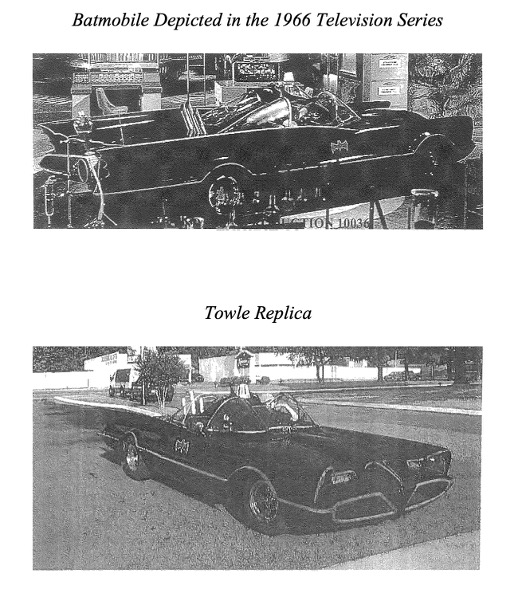
[Comparing the Batmobile Depicted in the 1966 Television Series to the Towle Replica]
Image description: Two black-and-white photographs of cars. The top image shows the Batmobile from the 1966 television series, a sleek, customized black car with bubble windshields and bat symbols on the doors. The bottom image shows the Towle Replica, a similar vehicle with the same overall shape and design elements, also featuring bat symbols, photographed outdoors on a street.
APPENDIX B
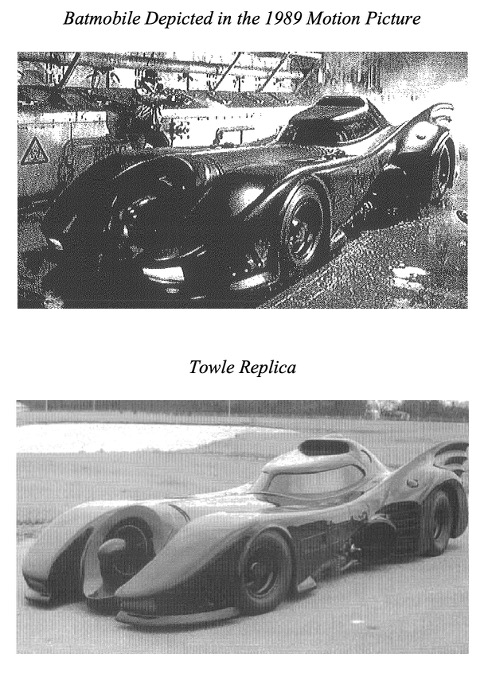
[Comparing the Batmobile Depicted in the 1989 Motion Picture to the Towle Replica]
Image description: Two black-and-white photographs of cars. The top image shows the Batmobile from the 1989 motion picture, a sleek, futuristic vehicle with an elongated body, dramatic curves, and a covered cockpit. The bottom image shows the Towle Replica, a very similar car with the same elongated shape, flared wheel covers, and central canopy, photographed outdoors on pavement.
Carroll Shelby Licensing, Inc. v. Halicki, 138 F.4th 1178 (9th Cir. 2025)
KERNODLE, District Judge:
The central question in this case is whether “Eleanor” is a copyrightable character. Eleanor is a collection of Ford Mustangs featured across four films, most recently in Gone in 60 Seconds (2000). Appellants argue that Eleanor is copyrightable under this Court’s test for independent character copyright protection. See DC Comics v. Towle, 802 F.3d 1012, 1021 (9th Cir. 2015).
But Appellants’ argument stalls at the starting line: we hold that Eleanor is not a character, much less a copyrightable one. As explained below, we affirm in part and reverse in part.
I. BACKGROUND
A. The Films
At the heart of this case are four films: Gone in 60 Seconds (1974), The Junkman (1982), Deadline Auto Theft (1983), and the remake of Gone in 60 Seconds (2000). The films feature several Ford Mustangs called “Eleanor.” A summary of each film is helpful to the forthcoming analysis.
In the original Gone in 60 Seconds, the film’s protagonist and his team are tasked with stealing forty-eight types of cars. To discuss the targets discreetly, each type of vehicle is assigned a common, feminine codename such as “Donna” or “Karen.” One target, a yellow Fastback Ford Mustang with black stripes, is designated “Eleanor.” The protagonist encounters four “Eleanors” throughout the film, stealing all of them and driving one in a climactic police chase.
In a meta turn, The Junkman features a protagonist who is the fictional director of Gone in 60 Seconds—a film within the film. The plot involves the protagonist evading an assassination attempt before the fictional premiere of Gone in 60 Seconds. “Eleanor” is made to look like the vehicle that the protagonist drove and severely damaged in the climactic police chase in Gone in 60 Seconds. The side of the car is painted with the message: “ ‘Eleanor’ from the movie Gone in 60 Seconds,” and a pull quote exclaiming, “The most hair raising chase scene ever filmed!”
Deadline Auto Theft recycles and repurposes footage from the first two films in service of a slightly revised plot of the original Gone in 60 Seconds. Accordingly, Eleanor’s appearances are largely the same as in the original.
The Gone in 60 Seconds remake features a familiar plot. The protagonist must steal fifty cars within a few days to save his brother’s life from a gangster. Again, a common, feminine codename is designated for each type of car targeted. This time, “Eleanor” is the codename for a Shelby GT-500 Ford Mustang. Two versions of Eleanor appear in the film. The first is gray with black stripes and is stolen by the protagonist and driven in a climactic police chase. The second is rusty and stripped of paint, gifted to the protagonist at the film’s conclusion.
B. Preceding Litigation
This case is not the beginning of the parties’ disagreement.1 Halicki owns the copyrights to the first three films and the merchandising rights to Eleanor as it appears in the remake film. After the remake’s release in the early 2000s, Shelby licensed a custom car shop to produce “GT-500E” Mustangs. Believing that the car unlawfully copied Eleanor’s design, Halicki filed suit against Shelby and the car shop for several claims, including copyright infringement. Halicki and Shelby ultimately settled the lawsuit in 2009.
Footnote 1: Appellants and Cross-Appellees are Denice Halicki and her corporate entities Eleanor Licensing, LLC, and Gone in 60 Seconds Motorsports, LLC. For brevity, we collectively refer to these parties as “Halicki.” Appellees and Cross-Appellants are Carroll Shelby Licensing, Inc., and Carroll Hall Shelby Trust. For brevity, we collectively refer to these parties as “Shelby.” The remaining Appellees are Classic Recreations, LLC, and its sole members Jason Engel and Tony Engel. For brevity, we collectively refer to these parties as “CR.”
The peace did not last. Shortly after the settlement, Shelby licensed CR to produce “GT-500CR” Mustangs. Halicki interpreted this as a violation of the settlement agreement. Accordingly, Halicki contacted GT-500E owners and auction houses to assert a copyright interest in the vehicles, and also contacted CR to demand they cease and desist in the production of GT-500CRs.
Shelby thereafter initiated this lawsuit, asserting several claims against Halicki, including for breach of the settlement agreement and declaratory relief. Halicki brought counterclaims, including for copyright infringement and breach of the settlement agreement. Halicki also named CR as a third-party defendant and asserted several claims, including for copyright infringement.
Three holdings by the district court are relevant in this appeal. First, in resolving cross motions for summary judgment, the district court held that Eleanor was not entitled to character copyright protection. Second, after a bench trial, the district court dismissed Halicki’s breach of contract claim against Shelby based on the settlement agreement. Third, also after a bench trial, the district court denied Shelby’s request for a declaration that the GT-500CR does not infringe any of Halicki’s rights.
We affirm on all grounds except as to the denial of declaratory relief, which we reverse and remand for further proceedings.
- CHARACTER COPYRIGHTABILITY
We begin with the question of whether Eleanor is entitled to character copyright protection.2 We review questions of character copyrightability de novo. Towle, 802 F. 3d at 1019. However, because “the district court here addressed this question in detail, we consider its factual findings in analyzing this issue.” Id. at 1021.
Footnote 2: Another panel of this court previously suggested that Eleanor could be a character entitled to copyright protection. See Halicki Films, LLC v. Sanderson Sales & Mktg., 547 F.3d 1213, 1225 (9th Cir. 2008). But this was dicta. The court acknowledged it was a “fact-intensive issue [that] must be remanded to the District Court” to address in the first instance. Id.
A. Towle Test
Federal copyright law enumerates several categories of protected subject matter, such as literary works, motion pictures, and more. See 17 U.S.C. § 102(a). Although the statute is silent as to the protection of the characters within these enumerated works, “there is a long history of extending copyright protection to graphically-depicted characters.” Daniels v. Walt Disney Co., 958 F.3d 767, 771 (9th Cir. 2020). But “not every comic book, television, or motion picture character is entitled to copyright protection.” Id. (quoting Towle, 802 F.3d at 1021) (cleaned up).
In Towle, we established a test to determine whether a character is entitled to copyright protection: (1) the character must have “physical as well as conceptual qualities,” (2) the character must be “sufficiently delineated to be recognizable as the same character whenever it appears” and display “consistent, identifiable character traits and attributes,” and (3) the character must be “especially distinctive” and contain “some unique elements of expression.” Daniels, 958 F.3d at 771 (quoting Towle, 802 F.3d at 1021) (cleaned up).
As we explain below, Eleanor fails at each prong of the Towle test. Accordingly, Eleanor is not entitled to character copyright protection.
B. Application of the Towle Test to Eleanor
- We first ask whether Eleanor is a character with “physical as well as conceptual qualities.” Id. Our precedent has primarily focused on “physical” qualities. See, e.g., id. (finding that characters satisfied prong one of Towle “[b]ecause they have physical qualities... [and thus] are not mere literary characters”); Towle, 802 F.3d at 1021 (finding the Batmobile satisfied prong one because it “appeared graphically in comic books, and as a three-dimensional car in television series and motion pictures,... and is thus not a mere literary character”); Walt Disney Producs. v. Air Pirates, 581 F.2d 751, 755 (9th Cir. 1978) (explaining the importance of “a visual image” for character copyrightability).
But equally important are the “conceptual” qualities that all characters inherently possess. These include anthropomorphic qualities, acting with agency and volition, displaying sentience and emotion, expressing personality, speaking, thinking, or interacting with other characters or objects. See Daniels, 958 F.3d at 770–71 (finding “anthropomorphic emotions” to be characters that satisfy prong one); Moonbug Entm’t Ltd. v. BabyBus (Fujian) Network Tech. Co., Ltd., 2023 WL 11922845, at 7 (N.D. Cal. Mar. 7, 2023) (listing as “conceptual elements” of a character: feeling emotion, acting with agency, talking, moving, interacting with objects, and thinking); Daniels v. Walt Disney Co., 2018 WL 4849700, at 6 (C.D. Cal. Jan. 31, 2018) (listing as character traits: speaking, interacting with other characters, acting with agency, and personality), aff’d, 958 F.3d 767 (9th Cir. 2020); Toho Co. v. William Morrow & Co., 33 F. Supp. 2d 1206, 1216 (C.D. Cal. 1998) (noting the morality, sentience, and actions of Godzilla’s character); Metro-Goldwyn-Mayer, Inc. v. Am. Honda Motor Co., 900 F. Supp. 1287, 1296 (C.D. Cal. 1995) (noting the particular personality, emotions, and behaviors of James Bond’s character).
Of course, these conceptual qualities are by no means limited to human characters. Animals, objects, or even anthropomorphized emotions may possess the conceptual qualities of a character. See, e.g., Air Pirates, 581 F.2d at 753 & n.5, 755 (finding several animal characters “endowed with human qualities” to be copyrightable, including “Mickey and Minnie Mouse, Donald Duck, the Big Bad Wolf, the Three Little Pigs, and Goofy”); Toho, 33 F. Supp. 2d at 1215 (finding Godzilla is a copyrightable character); Towle, 802 F.3d at 1022 (finding the Batmobile is a copyrightable character); Daniels, 958 F.3d at 770–71 (noting “anthropomorphic emotions” were characters). Indeed, we have found a car to be a copyrightable character where it expressed personality and a demonstrated level of autonomy.3 Towle, 802 F.3d at 1022 (describing the Batmobile as “loyal” to Batman); id. at 1021 (describing the Batmobile as “waiting like an impatient steed straining at the reins shivering as its super-charged motor throbs with energy before it tears after the fleeing hoodlums” (cleaned up)); see also Brief of 20 Professors of Law and Public Knowledge as Amici Curiae Supporting Appellants, at 15 (explaining that the Batmobile is “an autonomous-driving car with substantial intelligence—for example, politely stopping for passing children while driving itself ” to Batman’s aid).
Footnote 3: We noted in Towle that a character can still be protectable even if it “lacks sentient attributes and does not speak (like a car).” 802 F.3d at 1021. This remains true. Sentience and the ability to talk are just two of many conceptual qualities of a character already discussed.
Eleanor, however, lacks any such conceptual qualities. Indeed, Eleanor has no anthropomorphic traits. The car never acts with agency or volition; rather, it is always driven by the film’s protagonists. Eleanor expresses no sentience, emotion, or personality.4 Nor does Eleanor speak, think, or otherwise engage or interact with the films’ protagonists. Instead, Eleanor is just one of many named cars in the films. In this way, Eleanor is more akin to a prop than a character. Accordingly, Eleanor fails at prong one of the Towle test.5
Footnote 4: Halicki suggests that Eleanor does have some anthropomorphic qualities. For example, Halicki notes that in the remake, “Eleanor’s engine sputters and dies—suggesting possible jealousy, because [the protagonist’s] girlfriend is in the car.” But this is pure speculation. Halicki is referring to the Eleanor gifted to the protagonist at the end of the remake. This version of Eleanor was rusty, old, and in clear need of maintenance work. A reasonable viewer attributes the breakdown to the car’s poor condition, not Eleanor’s feelings.
Footnote 5: Halicki briefly argues that Eleanor as it appears only in the remake is also independently copyrightable under Towle. But Halicki cites no case where a character appeared in multiple works, and a court found the character to be copyrightability based on only a limited subset of those works. And our precedent suggests that if a character appears in multiple works, we consider all such works. See Daniels, 958 F.3d at 770, 773 (considering “every iteration” of the Moodsters including a pitchbook, a television episode, and a line of toys and books); Towle, 802 F.3d at 1016 (considering the Batmobile “since its creation,” including in comic books, TV shows, and films). In any event, for the same reasons already discussed, “remake Eleanor” similarly fails prong one of Towle and is not entitled to copyright protection.
- Turning to prong two of Towle, we ask whether Eleanor is “sufficiently delineated to be recognizable as the same character whenever it appears” and “display[s] consistent, identifiable character traits and attributes.” Daniels, 958 F.3d at 771 (quoting Towle, 802 F.3d at 1021). “Although a character that has appeared in multiple productions or iterations ‘need not have a consistent appearance,’ it ‘must display consistent, identifiable character traits and attributes’ such that it is recognizable whenever it appears.” Id. (quoting Towle, 802 F.3d at 1021). “By contrast, a character that lacks a core set of consistent and identifiable character traits and attributes is not protectable, because that character is not immediately recognizable as the same character whenever it appears.” Id. Indeed, the “key” analysis is the “persistence” of those core traits. Towle, 802 F.3d at 1020.
Here too, Eleanor fails. Across four films and eleven iterations in those films, Eleanor lacks consistent traits. For example, Eleanor’s physical appearance changes frequently throughout the various films, appearing as a yellow and black Fastback Mustang, a gray and black Shelby GT-500 Mustang, and a rusty, paintless Mustang in need of repair. Indeed, the latter Eleanors are unrecognizable until introduced as Eleanor by the protagonists. Halicki’s proffered Eleanor traits, moreover, only serve to further highlight Eleanor’s inconsistencies. Halicki claims Eleanor is always “incurring severe damage” and is “hard to steal.” But fewer than half of the Eleanors ever appear damaged at all, and the damage ranges from body damage incurred by a police chase, to cosmetic damage, to being entirely shredded for scrap. And of the Eleanors stolen by the films’ protagonists, most were stolen with little difficulty. Halicki also claims that Eleanor is “good at evading police” and “surviving spectacular jumps.” But these traits are more readily attributable to the films’ protagonists driving the cars, not to Eleanor. In sum, Eleanor is too “lightly sketched” to satisfy prong two of the Towle test. See Daniels, 958 F.3d at 771.
- Finally, under prong three of Towle, we consider whether Eleanor is “especially distinctive” and “contain[s] some unique elements of expression.” Id. at 773 (quoting Towle, 802 F.3d at 1021). To meet prong three, a character “cannot be a stock character such as a magician in standard magician garb.” Towle, 802 F.3d at 1021. Nor is a character especially distinctive if it “fit[s] general, stereotypical categories” like “an older scholar,” a “loyal friend,” or a “military leader.” McCormick v. Sony Pictures Entm’t, 2009 WL 10672263, at *14 (C.D. Cal. July 20, 2009), aff’d, 411 Fed.
Eleanor is not especially distinctive. Nothing distinguishes Eleanor from any number of sports cars appearing in car-centric action films. Cf. Towle, 802 F.3d at 1021–22 (highlighting the Batmobile’s distinct “bat-like appearance,” “jet engines and flame-shooting tubes,” and “ability to maneuver that far exceeds that of an ordinary car”). Nor is the name Eleanor unique; rather, it is a common female name—the normalcy of which was the entire point of codenaming vehicles in the films. Cf. id. at 1022 (noting the Batmobile’s “unique and highly recognizable name”). Eleanor is a “stock” sports car and fails prong three of Towle. See id. at 1021.
In sum, Eleanor is not really a character. And even if Eleanor were a character, it is not entitled to copyright protection under Towle. Accordingly, we AFFIRM the judgment of the district court that Eleanor is not entitled to character copyright protection.6
Footnote 6: The parties raise additional issues that are contingent upon a finding that Eleanor is a copyrightable character. Because Eleanor is not copyrightable, we need not reach these issues.
[In Part III, the court held that Shelby’s licensing of the GT-500CR did not breach the parties’ settlement agreement. Applying California contract law, it read the agreement to bar Shelby only from using Eleanor’s distinctive features, not from producing modified Mustangs generally.]
[In Part IV, the court reviewed the denial of declaratory relief de novo, held that Shelby was entitled to a declaration that the GT-500CR does not infringe, and remanded for the district court to determine its proper scope.]
V. CONCLUSION
We REVERSE and REMAND only as to the district court’s denial of declaratory relief to Shelby. We AFFIRM on all other grounds.
Notes and questions
(1) In the Sam Spade case, Warner Brothers v. CBS, 216 F.2d 945 (9th Cir. 1954), the Ninth Circuit set out the test for copyrightable characters in terms of the significance of the character to the story: “It is conceivable that the character really constitutes the story being told, but if the character is only the chessman in the game of telling the story he is not within the area of the protection afforded by the copyright.”
How does this “story being told” test compare with the three-part test adopted in Towle and applied in Halicki? The Sam Spade test asks what the character does in the narrative; Towle asks what qualities the character itself possesses and how consistently it possesses them. Would the two ever come apart? Eleanor is arguably a chessman in the game of telling the story, but so, one might think, is the Batmobile.
(2) Towle rested in part on Halicki Films, LLC v. Sanderson Sales & Marketing, 547 F.3d 1213 (9th Cir. 2008), which it read as establishing “that an automotive character can be copyrightable,” and which it credited with finding that Eleanor displayed “consistent, widely identifiable traits” — among them that “whenever the main human character tries to steal Eleanor, circumstances invariably become complicated.” The 2025 panel sets that discussion aside as dicta and finds the opposite on the record: most Eleanors “were stolen with little difficulty.” Which court had the better of the reading? If Towle’s three-part test was itself derived from the earlier Eleanor case, what happens to the test now?
(3) Character copyright is now being asserted against generative AI systems. In Disney Enterprises, Inc. v. Midjourney, Inc., No. 2:25-cv-05275 (C.D. Cal., filed June 11, 2025), and Warner Bros. Entertainment Inc. v. Midjourney, Inc., No. 2:25-cv-08376 (C.D. Cal., filed Sept. 4, 2025), the studios allege that an image generator reproduces their characters on demand. Both suits are pending and neither has produced a merits ruling. If the Towle test is satisfied, does it matter which particular film or comic an output resembles? Consider how that question relates to the discussion of characters as subworks below, and to the treatment of style later in this chapter.
Are characters subworks or hypertextual works?
To qualify as copyrightable, a character must be reasonably detailed and distinct, and, according to some cases dealing with literary works, it must be central to the underlying work such that it “constitute[s] the story being told.” Warner Bros. Pictures, Inc. v. Columbia Broadcasting System, 216 F.2d 945, 950 (9th Cir. 1954). The “story being told” test is regarded as unduly restrictive by many courts, particularly in the context of characters emerging from comics, film, and television. See e.g., Gaiman v. McFarlane, 360 F.3d 644 (7th Cir. 2004). In DC Comics v. Towle, the Ninth Circuit held that a character is entitled to copyright protection if (1) the character has “physical as well as conceptual qualities,” (2) the character is “sufficiently delineated to be recognizable as the same character whenever it appears” and “display[s] consistent, identifiable character traits and attributes,” and (3) the character is “especially distinctive” and “contain[s] some unique elements of expression.” DC Comics v. Towle, 802 F.3d 1012, 1021 (9th Cir. 2015).
This test focuses on consistency and distinctiveness and recognizes copyrightable characters need not be central to the story being told in the original work. Applying this test, the court found that the car from the Batman comics, television, and film franchise was a copyrightable character, infringed upon by the sale of replica kits intended to modify an existing car to look like the famous crime-fighting vehicle.
The test in DC Comics v. Towle explicitly recognizes the emergence of a discrete intellectual property entitlement based on emergent properties—the identification of features and characteristics across a series of copyrightable works. This is puzzling for those who regard individual copyrighted works as the fundamental unit of analysis for copyright law, which is what the text of the Copyright Act suggests. However, despite the tendency of federal judges to refer to copyrightable characters as distinct entitlements, the practice can be reconciled with ordinary principles of copyright law by acknowledging that copyrightable characters are a heuristic—not so much a legal fiction as a legal shortcut. In other words, although characters are not copyrightable works as such, in the context of an infringement action it is a reasonable time-saving heuristic to talk about them as though they were.
The practice is reasonable because there are many instances where closely copying a character will be enough to establish infringement of the underlying work. The conceit of copyrightable characters is advantageous for plaintiffs in two ways. First, it allows the copyright owner to establish substantial similarity by showing that a significant and identifiable character has been closely copied. Focusing the court’s attention on copyrightable characters ensures that other differences between the plaintiff’s and defendant’s works can safely be ignored. See e.g., Salinger v. Colting, 607 F.3d 68 (2d Cir. 2010), where the district court found that an unauthorized sequel of The Catcher in the Rye was substantially similar to the original because of the overlapping central character. The sequel took place 60 years later and had an entirely different plot to the original, however both works centered on the character of Holden Caulfield as “the story being told.”
Second, presenting a case in terms of the infringement of copyrightable characters frees the copyright owner from the burden of pointing to which specific work the defendant’s product is infringingly similar.
There are more critical views that make essentially the same point. See e.g., Leslie Kurtz, The Independent Legal Lives of Fictional Characters, 1986 Wisconsin Law Review 429, 440 (arguing that by “focusing on the copyrightability of a character, courts have blurred the distinction between the concepts of infringement and copyrightability;”) and Jani McCutcheon, Works of Fiction: The Misconception of Literary Characters As Copyright Works, 66 Journal of the Copyright Society of the U.S.A. 115 (2019). Note that the authors of the Copyright Restatement take the view that controversies involving allegedly copied characters should be decided by determining whether by copying a character the defendant has infringed copyright in a categorized work or works (literary, pictorial, audiovisual, etc.) in which the character appears. See, Restatement of the Law, Copyright § 2 TD No 2 (2021).
Halicki is a useful test of the heuristic account offered here. The Ninth Circuit concluded not merely that Eleanor was unprotectable, but that Eleanor “is not really a character” at all, and was “more akin to a prop.” If copyrightable characters are a shortcut for reasoning about infringement of the underlying works, what is being decided when a court holds that something is not a character in the first place? Note too that Halicki requires a court to consider every iteration across every work in which the character appears, and refuses to let a plaintiff rely on the subset that suits it best. That is hard to square with treating each film as the unit of analysis, and it suggests the emergent, cross-work entitlement that this section questions. Does Halicki make characters look more like subworks, more like hypertextual works, or neither?
Can you Copyright a Universe?
Paramount Pictures Corp. v. Axanar Prods., Inc., 2017 WL 83506 (C.D. Cal. Jan. 3, 2017)
Judge Klausner
… The undisputed facts are as follows: Plaintiffs Paramount and CBS own the copyrights to Star Trek motion pictures and television series, respectively. Star Trek is a popular science fiction franchise. Since debuting it on television in 1966, CBS has produced six Star Trek television series totaling more than 700 episodes. A seventh series is scheduled to premiere in 2017. Paramount has produced thirteen full-length Star Trek motion pictures since 1979; the most recent was released in 2016. In addition, Plaintiffs have licensed numerous Star Trek derivative works (together with the Star Trek television series and the Star Trek motion pictures, the “Star Trek Copyrighted Works”), including books, games, merchandise, and audio-visual works such as documentaries. These Star Trek Copyrighted Works have transported the hearts of a legion of fans to the Star Trek universe.
The original Star Trek television series (“The Original Series”) chronicle the adventures of the spaceship U.S.S. Enterprise and its crew as they explore space, the final frontier in the twenty-third century. U.S.S. Enterprise is one spaceship in the Starfleet of United Federation of Planets (the “Federation”). The Original Series feature humans and fictitious species such as Vulcans and Klingons. A human character known as Garth of Izar (“Garth”) appear in one episode. As depicted in The Original Series, Garth is a former starship captain and famous among Starfleet officers for his exploits in the Battle of Axanar. Planet Axanar seems to be the namesake of Defendant Axanar Productions.
Axanar Productions’ president is Peters, a long-time Star Trek fan. Like many other Star Trek fans, Peters wants to make his own Star Trek production. However, going where no man has gone before in producing Star Trek fan films, Defendants sought to make “a professional production” “with a fully professional crew, many of whom have worked on Star Trek itself” and raised over a million dollars on crowdsourcing websites Kickstarter and Indiegogo to fund their projects. Defendants first raised money and produced a twenty-one minute film Star Trek: Prelude to Axanar (“Prelude”). Defendants released Prelude on YouTube to promote and to raise funds for a full-length feature film (the “Axanar Motion Picture,” and, collectively with Prelude, the “Axanar Works”). In addition to releasing Prelude, Defendants have completed a script of the Axanar Motion Picture and have filmed and released a scene (the “Vulcan Scene”) therefrom. The Axanar Works are set in the Star Trek universe twenty-one years before The Original Series and depict the Battle of Axanar and the exploits of Garth.
DISCUSSION
… Here, Defendants argue that characters and species used in the Axanar Works are not subject to copyright protection under Plaintiffs’ copyrights. The Court concludes otherwise at least with respect to Garth of Izar.
The Ninth Circuit applies “a three-part test for determining whether a character in a ... television program ... is entitled to copyright protection.” DC Comics v. Towle, 802 F.3d 1012, 1021 (9th Cir. 2015). “First, the character must generally have physical as well as conceptual qualities. Second, the character must be sufficiently delineated to be recognizable as the same character whenever it appears ... Third, the character must be especially distinctive and contain some unique elements of expression.” “[A] stock character such as a magician in standard magician garb” is not distinctive.
Applying the three-part test to Garth of Izar leads to the conclusion that he is entitled to copyright protection. Garth first appeared in an episode in The Original Series. Since Garth has appeared as a live character, he has physical as well as conceptual qualities. As stated above, Garth was a former starship captain and was famous among Starfleet officers for his exploits in the Battle of Axanar. In fact, his exploits were required reading at the Starfleet Academy. He charted more planets than any other Starfleet captain. In the episode, Garth discussed his victory in the Battle of Axanar with Captain Kirk, the Captain of U.S.S. Enterprise. In addition, a 2003 novel, titled Garth of Izar and copyrighted by Paramount, further developed the character. Garth’s identity as a Federation hero sufficiently delineates him and sets him apart from a stock spaceship officer.
Also prominent in the Axanar Works are two fictional species from the Star Trek Copyrighted Works: Klingons and Vulcans. Klingons are a militaristic, alien species from the planet Qo’noS. They are long-time enemies of the Federation. Klingons have distinctive physical features including ridged foreheads, dark hair and skin, and upward sloping eyebrows. Klingon men have facial hair. Vulcans are a part of the Federation, a species that suppresses emotions in favor of logic and reason. They are advanced technologically. Vulcans have pointed ears and upswept eyebrows. Vulcan men usually have a bowl-shaped haircut. Taken together, these characteristics of Klingons and Vulcans are not “elements of expressions that necessarily follow from the idea” behind the expressions (visual expressions, for example) and may be entitled to copyright protection. Pasillas v. McDonald’s Corp., 927 F.2d 440, 443 (9th Cir. 1991).
Additionally, Plaintiffs submit evidence showing several costumes from the Star Trek Copyrighted Works similar to those Defendants use in the Axanar Works, including a Klingon officer’s uniform from the motion picture Star Trek VI—The Undiscovered Country. This uniform has a gray tunic with shoulder covers and a red neckpiece. Evidence also shows Vulcan Ambassador Soval’s Asian-style long robe and a drape decorated with Vulcan writing. The artistic aspects of these costumes that “can be identified separately from, and are capable of existing independently of, the utilitarian purpose of the costumes” may be copyright protectable. Entm’t Research Grp., Inc. v. Genesis Creative Grp., Inc., 122 F.3d 1211, 1221 (9th Cir. 1997). “Artistic work ... receives broader protection because of endless variations of expression available to artist.” Apple Computer, Inc. v. Microsoft Corp., 35 F.3d 1435, 1447 (9th Cir. 1994). The combination of artistic visual elements of these uniforms likely contains original expressions protectable under the Copyright Act.
The evidence also includes settings from the Star Trek Copyrighted Works such as planets Axanar, Qo’noS, and Vulcan (including a shot of Vulcan from Star Trek III: The Search for Spock); military spaceships including Klingon battlecruisers, Vulcan ships with an engine ring, and Federation spaceships with their iconic saucer-shaped hull (e.g., the U.S.S. Enterprise), space travel elements such as spacedocks, and Vulcan buildings—cathedrals with sword-blade-shaped domes. The evidence further describes plot points, sequence of events, and dialogs from the Star Trek Copyrighted Works such as the Federation, the Klingon Empire, and conflicts between the two in the Four Years War at the Battle of Axanar (which is also described in a Paramount-licensed game including a supplement titled Four Years War), the Vulcan council, the teachings of Vulcan philosopher Surak, the use of the Federation logo, stardate, transporters and warp drive, weapons such as phasers and photon torpedoes, and the Klingon language. Finally, the evidence describes mood and theme of the Star Trek Copyrighted Works as science fiction action adventure, specifically a military space drama. All these elements appear in the Axanar Works. Although each of these elements may not be individually original and copyright protectable,1 they are “numerous enough and their selection and arrangement original enough that their combination constitutes an original work of authorship,” especially when combined with the costumes and fictional characters and species, examples of which are described above. Satava, 323 F.3d at 811; see Swirsky, 376 F.3d at 849 (citing Three Boys Music Corp. v. Bolton, 212 F.3d 477, 485 (9th Cir. 2000)) (citing with approval a finding of substantial similarity based on the combination of five unprotectable elements).
Footnote 1: Some elements such as U.S.S. Enterprise may be individually copyright protectable under the DC Comics three-part test. See DC Comics, 802 F.3d at 1024 (holding that the Batmobile is a copyright-protected character). However, because Plaintiffs’ allegation is that Defendants infringe the Star Trek Copyrighted Works as a whole, the Court does not undertake an analysis beyond Garth for which evidence in unredacted records is relatively abundant.
Accordingly, the Court finds that Defendants use copyright-protected elements in the Axanar Works.
The Works Share Objective Substantial Similarity
Under the extrinsic test, the Axanar Works are substantially similar to the Star Trek Copyrighted Works. This conclusion finds strong support in Defendants’ intent for the Axanar Works. “Defendants expressly set out to create an authentic and independent Star Trek film that [stayed] true to Star Trek canon down to excruciating details.” Indeed, Defendants set out to create a motion picture “prequel” to The Original Series. To achieve this goal, Defendants set the Axanar story in the Star Trek universe. Defendants used the Four Years War supplement “as a bible” in developing the script of Prelude. Defendants intentionally use or reference many elements similar to those appeared in the Star Trek Copyrighted Works, some of which are discussed above. Klingons in the Axanar Works use some of the same weapons as those in Plaintiffs’ works. The physical appearances of Klingons and of Vulcans (including Ambassador Soval) resemble those in Plaintiffs’ works. Id. In fact, the same actor who played Soval in the Star Trek: Enterprise series reprised his role in Prelude, a fact Defendants noted in its Kickstarter promotion.2
Footnote 2: The Court notes this fact simply to emphasize the great length to which Defendants went to stay true to the Star Trek canon. The appearance of the actor is not original to Plaintiffs and is thus not copyright protectable.
Star Trek fans love Defendants’ faithfulness to the Star Trek canon; Peters considers himself “the keeper of faith with fans.” The many excruciating details Defendants intentionally duplicate from the Star Trek Copyrighted Works surely contain some “specific details of prior creators’ rendering of ideas” that are “protectable.” Metcalf v. Bochco, 294 F.3d 1069, 1074 (9th Cir. 2002).
Defendants argue that the works are not substantially similar because Defendants “created their own story about the obscure character Garth of Izar and the general events surrounding him.” Defendants’ argument fails for two reasons. First, the Court does not agree that Garth, being a featured character in one television episode, the title character of one novel, and having appeared in Four Years War, is obscure or lightly sketched. Cf. Olson v. Nat’l Broad. Co., 855 F.2d 1446, 1452–53 (9th Cir. 1988) (calling characters lightly sketched who are “depicted only by three– or four-line summaries in a screenplay, plus whatever insight into their characters may be derived from their dialogue and action”). Second, Defendants use many elements from the Star Trek universe in their works, not just Garth of Izar and the general events surrounding him. See id. (even lightly sketched characters together with other extrinsic test elements may be enough for a finding of infringement). Indeed, Defendants use and reference so many distinctive and widely recognized elements from the Star Trek universe that the Axanar Works invoke Star Trek in the minds of viewers. Together these elements are “qualitatively important” enough for a finding of substantial similarity, even if they are “relatively small in proportion to the entire work” (which they arguably are not). Swirsky, 376 F.3d at 852. Defendants’ extensive use of elements from the Star Trek Copyrighted Works to create a Star Trek prequel can constitute infringement in spite of Defendants’ new story. See TMTV, Corp. v. Mass Prods., Inc., 645 F.3d 464, 470–71 (1st Cir. 2011).
Defendants further argue that the Axanar Works are inspired by many sources. Assuming that to be true as the Court must on a summary judgment against Defendants, the argument still fails. Defendants must obtain permission to use protectable expression from any and all preexisting sources to which their work bears substantial similarity. Greene v. Ablon, 794 F.3d 133, 158 (1st Cir. 2015).
Finally, Defendants cites Hogan v. DC Comics where the court found no substantial similarity even though the main character of the two works share many attributes:
both were half-human, half-vampires named Nicholas Gaunt; were young white males with pale skin, a medium build, dark, tired eyes, and dark, scraggly hair; sought to learn the truth about their origins, and did so through flashbacks; faced the choice of pursuing good or evil; were indoctrinated into the forces of evil by killing.
(paraphrasing Hogan, 48 F. Supp. 2d 298, 310-11 (S.D.N.Y. 1999).) Hogan is factually distinguishable from this case, however. The Hogan court found pronounced differences in the “total look and feel [of the two works], the interactions of the characters and the plot.” The two main characters are drawn quite differently. The defendant author independently created the idea of her work, before the plaintiff sent his work to defendant DC Comics. For example, the defendant author offered detailed evidence explaining how and why she chose the name Nicholas Gaunt, supporting her assertion that the shared name was not a result of copying. Here, Defendants intentionally use elements from the Star Trek Copyrighted Works to create works that stay true to Star Trek canon down to excruciating details. Defendants even touted that “Axanar feels like Star Trek.” The Hogan finding is inappropriate here.
After reviewing evidence before the Court, including the Axanar Works, the Court is satisfied that Defendants have achieved their goal of creating authentic Star Trek films and script. The Axanar Works are substantially similar to the Star Trek Copyrighted Works, at least under the extrinsic test.
The Jury Will Decide Subjective Substantial Similarity
The intrinsic test is subjective and asks whether the ordinary, reasonable person would find the total concept and feel of the works to be substantially similar. The jury, not the court, is ordinarily the reasonable person. … Because the jury must determine issue of subjective substantial similarity for a finding of copyright infringement, the Court cannot rule on Plaintiffs’ request for declaratory and injunctive relief at this time. Plaintiffs must motion the Court for such relief if the jury finds subjective substantial similarity.
Notes and questions
(1) The Axanar defendants created an entirely new story. Their film depicted the Battle of Axanar, an event merely mentioned in passing in one episode of the original Star Trek series. The plot, dialogue, narrative structure, and specific scenes bore little resemblance to any particular Star Trek episode or motion picture. Yet the court found substantial similarity under the extrinsic test. Why?
(2) Is the court saying that there is copyright in the Star Trek universe?
(3) The court repeatedly emphasized that defendants “expressly set out to create an authentic and independent Star Trek film that stayed true to Star Trek canon down to excruciating details.” What work is intent doing in this case?
(4) Would a book about Federation officers during the Four Years War infringe even without using any named characters? What about a story using Klingons but not other Star Trek elements? Does it matter if the follow-on work is visual versus text?
Copyright in Style as a Response to Generative AI
U.S. Copyright Office Copyright and Artificial Intelligence, Part 1: Digital Replicas
The Office received many comments seeking protection against AI “outputs that imitate the artistic style of a human creator.” Commenters voiced concern over the ability of an AI system, in response to a text prompt asking for an output “in the style of artist X,” to quickly produce a virtually unlimited supply of material evoking the work of a particular author, visual artist, or musician. They asserted that these outputs can harm, and in some cases have already harmed, the market for that creator’s works.
For example, the Center for AI and Digital Policy warned that “if AI can replicate [artists’] signature style en masse, it might undermine the market value of their creations, unjustly depriving them of economic benefits.” The Authors Guild described “authors, who, after years of developing their unique voice and style, are finding AI appropriating a part of their personality and mimicries of their work being sold in the market.”
In addition, commenters argued that, while in the past the impact of human imitators was limited by the demands of time and labor, AI systems present a challenge exponentially greater given their speed and scale. An anonymous artist offered the following example:
As of November 29th, 2023, the top result when googling American artist Kelly McKernan is an AI-generated imitation of her style. Not only does this demonstrate the ability of AI forgeries to quickly propagate and pollute search engines and the wider internet but this digital impersonation has a chilling effect on artists’ agency and ability to control their online identity. Artists are essentially competing with a distorted version of themselves.
The Office acknowledges the seriousness of these concerns and believes that appropriate remedies should be available for this type of harm.
Copyright law’s application in this area is limited, as it does not protect artistic style as a separate element of a work. As noted by several commenters, copyright protection for style would be inconsistent with section 102(b)’s idea/expression dichotomy.324
Footnote 324: See, e.g., Pamela Samuelson, Christopher Sprigman & Matthew Sag, Initial Comments at 36–37 (“Any concept of style that can only be identified by considering several works collectively is far too abstract to merit copyright protection consistent with the idea/expression distinction and Section 102(b). Even if proposed copyright protection for ‘style’ were focused on stylistic features of individual works, it is difficult to see how copyright protection for style or artistic technique could be reconciled with the idea/expression distinction and Section 102(b).”); MPA Initial Comments at 74 (“However, the law does not grant individuals exclusive rights over artistic style. . . . This conclusion flows ineluctably from one of copyright’s most fundamental precepts: that it protects expression, not ideas.”). Cf. 17 U.S.C. § 102(b) (“In no case does copyright protection for an original work of authorship extend to any idea, procedure, process, system, method of operation, concept, principle, or discovery, regardless of the form in which it is described, explained, illustrated, or embodied in such work.”).
Moreover, in most cases the elements of an artist’s style cannot easily be delineated and defined separately from a particular underlying work. Google and EFF both stressed that, as a policy matter, stylistic aspects of expressive content should remain freely available for later creators to develop and build on.
The Copyright Act may, however, provide a remedy where the output of an “in the style of” request ends up replicating not just the artist’s style but protectible elements of a particular work. Additionally, as future Parts of this Report will discuss, there may be situations where the use of an artist’s own works to train AI systems to produce material imitating their style can support an infringement claim.
Numerous commenters pointed out that meaningful protections against imitations of style may be found in other legal frameworks, including the Lanham Act’s prohibitions on passing off and unfair competition. In its comments, the FTC stated:
Mimicking the creator’s writing style . . . may also constitute an unfair method of competition or an unfair or deceptive practice, especially when the copyright violation deceives consumers, exploits a creator’s reputation or diminishes the value of her existing or future works, reveals private information, or otherwise causes substantial injury to consumers.
Although state right of publicity statutes do not explicitly refer to style, where a particular style is closely identified with an individual performer, it may be protected. Protection may also be available under the common law. Although the law in this area is not fully developed, that may be because the means of easy and near-perfect stylistic impersonation have not been widely available until recently, and the advent of generative AI may result in an increase in such claims. Meanwhile, some AI developers have reportedly placed guardrails in their systems blocking requests to generate images in the style of living artists.
In sum, there are several sources of protection under existing laws that may be effective against unfair or deceptive copying of artistic style. Given these resources, as well as the policy reasons not to extend property-like rights to style in itself, the Office does not recommend including style as protected subject matter under a federal digital replica law at this time. If existing protections prove inadequate, this conclusion may be revisited.
U.S. Copyright Office Copyright and Artificial Intelligence, Part 3: Generative AI Training
Editorial note: Part 3: Generative AI Training remains the pre-publication version of 9 May 2025, which is still the only version the Office has released.
[Addressing the scope of the fourth fair use factor …] While we acknowledge this is uncharted territory, in the Office’s view, the fourth factor should not be read so narrowly. The statute on its face encompasses any “effect” upon the potential market. The speed and scale at which AI systems generate content pose a serious risk of diluting markets for works of the same kind as in their training data.374
Footnote 374: See Science Fiction and Fantasy Writers Association Initial Comments at 6 (“The harm creators and audiences are already experiencing is a flood of trash, directly enabled by generative AI with no restrictions on output. . . . AI- generated material . . . literally crowds human writers out.”); Boni Alimagno Reply Comments at 7 (“Focusing on specific copyrighted works neglect stylistic elements that recur throughout a body of work, which through publicity become how an artist creates market value for their style. AI art generators instead allow an artist’s own body of work to face competition from a too similar body of work—driving the monetary value of their uniqueness downward. An artist is in competition with themselves.”).
That means more competition for sales of an author’s works and more difficulty for audiences in finding them. If thousands of AI-generated romance novels are put on the market, fewer of the human-authored romance novels that the AI was trained on are likely to be sold. Royalty pools can also be diluted. UMG noted that “[a]s AI-generated music becomes increasingly easy to create, it saturates this already dense marketplace, competing unfairly with genuine human artistry, distorting digital platform algorithms and driving ‘cheap content oversupply’ - generic content diluting human creators’ royalties.”
Market harm can also stem from AI models’ generation of material stylistically similar to works in their training data. As the Office noted in Part 1 of this Report, many commenters raised concerns about AI outputs that imitate a creator’s style, which copyright does not protect as a separate element.376
Footnote 376: There may, however, be cases where the replication of “style” does capture protectible elements of an original work of authorship. See generally Benjamin L.W. Sobel, Elements of Style: Copyright, Similarity, and Generative AI, 38 Harvard Journal of Law & Technology 49 (2024).
Even when the output is not substantially similar to a specific underlying work, stylistic imitation made possible by its use in training may impact the creator’s market. In the words of the Writers Guild of America, because AI systems can be prompted to imitate a writer’s style, applying fair use would force writers “to compete with AI- generated scripts trained on their work, without their authorization, and without fair compensation.” This threat is more acute because of the technology’s ability to produce works so similar in style “that the average person cannot discern a difference in the marketplace, creating direct competition with the creators whose works have been used to train the model.”378
Footnote 378: Note: CISAC Reply Comments at 3. In one highly publicized example, an AI image generator now allows users to generate images in the style of a popular Japanese animation studio (Studio Ghibli), resulting in “a tsunami of images.” The result could undermine licensing opportunities for the studio.
Notes and questions
(1) Is there a tension between the Copyright Office position in Part 1 and Part 3?
(2) The Studio Ghibli controversy: In 2025 OpenAI publicized the ability of its new image tool to render existing photos into “Studio Ghibli” style. I.e. with the characteristic soft watercolor backgrounds, lush forests, and whimsical character designs that are hallmarks of the studio’s films. This trend quickly went viral on social media. While many users saw this as a fun and harmless way to engage with the aesthetic or whimsically alter their photos, it also sparked outrage among many artists and fans. Studio Ghibli’s art style is the result of decades of meticulous, hand-drawn work by dedicated animators. Creating a single scene can take months of effort. The ability of an AI to replicate this style in seconds is seen by many as a cheap imitation that devalues the immense skill and effort of human creators. The reaction was intensified because the principal artist associated with Studio Ghibli, Hayao Miyazaki, had called earlier versions of AI art “an insult to life itself.” Worse still, the official White House X account shared a Ghibli-style AI image. The image depicted a woman being taken into custody by ICE, which many found to be a disturbing and inappropriate use of a beloved art style often associated with themes of empathy and nuance.
What is your opinion of the Studio Ghibli controversy referred to by the Copyright Office? Should Studio Ghibli have a copyright in its characteristic style, what about Disney, what about the Simpsons? Is this a trademark problem or a copyright problem?
(3) Is a legislative response to style mimicry coming? At the federal level, so far, no. The NO FAKES Act was introduced in the Senate as S. 1367 (119th Cong.) on April 9, 2025, and a successor bill, S. 4591, was advanced by the Senate Judiciary Committee on June 18, 2026. Neither has been enacted. Note also the limits of what is proposed: as reported, the bill addresses unauthorized digital replicas of a person’s voice and visual likeness. It does not reach artistic style as such. If Congress were to legislate in this area, would protecting likeness do anything for the illustrator whose manner of drawing is imitated?
Matthew Sag, Copyright Safety for Generative AI, 61 Houston Law Review 295 (2023)
… Much of the anxiety about predatory style transfer would be alleviated if the names of individual living artists were replaced with stylistic markers. For example, one of the most commonly invoked style prompts in early 2023 was Greg Rutkowski, an artist who is well known for his richly detailed depictions of Dungeons & Dragons and similar worlds in a style comparable to the romantic English painter, William Turner.
Image description: A collage of four seascape paintings. Top left: “Ghosts of Saltmarsh” by Rutkowski shows a dramatic, stormy sea with a small ship battling waves under eerie green light. Top right: Turner’s “Fisherman at Sea” depicts boats illuminated by a moonlit sky, with dark water swirling beneath. Bottom left: Turner’s “Fishermen upon a Lee Shore, in Squally Weather” shows boats tossed in rough waves, with figures clinging desperately. Bottom right: Turner’s “Peace — Burial at Sea” presents a somber ship scene, with smoke rising into a hazy sky above calm but reflective waters.
The notion that Rutkowski has a copyright interest in this style, in the sense of some signature constellation of attributes that can be identified only by comparing a series of works, is hard to reconcile with basic copyright law doctrines, but the harm that Rutkowski suffers by having his genuine works crowded out in internet searches by tens of thousands of images produced “in the style of Rutkowski” is very real. That harm could easily be avoided with almost no loss of functionality because Rutkowski’s name is primarily used as a shortcut to invoke high-quality digital art generally, or in relation to fantasy motifs.
The notion of copyright protection in style as an emergent property (something that is identified by looking at a series of works) is inconsistent with the idea-expression distinction because it makes abstractions and techniques copyrightable. 17 U.S.C. § 106(1)–(3). It is also inconsistent with the fact that the Copyright Act creates rights with respect to works, not groups of works. Id. § 106(1) (giving the copyright owner the exclusive right “to reproduce the copyrighted work in copies or phonorecords” (emphasis added)). Section 101 defines “copies” as “material objects, other than phonorecords, in which a work is fixed by any method now known or later developed, and from which the work can be perceived, reproduced, or otherwise communicated, either directly or with the aid of a machine or device.” Id. § 101 (emphasis added).
However, if the term style is used to describe a constellation of attributes present within a single work, it is possible that reproducing those attributes will amount to copyright infringement. See Steinberg v. Columbia Pictures Indus., Inc., 663 F. Supp. 706, 709 (S.D.N.Y. 1987) (holding that a movie poster for Moscow on the Hudson infringed on artist Saul Steinberg’s famous New Yorker cover, View of the World from 9th Avenue, by copying the unprotectable idea of drawing a world map “from an egocentrically myopic perspective” along with the angle, layout, distinctive lettering, and specific features of four city blocks depicted in the New Yorker cover).
There is a critical difference between “style” in the sense of somewhat abstract features of a particular work, and style as an intertextual phenomenon, a property which arises from a collection of works by the act of observation. Intertextual/emergent style is intrinsically attached to public presentation, understanding, and reception, not to the formal content or composition of a work. Intertextual/emergent style seems like the province of trademark law, not copyright. Intertextual/emergent style is very difficult to reconcile with the focus of copyright law on the singular work.
Notes and questions
(1) To be fair, GPT 5 is probably a better art critic than Prof. Sag and it notes that “Rutkowski’s work is stylistically distinct, rooted in digital realism with fantasy elements, while Turner’s is painterly and atmospheric Romanticism. They resonate thematically but are not in the same style.” GPT 5 suggests Rutkowski’s style aligns more closely with 19th-century academic and fantasy painters such as Ivan Aivazovsky (1817–1900) who created highly detailed, luminous depictions of dramatic seascapes, storms, and naval battles, with a dash of Gustave Doré (1832–1883).
Steinberg v. Columbia Pictures Indus., 663 F. Supp. 706 (S.D.N.Y. 1987)
The leading case suggesting that there is copyright in “style” is Steinberg v. Columbia Pictures Indus., 663 F. Supp. 706 (S.D.N.Y. 1987). Saul Steinberg, a prominent New Yorker illustrator, was best known for a satirical rendering of New York City, compressed in the foreground with the rest of the world receding in exaggerated foreshortening. Columbia Pictures commissioned a similar illustration for a movie poster, reversing the perspective, altering the city’s features, and adding three film characters.
Judge Stanton found that the “whimsical, sketchy style and spiky lettering” were “recognizable as Steinberg’s,” and that this recognition was more than evidence of copying—it was an infringing reproduction of expression. The work’s unprotectable “idea” was “a map of the world from an egocentrically myopic perspective,” but Steinberg’s use of narrow blue washes, red horizon bands, and childlike block print constituted protectable expression. Notably, the court appeared to place weight on Steinberg’s reputation for this style, suggesting that “style” encompassed his broader artistic oeuvre, whether established through the trial record or judicial notice.
If Steinberg has a copyright in representations of New York that combine his characteristic elements, does that extend to similar approaches to representing Washington, D.C. or Beijing? For more, see Christopher Buccafusco, Copyrighting Style, 72 Journal of the Copyright Society 1091 (2025) (the illustrations below are copied from that article). Buccafusco’s account is a rival to the one this chapter has advanced. We have treated the boundaries of the work as set by fixation, version, and public presentation; he locates them instead in the union of form and content that makes a style an authorial symbol.
Image description: Two illustrated images side by side. On the left, a famous New Yorker magazine cover from March 29, 1976, shows a cartoonish map view of Manhattan’s 9th Avenue stretching westward, with exaggeratedly small representations of the Hudson River, New Jersey, the Pacific Ocean, and distant landforms. On the right, a movie poster for Moscow on the Hudson mirrors the style, showing New York skyscrapers in the foreground and Moscow landmarks in the background, with three characters—one holding an American flag—standing prominently at the bottom.
Image description: Two magazine covers side by side. On the left, Politico features the headline “50 Politicos to Watch” above an illustration of Washington, D.C., drawn in a cartoon map style with exaggerated perspective, stretching toward the Pacific Ocean. On the right, The Economist cover titled “How China sees the world” uses the same illustrative style, showing China at the forefront with the Pacific and Atlantic Oceans, continents, and cities drawn in a whimsical, compressed scale extending into the distance.
In Greene v. Ablon, 794 F.3d 133 (1st Cir. 2015) the First Circuit held that a work can be both a “joint work” and a “derivative work,” simultaneously.↩︎