Part 2 · Chapter 19
Copyright and Industrial Design
Different approaches to functional art
There is no question that copyright protects drawings, paintings, and sculptures. However, when aesthetic and creative choices are embodied in utilitarian or useful articles, such as the shape of a chair or the design of a piece of consumer electronics, the appropriate scope of copyright protection is a point of contention.
Consider, for example, the Aeron office chair designed in 1992 by Don Chadwick and Bill Stumpf. One of America’s best-selling and most recognizable chairs in the late 1990s and 2000s, the Aeron chair is also featured in the Museum of Modern Art’s permanent collection. Is the chair a functional object, an artistic design, or both?
Design Patents in the United States
In the United States, the ornamental design of a functional item is eligible for a design patent as long as it meets the threshold requirements of novelty and non-obviousness. The test for non-obviousness was reset in 2024. Sitting en banc in LKQ Corp. v. GM Global Technology Operations LLC, 102 F.4th 1280 (Fed. Cir. 2024), the Federal Circuit overruled the long-standing Rosen/Durling framework — which had required a primary reference “basically the same” as the claimed design — as too rigid to survive the Supreme Court’s guidance in KSR, and held that the four Graham factors govern the obviousness of a design patent just as they govern a utility patent.
35 U.S. Code § 171 - Patents for designs
(a) Whoever invents any new, original and ornamental design for an article of manufacture may obtain a patent therefor, subject to the conditions and requirements of this title.
(b) The provisions of this title relating to patents for inventions shall apply to patents for designs, except as otherwise provided.
Jewelry, furniture, the shapes of containers, and even computer icons have been patented as designs. A design patent confers the exclusive right to make, use, and sell objects embodying the design, regardless of whether the defendant’s product was copied or independently conceived. However, design patents only last for 15 years from the date that they are issued.
Design patent applications are filed with the U.S. Patent and Trademark Office and rely heavily on detailed drawings or photographs that depict the claimed design from multiple angles, accompanied by a brief specification identifying the article and describing the design.
Remedies include injunctive relief, damages, and, under 35 U.S.C. § 289, the possibility of recovering the infringer’s total profits from sales of infringing articles. Design patents differ from utility patents, which protect functional inventions — although a utility patent of one’s own can be fatal to a trade dress claim over the same feature, as the Federal Circuit confirmed in CeramTec GmbH v. CoorsTek Bioceramics LLC, 124 F.4th 1358 (Fed. Cir. 2025), and Focus Products Group International, LLC v. Kartri Sales Co., No. 23-1446 (Fed. Cir. 2025) — from copyright, which protects certain two-dimensional or sculptural works but not functional articles, and from trade dress under trademark law, which may protect product appearance if it serves as an indicator of source.
Design patent infringement is determined under the “ordinary observer” test from Gorham Co. v. White, 81 U.S. 511 (1871), which asks whether an ordinary observer familiar with the prior art would find the accused design substantially the same as the patented design in overall visual impression. The key differences between design patents and copyrights in this regard are that design patent infringement is assessed by comparing the accused product to the patented design as a whole, without requiring proof of copying or access. Copyright infringement requires both substantial similarity in protectable expression and some evidence or inference of copying. In copyright law, independent creation is a complete defense, whereas in design patent law, independent creation does not excuse infringement if the accused design is substantially the same in overall visual impression.
The test for design patent infringement was modified in Egyptian Goddess, Inc. v. Swisa, Inc., 543 F.3d 665 (Fed. Cir. 2008) (en banc). Before Egyptian Goddess, courts often applied a two-step test combining the “ordinary observer” standard from Gorham Co. v. White with a “point of novelty” requirement, which asked whether the accused design appropriated the novel features distinguishing the patented design from the prior art. In Egyptian Goddess, the Federal Circuit abandoned the point-of-novelty test as a separate requirement, holding that the ordinary observer test—viewed in light of the prior art—is the sole standard for determining design patent infringement.
The case involved a design patent for a nail buffer with a rectangular, hollow, tubular body and pads on certain sides. The accused product had a similar shape but placed abrasive pads on all sides. The Federal Circuit emphasized that when the claimed design and the accused design are compared, the ordinary observer’s perception must be informed by the scope of the prior art; small differences may loom larger when the prior art is crowded. On the facts, the court found no infringement because, in light of the prior art, an ordinary observer would recognize the differences in pad placement and appearance. How does this compare to establishing infringement in copyright cases?
That test is no longer as settled as it looks. In Range of Motion Products, LLC v. Armaid Co., 166 F.4th 981 (Fed. Cir. 2026), Chief Judge Moore wrote that Egyptian Goddess had “inadvertently inverted” the Supreme Court’s test in Gorham Co. v. White — that in dispensing with the point of novelty as a separate step, the court had shifted the ordinary observer’s attention away from what the patentee actually claimed. Rehearing en banc was denied on 11 August 2026 by a vote of six to four. A court divided that closely over whether its own leading test misreads the decision it purports to apply is not a court at rest, and students should treat the design patent standard as live rather than fixed.
Protecting industrial designs and other PGS works through copyright
PGS works
The subject matter of copyright as initially conceived related to things written, not just works of literature such as books, but also maps, charts, and tables. Over time, however, the subject matter of copyright expanded to include works of authorship of a non-literary nature. One important classification of copyright subject matter under the US Copyright Act of 1976 is “pictorial, graphic, and sculptural works,” usually abbreviated to PGS works. This category includes maps and diagrams as well as drawings, paintings, and photographs. It also includes three-dimensional objects, and “the design of a useful article,” but only in some circumstances.
17 U.S. Code § 102(a)
Copyright protection subsists, in accordance with this title, in original works of authorship fixed in any tangible medium of expression[.] Works of authorship include the following categories: … (5) pictorial, graphic, and sculptural works;
17 U.S. Code § 101
“Pictorial, graphic, and sculptural works” include two-dimensional and three-dimensional works of fine, graphic, and applied art, photographs, prints and art reproductions, maps, globes, charts, diagrams, models, and technical drawings, [including architectural plans]. … Such works shall include works of artistic craftsmanship insofar as their form but not their mechanical or utilitarian aspects are concerned; the design of a useful article, as defined in this section, shall be considered a pictorial, graphic, or sculptural work only if, and only to the extent that, such design incorporates pictorial, graphic, or sculptural features that can be identified separately from, and are capable of existing independently of, the utilitarian aspects of the article. (emphasis added)
Useful Articles and Conceptual Severability
The expression “useful article” is a term of art in copyright law with some profound implications. Section 101 of the Copyright Act provides that PGS works include “works of artistic craftsmanship insofar as their form but not their mechanical or utilitarian aspects are concerned.” It also provides that the design of a work that constitutes a “useful article” is protectable as a PGS work “only if, and only to the extent that, such design incorporates pictorial, graphic, or sculptural features that can be identified separately from, and are capable of existing independently of, the utilitarian aspects of the article.”
The upshot of these provisions and the case law interpreting them is that a work of design is protectable under copyright where its expressive “pictorial, graphic, or sculptural features” are “separable” in some fashion from its “utilitarian aspects.” How did we get here?
Mazer v. Stein, 347 U.S. 201 (1954)
Mr. Justice Reed delivered the opinion of the Court.
This case involves the validity of copyrights obtained by respondents for statuettes of male and female dancing figures made of semivitreous china. The controversy centers around the fact that although copyrighted as “works of art,” the statuettes were intended for use and used as bases for table lamps, with electric wiring, sockets and lamp shades attached.
Respondents are partners in the manufacture and sale of electric lamps. One of the respondents created original works of sculpture in the form of human figures by traditional clay-model technique. From this model, a production mold for casting copies was made. The resulting statuettes, without any lamp components added, were submitted by the respondents to the Copyright Office for registration as “works of art” or reproductions thereof and certificates of registration issued. Thereafter, the statuettes were sold in quantity throughout the country both as lamp bases and as statuettes. The sales in lamp form accounted for all but an insignificant portion of respondents’ sales.
Petitioners are partners and, like respondents, make and sell lamps. Without authorization, they copied the statuettes, embodied them in lamps and sold them. Petitioners, charged by the present complaint with infringement of respondents’ copyrights of reproductions of their works of art, seek here a reversal of the Court of Appeals decree upholding the copyrights.
The case requires an answer, not as to a manufacturer’s right to register a lamp base but as to an artist’s right to copyright a work of art intended to be reproduced for lamp bases. Petitioners question the validity of a copyright of a work of art for “mass” production. Their position is that a copyright does not cover industrial reproduction of the protected article. Thus their reply brief states:
When an artist becomes a manufacturer or a designer for a manufacturer he is subject to the limitations of design patents and deserves no more consideration than any other manufacturer or designer.
It is not the right to copyright an article that could have utility under §§ 5 (g) and (h) that petitioners oppose. … It is publication as a lamp and registration as a statue to gain a monopoly in manufacture that they assert is such a misuse of copyright as to make the registration invalid.
The successive acts, the legislative history of the 1909 Act and the practice of the Copyright Office unite to show that “works of art” and “reproductions of works of art” are terms that were intended by Congress to include the authority to copyright these statuettes. Individual perception of the beautiful is too varied a power to permit a narrow or rigid concept of art. As a standard we can hardly do better than the words of the present Regulation, § 202.8, naming the things that appertain to the arts. They must be original, that is, the author’s tangible expression of his ideas. [The Court is referring to the then applicable 37 CFR, 1949, § 202.8: “Works of art (Class G)—(a) In General. This class includes works of artistic craftsmanship, in so far as their form but not their mechanical or utilitarian aspects are concerned, such as artistic jewelry, enamels, glassware, and tapestries, as well as all works belonging to the fine arts, such as paintings, drawings and sculpture. . . .”]
But petitioners assert that congressional enactment of the design patent laws should be interpreted as denying protection to artistic articles embodied or reproduced in manufactured articles. … Their argument is that design patents require the critical examination given patents to protect the public against monopoly. … Petitioner urges that overlapping of patent and copyright legislation so as to give an author or inventor a choice between patents and copyrights should not be permitted. We assume petitioner takes the position that protection for a statuette for industrial use can only be obtained by patent, if any protection can be given.
As we have held the statuettes here involved copyrightable, we need not decide the question of their patentability. Though other courts have passed upon the issue as to whether allowance by the election of the author or patentee of one bars a grant of the other, we do not. We do hold that the patentability of the statuettes, fitted as lamps or unfitted, does not bar copyright as works of art. Neither the Copyright Statute nor any other says that because a thing is patentable it may not be copyrighted. We should not so hold.
Unlike a patent, a copyright gives no exclusive right to the art disclosed; protection is given only to the expression of the idea—not the idea itself. The copyright protects originality rather than novelty or invention—conferring only “the sole right of multiplying copies.” Absent copying there can be no infringement of copyright. Thus, respondents may not exclude others from using statuettes of human figures in table lamps; they may only prevent use of copies of their statuettes as such or as incorporated in some other article. Regulation § 202.8 makes clear that artistic articles are protected in “form but not their mechanical or utilitarian aspects.” The dichotomy of protection for the aesthetic is not beauty and utility but art for the copyright and the invention of original and ornamental design for design patents. We find nothing in the copyright statute to support the argument that the intended use or use in industry of an article eligible for copyright bars or invalidates its registration. We do not read such a limitation into the copyright law.
… Nor do we think the subsequent registration of a work of art published as an element in a manufactured article, is a misuse of the copyright. This is not different from the registration of a statuette and its later embodiment in an industrial article.
Notes and questions
(1) Although the term “conceptual separability” does not appear in Mazer, later courts interpreted its reasoning to mean that if the aesthetic features of a useful article can be identified separately from, and exist independently of, its utilitarian function, they may be protected by copyright. This idea became the “conceptual separability” doctrine ultimately codified in 17 U.S.C. § 101 of the 1976 Copyright Act.
(2) If you copyright a lamp, should you be able to patent it as well? ¶ 15.55 of the USPTO’s Manual of Patent Examining Procedure notes that
There is an area of overlap between Copyright and Design Patent Statutes where an author/inventor can secure both a Copyright and a Design Patent. Thus, an ornamental design may be copyrighted as a work of art and may also be the subject matter of a Design Patent. The author/inventor may not be required to elect between securing a copyright or a design patent. See In re Yardley, 493 F. 2d 1389, 181 USPQ 331 (CCPA 1974). In Mazer v. Stein, 347 U.S. 201 (U.S. 1954), the Supreme Court noted the election of protection doctrine but did not express any view on it since a Design Patent had been secured in the case and the issue was not before the Court.
It is the policy of the Patent and Trademark Office to permit the inclusion of a copyright notice in a Design Patent application, and thereby any patent issuing therefrom, under [certain] conditions…
The definition of “pictorial, graphic, and sculptural works” in the Copyright Act of 1976
The Supreme Court’s ruling in Mazer v. Stein led directly to the definition of “pictorial, graphic, and sculptural works” in the Copyright Act of 1976. As noted above, Section 101 defines pictorial, graphic, and sculptural works to include two-dimensional and three-dimensional works of fine, graphic and applied art, and more. The definition distinguishes between the form and the “mechanical or utilitarian aspects” of works of artistic craftsmanship and provides that the design of a useful article shall be considered a PGS work “only if, and only to the extent that, such design incorporates pictorial, graphic, or sculptural features that can be identified separately from, and are capable of existing independently of, the utilitarian aspects of the article.”
Distinguishing Between Useful Articles and other PGS works
For a pictorial, graphical, or sculptural work to qualify as copyright subject matter it must meet the thresholds of originality and the requirement of fixation like any other work of authorship, but if it is a “useful article” it must also satisfy the requirement of “conceptual separability.” However, not every PGS work is a useful article.
Section 101 also contains a definition of “useful article.”
17 U.S. Code § 101.
A “useful article” is an article having an intrinsic utilitarian function that is not merely to portray the appearance of the article or to convey information. An article that is normally a part of a useful article is considered a “useful article”.
Christopher Buccafusco and Mark Lemley provide a nice summary of this issue in their 2017 Virginia Law Review article, Functionality Screens:
Many PGS works will have no intrinsic utilitarian function. Although a painting may serve to cover a hole in the wall or a sculpture may offer shade from the sun, we would not treat them as being intrinsically utilitarian. These works are not useful articles, are protectable to the extent that they are original, and, yet, any residual functional aspects of the works will not receive protection. If, however, the work does have an intrinsic utilitarian function, then it constitutes a useful article. For example, clothing garments, automobiles, personal electronics, and furniture all have some significant usefulness.
[If a work] constitutes a useful article, the next step of the analysis has been to apply the separability criterion. As noted above, this requires the court to determine whether pictorial, graphic, or sculptural features of the work can be identified separately from, and are capable of existing independently of, the utilitarian aspects of the article. Thus, the court must determine which parts of the work are purely aesthetic features, which parts are purely utilitarian aspects, and which parts are dual-nature, those that simultaneously exhibit aesthetics and functionality. Although the nature of this inquiry is not entirely clear, the best reading of the statute treats as “utilitarian aspects” any components of the work that do not “merely ... portray the appearance of the article or ... convey information.”
Having analyzed the components of the work, the court can now apply the separability criterion by asking whether the aesthetic features can be identified separately from, and are capable of existing independently of, the utilitarian aspects of the article. That is, the court will ask whether the useful article exhibits any purely aesthetic features. These features, and only these features, can receive copyright protection. In some cases, this inquiry is easy, because the aesthetic features can be physically removed from the useful article. For example, the sculpted hood ornament on a Jaguar automobile can simply be removed from the car leaving both a sculpture and a car. Here, the aesthetic features are said to be “physically separable.”
In other cases, however, the aesthetic features cannot be removed from an article. Nonetheless, courts typically hold that the aesthetic features of useful articles may still be copyrightable if they are “conceptually separable.” Here, in particular, courts and scholars have struggled to understand how to make this determination. Although different formulations for the conceptual separability criterion exist, they all tend to ask a similar question: is the work (or its separable features) primarily aesthetic or utilitarian?
What is “conceptual separability” after Star Athletica v. Varsity Brands?
Tests for conceptual separability prior to Star Athletica
In 2017, the Supreme Court announced its decision in a case involving the copyrightability of designs for cheerleading uniforms, Star Athletica v. Varsity Brands, a case that squarely presented the question of how the concept of conceptual separability should be understood and applied. Since the 1976 Act came into effect, lower courts and the Copyright Office had proposed a variety of tests for conceptual separability, including:
whether the aesthetic features and utilitarian aspects could exist side by side and be perceived as fully realized, separate works;
whether the aesthetic features are primary to a subsidiary utilitarian function;
whether the aesthetic features can be identified as reflecting the designer’s artistic judgment exercised independently of functional influences; and
whether there is a substantial likelihood that the aesthetic features would still be marketable to a significant segment of the community if the work had no utilitarian function.1
The different formulations all appear to converge on a central question: how important are the aesthetic features relative to the utilitarian aspects of the article?
Star Athletica LLC v. Varsity Brands Inc., 137 S.Ct. 1002 (2017)
Justice Thomas delivered the opinion of the Court.
Congress has provided copyright protection for original works of art, but not for industrial designs. The line between art and industrial design, however, is often difficult to draw. This is particularly true when an industrial design incorporates artistic elements. Congress has afforded limited protection for these artistic elements by providing that “pictorial, graphic, or sculptural features” of the “design of a useful article” are eligible for copyright protection as artistic works if those features “can be identified separately from, and are capable of existing independently of, the utilitarian aspects of the article.” 17 U.S.C. §101.
We granted certiorari to resolve widespread disagreement over the proper test for implementing §101’s separate-identification and independent-existence requirements. We hold that a feature incorporated into the design of a useful article is eligible for copyright protection only if the feature (1) can be perceived as a two- or three-dimensional work of art separate from the useful article and (2) would qualify as a protectable pictorial, graphic, or sculptural work—either on its own or fixed in some other tangible medium of expression—if it were imagined separately from the useful article into which it is incorporated. Because that test is satisfied in this case, we affirm.
Respondents Varsity Brands, Inc., Varsity Spirit Corporation, and Varsity Spirit Fashions & Supplies, Inc., design, make, and sell cheerleading uniforms. Respondents have obtained or acquired more than 200 U.S. copyright registrations for two-dimensional designs appearing on the surface of their uniforms and other garments. These designs are primarily “combinations, positionings, and arrangements of elements” that include “chevrons . . . , lines, curves, stripes, angles, diagonals, inverted [chevrons], coloring, and shapes.” At issue in this case are Designs 299A, 299B, 074, 078, and 0815. See infra.
Figure 1 Varsity’s Claimed Designs
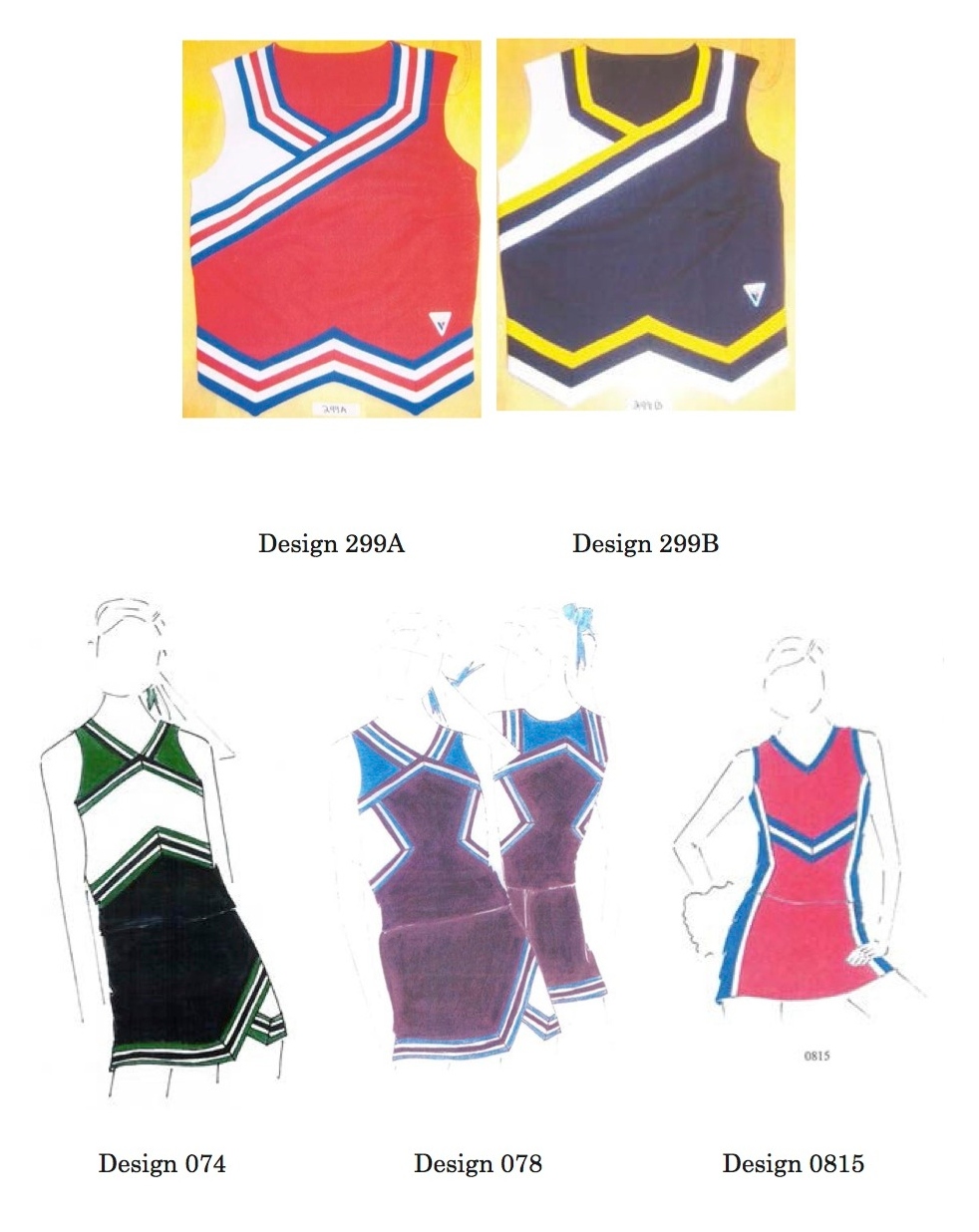
Image description: A page showing six cheerleading uniform designs. At the top, two sleeveless tops: one red with diagonal white and blue stripes (Design 299A) and one navy with diagonal yellow and white stripes (Design 299B). Below are four full-length sketches: a green and black dress with white chevron stripes (Design 074), a purple dress with blue and red accents shown on two figures (Design 078), and a red dress with blue and white stripes (Design 0815). All feature bold chevron or diagonal stripe patterns.
Petitioner Star Athletica, L.L.C., also markets and sells cheerleading uniforms. Respondents sued petitioner for infringing their copyrights in the five designs.
The Copyright Act establishes a special rule for copyrighting a pictorial, graphic, or sculptural work incorporated into a “useful article,” which is defined as “an article having an intrinsic utilitarian function that is not merely to portray the appearance of the article or to convey information.” The statute does not protect useful articles as such. Rather, “the design of a useful article” is “considered a pictorial, graphical, or sculptural work only if, and only to the extent that, such design incorporates pictorial, graphic, or sculptural features that can be identified separately from, and are capable of existing independently of, the utilitarian aspects of the article.” In this case, our task is to determine whether the arrangements of lines, chevrons, and colorful shapes appearing on the surface of respondents’ cheerleading uniforms are eligible for copyright protection as separable features of the design of those cheerleading uniforms.
We must decide when a feature incorporated into a useful article “can be identified separately from” and is “capable of existing independently of” “the utilitarian aspects” of the article. This is not a free-ranging search for the best copyright policy, but rather “depends solely on statutory interpretation.” “The controlling principle in this case is the basic and unexceptional rule that courts must give effect to the clear meaning of statutes as written.” We thus begin and end our inquiry with the text, giving each word its “ordinary, contemporary, common meaning.”
The statute provides that a pictorial, graphic, or sculptural feature incorporated into the design of a useful article is eligible for copyright protection if it (1) “can be identified separately from,” and (2) is “capable of existing independently of, the utilitarian aspects of the article.” §101. The first requirement—separate identification—is not onerous. The decisionmaker need only be able to look at the useful article and spot some two- or three-dimensional element that appears to have pictorial, graphic, or sculptural qualities.
The independent-existence requirement is ordinarily more difficult to satisfy. The decisionmaker must determine that the separately identified feature has the capacity to exist apart from the utilitarian aspects of the article. In other words, the feature must be able to exist as its own pictorial, graphic, or sculptural work as defined in §101 once it is imagined apart from the useful article. If the feature is not capable of existing as a pictorial, graphic, or sculptural work once separated from the useful article, then it was not a pictorial, graphic, or sculptural feature of that article, but rather one of its utilitarian aspects.
Of course, to qualify as a pictorial, graphic, or sculptural work on its own, the feature cannot itself be a useful article or “[a]n article that is normally a part of a useful article” (which is itself considered a useful article). §101. Nor could someone claim a copyright in a useful article merely by creating a replica of that article in some other medium—for example, a cardboard model of a car. Although the replica could itself be copyrightable, it would not give rise to any rights in the useful article that inspired it.
In sum, a feature of the design of a useful article is eligible for copyright if, when identified and imagined apart from the useful article, it would qualify as a pictorial, graphic, or sculptural work either on its own or when fixed in some other tangible medium.
Applying this test to the surface decorations on the cheerleading uniforms is straightforward. First, one can identify the decorations as features having pictorial, graphic, or sculptural qualities. Second, if the arrangement of colors, shapes, stripes, and chevrons on the surface of the cheerleading uniforms were separated from the uniform and applied in another medium—for example, on a painter’s canvas—they would qualify as “two-dimensional … works of … art,” §101. And imaginatively removing the surface decorations from the uniforms and applying them in another medium would not replicate the uniform itself. Indeed, respondents have applied the designs in this case to other media of expression—different types of clothing—without replicating the uniform. The decorations are therefore separable from the uniforms and eligible for copyright protection.1
Footnote 1: We do not today hold that the surface decorations are copyrightable. We express no opinion on whether these works are sufficiently original to qualify for copyright protection, see Feist Publications, Inc. v. Rural Telephone Service Co., 499 U.S. 340–359 (1991), or on whether any other prerequisite of a valid copyright has been satisfied.
The dissent argues that the designs are not separable because imaginatively removing them from the uniforms and placing them in some other medium of expression—a canvas, for example—would create “pictures of cheerleader uniforms.” Petitioner similarly argues that the decorations cannot be copyrighted because, even when extracted from the useful article, they retain the outline of a cheerleading uniform.
This is not a bar to copyright. Just as two-dimensional fine art corresponds to the shape of the canvas on which it is painted, two-dimensional applied art correlates to the contours of the article on which it is applied. A fresco painted on a wall, ceiling panel, or dome would not lose copyright protection, for example, simply because it was designed to track the dimensions of the surface on which it was painted. Or consider, for example, a design etched or painted on the surface of a guitar. If that entire design is imaginatively removed from the guitar’s surface and placed on an album cover, it would still resemble the shape of a guitar. But the image on the cover does not “replicate” the guitar as a useful article. Rather, the design is a two-dimensional work of art that corresponds to the shape of the useful article to which it was applied. The statute protects that work of art whether it is first drawn on the album cover and then applied to the guitar’s surface, or vice versa. Failing to protect that art would create an anomaly: It would extend protection to two-dimensional designs that cover a part of a useful article but would not protect the same design if it covered the entire article. The statute does not support that distinction, nor can it be reconciled with the dissent’s recognition that “artwork printed on a t-shirt” could be protected.
To be clear, the only feature of the cheerleading uniform eligible for a copyright in this case is the two-dimensional work of art fixed in the tangible medium of the uniform fabric. Even if respondents ultimately succeed in establishing a valid copyright in the surface decorations at issue here, respondents have no right to prohibit any person from manufacturing a cheerleading uniform of identical shape, cut, and dimensions to the ones on which the decorations in this case appear. They may prohibit only the reproduction of the surface designs in any tangible medium of expression—a uniform or otherwise.2
Footnote 2: The dissent suggests that our test would lead to the copyrighting of shovels. But a shovel, like a cheerleading uniform, even if displayed in an art gallery, is “an article having an intrinsic utilitarian function that is not merely to portray the appearance of the article or to convey information.” 17 U.S.C. §101. It therefore cannot be copyrighted. A drawing of a shovel could, of course, be copyrighted. And, if the shovel included any artistic features that could be perceived as art apart from the shovel, and which would qualify as protectable pictorial, graphic, or sculptural works on their own or in another medium, they too could be copyrighted. But a shovel as a shovel cannot.
According to petitioner, if a feature of a useful article “advances the utility of the article,” then it is categorically beyond the scope of copyright. The designs here are not protected, it argues, because they are necessary to two of the uniforms’ “inherent, essential, or natural functions”—identifying the wearer as a cheerleader and enhancing the wearer’s physical appearance. Because the uniforms would not be equally useful without the designs, petitioner contends that the designs are inseparable from the “utilitarian aspects” of the uniform.
The Government suggests that the appropriate test is whether the useful article with the artistic feature removed would “remain similarly useful.” In the view of the United States, however, a plain white cheerleading uniform is “similarly useful” to uniforms with respondents’ designs.
The debate over the relative utility of a plain white cheerleading uniform is unnecessary. The focus of the separability inquiry is on the extracted feature and not on any aspects of the useful article that remain after the imaginary extraction. The statute does not require the decisionmaker to imagine a fully functioning useful article without the artistic feature. Instead, it requires that the separated feature qualify as a nonuseful pictorial, graphic, or sculptural work on its own.
Of course, because the removed feature may not be a useful article—as it would then not qualify as a pictorial, graphic, or sculptural work—there necessarily would be some aspects of the original useful article “left behind” if the feature were conceptually removed. But the statute does not require the imagined remainder to be a fully functioning useful article at all, much less an equally useful one.
Because we reject the view that a useful article must remain after the artistic feature has been imaginatively separated from the article, we necessarily abandon the distinction between “physical” and “conceptual” separability, which some courts and commentators have adopted based on the Copyright Act’s legislative history.
The statutory text indicates that separability is a conceptual undertaking. Because separability does not require the underlying useful article to remain, the physical-conceptual distinction is unnecessary.
Petitioner next argues that we should incorporate two “objective” components into our test to provide guidance to the lower courts: (1) “whether the design elements can be identified as reflecting the designer’s artistic judgment exercised independently of functional influence,” and (2) whether “there is [a] substantial likelihood that the pictorial, graphic, or sculptural feature would still be marketable to some significant segment of the community without its utilitarian function.”
We reject this argument because neither consideration is grounded in the text of the statute. The statute’s text makes clear that our inquiry is limited to how the article and feature are perceived, not how or why they were designed. See Brandir Int’l, Inc. v. Cascade Pacific Lumber Co., 834 F. 2d 1142, 1152 (CA2 1987) (Winter, J., concurring in part and dissenting in part) (The statute “expressly states that the legal test is how the final article is perceived, not how it was developed through various stages”).
The same is true of marketability. Nothing in the statute suggests that copyrightability depends on market surveys. Moreover, asking whether some segment of the market would be interested in a given work threatens to prize popular art over other forms, or to substitute judicial aesthetic preferences for the policy choices embodied in the Copyright Act.
Finally, petitioner argues that allowing the surface decorations to qualify as a “work of authorship” is inconsistent with Congress’ intent to entirely exclude industrial design from copyright. Petitioner notes that Congress refused to pass a provision that would have provided limited copyright protection for industrial designs, including clothing, when it enacted the 1976 Act and that it has enacted laws protecting designs for specific useful articles—semiconductor chips and boat hulls—while declining to enact other industrial design statutes. From this history of failed legislation petitioner reasons that Congress intends to channel intellectual property claims for industrial design into design patents. It therefore urges us to approach this question with a presumption against copyrightability
We do not share petitioner’s concern. As an initial matter, “congressional inaction lacks persuasive significance” in most circumstances. Moreover, we have long held that design patent and copyright are not mutually exclusive. In any event, as explained above, our test does not render the shape, cut, and physical dimensions of the cheerleading uniforms eligible for copyright protection.
Justice Ginsburg, concurring in the judgment.
I concur in the Court’s judgment but not in its opinion. Unlike the majority, I would not take up in this case the separability test appropriate under 17 U.S.C. §101. Consideration of that test is unwarranted because the designs at issue are not designs of useful articles. Instead, the designs are themselves copyrightable pictorial or graphic works reproduced on useful articles.
The designs here in controversy are standalone pictorial and graphic works that respondents Varsity Brands reproduce on cheerleading uniforms. Varsity’s designs first appeared as pictorial and graphic works that Varsity’s design team sketched on paper. Varsity then sought copyright protection for those two-dimensional designs, not for cheerleading costumes; its registration statements claimed “2-Dimensional artwork” and “fabric design (artwork).” Varsity next reproduced its two-dimensional graphic designs on cheerleading uniforms, also on other garments, including T-shirts and jackets.
In short, Varsity’s designs are standalone PGS works that may gain copyright protection as such, including the exclusive right to reproduce the designs on useful articles.
Justice Breyer, with whom Justice Kennedy joins, dissenting.
I agree with much in the Court’s opinion. But I do not agree that the designs that Varsity Brands, Inc., submitted to the Copyright Office are eligible for copyright protection. Even applying the majority’s test, the designs cannot “be perceived as … two- or three-dimensional works of art separate from the useful article.”
Look at the designs that Varsity submitted to the Copyright Office. You will see only pictures of cheerleader uniforms. And cheerleader uniforms are useful articles. A picture of the relevant design features, whether separately “perceived” on paper or in the imagination, is a picture of, and thereby “replicate[s],” the underlying useful article of which they are a part. Hence the design features that Varsity seeks to protect are not “capable of existing independently [of] the utilitarian aspects of the article.” 17 U.S.C. §101.
The relevant statutory provision says that the “design of a useful article” is copyrightable “only if, and only to the extent that, such design incorporates pictorial, graphic, or sculptural features that can be identified separately from, and are capable of existing independently of, the utilitarian aspects of the article.” But what, we must ask, do the words “identified separately” mean? The most direct, helpful aspect of the Court’s opinion answers this question by stating:
Nor could someone claim a copyright in a useful article merely by creating a replica of that article in some other medium—for example, a cardboard model of a car. Although the replica could itself be copyrightable, it would not give rise to any rights in the useful article that inspired it.
Exactly so. These words help explain the Court’s statement that a copyrightable work of art must be “perceived as a two- or three-dimensional work of art separate from the useful article.” They help clarify the concept of separateness. They are consistent with Congress’ own expressed intent.
Consider, for example, the explanation that the House Report for the Copyright Act of 1976 provides. It says:
“Unless the shape of an automobile, airplane, ladies’ dress, food processor, television set, or any other industrial product contains some element that, physically or conceptually, can be identified as separable from the utilitarian aspects of that article, the design would not be copyrighted … .” House Report at 55 (emphasis added).
These words suggest two exercises, one physical, one mental. Can the design features (the picture, the graphic, the sculpture) be physically removed from the article (and considered separately), all the while leaving the fully functioning utilitarian object in place? If not, can one nonetheless conceive of the design features separately without replicating a picture of the utilitarian object? If the answer to either of these questions is “yes,” then the design is eligible for copyright protection. Otherwise, it is not.
An example will help. Imagine a lamp with a circular marble base, a vertical 10-inch tall brass rod (containing wires) inserted off center on the base, a light bulb fixture emerging from the top of the brass rod, and a lampshade sitting on top. In front of the brass rod a porcelain Siamese cat sits on the base facing outward. Obviously, the Siamese cat is physically separate from the lamp, as it could be easily removed while leaving both cat and lamp intact. And, assuming it otherwise qualifies, the designed cat is eligible for copyright protection.
Now suppose there is no long brass rod; instead the cat sits in the middle of the base and the wires run up through the cat to the bulbs. The cat is not physically separate from the lamp, as the reality of the lamp’s construction is such that an effort to physically separate the cat and lamp will destroy both cat and lamp. The two are integrated into a single functional object, like the similar configuration of the ballet dancer statuettes that formed the lamp bases at issue in Mazer v. Stein, 347 U.S. 201 (1954). But we can easily imagine the cat on its own, as did Congress when conceptualizing the ballet dancer. See House Report, at 55 (the statuette in Mazer was “incorporated into a product without losing its ability to exist independently as a work of art”). In doing so, we do not create a mental picture of a lamp (or, in the Court’s words, a “replica” of the lamp), which is a useful article. We simply perceive the cat separately, as a small cat figurine that could be a copyrightable design work standing alone that does not replicate the lamp. Hence the cat is conceptually separate from the utilitarian article that is the lamp. The pair of lamps pictured at Figures 1 and 2 illustrate this principle.
Justice Breyer’s Figures 1 and 2 (Cat Lamps)
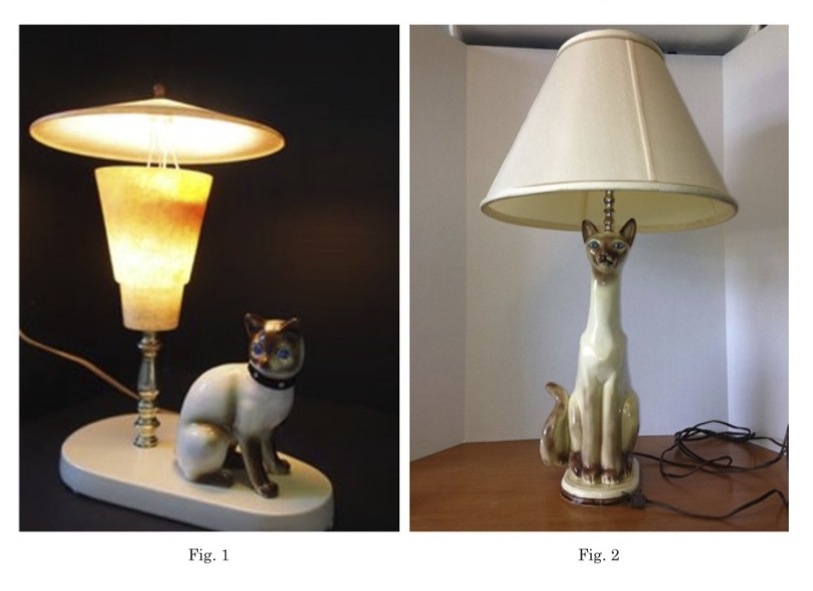
Image description: Two vintage cat-themed table lamps. Fig. 1 shows a lamp with a squat ceramic cat figurine at the base, white with dark points, wearing a black collar. The shade is conical with a glowing amber tone. Fig. 2 shows a taller lamp with a slender ceramic Siamese-style cat figurine forming the base, cream with brown points. It has a large beige conical shade and sits on a wooden surface.
By way of contrast, Van Gogh’s painting of a pair of old shoes, though beautifully executed and copyrightable as a painting, would not qualify for a shoe design copyright. See fig. 3. Courts have similarly denied copyright protection to objects that begin as three-dimensional designs, such as measuring spoons shaped like heart-tipped arrows, candleholders shaped like sailboats, and wire spokes on a wheel cover. None of these designs could qualify for copyright protection that would prevent others from selling spoons, candleholders, or wheel covers with the same design. Why not? Because in each case the design is not separable from the utilitarian aspects of the object to which it relates. The designs cannot be physically separated because they themselves make up the shape of the spoon, candleholders, or wheel covers of which they are a part. One cannot easily imagine or otherwise conceptualize the design of the spoons or the candleholders or the shoes without that picture, or image, or replica being a picture of spoons, or candleholders, or wheel covers, or shoes. The designs necessarily bring along the underlying utilitarian object. Hence each design is not conceptually separable from the physical useful object.
Justice Breyer’s Figure 3
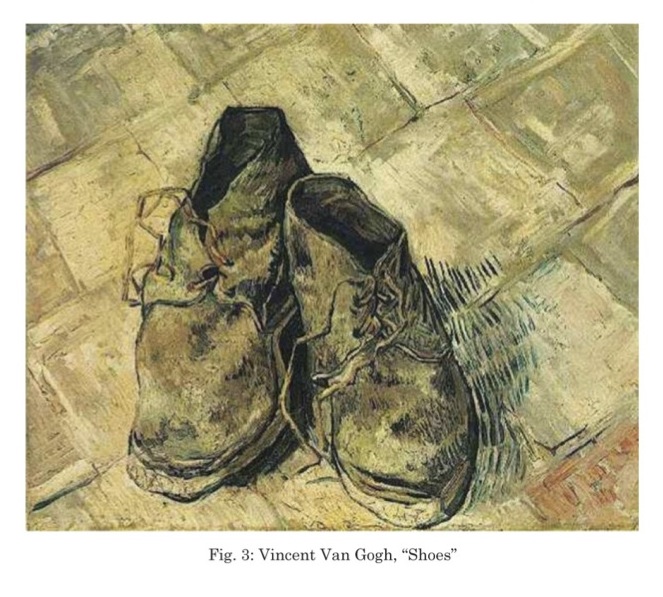
Image description: A painting by Vincent van Gogh titled Shoes. It depicts a worn, brown pair of lace-up work shoes resting on a tiled floor. The shoes appear scuffed and creased, with loose laces, rendered in Van Gogh’s distinctive textured brushstrokes. The muted tones of tan, brown, and green give the scene a rugged, earthy feel.
To repeat: A separable design feature must be “capable of existing independently” of the useful article as a separate artistic work that is not itself the useful article. If the claimed feature could be extracted without replicating the useful article of which it is a part, and the result would be a copyrightable artistic work standing alone, then there is a separable design. But if extracting the claimed features would necessarily bring along the underlying useful article, the design is not separable from the useful article. In many or most cases, to decide whether a design or artistic feature of a useful article is conceptually separate from the article itself, it is enough to imagine the feature on its own and ask, “Have I created a picture of a (useful part of a) useful article?” If so, the design is not separable from the useful article. If not, it is.
In referring to imagined pictures and the like, I am not speaking technically. I am simply trying to explain an intuitive idea of what separation is about, as well as how I understand the majority’s opinion. So understood, the opinion puts design copyrights in their rightful place. The law has long recognized that drawings or photographs of real world objects are copyrightable as drawings or photographs, but the copyright does not give protection against others making the underlying useful objects. That is why a copyright on Van Gogh’s painting would prevent others from reproducing that painting, but it would not prevent others from reproducing and selling the comfortable old shoes that the painting depicts.
To ask this kind of simple question—does the design picture the useful article?—will not provide an answer in every case, for there will be cases where it is difficult to say whether a picture of the design is, or is not, also a picture of the useful article. But the question will avoid courts focusing primarily upon what I believe is an unhelpful feature of the inquiry, namely, whether the design can be imagined as a “two- or three-dimensional work of art.” That is because virtually any industrial design can be thought of separately as a “work of art”: Just imagine a frame surrounding the design, or its being placed in a gallery. Consider Marcel Duchamp’s “readymades” series, the functional mass-produced objects he designated as art. See fig. 4, [picture of shovel]. What design features could not be imaginatively reproduced on a painter’s canvas?
Editor’s note: “Readymades” were ordinary objects which the artist Marcel Duchamp chose and presented as art. The figure In Advance of the Broken Arm (1915) is an ordinary snow shovel. Duchamp’s most famous work is Fountain (1917), a urinal signed with the pseudonym “R. Mutt” and declared as art. Fountain was selected in 2004 as “the most influential artwork of the 20th century” by 500 renowned artists and historians. See, Duchamp’s Urinal Tops Art Survey, BBC News (Dec. 1, 2004, 5:56 PM), http://news.bbc.co.uk/2/hi/entertainment/4059997.stm.
Justice Breyer’s Figure 4
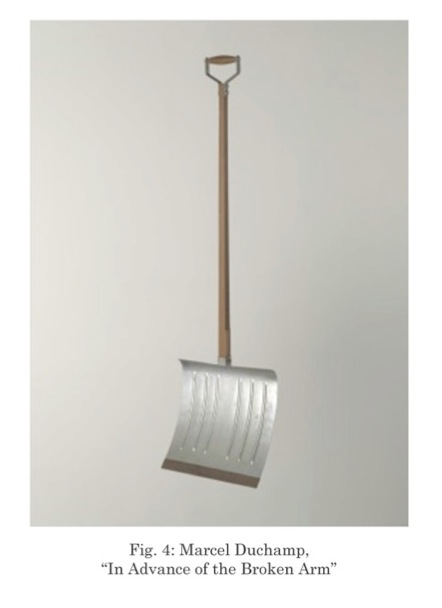
Image description: Marcel Duchamp’s artwork In Advance of the Broken Arm. It is a plain snow shovel with a long wooden handle and a wide silver metal scoop. The shovel hangs vertically against a neutral background.
The conceptual approach that I have described reflects Congress’ answer to a problem that is primarily practical and economic. Years ago Lord Macaulay drew attention to the problem when he described copyright in books as a “tax on readers for the purpose of giving a bounty to writers.” He called attention to the main benefit of copyright protection, which is to provide an incentive to produce copyrightable works and thereby “promote the Progress of Science and useful Arts.” But Macaulay also made clear that copyright protection imposes costs. Those costs include the higher prices that can accompany the grant of a copyright monopoly. They also can include (for those wishing to display, sell, or perform a design, film, work of art, or piece of music, for example) the costs of discovering whether there are previous copyrights, of contacting copyright holders, and of securing permission to copy. Sometimes, as Thomas Jefferson wrote to James Madison, costs can outweigh “the benefit even of limited monopolies.” And that is particularly true in light of the fact that Congress has extended the “limited Times” of protection, from the “14 years” of Jefferson’s day to potentially more than a century today.
The Constitution grants Congress primary responsibility for assessing comparative costs and benefits and drawing copyright’s statutory lines. Courts must respect those lines and not grant copyright protection where Congress has decided not to do so. And it is clear that Congress has not extended broad copyright protection to the fashion design industry.
Congress’ decision not to grant full copyright protection to the fashion industry has not left the industry without protection. Patent design protection is available. A maker of clothing can obtain trademark protection under the Lanham Act for signature features of the clothing. And a designer who creates an original textile design can receive copyright protection for that pattern as placed, for example, on a bolt of cloth, or anything made with that cloth.
The fashion industry has thrived against this backdrop, and designers have contributed immeasurably to artistic and personal self-expression through clothing. But a decision by this Court to grant protection to the design of a garment would grant the designer protection that Congress refused to provide. It would risk increased prices and unforeseeable disruption in the clothing industry, which in the United States alone encompasses nearly $370 billion in annual spending and 1.8 million jobs. That is why I believe it important to emphasize those parts of the Court’s opinion that limit the scope of its interpretation. That language, as I have said, makes clear that one may not “claim a copyright in a useful article merely by creating a replica of that article in some other medium,” which “would not give rise to any rights in the useful article that inspired it.”
If we ask the “separateness” question correctly, the answer here is not difficult to find. The majority’s opinion, in its appendix, depicts the cheerleader dress designs that Varsity submitted to the Copyright Office. Can the design features in Varsity’s pictures exist separately from the utilitarian aspects of a dress? Can we extract those features as copyrightable design works standing alone, without bringing along, via picture or design, the dresses of which they constitute a part?
Consider designs 074, 078, and 0815. They certainly look like cheerleader uniforms. That is to say, they look like pictures of cheerleader uniforms, just like Van Gogh’s old shoes look like shoes. I do not see how one could see them otherwise. Designs 299A and 2999B present slightly closer questions. They omit some of the dresslike context that the other designs possess. But the necklines, the sleeves, and the cut of the skirt suggest that they too are pictures of dresses. Looking at all five of Varsity’s pictures, I do not see how one could conceptualize the design features in a way that does not picture, not just artistic designs, but dresses as well.
Were I to accept the majority’s invitation to “imaginatively remove” the chevrons and stripes as they are arranged on the neckline, waistline, sleeves, and skirt of each uniform, and apply them on a “painter’s canvas,” that painting would be of a cheerleader’s dress. The esthetic elements on which Varsity seeks protection exist only as part of the uniform design—there is nothing to separate out but for dress-shaped lines that replicate the cut and style of the uniforms. Hence, each design is not physically separate, nor is it conceptually separate, from the useful article it depicts, namely, a cheerleader’s dress. They cannot be copyrighted.
Varsity, of course, could have sought a design patent for its designs. Or, it could have sought a copyright on a textile design, even one with a similar theme of chevrons and lines.
But that is not the nature of Varsity’s copyright claim. It has instead claimed ownership of the particular “treatment and arrangement” of the chevrons and lines of the design as they appear at the neckline, waist, skirt, sleeves, and overall cut of each uniform. The majority imagines that Varsity submitted something different—that is, only the surface decorations of chevrons and stripes, as in a textile design. As the majority sees it, Varsity’s copyright claim would be the same had it submitted a plain rectangular space depicting chevrons and stripes, like swaths from a bolt of fabric. But considered on their own, the simple stripes are plainly unoriginal. Varsity, then, seeks to do indirectly what it cannot do directly: bring along the design and cut of the dresses by seeking to protect surface decorations whose “treatment and arrangement” are coextensive with that design and cut. As Varsity would have it, it would prevent its competitors from making useful three-dimensional cheerleader uniforms by submitting plainly unoriginal chevrons and stripes as cut and arranged on a useful article. But with that cut and arrangement, the resulting pictures on which Varsity seeks protection do not simply depict designs. They depict clothing. They depict the useful articles of which the designs are inextricable parts. And Varsity cannot obtain copyright protection that would give them the power to prevent others from making those useful uniforms, any more than Van Gogh can copyright comfortable old shoes by painting their likeness.
I fear that, in looking past the three-dimensional design inherent in Varsity’s claim by treating it as if it were no more than a design for a bolt of cloth, the majority has lost sight of its own important limiting principle. One may not “claim a copyright in a useful article merely by creating a replica of that article in some other medium,” such as in a picture. That is to say, one cannot obtain a copyright that would give its holder “any rights in the useful article that inspired it.”
With respect, I dissent.
Questions & Comments
(1) Is it fair to say that Justice Breyer agreed with the majority’s test, but not its application? If not, what exactly is the difference between the majority and the dissent?
(2) Even prior to Star Athletica it was well settled that printed designs on clothes are copyrightable because the ornamentation is separable from the useful aspects of the article. However, it was equally well settled that items of clothing as such are generally not eligible for copyright protection. They were considered useful articles in which any artistic element is hopelessly merged with the item’s utilitarian function. As the Compendium III of U.S. Copyright Office Practices, § 924.3(A)(1) explains “… clothing provides utilitarian functions, such as warmth, protection, and modesty. As a result, the U.S. Copyright Office will not register a claim in clothing or clothing designs.” Did Star Athletica change the law with respect to the copyrightability of fashion?
(3) The plaintiff in the Star Athletica case, Varsity Brands, did not attempt to register the design of a cheerleading uniform per se, it registered five different sets of two-dimensional artwork to be embodied in a uniform. This is a tricky move, but Section 113(b) provides:
This title does not afford, to the owner of copyright in a work that portrays a useful article as such, any greater or lesser rights with respect to the making, distribution, or display of the useful article so portrayed than those afforded to such works under [copyright law].
So, can you avoid the useful article doctrine simply by copyrighting a picture of a useful article? How do Justices Thomas, Ginsburg, and Breyer address this section in their respective opinions? How should we apply Section 113(b) after Star Athletica?
That question has now been litigated. In Metro Light & Power LLC v. Furnlite, Inc., 2026 WL 686511 (S.D.N.Y. 2026), the plaintiff made bezel face plates designed to sit flush with a furniture surface around an electrical outlet. Judge Subramanian dismissed on the pleadings: “The face plates here cannot be perceived as a work of art separate from the useful article — the electrical and USB outlets. To the extent they have artistic value, it is from the role they play bordering the outlet.” He added that even if they could be so perceived, “it is unlikely that a simple rectangular shape would qualify as protectable.” The plaintiff then tried the maneuver this note describes: it held valid copyrights in photographs of the face plates on its website, and argued the defendants’ products were derivative of the photographs. The court refused to let a copyright in a picture of a useful article do the work that a copyright in the article itself could not. Notice, though, how the court got there — through Star Athletica and the dictum about pictures, rather than through § 113(b), which is on its face the provision written for exactly this problem. Why might a court prefer the one to the other?
(4) In DC Comics v. Towle, 802 F.3d 1012 (9th Cir. 2015), the court ruled that copyright in the Batmobile as visually depicted in Batman comic books, television programs, and movies, was violated by a manufacturer of replica kits that attached to actual automobiles to make them look like the Batmobile. The court did not consider whether the copyright in the depiction of a useful article like an automobile could extend protection to the production of actual car parts. Should it have?
(5) Is clothing on a doll protectable under copyright law? See Mattel, Inc. v. MGA Entertainment, Inc., 616 F.3d 904, 916 n.12 (9th Cir. 2010).
(6) The iconic Noguchi Table was designed by Isamu Noguchi in 1939. Noguchi was born in Los Angeles to an American mother and a Japanese father in 1904. He was placed in an internment camp in Arizona during WWII. The version of the table that is still current today was commissioned by the then president of the Museum of Modern Art in New York City; the original remains in the museum’s permanent collection. Is the Noguchi Table copyrightable under Star Athletica? Would it have been copyrightable before Star Athletica? (this is a rhetorical question, see below).
The Noguchi Table, Isamu Noguchi
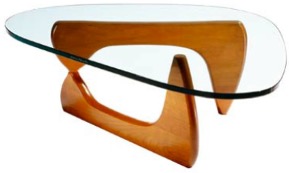
Image description: A modernist coffee table with a clear, irregularly shaped glass top. The base is sculptural, made of smooth, curved wood in a warm brown tone, forming two interlocking supports that balance the glass surface. The design is sleek and organic, combining functionality with artistic form.
Did Star Athletica change the law?
How does Star Athletica change the law? Perhaps Star Athletica really does not say anything at all. An excellent student note in the 2017 Harvard Law Review, Copyright Act of 1976-Useful Articles-Star Athletica, L.L.C. v. Varsity Brands, Inc., argues that the Court’s decision “invites various interpretations” because the “Court’s test does little more than restate the statute’s language.”
“Features that can be identified separately” becomes “features [that] can be perceived as a ... separate” work. “Features that ... are capable of existing independently” becomes “features ... [that] would qualify as a protectable ... work.”
Paraphrases are ordinarily helpful, as they provide other ways of thinking through a question. But the number of approaches developed by lower courts renders it “obvious” that there was no settled way to understand the statute’s text, how it should be applied, or under what standard. A gloss on the text will likely not resolve those questions.
This might understate the impact of Star Athletica. For one thing, in addition to setting out the two-part test discussed above, Justice Thomas’ majority opinion also explicitly disapproved of a number of other tests, including the physical separability test, the designer’s perspective test, and the marketability test. So, at the very least, that is a change in the law of some circuits.
In addition, it is easy to read Star Athletica as a drastic change in the law. Prior to Star Athletica most courts would have agreed that a design element is not conceptually separable if removing it or replacing it with a less creative alternative changes the functional attributes of the product. In her 2018 NYU Law Review article, Conceptual Separability As Conceivability: A Philosophical Analysis Of The Useful Articles Doctrine, Professor Mala Chatterjee explains
“When you conceive of the article as lacking the design element in question, is the article you imagine functionally identical to the actual article?” If the answer to this question is yes, then we can conclude that the design element is conceptually separable from the article’s utilitarian aspects; if not, then the element has failed the test, and it is not entitled to copyright protection.
Thus, the Aeron Chair would not be copyrightable because none of its design features are conceptually separable from the useful article. There is no obvious substitute for the design features of the Aeron Chair that would not significantly change the utility of the chair. For the Noguchi Table, in contrast, one could replace the design elements with more standard table elements and the table function would be unchanged. This approach makes sense, but can it be reconciled with Justice Thomas’ majority opinion (at 1013):
The focus of the separability inquiry is on the extracted feature and not on any aspects of the useful article that remain after the imaginary extraction. The statute does not require the decisionmaker to imagine a fully functioning useful article without the artistic feature. Instead, it requires that the separated feature qualify as a nonuseful pictorial, graphic, or sculptural work on its own.
Of course, because the removed feature may not be a useful article—as it would then not qualify as a pictorial, graphic, or sculptural work—there necessarily would be some aspects of the original useful article “left behind” if the feature were conceptually removed. But the statute does not require the imagined remainder to be a fully functioning useful article at all, much less an equally useful one .... The statute does not require that we imagine a nonartistic replacement for the removed feature to determine whether that feature is capable of an independent existence.
In this passage, Justice Thomas seems to suggest that so long as such a feature could be “imagined” in a different non-utilitarian context, it does not matter if what is left behind “after the imaginary extraction” is less useful. Justice Thomas arrived at this conclusion based on his reading of the statute, focusing on the words in Section 101 “… can be identified separately from, and are capable of existing independently of, the utilitarian aspects of the article.” However, the majority opinion does not seem to have accounted for all of the language of Section 101. Section 101 provides that PGS works “shall include works of artistic craftsmanship insofar as their form but not their mechanical or utilitarian aspects are concerned; the design of a useful article, as defined in this section, shall be considered a pictorial, graphic, or sculptural work only if, and only to the extent that, such design incorporates pictorial, graphic, or sculptural features that can be identified separately from, and are capable of existing independently of, the utilitarian aspects of the article.” The majority opinion in Star Athletica does not appear to give any weight to the words “but not their mechanical or utilitarian aspects are concerned” which suggest that protection should only be allowed for non-functional aspects of a given design. If these words mean anything, how can it not matter if what is left behind “after the imaginary extraction” is less useful?
To take Justice Thomas at his word in the above quoted extract would be to negate Congress’ clearly expressed intention with respect to the useful article doctrine. The core holding of Star Athletica is that lines and chevrons on a cheerleader uniform outline are conceptually separable from the useful article of a cheerleader uniform and are thus copyrightable PGS elements (assuming they display sufficient originality). Perhaps the Copyright Office and lower courts should simply treat the rest of the opinion as dicta, and poorly reasoned dicta at that?
In “What Is A ‘Useful Article’ in Copyright Law After Star Athletica?,” a 2017 article in the Pennsylvania Law Review Online, Professor Tyler Ochoa makes a strong case for simply ignoring the above quoted extract.
This passage is, frankly, nonsensical. The removed feature either contributes to the utility of the useful article or it doesn’t. If it does contribute to the utility of the useful article, then it is one of the “utilitarian aspects” of the article that are not protected by copyright. If it doesn’t contribute to the utility of the useful article, then, by definition, the useful article would remain equally useful without it. The key to applying the “equally useful” argument is to remember that, because of the two statutory exclusions in the definition of a “useful article,” certain types of utility are excluded and simply don’t count when deciding whether the article remains “useful.” In other words, the reason a blank cheerleading uniform is less useful than a colorful one is because it fails to convey information; but conveying information is a “utilitarian function” that is excluded from the definition of a “useful article.” A blank cheerleading uniform remains equally useful in all of the ways that matter to the statutory definition.
Fortunately, Justice Thomas’ flawed reasoning should not affect the outcome of the separability analysis. He expressly recognizes that the removed feature cannot itself be a “useful article,” and earlier in the opinion he expressly recognizes that the statutory definition of a “useful article” includes “[a]n article that is normally a part of a useful article,” i.e., any functional component of a useful article. Thus, the majority’s insistence that the “imagined remainder” need not be a fully functional useful article at all should be a null set, since any “utilitarian aspects” of the removed feature would necessarily disqualify the removed feature from being a separable pictorial, graphic, or sculptural work.
So, where are we now?
In Star Athletica, the majority held that a feature incorporated into the design of a useful article is eligible for copyright protection only if (1) the feature can be perceived or imagined as a two- or three-dimensional work of art separate from the useful article—i.e. the “separate-identification” requirement; and (2) the feature would qualify as a protectable pictorial, graphic, or sculptural work if it were imagined separately from the useful article into which it is incorporated—i.e. the “independent-existence” requirement.
Exactly how courts should implement this separate-identification requirement is still less than clear. To summarize:
1. Design elements are conceptually separable when they are literally separable without impairing function. Consider a hood ornament, for example.
2. Design elements are conceptually separable when the product in question would work just as well without them, even if it would be a different product in terms of its visual appeal.
3. Design elements are conceptually separable when the product in question would work just as well if one swapped out the design element for a less creative alternative element that fulfilled the same function. Thus, the design of the Noguchi coffee table or Justice Breyer’s cat lamps are conceptually separable because they are fanciful ways of achieving ordinary ends.
4. Under a narrow reading of Star Athletica (one that discards some of the more troubling dicta in the decision), a design element is not conceptually separable if removing it or replacing it with a less creative alternative changes the functional attributes of the product. Thus, the Aeron Chair would not be copyrightable because there are no obvious substitutes for the design features of the Aeron Chair that would not significantly change the utility of the chair.
5. Under a maximalist reading of Star Athletica, design elements are conceptually separable, even if replacing them with less creative alternatives would change the functional attributes of the product in question. This follows, because any feature can be “imagined” in a non-utilitarian context, and one can read Star Athletica for the proposition that it does not matter if what is left behind “after the imaginary extraction” is less useful.
Star Athletica at the Copyright Office
Colosseum Flatware Artwork
In a 2019 decision the Review Board of the United States Copyright Office agreed that the work titled “Colosseum Flatware Artwork,” pictured below, met the “separate-identification” requirement of the conceptual separability test, but failed the “independent-existence” requirement. See, Second Request for Reconsideration for Refusal to Register Colosseum Flatware Artwork; Correspondence ID: 1-3H7MI85; SR 1-6342140861
Figure: Colosseum Flatware Artwork
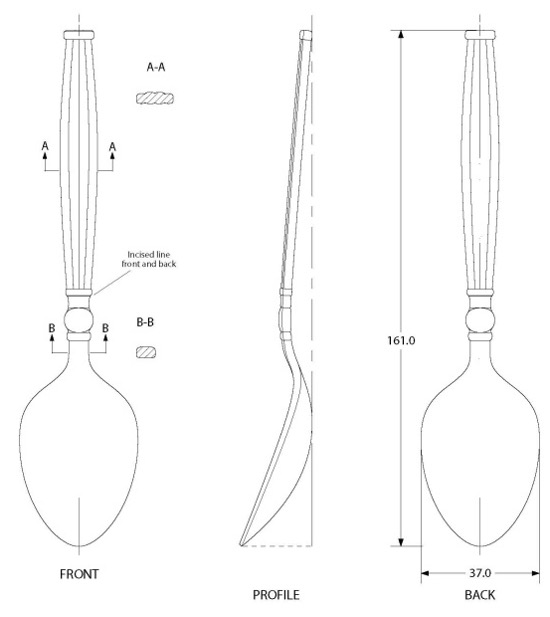
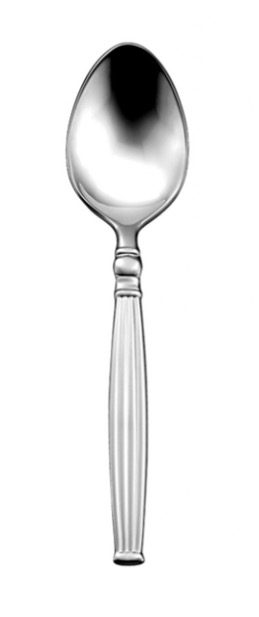
Image description: Left, a technical drawing of a large spoon shown in three views: front, profile, and back. Right, a metal spoon with a reflective oval bowl and a long handle. The handle has vertical grooves running its length, ending in a squared tip with simple decorative ridges.
The Board concluded that the separable features did not qualify as a protectable pictorial, graphic or sculptural work because they lacked, individually or in combination, the requisite minimum degree of creativity required for copyright protection.
In this decision, the Board analyzed the design features of the spoon separate from its intrinsic spoon shape and function and concluded that those remaining features—evenly spaced stripes, a sphere and basic lines—were standard geometric shapes that are not copyrightable individually or in the “workaday combination” presented.
Kitchen Helper Children’s Stool
In assessing the copyrightability of the Kitchen Helper Children’s Stool, pictured below, the Board concluded that the only aspect of the design that made it through the separate-identification requirement was “the geometric cutouts—four stars, two circles, two squares, and a half-moon.” Second Request for Reconsideration for Refusal to Register Kitchen Helper Children’s Stool (Correspondence ID: 1-30JN911, SR # 1-6843395721)
Figure: Kitchen Helper Children’s Stool
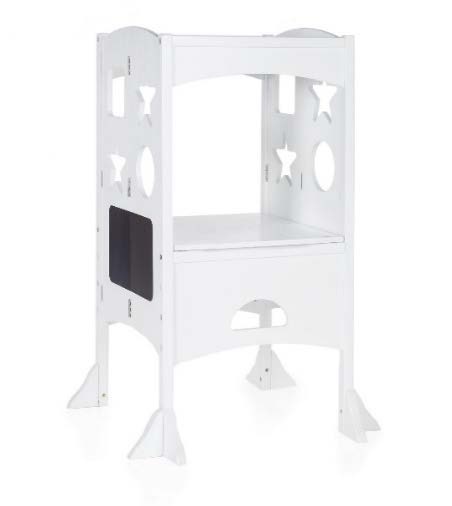
Image description: A white wooden step stool designed for children, with guard rails on all sides. The sides feature cut-out shapes including circles, stars, and rectangles. The stool has a wide base with flared feet for stability and an elevated platform inside for standing.
Once the work is reduced down to those basic geometric features, the conclusion that it failed the Feist threshold under the “independent-existence” requirement was inevitable.
The Board concluded that:
… neither the Work’s separable individual elements nor the combination of those elements meet this threshold. The individual separable elements—four stars, two circles, two squares, and a half-moon—are common and familiar shapes, and, as such, are not copyrightable. Moreover, viewed as a whole, the Board finds that the selection, coordination, and arrangement of these shapes are insufficient to render the Work sufficiently creative and original. Here, the arrangement of the stars, circles, and squares are evenly spaced and create a mirror image on either side of the stool. The shapes are each the same size and contain no variation. The half-moon is vertically centered below the step. While a sufficiently creative arrangement of shapes may provide a basis for copyrightability, a mirror image arrangement of evenly spaced shapes amounts to a garden variety pattern that falls short of the Copyright Act’s requirements for protection.
Yeezy Boost
In contrast, in another decision the Copyright Office overturned an examination decision refusing to register “2-D artwork and sculpture claims” for two pairs of sneakers, the Yeezy Boost 350 Version 1 and Yeezy Boost 350 Version 2.
In Adidas’ first request for reconsideration, the Copyright Office took the view that the works were useful articles. Applying the useful article doctrine, the Office argued that although the works contained separable designs, “those designs did not meet the originality requirement as they consisted of simple shapes arranged into common, expected patterns in very simple color schemes.”
However, after Adidas’ second request, the Copyright Office Review Board applied the law as follows:
… The Board agrees that the Works can be perceived as two- or three-dimensional works of art separate from the useful article, that is, the sneaker. Thus, the only remaining issue is whether the Works are protectable as original works of authorship if imagined separately from the sneaker.
The Board believes that the Works contain a sufficient amount of original and creative two- and three-dimensional authorship for registration. Our decision to register the Works is based on the low standard for copyrightability articulated in Feist Publications v. Rural Telephone Service Co., 499 U.S. 340 (1991). But the Board’s decision relates only to the Works as a whole, and does not extend individually to any of the standard and common elements depicted in the Works such as lines, stripes, or swirl designs. … When reviewed as a whole, the Works reflect that the common constituent shapes were “combined in a distinctive manner indicating some ingenuity.” Atari Games Corp. v. Oman, 888 F.2d 878, 883 (D.C. Cir. 1989). Thus, the Board believes that the Works contain a sufficient amount of original and creative authorship.
Re: Second Request for Reconsideration for Refusal to Register Yeezy Boost 350 Version 1, Yeezy Boost 350 Version 2
Various Illustrations of the Yeezy Boost 350 Version 1 Included in the Copyright Office’s Letter Granting Adidas’ Second Request for Reconsideration
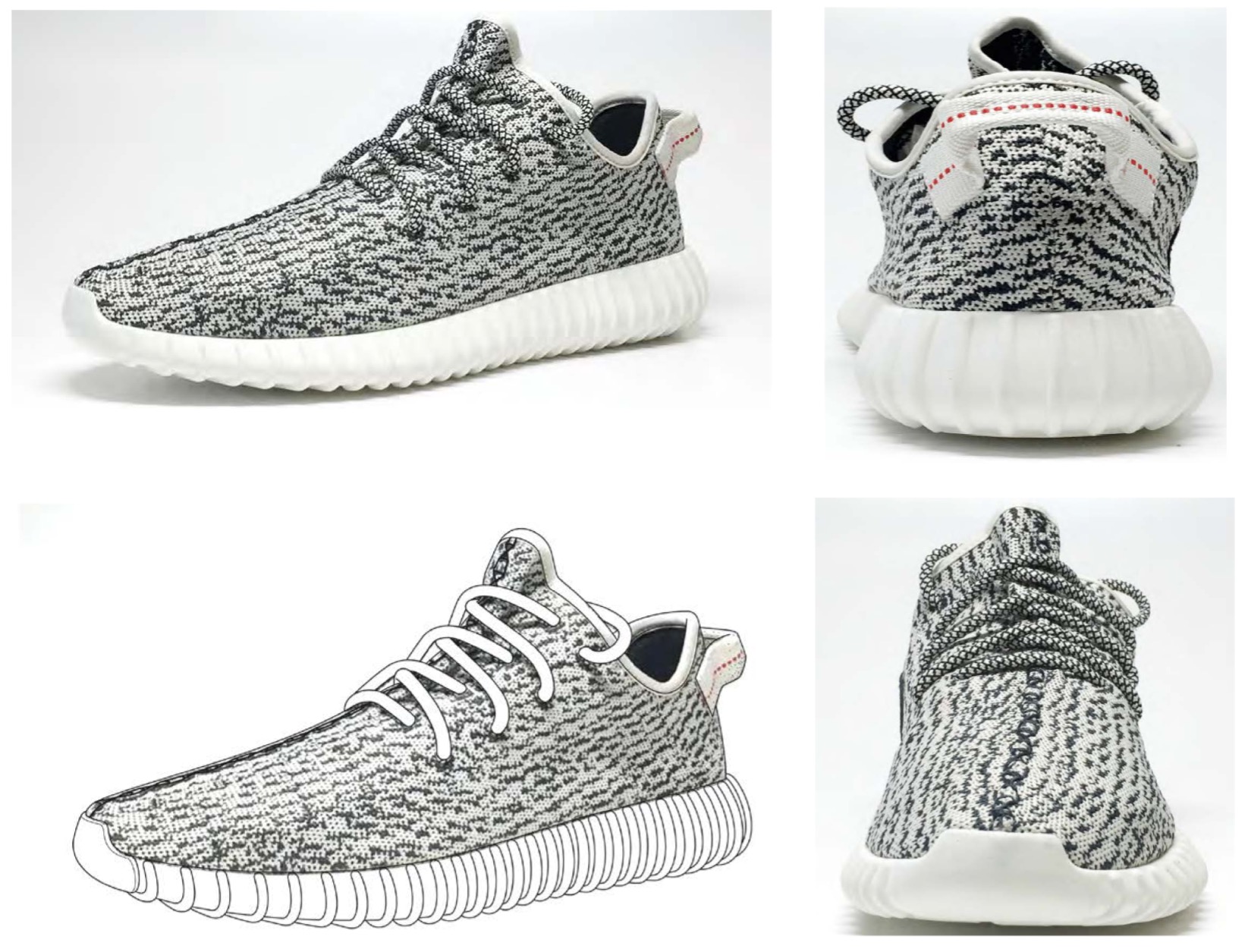
Image description: A collage of four views of a sneaker with a knitted, black-and-white patterned upper and thick white ribbed sole.
Compare Artistic Features of Canyon Boot v1 and 9 Other Unpublished Works (Review Board, March 20, 2026). Urban Outfitters sought to register three-dimensional artwork in the decorative features of ten western-style boot designs: stitching, nail heads, piping, cowhide, and the words “WE THE FREE” embossed on the sole. The Board split the analysis. Some features failed at the first stage — “the leather loops, or pull tabs, are not separable because they have an intrinsic utilitarian purpose” — but the decorative features generally satisfied separate identification. The claim then died on originality. The Board described the designs as “obvious and preordained configurations of unprotectable elements,” most of them “stock or standard features within the boot industry.”
Urban Outfitters pointed to earlier registrations of comparable footwear. The Board refused the comparison, quoting the Compendium (Third) § 309.3: “[a] decision to register a particular work has no precedential value.”
***
How much work is the useful article doctrine doing in these cases?
Evaluated without reference to the useful article doctrine, the Kitchen Helper stool combines a few basic geometric and structural features and might still fail the originality threshold. But arguably there is just enough complexity here to satisfy the designedly low threshold in Feist. However, after the application of the first prong of the conceptual separability test, the structural features of the stool vanish and all we are left with is clearly uncopyrightable geometric features. The same analysis probably holds for the Colosseum Flatware Artwork.
The Yeezy Boost decision illustrates that under a broad reading of Star Athletica, design features that are integrated into the product will allow the entire product to pass through the first stage of the conceptual separability test and thus leave more material to evaluate in terms of originality. The most intriguing part of the Board’s decision in this case is what is left out. The Board does not explain at all how or why the Yeezy works can be “imagined separately from the sneaker.” One is left with the suspicion that as long as is always a work is significantly different from conventional designs for the same utilitarian article that will satisfy the separate-identification requirement. If so, then conceptual separability becomes a test of significant novelty for integrated design features.
What the Office has done since
The Yeezy Boost decision is the strongest evidence that Star Athletica loosened the useful article doctrine, and it is the decision applicants cite. Six-plus years of subsequent practice points the other way. The pattern in the Review Board’s letters is that separability is conceded or assumed, and the claim then dies on Feist originality. Every letter in the useful-article category issued in 2025 and 2026 affirmed the refusal to register.
Moynihan Train Hall Clock (Review Board, May 22, 2026) is representative. Peter Pennoyer sought to register a sculptural claim in the four-faced clock that hangs in the main hall of New York’s Moynihan Train Hall. The Board accepted that the work was separable — “The case surrounding the clock is a separable sculptural design that can be perceived notwithstanding the utilitarian aspects of the clock mechanism” — and then refused registration for want of creativity, describing the separable features as “regularly shaped and neatly arranged rectangles, trapezoids, and circles.”
The applicant argued that the design was distinctive, striking, and inspired by art deco. The Board declined to weigh any of that, quoting Star Athletica: “[O]ur inquiry is limited to how the [work is] perceived, not how or why [it] was designed.” The pattern is worth noticing. Since Star Athletica the Office concedes separability far more readily than it once did, and then refuses on originality instead. The gate has moved rather than opened, and a landmark clock in a landmark building does not get through it.
The Moynihan Train Hall Clock, from the Copyright Office Review Board letter
Image description: Two side-by-side photographs show the suspended clock inside Moynihan Train Hall at Pennsylvania Station. The clock is a tall, dark, rectangular structure with vertical, ribbed Art Deco-style detailing. Large round cream-colored clock faces with black numbers and hands are visible on multiple sides. The clock hangs from thin cables attached to exposed steel beams beneath the hall’s high glass-and-metal roof.
Recent cases
(1) The district courts have gone on applying Star Athletica at the pleading stage, and the results have not been kind to designers. In Young-Hwan Choi v. Urban Intelligence Inc., No. 25-cv-9496 (S.D.N.Y. 2026), the plaintiff had won the 2009 urbanSHED International Design Competition, run by New York City’s Department of Buildings and the American Institute of Architects, with a redesigned sidewalk shed — the scaffolding that shrouds Manhattan pavements during construction. His design is now marketed as the Urban Umbrella, and he sued the company selling it. Judge Marrero worked the two prongs expressly and dismissed. The arch shapes, integrated lighting and transparent roofing passed the first prong, since the court could identify features “having pictorial, graphic, or sculptural qualities”; but they failed the second. “Simply put, arch shapes, integrated lighting, and transparent roofing features cannot be ‘identified separately from’ the useful aspects of the scaffolding structure.” A design can win an architectural competition, be built across a city, and still not be a work of authorship.
(2) In Silvertop Associates v. Kangaroo Manufacturing Inc., 931 F.3d 215 (3d Cir. 2019) the Third Circuit held under Star Athletica that a banana costume is (likely) copyrightable, i.e. original and non-utilitarian. Compare to Lanard Toys Ltd. v. Dolgencorp LLC, 958 F.3d 1337 (Fed. Cir. 2020) holding that a toy chalk holder designed to look like a pencil was not copyrightable because it was not capable of existing independently as a work of art.
Appendix A from Silvertop v. Kangaroo
Image description: Three men wearing banana costumes. Each costume is a large, bright yellow banana suit with a hole for the wearer’s face near the top. The men wear black clothing underneath and strike playful poses with arms raised or outstretched.
International: the concept of “industrial property”
The European tradition of intellectual property protection draws a distinction between “artistic and literary works of authorship” on the one hand and “industrial property” on the other. Around the world, industrial designs are protected, variously, under sui generis design right regimes, as special types of patents, and/or under the umbrella of copyright. Articles 25 and 26 of the TRIPs Agreement require the protection of industrial designs for a minimum period of 10 years.
TRIPs Article 25(1)
Members shall provide for the protection of independently created industrial designs that are new or original. Members may provide that designs are not new or original if they do not significantly differ from known designs or combinations of known design features. Members may provide that such protection shall not extend to designs dictated essentially by technical or functional considerations.
TRIPs Article 26
(1) The owner of a protected industrial design shall have the right to prevent third parties not having the owner’s consent from making, selling or importing articles bearing or embodying a design which is a copy, or substantially a copy, of the protected design, when such acts are undertaken for commercial purposes.
(3) The duration of protection available shall amount to at least 10 years.
The Berne Convention (Paris 1971) requires that member nations protect “every production in the literary, scientific and artistic domain” as a literary work. However, Article 2(7) of the Berne Convention leaves it up to member countries to determine the extent to which copyright law should apply to “works of applied art and industrial designs and models, as well as the conditions under which such works, designs and models shall be protected.” But note that subsection 7 also provides that if a country has no special protection for designs and models, they must be protected as artistic works.
Berne Convention (Paris 1971) Article 2
(1) The expression “literary and artistic works” shall include every production in the literary, scientific and artistic domain, whatever may be the mode or form of its expression …
(7) … it shall be a matter for legislation in the countries of the Union to determine the extent of the application of their laws to works of applied art and industrial designs and models, as well as the conditions under which such works, designs and models shall be protected. Works protected in the country of origin solely as designs and models shall be entitled in another country of the Union only to such special protection as is granted in that country to designs and models; however, if no such special protection is granted in that country, such works shall be protected as artistic works.
Accordingly, the TRIPs Agreement and the Berne Convention require some type of protection for applied art and industrial design, but they leave considerable discretion open to member nations.
The EU’s single standard
In its judgment of 4 December 2025 in the joined cases Mio and Others (C-580/23 and C-795/23, the latter arising from the Konektra proceedings), the Court of Justice confirmed that works of applied art are subject to the same originality standard as other copyright works: they must be the author’s own intellectual creation, expressed through free and creative choices that bear the imprint of the author’s personality. There is no additional requirement of artistic merit or aesthetically significant effect, and Member States may not apply a separate national originality threshold. Although aesthetic considerations may form part of the creative process, aesthetic effect is not by itself determinative. Functional and other constraints matter to the extent that they dictate the choices embodied in the design; partial constraints do not preclude protection, but choices that remain available are not necessarily creative merely because they were not dictated by function. The Court added a third ruling that has no ready American analogue: to establish infringement it is necessary to ask whether creative elements of the protected work have been reproduced in a recognizable manner, and “[t]he same overall visual impression created by the subject matter in conflict and the degree of originality of the work concerned are irrelevant.” American courts, by contrast, routinely put overall impression at the center of the infringement inquiry.
The contrast with United States law is instructive. Both systems exclude the purely functional, but they do so through differently structured inquiries. American law asks whether a pictorial, graphic, or sculptural feature can be identified separately from, and is capable of existing independently of, the utilitarian aspects of the article; the separately imagined feature must then satisfy the ordinary requirements for copyright protection, including originality. EU law imposes no corresponding separability requirement. In the case of a table, the inquiry is not whether its design yields a separable sculptural feature, but whether the protected shape itself embodies free and creative choices rather than choices dictated by technical or other constraints.
See 1-2 Nimmer on Copyright, § 2.08.↩︎