Part 3 · Chapter 27
Volitional Conduct
New technologies expose latent ambiguities in copyright law
In a world of analog technology determining who should be directly liable for copyright infringement, as opposed to indirectly liable on the basis of contributory or vicarious infringement, was relatively straightforward. If a customer used the machine at a photocopy store herself, it made sense to regard her as “making” the copy and to regard the store as potentially liable depending on whether it had knowledge that the customer was infringing (material contribution seems like a given).
In his dissenting opinion in American Broadcasting Companies, Inc. v. Aereo, Inc., 134 S. Ct. 2498, 2513 (2014), Justice Scalia expands on this example:
A copy shop rents out photocopiers on a per-use basis. One customer might copy his 10–year–old’s drawings—a perfectly lawful thing to do—while another might duplicate a famous artist’s copyrighted photographs—a use clearly prohibited by § 106(1). Either way, the customer chooses the content and activates the copying function; the photocopier does nothing except in response to the customer’s commands. Because the shop plays no role in selecting the content, it cannot be held directly liable when a customer makes an infringing copy. (emphasis original)
Note the key points in this description: (i) the customer’s use may be either infringing or non-infringing, (ii) the customer, not the copy shop, chooses the content and (iii) activates the copying function, and (iv) the machinery used by the customer is passive—“the photocopier does nothing except in response to the customer’s commands.”
In contrast, where the store clerk undertakes the copying on behalf of the customer, it is the store that is directly liable and the customer who would be subject to contributory liability. As above, the customer’s use may be either infringing or non-infringing and the customer chooses the content, but critically the copy shop activates the copying function and the machinery is not merely dependent on the customer’s will.
In the concluding sentence of the above quoted passage Justice Scalia restates the importance of selection of content (at 2513):
Because the shop plays no role in selecting the content, it cannot be held directly liable when a customer makes an infringing copy.
However, the customer’s role in activating the copying function and the passivity of the machinery otherwise is arguably just as important. Indeed, it is because the customer activates the copying that we can truly say the shop plays no role in selecting the content. If the copy shop employee activated the copying function he would be in a position to review the customer’s selection and make the ultimate choice whether to copy or not to copy.
Even if the division between primary and secondary liability is clear in the photocopying scenarios above, it can quickly become less clear as we transition from analog copying machines to digital copying services.
In Sony v. Universal Studios, the Supreme Court considered the copyright implications of the videocassette recorder and found that consumer time shifting broadcast television was fair use and thus not infringing. However, other uses of the VCR, such as building a permanent video library, may have been infringing. The Sony Betamax litigation lasted from the mid-1970s to the mid-1980s. At no stage in this litigation did anyone suggest that the manufacturer of the VCR could be directly liable for the recording decisions made by its customers.
In fact, in Sony the Supreme Court held that a manufacturer of copy machines, possessing constructive knowledge that purchasers of its machine may be using them to engage in copyright infringement, is not strictly liable for infringement. Sony v. Universal City Studios, 464 U.S. at 439-42. Fast-forward 40 years and the same functionality can now be delivered to consumers as a service called a remote digital video recorder (R-DVR), rather than as a product. Suddenly the dividing line between direct and indirect liability is more contentious. An R-DVR is more or less the same as the old VCR, except that the recordings are digital rather than analog, and rather than residing in the user’s home the recording device is maintained at a central location by the service provider. In either case, it is the consumer who decides what to record and what to watch.
As Justice Scalia noted in his Aereo dissent (at 2512), the volitional conduct requirement is “a simple but profoundly important rule: A defendant may be held directly liable only if it has engaged in volitional conduct that violates the Act.” As Scalia explained (at 2513), although volitional conduct is an element of the cause of action for copyright infringement, it has often been left unstated because it is not in doubt in most scenarios:
The volitional-conduct requirement is not at issue in most direct-infringement cases; the usual point of dispute is whether the defendant’s conduct is infringing (e.g., Does the defendant’s design copy the plaintiff’s?), rather than whether the defendant has acted at all (e.g., Did this defendant create the infringing design?). But it comes right to the fore when a direct-infringement claim is lodged against a defendant who does nothing more than operate an automated, user-controlled system.
The volitional conduct requirement may have been of marginal relevance to copyright law in earlier times, but it is of critical importance now as we move more and more activity into the cloud and consumers buy services rather than software and machines.
The question is about to be litigated on a full record. In Concord Music Group, Inc. v. Anthropic PBC, No. 5:24-cv-03811 (N.D. Cal.), music publishers allege that Anthropic’s models reproduce song lyrics in response to user prompts. Anthropic’s answer is, in substance, that the user does the prompting. Whether a generative model that outputs protected expression on request is more like Netcom’s server or more like the copy shop is a question no court has yet had to answer on a developed factual record. For updates on this case and the generative AI copyright litigation more generally, see Professor Ed Lee’s blog, ChatGPT is eating the world, https://chatgptiseatingtheworld.com/concord-music-group-v-anthropic-i/.
The emergence of volitional conduct
In a series of cases beginning in the mid-1990s, courts in the United States began to clearly articulate a requirement of volitional action for copyright infringement. As Justice Scalia explained in Aereo, (at 2514):
The distinction between direct and secondary liability would collapse if there were not a clear rule for determining whether the defendant committed the infringing act. The volitional-conduct requirement supplies that rule; its purpose is not to excuse defendants from accountability, but to channel the claims against them into the correct analytical track.
The volitional act requirement is not a mechanism to absolve parties of their responsibility for copyright infringement, but it channels the question of responsibility to the appropriate doctrines: direct liability for copyright infringement is often said to be a question of strict liability and the question of whether the infringer knew or intended the infringement is irrelevant; whereas, copyright’s doctrines of secondary liability require either knowledge of infringement, inducement of infringement, or the right and ability to control the infringing activity as might be found in the employer-employee context.
Netcom
Our discussion of copyright’s volitional act requirement begins with Religious Technology Center v. Netcom On-Line Communication Services, Inc., 907 F. Supp. 1361 (N.D. Cal. 1995), possibly the most influential district court decision in modern American copyright law.
The Netcom case concerns an online bulletin board service and the secrets of the Church of Scientology. A bulletin board system, or BBS, allows multiple users to connect to a single server using a terminal program. In this configuration, all content resides on the central server and the user’s terminal is little more than a screen and a keyboard. Bulletin board systems were often networked such that several hosts in different locations would mirror the same content—this made dialing into a BBS cheaper and interacting with a BBS faster as well.
Bulletin board systems predate the World Wide Web although they are still used in various contexts today. Bulletin board systems were generally text-based, rather than graphical user interface-based (to sound knowledgeable, one says “gooey” for GUI, rather than “graphical user interface”).
An AI drawing of old-style Bulletin Board System
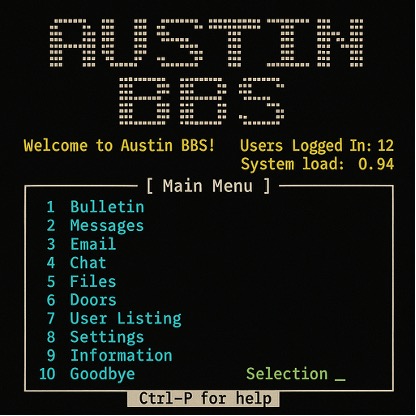
The image above depicts a simulated old-style Bulletin Board System (BBS) screen, with text displayed in blocky, fixed-width characters on a black background. At the top, “AUSTIN BBS” appears in large ASCII-art letters. Below, yellow text says “Welcome to Austin BBS!” and lists “Users Logged In: 12” and “System load: 0.94.” Menu options are numbered and include “bulletin,” “chat,” and “files.”
In Netcom, a disgruntled former Scientology minister posted allegedly infringing copies of Scientological works on an electronic BBS. The messages were stored on the bulletin board operator’s computer, then automatically copied onto Netcom’s computer, and from there, copied onto other computers comprising “a worldwide community of electronic bulletin board systems.” The plaintiff, Religious Technology Center (“RTC”) controlled the copyrights, trademarks, and other IP rights of the Church of Scientology. RTC brought an infringement action against operator of computer bulletin board service (BBS) and Netcom, an Internet access provider.
In Netcom, the district court held that the defendant Internet service provider was not liable for the automatic reproduction of a copyrighted work by its computer system. The court refused to impose direct liability on the service provider, reasoning (at 1370) that:
Although copyright is a strict liability statute, there should still be some element of volition or causation which is lacking where a defendant’s system is merely used to create a copy by a third party.
Rather than holding Netcom, the Internet service provider, liable as a direct infringer, the district court put it in the same position as the owner of a copying machine used by a customer. Thus, its liability turned on the existence of an underlying infringement plus the elements of contributory liability or vicarious liability. The Netcom court thought that it was significant that the service provider did not take any affirmative action that directly resulted in copying plaintiffs’ works other than by installing and maintaining a system whereby software automatically forwards messages received from subscribers onto the Usenet, and temporarily stores copies on its system. The court explained (at 1369):
Netcom’s act of designing or implementing a system that automatically and uniformly creates temporary copies of all data sent through it is not unlike that of the owner of a copying machine who lets the public make copies with it. Although some of the people using the machine may directly infringe copyrights, courts analyze the machine owner’s liability under the rubric of contributory infringement, not direct infringement.
Why did the court draw this distinction? Confronted with electronic communication systems whose content was determined by the end users the court recognized that holding service providers directly liable would create a multiplicity of infringements and lead to an unreasonable expansion of copyright liability. From the court’s point of view, propagating direct liability in this technological context would create an unworkable situation: it would not just make Netcom the ISP liable regardless of knowledge of infringement, it would make every server in the BBS network liable as well. At 1369, the court explained:
Plaintiffs’ theory would create many separate acts of infringement and, carried to its natural extreme, would lead to unreasonable liability.
It would also result in liability for every single Usenet server in the worldwide link of computers transmitting Erlich’s message to every other computer. These parties, who are liable under plaintiffs’ theory, do no more than operate or implement a system that is essential if Usenet messages are to be widely distributed. There is no need to construe the Act to make all of these parties infringers. Although copyright is a strict liability statute, there should still be some element of volition or causation which is lacking where a defendant’s system is merely used to create a copy by a third party. (emphasis added)
The court reiterated the unworkability of imposing direct “liability of countless parties whose role in the infringement is nothing more than setting up and operating a system that is necessary for the functioning of the Internet.” At 1372-73 the court said:
Where the infringing subscriber is clearly directly liable for the same act, it does not make sense to adopt a rule that would lead to the liability of countless parties whose role in the infringement is nothing more than setting up and operating a system that is necessary for the functioning of the Internet.
The court does not find workable a theory of infringement that would hold the entire Internet liable for activities that cannot reasonable be deterred. Billions of bits of data flow through the Internet and are necessarily stored on servers throughout the network and it is thus practically impossible to screen out infringing bits from noninfringing bits. Because the court cannot see any meaningful distinction (without regard to knowledge) between what Netcom did and what every other Usenet server does, the court finds that Netcom cannot be held liable for direct infringement.
Netcom is significant in at least two ways. It was the first copyright case in the U.S. to clearly explain that copyright infringement involves “some element of volition or causation” and that this volitional conduct “is lacking where a defendant’s system is merely used to create a copy by a third party.” Additionally, the decision in Netcom significantly influenced the eventual design of the Internet safe harbors of the Digital Millennium Copyright Act of 1998, see Section 512 of the Copyright Act.1
CoStar
CoStar Group, Inc., and a related company owned the rights in a number of photographs of commercial real estate. These photos had been posted on LoopNet’s website by LoopNet’s subscribers — generally real estate brokers — without CoStar’s consent. LoopNet did not post real estate listings on its own account. Rather it provided a “web hosting service that enables users who wish to display real estate over the Internet to post listings for those properties on LoopNet’s web site.” CoStar sued LoopNet for copyright infringement.2
Adopting the reasoning in Netcom, the Fourth Circuit held in CoStar Group, Inc. v. LoopNet, Inc., 373 F.3d 544 (4th Cir. 2004), that because LoopNet was simply the owner and manager of a system used by others who are violating CoStar’s copyrights and not an actual duplicator itself, it is not directly liable for copyright infringement. As the Fourth Circuit explained (at 550):
But to establish direct liability under §§ 501 and 106 of the Act, something more must be shown than mere ownership of a machine used by others to make illegal copies. There must be actual infringing conduct with a nexus sufficiently close and causal to the illegal copying that one could conclude that the machine owner himself trespassed on the exclusive domain of the copyright owner. The Netcom court described this nexus as requiring some aspect of volition or causation. (emphasis added)
The Fourth Circuit focused on the text of the Copyright Act and noted that to violate the reproduction right under § 106(1) one must, without the copyright owner’s consent “reproduce the work in copies” and the term “copies” in this context is defined in Section 101 as “material objects ... in which a work is fixed.” Moreover, Section 101 also instructs that a work is “fixed,” in the relevant sense, when it is embodied in a material form “sufficiently permanent or stable to permit it to be perceived, reproduced, or otherwise communicated for a period of more than transitory duration.” The Fourth Circuit concluded (at 550-551) that as a mere conduit of data, it was wrong to say that the defendant copied the work:
When an electronic infrastructure is designed and managed as a conduit of information and data that connects users over the Internet, the owner and manager of the conduit hardly “copies” the information and data in the sense that it fixes a copy in its system of more than transitory duration.
In other words, the service provider may set up the system, but it is the user who undertakes the action of copying the work.
The court of appeals reprised the policy argument from Netcom in the following terms:
… we conclude that Netcom made a particularly rational interpretation of § 106 when it concluded that a person had to engage in volitional conduct — specifically, the act constituting infringement — to become a direct infringer. As the court in Netcom concluded, such a construction of the Act is especially important when it is applied to cyberspace. There are thousands of owners, contractors, servers, and users involved in the Internet whose role involves the storage and transmission of data in the establishment and maintenance of an Internet facility. Yet their conduct is not truly “copying” as understood by the Act; rather, they are conduits from or to would-be copiers and have no interest in the copy itself.
In a later passage the Fourth Circuit summarized its holding (at 555):
At bottom, we hold that ISPs, when passively storing material at the direction of users in order to make that material available to other users upon their request, do not “copy” the material in direct violation of § 106 of the Copyright Act.
Agreeing with the analysis in Netcom, we hold that the automatic copying, storage, and transmission of copyrighted materials, when instigated by others, does not render an ISP strictly liable for copyright infringement under §§ 501 and 106 of the Copyright Act.
An ISP, however, can become liable indirectly upon a showing of additional involvement sufficient to establish a contributory or vicarious violation of the Act. In that case, the ISP could still look to the DMCA for a safe harbor if it fulfilled the conditions therein.
In their 2020 Iowa Law Review article, Convergence and Conflation in Online Copyright, Professors Christopher Cotropia and James Gibson argue that CoStar Group v. LoopNet illustrates how in some respects at least, the DMCA safe harbor rules and the substantive liability doctrines in copyright have merged.
… the CoStar case presented the typical System Storage scenario, with service provider LoopNet operating a server onto which its users copied CoStar’s copyrighted photographs without a license. The twist here was that LoopNet had not met the threshold conditions for the DMCA safe harbor (having failed to implement a repeat-infringer policy), which made this a case purely about the ultimate liability standards.
Because the DMCA was unavailable to LoopNet, CoStar argued that Netcom should also be unavailable. In other words, it asserted that the statute “supplanted and preempted Netcom,” making the safe harbors the sole determinant of liability and thus finding infringement whenever they did not apply. The Fourth Circuit rejected this claim, embraced Netcom as the governing standard, and “held that the automatic copying, storage, and transmission of copyrighted materials, when instigated by others, does not render [a service provider] strictly liable for copyright infringement.” The substance of the safe harbors and the direct infringement liability standard were therefore viewed as identical, even when the DMCA defenses were technically unavailable. … This is textbook convergence.3
* * *
The volitional act requirement has also been endorsed by the Third Circuit in Parker v. Google, Inc., 242 F.App’x 833, 837 (3d Cir. 2007) (per curiam) (“To state a direct copyright infringement claim, a plaintiff must allege volitional conduct on the part of the defendant.”).
Cablevision
As noted previously in this book, the Second Circuit’s Cablevision ruling rests on three essential pillars. First, that temporary buffer storage does not meet the definition of creating a ‘copy’ as that term is defined in the Act because to qualify as a copy a work must be fixed for more than a transitory duration. Second, Cablevision was not a direct infringer of the reproduction right because it was not the ‘maker’, in the sense of the ‘volitional copy’ doctrine, of the fixed copies. Third, Cablevision did not publicly perform the works within the meaning of the ‘transmit clause’ of the public performance right. We will now focus on the second holding: that Cablevision was not a direct infringer of the reproduction right because it was not the ‘maker’, in the sense of the ‘volitional copy’ doctrine, of the fixed copies.
Cartoon Network LP v. CSC Holdings, Inc., 536 F.3d 121 (2d Cir. 2008)
Opinion by Circuit Judge John M. Walker, Jr.
… Direct Liability for Creating the Playback Copies
In most copyright disputes, the allegedly infringing act and the identity of the infringer are never in doubt. These cases turn on whether the conduct in question does, in fact, infringe the plaintiff’s copyright. In this case, however, the core of the dispute is over the authorship of the infringing conduct. After an RS-DVR subscriber selects a program to record, and that program airs, a copy of the program — a copyrighted work — resides on the hard disks of Cablevision’s Arroyo Server, its creation unauthorized by the copyright holder. The question is who made this copy. If it is Cablevision, plaintiffs’ theory of direct infringement succeeds; if it is the customer, plaintiffs’ theory fails because Cablevision would then face, at most, secondary liability, a theory of liability expressly disavowed by plaintiffs.
Few cases examine the line between direct and contributory liability. Both parties cite a line of cases beginning with Religious Technology Center v. Netcom On-Line Communication Services, 907 F. Supp. 1361 (N.D. Cal.1995). In Netcom, a third-party customer of the defendant Internet service provider (“ISP”) posted a copyrighted work that was automatically reproduced by the defendant’s computer. The district court refused to impose direct liability on the ISP, reasoning that “although copyright is a strict liability statute, there should still be some element of volition or causation which is lacking where a defendant’s system is merely used to create a copy by a third party.” Recently, the Fourth Circuit endorsed the Netcom decision, noting that
to establish direct liability under ... the Act, something more must be shown than mere ownership of a machine used by others to make illegal copies. There must be actual infringing conduct with a nexus sufficiently close and causal to the illegal copying that one could conclude that the machine owner himself trespassed on the exclusive domain of the copyright owner.”
CoStar Group, Inc. v. LoopNet, Inc., 373 F.3d 544, 550 (4th Cir.2004).
Here, the district court pigeon-holed the conclusions reached in Netcom and its progeny as “premised on the unique attributes of the Internet.” While the Netcom court was plainly concerned with a theory of direct liability that would effectively “hold the entire Internet liable” for the conduct of a single user, its reasoning and conclusions, consistent with precedents of this court and the Supreme Court, and with the text of the Copyright Act, transcend the Internet. Like the Fourth Circuit, we reject the contention that “the Netcom decision was driven by expedience and that its holding is inconsistent with the established law of copyright,” and we find it “a particularly rational interpretation of § 106,” rather than a special-purpose rule applicable only to ISPs.
When there is a dispute as to the author of an allegedly infringing instance of reproduction, Netcom and its progeny direct our attention to the volitional conduct that causes the copy to be made. There are only two instances of volitional conduct in this case: Cablevision’s conduct in designing, housing, and maintaining a system that exists only to produce a copy, and a customer’s conduct in ordering that system to produce a copy of a specific program. In the case of a VCR, it seems clear — and we know of no case holding otherwise — that the operator of the VCR, the person who actually presses the button to make the recording, supplies the necessary element of volition, not the person who manufactures, maintains, or, if distinct from the operator, owns the machine. We do not believe that an RS-DVR customer is sufficiently distinguishable from a VCR user to impose liability as a direct infringer on a different party for copies that are made automatically upon that customer’s command.
The district court emphasized the fact that copying is “instrumental” rather than “incidental” to the function of the RS-DVR system. While that may distinguish the RS-DVR from the ISPs in Netcom and CoStar, it does not distinguish the RS-DVR from a VCR, a photocopier, or even a typical copy shop. And the parties do not seem to contest that a company that merely makes photocopiers available to the public on its premises, without more, is not subject to liability for direct infringement for reproductions made by customers using those copiers. They only dispute whether Cablevision is similarly situated to such a proprietor.
The district court found Cablevision analogous to a copy shop that makes course packs for college professors. In the leading case involving such a shop, for example, “the professor gave the copyshop the materials of which the coursepack was to be made up, and the copyshop did the rest.” Princeton Univ. Press v. Mich. Document Servs., 99 F.3d 1381, 1384 (6th Cir.1996) (en banc). There did not appear to be any serious dispute in that case that the shop itself was directly liable for reproducing copyrighted works. The district court here found that Cablevision, like this copy shop, would be “doing” the copying, albeit “at the customer’s behest.”
But because volitional conduct is an important element of direct liability, the district court’s analogy is flawed. In determining who actually “makes” a copy, a significant difference exists between making a request to a human employee, who then volitionally operates the copying system to make the copy, and issuing a command directly to a system, which automatically obeys commands and engages in no volitional conduct. In cases like Princeton University Press, the defendants operated a copying device and sold the product they made using that device. See 99 F.3d at 1383 (“The corporate defendant is a commercial copyshop that reproduced substantial segments of copyrighted works of scholarship, bound the copies into coursepacks, and sold the coursepacks to students.”). Here, by selling access to a system that automatically produces copies on command, Cablevision more closely resembles a store proprietor who charges customers to use a photocopier on his premises, and it seems incorrect to say, without more, that such a proprietor “makes” any copies when his machines are actually operated by his customers. Some courts have held to the contrary, but they do not explicitly explain why, and we find them unpersuasive. See, e.g., Elektra Records Co. v. Gem Elec. Distribs., Inc., 360 F.Supp. 821, 823 (E.D.N.Y.1973) (concluding that, “regardless” of whether customers or defendants’ employees operated the tape-copying machines at defendants’ stores, defendant had actively infringed copyrights).
The district court also emphasized Cablevision’s “unfettered discretion in selecting the programming that it would make available for recording.” This conduct is indeed more proximate to the creation of illegal copying than, say, operating an ISP or opening a copy shop, where all copied content was supplied by the customers themselves or other third parties. Nonetheless, we do not think it sufficiently proximate to the copying to displace the customer as the person who “makes” the copies when determining liability under the Copyright Act. Cablevision, we note, also has subscribers who use home VCRs or DVRs (like TiVo), and has significant control over the content recorded by these customers. But this control is limited to the channels of programming available to a customer and not to the programs themselves. Cablevision has no control over what programs are made available on individual channels or when those programs will air, if at all. In this respect, Cablevision possesses far less control over recordable content than it does in the [video on demand] context, where it actively selects and makes available beforehand the individual programs available for viewing. For these reasons, we are not inclined to say that Cablevision, rather than the user, “does” the copying produced by the RS-DVR system. As a result, we find that the district court erred in concluding that Cablevision, rather than its RS-DVR customers, makes the copies carried out by the RS-DVR system.
Our refusal to find Cablevision directly liable on these facts is buttressed by the existence and contours of the Supreme Court’s doctrine of contributory liability in the copyright context. After all, the purpose of any causation-based liability doctrine is to identify the actor (or actors) whose “conduct has been so significant and important a cause that [he or she] should be legally responsible.” W. Page Keeton et al., Prosser and Keeton on Torts § 42, at 273 (5th ed.1984). But here, to the extent that we may construe the boundaries of direct liability more narrowly, the doctrine of contributory liability stands ready to provide adequate protection to copyrighted works.
Most of the facts found dispositive by the district court — e.g., Cablevision’s “continuing relationship” with its RS-DVR customers, its control over recordable content, and the “instrumentality” of copying to the RS-DVR system, — seem to us more relevant to the question of contributory liability. In Sony Corp. of America v. Universal City Studios, Inc., the lack of an “ongoing relationship” between Sony and its VCR customers supported the Court’s conclusion that it should not impose contributory liability on Sony for any infringing copying done by Sony VCR owners. 464 U.S. 417, 437-38 (1984). The Sony Court did deem it “just” to impose liability on a party in a “position to control” the infringing uses of another, but as a contributory, not direct, infringer. Id. at 437. And asking whether copying copyrighted material is only “incidental” to a given technology is akin to asking whether that technology has “commercially significant noninfringing uses,” another inquiry the Sony Court found relevant to whether imposing contributory liability was just. Id. at 442.
The Supreme Court’s desire to maintain a meaningful distinction between direct and contributory copyright infringement is consistent with congressional intent. If Congress had meant to assign direct liability to both the person who actually commits a copyright-infringing act and any person who actively induces that infringement, the Patent Act tells us that it knew how to draft a statute that would have this effect. Because Congress did not do so, the Sony Court concluded that “the Copyright Act does not expressly render anyone liable for infringement committed by another.” 464 U.S. at 434. Furthermore, in cases like Sony, the Supreme Court has strongly signaled its intent to use the doctrine of contributory infringement, not direct infringement, to “identify[] the circumstances in which it is just to hold one individual accountable for the actions of another.” Id. at 435. Thus, although Sony warns us that “the lines between direct infringement, contributory infringement, and vicarious liability are not clearly drawn,” id. at 435 n. 17, that decision does not absolve us of our duty to discern where that line falls in cases, like this one, that require us to decide the question.
The district court apparently concluded that Cablevision’s operation of the RS-DVR system would contribute in such a major way to the copying done by another that it made sense to say that Cablevision was a direct infringer, and thus, in effect, was “doing” the relevant copying. There are certainly other cases, not binding on us, that follow this approach. See, e.g., Playboy Enters. v. Russ Hardenburgh, Inc., 982 F.Supp. 503, 513 (N.D.Ohio 1997) (noting that defendant ISP’s encouragement of its users to copy protected files was “crucial” to finding that it was a direct infringer). We need not decide today whether one’s contribution to the creation of an infringing copy may be so great that it warrants holding that party directly liable for the infringement, even though another party has actually made the copy. We conclude only that on the facts of this case, copies produced by the RS-DVR system are “made” by the RS-DVR customer, and Cablevision’s contribution to this reproduction by providing the system does not warrant the imposition of direct liability. Therefore, Cablevision is entitled to summary judgment on this point, and the district court erred in awarding summary judgment to plaintiffs.
…
[With respect to the public performance right] Cablevision contends that (1) the RS-DVR customer, rather than Cablevision, does the transmitting and thus the performing and (2) the transmission is not “to the public” under the transmit clause.
As to Cablevision’s first argument, we note that our conclusion [above] that the customer, not Cablevision, “does” the copying does not dictate a parallel conclusion that the customer, and not Cablevision, “performs” the copyrighted work. The definitions that delineate the contours of the reproduction and public performance rights vary in significant ways. For example, the statute defines the verb “perform” and the noun “copies,” but not the verbs “reproduce” or “copy.” We need not address Cablevision’s first argument further because, even if we assume that Cablevision makes the transmission when an RS-DVR playback occurs, we find that the RS-DVR playback, as described here, does not involve the transmission of a performance “to the public.”
Notes and questions
(1) Why does the court think that Cablevision’s customers made the copies using the RS-DVR system? What are the key facts pointing toward this conclusion?
(2) Can you see why the Second Circuit suggests that the volitional act requirement might work differently in the context of the performance right than in reproduction right cases?
(3) Cablevision reasoned that a narrow rule of direct liability was safe because contributory liability stood behind it: the court’s “refusal to find Cablevision directly liable on these facts is buttressed by the existence and contours of the Supreme Court’s doctrine of contributory liability.” That assumption is worth revisiting after Cox Communications, Inc. v. Sony Music Entertainment, 146 S. Ct. 959 (2026), discussed at length in the chapter on secondary liability, where the Court held that “a company is not liable as a copyright infringer for merely providing a service to the general public with knowledge that it will be used by some to infringe copyrights.” If the backstop is narrower than Cablevision supposed, does that change how hard the volitional conduct line should work? Or does it simply mean that some conduct now falls outside both doctrines?
How did the Supreme Court decision in Aereo affect the Cablevision ruling?
This is a difficult question to answer because Justice Breyer’s majority opinion in Aereo can be read in different ways. In Aereo, the majority of the Supreme Court held that the defendant Internet retransmission service did publicly perform works initially broadcast by various television networks within the meaning of the ‘transmit clause’ of the public performance right. At its narrowest, Aereo holds that, regardless of the source of the transmission or whether the user initiated the transmission, a service provider that is indistinguishable from a cable retransmission service from the point of view of the end-user publicly performs whenever it makes a transmission to the end-user. More broadly, one could read Aereo as holding that any transmission of the same work to multiple people is potentially a public performance, regardless of whether it is sourced from the same copy, depending on the “relationship” those people have to the work, particularly, whether they receive the work “in their capacities as owners or possessors” thereof.
Aereo’s system combined the features of an RS-DVR and Internet retransmission service. Aereo’s customers predominantly used it to watch broadcast television in close-to-real-time as a substitute for using their own antenna or subscribing to a traditional cable system. The Aereo service was clearly designed to take as much advantage of the Second Circuit’s Cablevision holding as possible. Rather than using a single receiver and recording only one copy of each work that might be required, Aereo supposedly dedicated an individual dime-sized antenna and an individual hard drive allocation to each user. Broadcast television was only received, recorded, and transmitted to the end-user if that end-user so specified.
In the Aereo case, the defendant argued that given the individualized and automated nature of its system, the individual users and not the service provider ‘made’ the transmissions at issue. It also argued that these same design choices made any transmissions to end-users private, rather than public. These arguments resonated with Justice Scalia, but found no traction with the majority. Indeed, it is striking that the majority decision barely addresses the volitional conduct question at all. The majority simply holds that, in view of the legislative history and the manifest intention of Congress to make cable retransmission services liable for copyright infringement, “an entity that acts like a CATV system itself performs, even if when doing so, it simply enhances viewers’ ability to receive broadcast television signals.” Aereo at 2506 (emphasis added).
In his detailed exposition of the volitional act requirement, Justice Scalia argued that cable systems perform because they send a constant transmission stream to their subscribers. The Aereo system, in contrast, remained inert until a subscriber sent the ‘watch’ command. Only then, and quite automatically, would the Aereo system activate an antenna and begin to transmit the requested program. In Scalia’s view, even though both sender and receiver of a conventional broadcast could be said to ‘perform’ because both engage in an affirmative volitional act, only the user of an automated system performs when she alone initiates and receives a transmission.
Writing for the majority, Justice Breyer dismissed this argument, noting that the “sole technological difference between Aereo and traditional cable companies” was invisible and meaningless to Aereo’s subscribers and to Aereo itself. Breyer’s commitment to purposivism brushed aside Scalia’s commitment to formalism, (at 2507):
But this difference means nothing to the subscriber. It means nothing to the broadcaster. We do not see how this single difference, invisible to subscriber and broadcaster alike, could transform a system that is for all practical purposes a traditional cable system into ‘a copy shop that provides its patrons with a library card.’
The majority in Aereo did not reject the volitional act requirement across the board, not even necessarily in the context of the performance right. The contours of the cable system analogy are far from clear; all that can be said without fear of contradiction is that transmissions that “look like a cable system” to the Supreme Court are deemed volitional.
Is there a textual basis in the Copyright Act for the volitional act requirement?
In Aereo, Justice Scalia observed:
The Networks’ claim is governed by a simple but profoundly important rule: A defendant may be held directly liable only if it has engaged in volitional conduct that violates the Act. This requirement is firmly grounded in the Act’s text, which defines “perform” in active, affirmative terms: One “perform[s]” a copyrighted “audiovisual work,” such as a movie or news broadcast, by “show[ing] its images in any sequence” or “mak[ing] the sounds accompanying it audible.” § 101. And since the Act makes it unlawful to copy or perform copyrighted works, not to copy or perform in general, see § 501(a), the volitional-act requirement demands conduct directed to the plaintiff’s copyrighted material.
Are you convinced?
Fox Broadcasting Co., Inc. v. Dish Network L.L.C., 747 F.3d 1060 (9th Cir. 2014)
Opinion by Circuit Judge Thomas:
[Fox sued Dish Network for copyright infringement and breach of contract after the satellite broadcaster began offering a DVR said to automatically record the primetime programming of the major commercial networks combined with the feature called AutoHop that allowed users to automatically skip the commercials in those primetime blocks. Notably, AutoHop did not create a new copy of the primetime broadcasts with the ads edited out; the ads were simply passed over during playback.]
The district court did not abuse its discretion in holding that Fox was unlikely to succeed on its claim of direct copyright infringement regarding PrimeTime Anytime. To establish a claim of copyright infringement by reproduction, the plaintiff must show ownership of the copyright and copying by the defendant. In this case, the district court determined that Fox had demonstrated ownership of the copyrights of some of the shows. The court then focused on who made the copies of Fox programs using PrimeTime Anytime: Dish or its customers. The district court noted that the Second Circuit had considered a similar question in Cartoon Network LP v. CSC Holdings, Inc. (“Cablevision”), 536 F.3d 121 (2d Cir.2008). The Second Circuit concluded that Cablevision’s remote-storage DVR system did not directly infringe the plaintiffs’ copyrights. Unlike a typical DVR system, in which a customer’s remote sends signals to the set-top box in her home, users of Cablevision’s remote-storage DVR system sent signals to Cablevision’s central facility, where a copy of the program the viewer selected was created and stored on Cablevision’s central servers. The question was “who made this copy” — the viewer or Cablevision? Id. at 130. The Second Circuit held that much like a VCR user makes the copy, so did the Cablevision customer.
In this case, the district court found that “Dish exercises a degree of discretion over the copying process beyond that which was present in Cablevision.” It pointed to the facts that Dish decides how long copies are available for viewing, Dish maintains the authority to modify the start and end times of the primetime block, and a user cannot stop a copy from being made once the recording has started. Yet the court held that “at this stage of the proceedings,” it was “not satisfied” that PrimeTime Anytime had “crossed over the line that leads to direct liability.” The court held that the “user, not Dish, must take the initial step of enabling” PrimeTime Anytime. “The user, then, and not Dish, is the most significant and important cause of the copy.”
The district court did not abuse its discretion in concluding that Fox had not established a likelihood of success on this claim. Infringement of the reproduction right requires copying by the defendant, which comprises a requirement that the defendant cause the copying. See Cablevision, 536 F.3d at 130 (explaining that direct infringement claim turned on “who made” the copies). Fox argues that because Dish participates in the operation of PrimeTime Anytime on a daily basis, Dish made the copies, either alone or concurrently with its users. However, operating a system used to make copies at the user’s command does not mean that the system operator, rather than the user, caused copies to be made. Here, Dish’s program creates the copy only in response to the user’s command. Therefore, the district court did not err in concluding that the user, not Dish, makes the copy.
That Dish decides how long copies are available for viewing, modifies the start and end times of the primetime block, and prevents a user from stopping a recording might be relevant to a secondary or perhaps even a direct infringement claim. Cf. Cablevision, 536 F.3d at 132-33 (finding that factors evidencing Cablevision’s control over copying process seemed “more relevant to the question of contributory liability” but reserving the question “whether one’s contribution to the creation of an infringing copy may be so great that it warrants holding that party directly liable for the infringement, even though another party has actually made the copy”). But these facts do not establish that Dish made the copies. Therefore, the district court did not err in holding that Fox did not establish a likelihood of success on its direct infringement claim.
Notes and questions
(1) In Fox v. Dish Network, the Ninth Circuit followed earlier decisions such as Netcom, CoStar, and Cablevision and held: “Infringement of the reproduction right requires copying by the defendant, which comprises a requirement that the defendant cause the copying.” It elaborated that “operating a system used to make copies at the user’s command does not mean that the system operator, rather than the user, caused copies to be made.” Is Fox Broadcasting a significant extension of Cablevision? At what point should the “degree of discretion over the copying process” make a service provider directly liable for copyright infringement? In Fox Broadcasting, the service provider decided how long copies are available for viewing, it modified the start and end times of the primetime block according to the networks’ own schedules, and it did not allow users to stop a recording of the primetime blocks once it had begun. How significant were these features?
(2) Some overseas jurisdictions treat a service provider like Dish as jointly making copies along with its customers. Does that make sense? Fox argued that because the defendant participated in the operation of its PrimeTime Anytime feature on a daily basis, the defendant service provider made the copies, either alone or concurrently with its users. In Fox’s view, the conclusion that the users made the copies does not negate a finding that the service provider did too — the copies could be considered jointly made by both service provider and end-user. What did the court of appeals make of that argument?
(3) Note that not everything turns on who made the copy. The court of appeals notes several factors indicating Dish’s degree of involvement with the copying notes that these “might be relevant to a secondary or perhaps even a direct infringement claim” (emphasis added). The court cites the passage in Cablevision where the Second Circuit reserved the question “whether one’s contribution to the creation of an infringing copy may be so great that it warrants holding that party directly liable for the infringement, even though another party has actually made the copy …” See Cablevision 536 F.3d at 132-33. What degree of involvement might justify holding a service provider liable as a direct infringer even if the service provider did not perform the infringing act?
(4) In addition to holding that the district court had not abused its discretion in holding that Fox was unlikely to succeed on its claim of direct copyright infringement regarding Dish Network’s new DVR features, the court of appeals also found that Fox was unlikely to succeed on its claim of secondary copyright infringement for the PrimeTime Anytime and AutoHop programs because the copying by the consumers was fair use.
(5) More recent cases on the volitional act requirement include Perfect 10, Inc. v. Giganews, Inc., 847 F.3d 657 (9th Cir. 2017), BWP Media USA, Inc. v. T & S Software Assocs., Inc., 852 F.3d 436 (5th Cir. 2017), VHT, Inc. v. Zillow Group, Inc. (9th Cir. 2019) (March 15, 2019) and BWP Media USA Inc. v. Polyvore, Inc. (2d Cir. 2019); Oracle America, Inc. v. Hewlett Packard Enterprises Co., 971 F.3d 1042, 1053 (9th Cir. 2020). Some of these are discussed below.
Volition as proximate cause?
Perfect 10, Inc. v. Giganews, Inc., 847 F.3d 657 (9th Cir. 2017) is a good place to pick up the debate about whether volition means an act of deciding/choosing or something like proximate cause in tort law. The 2017 Ninth Circuit decision in Giganews is in some ways a replay of the Netcom decision that first articulated the volitional conduct requirement in 1995. The USENET group that is the subject of the Giganews case is essentially the same thing as the Internet BBS in Netcom. The extract below is confined to the volition as an act of deciding versus volition as causation issue.
Perfect 10, Inc. v. Giganews, Inc., 847 F.3d 657 (9th Cir. 2017)
Circuit Judge D.W. Nelson
… To establish a prima facie case of direct infringement, a plaintiff “must show ownership of the allegedly infringed material” and “demonstrate that the alleged infringers violated at least one exclusive right granted to copyright holders under 17 U.S.C. § 106.” A&M Records, Inc. v. Napster, Inc., 239 F.3d 1004, 1013 (9th Cir. 2001). In addition, direct infringement requires the plaintiff to show causation (also referred to as “volitional conduct”) by the defendant. See Fox Broad. Co., Inc. v. Dish Network L.L.C., 747 F.3d 1060, 1067 (9th Cir. 2013).
We wish to emphasize that the word “volition” in this context does not really mean an “act of willing or choosing” or an “act of deciding,” which is how the dictionary defines the term. Volition, Webster’s Third New International Dictionary (1986). Rather, as used by the court in Religious Technology Center v. Netcom 907 F.Supp. 1361, 1370 (N.D. Cal. 1995), it simply stands for the unremarkable proposition that proximate causation historically underlines copyright infringement liability no less than other torts. As the district court cogently explained:
The so-called “volition” element of direct infringement is not a judicially-created element of intent or knowledge; it is a basic requirement of causation. As its name suggests, direct liability must be premised on conduct that can reasonably be described as the direct cause of the infringement.
Perfect 10, Inc., 2014 WL 8628034, at *7 (emphasis in original).
Contrary to Perfect 10’s contention, this requirement of causation remains an element of a direct infringement claim. In Fox Broadcasting, we explained that “infringement of the reproduction right requires copying by the defendant, which comprises a requirement that the defendant cause the copying.” 747 F.3d at 1067. In using this language, we indicated that causation is an element of a direct infringement claim.
Notes and questions
(1) In addition to the causation discussion extracted above, Giganews is also significant for its post-Aereo reaffirmation of the volitional conduct requirement. The Ninth Circuit reviewed the case law on volitional conduct and noted that every Court of Appeals to have considered an automated service provider’s direct liability for copyright infringement had adopted the volitional-conduct requirement. The court argued that the Aereo majority did not expressly address the volitional conduct requirement and that the Court’s analysis could be reconciled with it, and thus “we conclude that the requirement was left intact …” This was recently reaffirmed in the 2023 case of Hunley v. Instagram, LLC discussed in the chapter of this book addressing the Copyright Implications of Linking and Embedding on the Internet.
(2) In BWP Media USA Inc. v. Polyvore, Inc., 922 F.3d 42 (2d Cir. 2019) the Second Circuit also confirmed that volitional act survives Aereo. However, the Second Circuit panel divided on the exact nature of the volition requirement. In addition to a short per curiam decision, each member of the panel wrote separately, concurring in the result.
Judge Newman argued that volition should be understood to mean proximate causation in the sense that term is used in torts. Judge Walker disagreed, insisting that “volition and causation are different concepts.” Whereas Judge Pooler also wrote separately but did not take a side in the volition versus proximate cause debate.
As Judge Walker notes,
Proximate causation is a negligence concept that has to do with risk and foreseeability. Volition, on the other hand, is the act of making a choice or determining something. In the context of direct copyright infringement, volition is choosing to engage in an act that causes infringement. Therefore, although a volition analysis may under certain circumstances require an explicit causation analysis, and although applying only a causation analysis to particular facts may yield the same result as a volition analysis, volition is not the same thing as causation.
Even if one accepts that volition is something like the tort law concept of proximate cause, the imprecision of that particular analytical tool means that one is still left wondering exactly what volition means. Do acts too remote from the infringing act lack volition, or does a lack of volition make an act too remote from the infringing act to qualify as direct infringement? If we concede that volition is, or is like, proximate cause and that proximate cause reflects important policy judgments about how far tort liability should extend, then what are the relevant policies that should flesh out the concept of volition?
(3) For further reading, see Professor Robert C. Denicola, Volition and Copyright Infringement, 37 Cardozo Law Review 1259 (2016).
Linking, Embedding and the “Server Test”
Origins of the server test in Perfect 10, Inc. v. Amazon.com, Inc.
In the language of computer programming, a “server” is a computer which manages access to a centralized resource or service in a network. A server can be a program running on a laptop connected to a network, or it can be an enormous data center occupying millions of square feet and consuming as much power as a small city. For many purposes, which server a piece of data resides on is not very important, but sometimes in copyright law it is vitally important.
In Perfect 10, Inc. v. Amazon.com, Inc., 508 F.3d 1146 (9th Cir. 2007), the plaintiff argued, among other things, that Google and Amazon were directly liable for copyright infringement when they linked to third party websites that hosted infringing materials. Perfect 10 argued that when a user clicks on a link to an image, the search engine that provided that image makes an unauthorized display.
In Perfect 10 the Ninth Circuit drew a sharp distinction between displaying an image from one’s own server and merely linking to the same image stored on someone else’s server. The former is both a reproduction and a display; the latter is merely an instruction to the user’s Internet browser to render a display from elsewhere. As such, under the “server test,” there is no direct liability for ordinary linking on the Internet.
As a matter of statutory interpretation, the Ninth Circuit reasoned that because “display” is defined as “to show a copy of [the work] either directly or by means of [any] device or process” and “copies” is defined in terms of “material objects,” it follows that “based on the plain language of the statute, a person displays a photographic image by using a computer to fill a computer screen with a copy of the photographic image fixed in the computer’s memory.” Is that convincing?
The server test and embedded content
In Goldman v. Breitbart News Network, LLC, 302 F.Supp.3d 585 (S.D.N.Y. 2018), the district court held third parties who embedded a Tweet displaying a copyrighted photograph potentially violated the exclusive right to display the work, directly and not merely through contributory or vicarious liability. The court held that the Ninth Circuit’s “server test” was inapplicable, finding no basis in the “plain language of the Copyright Act, the legislative history undergirding its enactment, and subsequent Supreme Court jurisprudence … for a rule that allows the physical location or possession of an image to determine who may or may not have ‘displayed’ a work within the meaning of the Copyright Act.” The court in Goldman held that the “server test” was inapplicable in cases where the user takes no action to “display” the image. Although Goldman and a handful of other cases have questioned, if not refuted, the server test, the Ninth Circuit seems reluctant to let it go.
Hunley v. Instagram, LLC, 73 F.4th 1060 (9th Cir. 2023)
Opinion by Judge Bybee
This copyright dispute tests the limits of our holding in Perfect 10 v. Amazon, 508 F.3d 1146 (9th Cir. 2007) in light of the Supreme Court’s subsequent decision in American Broadcasting Companies, Inc. v. Aereo, 573 U.S. 431 (2014). Plaintiffs-appellees Alexis Hunley and Matthew Scott Brauer (collectively “Hunley”) are photographers who sued defendant Instagram for copyright infringement. Hunley alleges that Instagram violates their exclusive display right by permitting third-party sites to embed the photographers’ Instagram content. See 17 U.S.C. § 106(5). The district court held that Instagram could not be liable for secondary infringement because embedding a photo does not “display a copy” of the underlying images under Perfect 10.
We agree with the district court that Perfect 10 forecloses relief in this case. Accordingly, we affirm.
A. Facts
1. The Background
Instagram is a social media platform where users share photo and video content to their followers. Users with public profiles grant Instagram a royalty-free sublicense to display their photos. Instagram’s infrastructure also allows third-party websites to “embed” public Instagram posts.
Embedding—we have sometimes referred to embedding as “in-line linking” or “framing”—is a method that allows a third-party website (the embedding website) to incorporate content directly from the website where it originally appeared (the host website). Websites are created using instructions written in Hypertext Markup Language (“HTML”). Perfect 10, 508 F.3d at 1155. HTML is a text-only code, meaning that the underlying HTML instructions cannot contain images. Instead, when a website wants to include an image, “the HTML instructions on the web[site] provide an address for where the images are stored, whether in the web[site] publisher’s computer or some other computer.” Id.
Users access a website through a web browser application. When a web creator wants to include an image on a website, the web creator will write HTML instructions that direct the user’s web browser to retrieve the image from a specific location on a server and display it according to the website’s formatting requirements. When the image is located on the same server as the website, the HTML will include the file name of that image. So for example, if the National Parks Service wants to display a photo of Joshua Tree National Park located on its own server, it will write HTML instructions directing the browser to display the image file, <img src=“Joshua_Tree.jpg”>, and the browser will retrieve and display the photo, hosted by the NPS server.
By contrast, if an external website wants to include an image that is not located on its own servers, it will use HTML instructions to “embed” the image from another website’s server. To do so, the embedding website creator will use HTML instructions directing the browser to retrieve and display an image from an outside website rather than an image file. So if the embedding website wants to show the National Park Service’s Instagram post featuring Joshua Tree National Park—content that is not on the embedding website’s same server—it will direct the browser to retrieve and display content from the Instagram’s server. The HTML instructions that direct a browser to embed an external social media post look something like this:
Embedding code
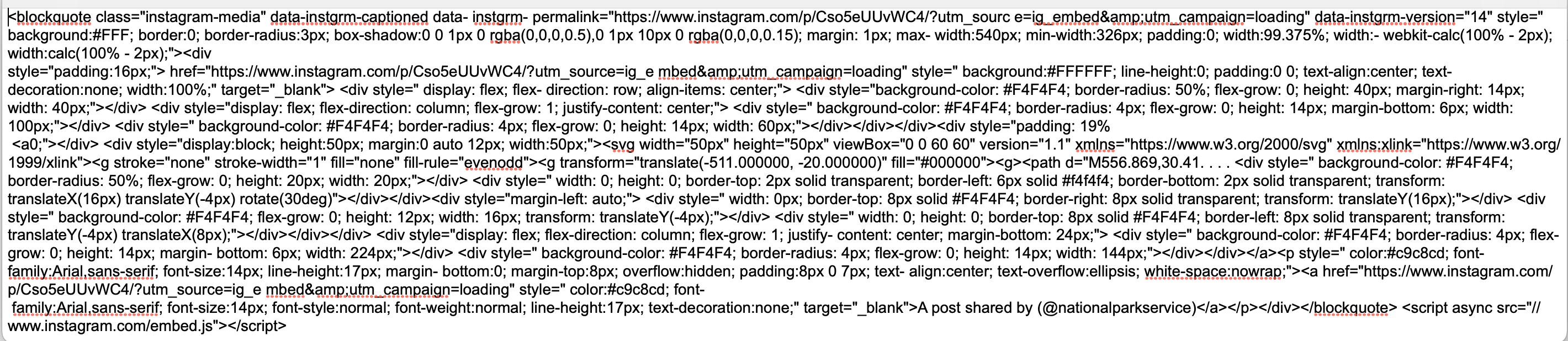
Image description: The embedding code appears as text in the judgment, it consists of a large chunk of html code
When the browser follows these HTML instructions, the browser will retrieve the image, caption, and formatting from the host website and display all these elements alongside content from the embedding website. The final product will show the external image “embedded” seamlessly into a third-party website.
As illustrated by the HTML instructions above, embedding is different from merely providing a hyperlink. Hyperlinking gives the URL address where external content is located directly to a user. To access that content, the user must click on the URL to open the linked website in its entirety. By contrast, embedding provides instructions to the browser, and the browser automatically retrieves and shows the content from the host website in the format specified by the embedding website. Embedding therefore allows users to see the content itself—not merely the address—on the embedding website without navigating away from the site. Courts have generally held that hyperlinking does not constitute direct infringement.
From the user’s perspective, embedding is entirely passive: the embedding website directs the user’s own browser to the Instagram account and the Instagram content appears as part of the embedding website’s content. The embedding website appears to the user to have included the copyrighted material in its content. In reality, the embedding website has directed the reader’s browser to retrieve the public Instagram account and juxtapose it on the embedding website. Showing the Instagram content is almost instantaneous.
Importantly, the embedding website does not store a copy of the underlying image. Rather, embedding allows multiple websites to incorporate content stored on a single server simultaneously. The host server can control whether embedding is available to other websites and what image appears at a specific address. The host server can also delete or replace the image. For example, the National Park Service could replace the picture of Joshua Tree at <Joshua_Tree.jpg> with a picture of Canyonlands National Park. So long as the HTML instructions from the third-party site instruct the browser to retrieve the image located at a specific address, the browser will retrieve whatever the host server supplies at that location.
2. This case
Hunley and Brauer are photographers who own the copyrights to several of their works. Both have public Instagram profiles where they post some of their photography.
BuzzFeed News and Time are platforms that share news content online. On June 3, 2020, during the Black Lives Matter protests, BuzzFeed News published an article titled “17 Powerful Pictures Of The Protests Through The Eyes of Black Photographers.” As part of that article, BuzzFeed embedded one of Hunley’s Instagram posts. The embedded image showed Hunley’s Instagram username (called her “handle”) followed by Hunley’s photograph, which featured the hands of a protestor juxtaposed with a line of police officers:
Hunley owns the copyright to this photograph. BuzzFeed did not seek a license from Hunley to display this photo as part of its news reporting, nor did BuzzFeed seek authorization directly from Instagram.2
Footnote 2: Websites that embed Instagram’s content are bound by Instagram’s Platform Policy, and Instagram does not grant third parties a license to users’ works. Rather, Instagram maintains that third-party sites have the responsibility to seek permission from the copyright holder as “required by law.” According to Hunley, no third party obtained permission from Instagram to embed copyrighted content.
BuzzFeed never created a copy of or stored the underlying photo. Instead, BuzzFeed used HTML, provided by a feature on Instagram’s platform, to embed the Instagram post containing the photo, which made Hunley’s Instagram post appear on BuzzFeed’s website alongside BuzzFeed’s own content.
Buzzfeed News Screenshot
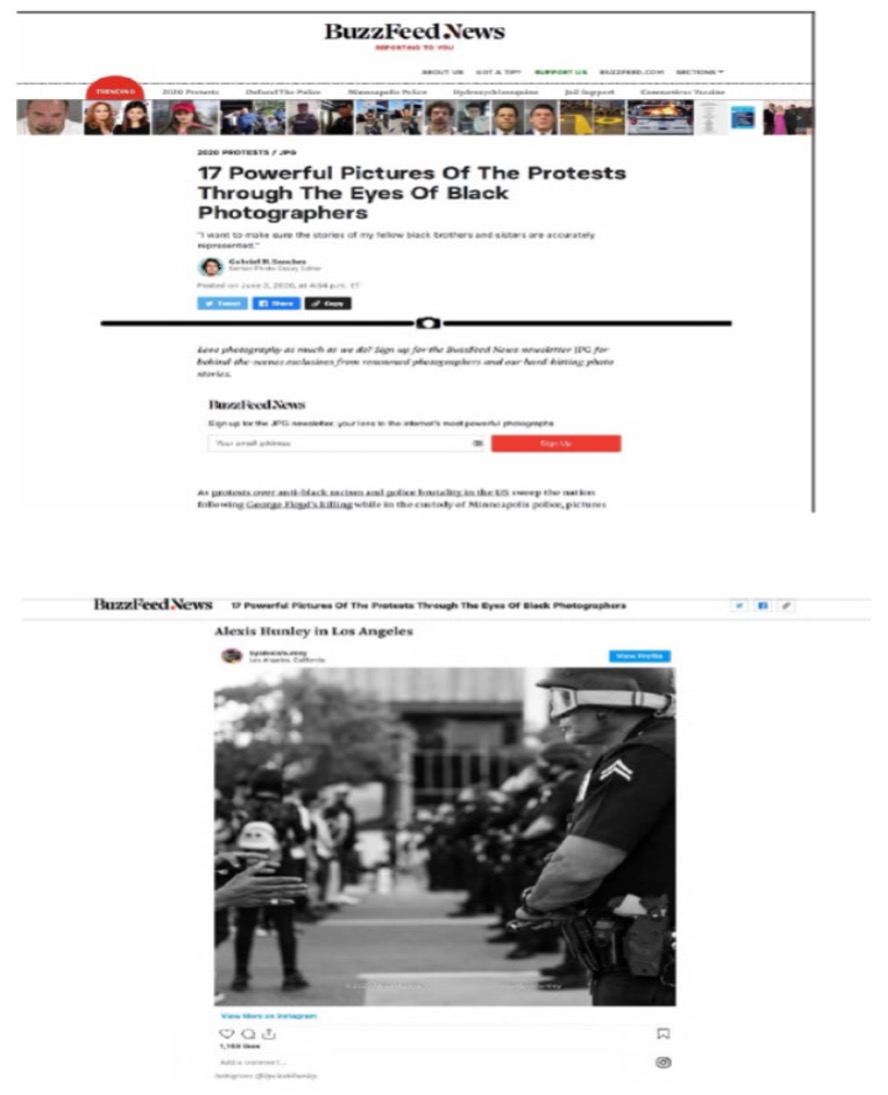
Image description: A screenshot of a BuzzFeed News article titled “17 Powerful Pictures Of The Protests Through The Eyes Of Black Photographers.” The page shows the headline, byline, and sharing options, followed by a black-and-white protest photograph. In the photo, police officers in riot gear face demonstrators on a city street, with tension evident in the scene.
Similarly, Time published an article on January 31, 2016, titled “These Photographers Are Covering the Presidential Campaign on Instagram.” As part of that article, Time embedded one of Brauer’s Instagram posts, featuring a copyrighted photo of candidate Hillary Clinton:
The post showed Brauer’s Instagram post in its entirety. Time did not seek a license from Brauer or permission from Instagram to display this photo. Because Time embedded Brauer’s Instagram post containing the photo, Time never stored or made a copy of Brauer’s photo. Instead, the embedding instructions caused Brauer’s Instagram post to appear on Time’s website alongside Time’s own content.
Brauer’s Instagram post on Time’s website
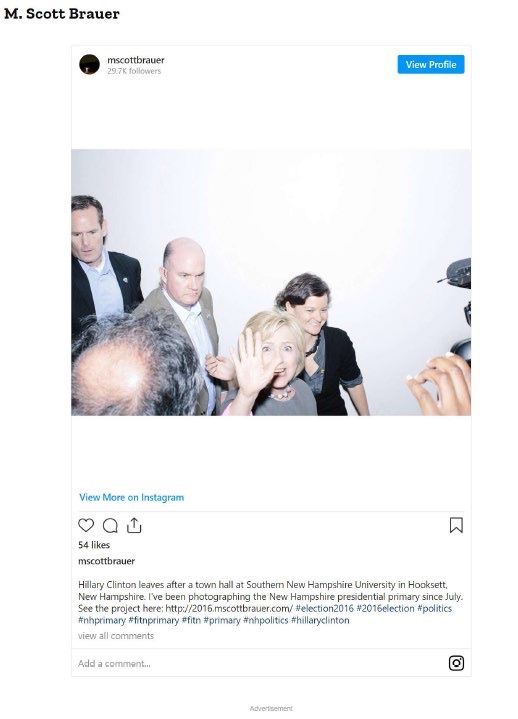
Image description: A screenshot of an Instagram post by photographer M. Scott Brauer. The photo shows Hillary Clinton leaving an event at Southern New Hampshire University, surrounded by security personnel and supporters. She appears in the center, slightly raising her hand while moving through a crowd in a brightly lit, somewhat chaotic scene.
B. Proceedings Below
Hunley and Brauer brought a class action suit against Instagram on behalf of other copyright owners whose work was “caused to be displayed via Instagram’s embedding tool on a third party website without the copyright owner’s consent.” Hunley alleged that Instagram’s embedding tool violated her exclusive display right under the Copyright Act by enabling third-party websites such as BuzzFeed and Time to display copyrighted photos posted to Instagram. See 17 U.S.C. § 106(5). Hunley brought three causes of action against Instagram: inducement of copyright infringement, contributory copyright infringement, and vicarious copyright infringement. Hunley alleged that “Instagram intentionally and brazenly encouraged, aided and induced third party embedding websites to cause to be displayed copyrighted photos and videos without making any effort to control or stop the rampant infringement” while “knowingly participating in such conduct.”3
Footnote 3: Hunley alleged that Instagram made embedding available to create a revenue stream for its photo-sharing platform, and that Instagram “reaps billions of dollars annually” from encouraging third parties to embed Instagram content.
Hunley conceded that Instagram is not a direct infringer, and these theories of secondary liability all rely on the existence of direct infringement by BuzzFeed and Time. See Perfect 10, Inc. v. Giganews, 847 F.3d 657, 671 (9th Cir. 2017) (“Giganews”). Hunley thus alleged that third-party embedding websites, BuzzFeed and Time, infringed her display right even though they did not host or store a copy of the underlying image. Hunley sought damages and injunctive relief.
Instagram filed a motion to dismiss, which the district court granted. The district court concluded that our holding in Perfect 10 precluded relief to Hunley. To violate the public display right, infringers must “display ‘copies’ of the copyrighted work.” 17 U.S.C. § 101. According to the district court, embedding websites that do not “‘store’ an image or video” do not “‘communicate a copy’ of the image or video and thus do[] not violate the copyright owner’s exclusive display right.” See Perfect 10, 508 F.3d at 1160– 61. Applying Perfect 10, the district court explained:
[BuzzFeed and Time] do not violate Instagram users’ exclusive display rights. Because they do not store the images and videos, they do not “fix” the copyrighted work in any “tangible medium of expression.” Therefore, when they embed the images and videos, they do not display “copies” of the copyrighted work.
And without direct infringement by BuzzFeed or Time, Instagram could not be held secondarily liable. The district court concluded that the “only fact that matters” for infringement purposes is storing the photos on servers, and that because Hunley could not remedy this issue, “amendment would be futile.” The district court dismissed the action with prejudice, and Hunley timely appealed.
III. ANALYSIS
We begin our analysis with the legal framework of the Copyright Act, including our interpretation of the Act in Perfect 10. We will then consider Hunley’s legal and policy arguments for limiting the scope of Perfect 10. We conclude by applying Perfect 10 to this case.
A. The Copyright Act and Perfect 10
1. The Right of Public Display
The Copyright Act grants authors the exclusive right “to display the copyrighted work publicly.” 17 U.S.C. § 106(5). To infringe this exclusive right to public display, the infringer must “show a copy of [the work], either directly or by means of a film, slide, television image, or any other device or process.” 17 U.S.C. § 101 (definition of “display”). The Copyright Act defines “copies” as “material objects . . . in which a work is fixed by any method now known or later developed, and from which the work can be perceived, reproduced, or otherwise communicated, either directly or with the aid of a machine or device.” Id. (definition of “Copies”). For copyright purposes, “copy” does not necessarily mean a duplicate of the original, but includes the original itself: “The term ‘copies’ includes the material object . . . in which the work is first fixed.” Id. (definition of “Copies”). And “[a] work is ‘fixed’ in a tangible medium of expression when its embodiment in a copy . . . is sufficiently permanent or stable to permit it to be perceived, reproduced, or otherwise communicated for a period of more than transitory duration.” Id. (definition of “fixed”).
The Copyright Act went through significant amending in 1976. Those amendments clarified that the public display right can also be infringed by a transmission. See Public Law 94-533 (Oct. 19, 1976). The amended statute states in relevant part:
To perform or display a work “publicly” means
(1) to perform or display it at a place open to the public or at any place where a substantial number of persons outside of a normal circle of a family and its social acquaintances is gathered; or
(2) to transmit or otherwise communicate a performance or display of the work to a place specified by clause (1) or to the public, by means of any device or process, whether the members of the public capable of receiving the performance or display receive it in the same place or in separate places and at the same time or at different times.
17 U.S.C. § 101 (definition of “publicly”). Part (2) of this definition is known as the Transmit Clause. To “transmit” a display means “to communicate it by any device or process whereby images or sounds are received beyond the place from which they are sent.” Id. (definition of “transmit”). By this definition, an internet communication of an image necessarily implicates the Transmit Clause. Perfect 10, 508 F.3d at 1161 n.7. A transmitted image is “fixed” for copyright purposes “if a fixation of the work is being made simultaneously with its transmission.” 17 U.S.C. § 101 (definition of “fixed”).
In sum, infringing the exclusive right of public display requires the transmission of a display. For a display to be actionable, it must display a copy. A copy means either an original or a duplicate that is fixed, and fixation requires embodiment in a perceivable format. See generally 17 U.S.C. § 101.
2. Perfect 10 Interprets 17 U.S.C. § 106(5)
In Perfect 10 v. Amazon, Inc., we decided for the first time “when a computer displays a copyrighted work for purposes of section 106(5),” the right to public display. 508 F.3d at 1160. In that case, Perfect 10, an online magazine that marketed photos of nude models, sued Amazon and Google for showing Perfect 10’s copyrighted images on their websites. Id. at 1157. Perfect 10 alleged that Google infringed its public display right by including pared-down thumbnail images in Google Image Search results and by embedding full-sized images from third-party websites, which posted copyrighted images without permission. Id. Google’s embedding feature worked in the following manner:
When a user clicks on a thumbnail image, the user’s browser program interprets HTML instructions on Google’s webpage. Following these instructions, the browser creates a “window”: the infringing image appeared “in its original context[] on the lower portion of the window on the user’s computer screen[,] framed by information from Google. Google did not host or store the image that filled the bottom part of the screen, nor did Google communicate the images to the user: the browser, following directions from Google, accessed the third-party website and relayed it to the user.
Id. at 1155–57.
We interpreted the Copyright Act’s fixation requirement and found that an image is “fixed in a tangible medium of expression” when it is “embodied (i.e., stored) in a computer’s server, (or hard disk, or other storage device).” Id. at 1160 (citing MAI Sys. Corp. v. Peak Computer, Inc., 991 F.2d 511, 517–18 (9th Cir. 1993)). Applying that interpretation, we concluded that a “computer owner shows a copy ‘by means of a . . . device or process’ when the owner uses the computer to fill the computer screen with the photographic image stored on that computer.” Id. (quoting 17 U.S.C. § 101. And “a person displays a photographic image by using a computer to fill a computer screen with a copy of the photographic image fixed in the computer’s memory.” Id. This requirement that a copy be “fixed in the computer’s memory” has come to be known as the “Server Test.”
Applying the Server Test to the facts, we concluded that Google’s in-line linking (what we now call embedding) did not display a “copy” of Perfect 10’s copyrighted images as that term is defined in the Copyright Act. Id. at 1160–61. Because Google did not store a copy of the full-size images, but merely embedded them and allowed them to be displayed alongside its search results, “Google does not have a copy of the images for purposes of the Copyright Act.” Id. Without a copy on its servers, “Google transmits or communicates only an address which directs a user’s browser to the location where a copy of the full-size image is displayed. Google does not communicate a display of the work itself.” Id. at 1161 n.7. Although “Google may have facilitated the user’s access to infringing images,” we concluded that “such assistance does not constitute direct infringement.” Id. at 1161.
B. Arguments for Limiting the Server Test
The district court held that Perfect 10 governed this case. On appeal, as before the district court, Hunley argues that Perfect 10’s Server Test does not determine the outcome in this case. First, Hunley argues that the Server Test should only apply to search engines such as Google. Second, Hunley argues that Perfect 10 is inconsistent with the Copyright Act. Third, Hunley argues that Perfect 10 conflicts with the Supreme Court’s subsequent decision in American Broadcasting Co. v. Aereo, 573 U.S. 431 (2014). Fourth and finally, Hunley argues that there are policy reasons for overruling Perfect 10. We disagree with each of these claims, and we will address each in turn.
1. Whether Perfect 10 should be limited to specific types of websites
Hunley argues that the Server Test should apply only “to search engines or other automated, algorithmic indexing platforms” and should not extend to “content embedded into commercial websites from social media platforms.” Hunley’s argument finds no support in our law.
Perfect 10 did not restrict the application of the Server Test to a specific type of website, such as search engines. To be sure, in Perfect 10, we considered the technical specifications of Google Image Search, including Google’s ability to index third-party websites in its search results. Perfect 10, 508 F.3d at 1155. We also noted Google’s reliance on an automated process for searching vast amounts of data: to create such a search engine, Google “automatically accesses thousands of websites . . . and indexes them within a database” and “Google’s computer program selects the advertising automatically by means of an algorithm.” Id. at 1155–56. But in articulating the Server Test, we did not rely on the unique context of a search engine. Our holding relied on the “plain language” of the Copyright Act and our own precedent describing when a copy is “fixed” in a tangible medium of expression. Id. (citing 17 U.S.C. § 101). We looked to MAI Sys. Corp. v. Peak Computer, Inc., for the conclusion that a digital image is “fixed” when it is stored in a server, hard disk, or other storage device. 991 F.2d 511, 517–18 (9th Cir. 1993). Applying this fixation requirement to the internet infrastructure, we concluded that in the embedding context, a website must store the image on its own server to directly infringe the public display right. Perfect 10, 508 F.3d at 1160.
We have subsequently applied the Server Test outside the search-engine context. For example, in Bell v. Wilmott Storage Servs., LLC, 12 F.4th 1065 (9th Cir. 2021), a photographer sued a storage-service website over its use of his photo of the Indianapolis skyline. Although the image was not shown directly on Wilmott Storage Services’ website, it was visible through a “reverse image search.” Id. at 1073. Because it was “undisputed” that the infringing photos were stored on Wilmott’s own server, “Wilmott transmitted, and therefore displayed, the Indianapolis photo without Bell’s permission.” We concluded that the storage and display was sufficient to hold Wilmott directly liable under the Copyright Act. Id. We have also applied the Server Test to blogs, see Perfect 10, Inc. v. Google, Inc., 653 F.3d 976, 978 (9th Cir. 2011) (noting that “Blogger account holders may upload images from the web onto Google’s server in order to post them on their blogs, or may use a hyperlink to images hosted on other servers.”), and to online bulletin boards, Evox Prods., LLC v. Verizon Media, Inc., No. 21-56046, 2022 WL 17430309, at *1–2 (9th Cir. Dec. 6, 2022) (unpublished) (holding Verizon liable for infringing the display right when it stored the image on its Yahoo Autos and Tumblr servers after its license with copyright owners had expired).
Hunley points out that other circuits have not adopted the Server Test. The statement is true, but of little use to Hunley. At least two circuits have referred to the Server Test without either endorsing or rejecting it. [Society of Holy Transfiguration Monastery, Inc. v. Gregory, 689 F.3d 29, 55 (1st Cir. 2012); Flava Works, Inc. v. Gunter, 689 F.3d 754, 761 (7th Cir. 2012).]
Although no circuit has disapproved of Perfect 10, several district courts have either rejected or limited the Server Test. See, e.g., McGucken v. Newsweek, 2022 WL 836786 (S.D.N.Y 2022) (rejecting the Server Test); Nicklen v. Sinclair Broad. Grp., Inc., F. Supp. 3d 188 (S.D.N.Y 2021) (rejecting the Server Test); Goldman v. Breitbart, 302 F. Supp. 3d 585, 586 (S.D.N.Y 2018) (holding that publishing an embedded tweet featuring Tom Brady was sufficient for direct infringement, even if Twitter did not store or host the infringing image); Leader’s Institute, LLC v. Jackson, 2017 WL 5629514 (N.D. Tex. Nov. 22, 2017) (“to the extent Perfect 10 makes actual possession of a copy a necessary condition to violating a copyright owner’s exclusive right to display her copyrighted works, the Court respectfully disagrees with the Ninth Circuit.”).
We have not limited Perfect 10 to search engines, and it is too late to argue that it is so limited. The application of the Server Test depends on the method used for displaying a photo—not the context in which the photo is displayed. And the process used by BuzzFeed and Time to show users third-party Instagram content is the same process used by Google to show users third-party images: embedding. Nothing in Perfect 10 or the cases following it limits its application to search engines.
2. Whether Perfect 10 Is inconsistent with the Copyright Act
Hunley argues that applying the Server Test to social media platforms is inconsistent with the Copyright Act’s statutory scheme. Hunley claims that the Server Test conflates the copyright holder’s exclusive right to display a work with his exclusive right to reproduce the work. Specifically, Hunley contends that after Perfect 10 an infringer must violate the copyright holder’s reproduction right before the display right can be violated. This, Hunley says, renders portions of the Copyright Act superfluous or insignificant. See 17 U.S.C. § 106(1), (3). Hunley also claims that the Server Test cannot be reconciled with other provisions of the Copyright Act that prohibit transmissions by a party, whether or not the party possesses or controls a copy of the work allegedly infringed. And Hunley argues that the Server Test is inconsistent with other provisions related to “secondary transmissions of a performance or display.” 17 U.S.C. § 111; see also id. § 118–19. According to Hunley, “The Server Test, applied to a social media platform, contains an insupportable assumption that a transmission can have only one actionable source, and that such source must only be the place where the physical copy of the work is hosted.”
We will not consider these arguments in any detail because they are foreclosed by Perfect 10. Whatever merit these arguments might have in other contexts, Perfect 10 states the rule for infringing the public display right using embedding. See, e.g., Perfect 10, 508 F.3d at 1162 (discussing copies “in the electronic context”). In Perfect 10, we did not address the precise arguments Hunley now presses, but we carefully considered display and distribution rights. See id. at 1159–63. Even if we thought, in retrospect, that Perfect 10 created some inconsistencies with other provisions of the Copyright Act, we are not free to overrule Perfect 10 outside of an en banc proceeding unless there has been a change in the statute or an intervening Supreme Court decision. For the reasons described infra, we find no such intervening authority.
We have a similar response to Hunley’s arguments concerning the Copyright Act’s legislative history. Hunley identified various passages of legislative history from 1965, 1967, and 1976 to show that Perfect 10 took an unnecessarily narrow view of the meaning of “display.” We have already given the statute a definitive reading in Perfect 10, and we will not revisit a decision in light of materials available at the time of the decision. The Act’s legislative history is not law. If we look to legislative history at all, we will only recur to it as an aid to understanding an ambiguous text. Here, however, even Hunley has argued that “the Copyright Act is not ambiguous,” because Hunley claims that Perfect 10 is unambiguously wrong and that the legislative history confirms it. If Hunley believes there is an irreconcilable disjunct between Perfect 10 and some prior authority— whether that is a prior decision of this court, a statute not considered by the prior panel, or legislative history—the proper procedure is to seek rehearing en banc.
3. Whether Perfect 10 is inconsistent with Aereo
Finally, Hunley argues that Perfect 10 has been effectively overturned because it conflicts with the Supreme Court’s decision in American Broadcasting Company v. Aereo, 573 U.S. 431 (2014). In Aereo, ABC and other public broadcasting companies, television producers, marketers, and distributors (“the broadcasters”) sued Aereo, an equipment provider that offered a subscription to stream public broadcast television simultaneously over the internet. Id. at 436. Subscribers visited Aereo’s website to select shows from local programming. Id. Aereo dedicated a specific antenna to each subscriber, and the server tuned the antenna to the selected over-the-air broadcast. Id. Aereo’s transcoder translated the signals and transmitted them to the subscriber over the internet. Id. Aereo saved the data “in a subscriber-specific folder on Aereo’s hard drive.” Id. At the time of the suit, Aereo did not own any copyrights in the broadcasts, nor did it possess “a license from the copyright owners to perform those works publicly.” Id. The subscriber received the streamed transmission “a mere few seconds behind the over-the-air broadcast.” Id. at 437. The broadcasters brought suit against Aereo, alleging that Aereo infringed the broadcaster’s exclusive right “to perform the copyrighted work publicly.” 17 U.S.C. § 106(4).
The infringement analysis required the Court to construe the Transmit Clause. Id. § 101 (definition (2) of “publicly”) (“to transmit or otherwise communicate a performance or display of the work . . . by means of any device or process . . . .”). The Court considered whether Aereo performed publicly within the meaning of the Copyright Act. Aereo, 537 U.S. at 438. The Court first concluded that Aereo “performed.” As amended in 1976, the Copyright Act “clarified that to ‘perform’ an audiovisual work means ‘to show its image in any sequence or to make the sounds audible.’” Id. at 441 (quoting 17 U.S.C. § 101). The Court held that “both the broadcaster and the viewer of a television program ‘perform,’ because they both show the program’s images and make audible the program’s sounds.” Id. The Court concluded: “Aereo is not simply an equipment provider. Rather, Aereo, and not just its subscribers, ‘perform[s]’ or ‘transmit[s].’” Id. (alteration in original). The Court noted that “in other cases involving different kinds of service or technology providers, a user’s involvement in the operation of the provider’s equipment and selection of the content transmitted may well bear on whether the provider performs within the meaning of the Act.” Id. at 444.
Hunley proposes two inconsistencies between Perfect 10 and Aereo: First, Hunley claims that the performance right, which was at issue in Aereo, “has equal value and weight as the display right” at issue in Perfect 10; in fact, Hunley argues that the two rights can be “easily [] interchanged.” Hunley reasons that because the performance and display rights are both “exclusive,” 17 U.S.C. § 106(4),(5), Instagram must be liable because Aereo was liable. Second, Hunley argues that “it is the practical, functional perspective of the public viewer, and not hyper technicalities, that must determine whether a particular mode of content or delivery system is infringing or not.” See Aereo, 573 U.S. at 443–44. We find both arguments unpersuasive.
(a). Differences between the performance and the display right. The Copyright Act grants independent, exclusive rights “to perform . . . [and] to display [a] copyrighted work.” 17 U.S.C. § 106(4), (5). The Act’s definition of “display” means “to show a copy” of the underlying work. To “perform” means “to recite, render, play, dance or act it . . . or . . . to show its images.” Compare 17 U.S.C. § 101 (definition of “display”) with id. (definition of “perform”). Both the right to display and the right to perform can be infringed by transmission: the Transmit Clause expanded the definition of “perform[ing] or display[ing] a work ‘publicly’” to include “transmi[ssion] or other[] communicat[ion of] a performance or display of the work . . . by means of any device or process.” Id. § 101 (definition of “To perform or display a work ‘publicly’”).
However, infringing the public display right requires an underlying copy. By definition, displaying a work publicly requires that the infringer display a copy of the work, id. § 101 (definition of “display”); and transmission of a display means that someone has transmitted a copy of the work “to the public.” Id. (definition of “To perform or display a work ‘publicly’”). However, to infringe the public performance right, the infringer need not show or perform a copy of the underlying work. Id. § 101 (definition of “perform”).
This difference between these two rights is significant in this case. Perfect 10 and Aereo deal with separate provisions of the Copyright Act—Perfect 10 addressed the public display right, and Aereo concerned the public performance right. In Perfect 10, we analyzed what it meant to publicly display a copy in the electronic context. See Perfect 10, 508 F.3d at 1161. By contrast, in Aereo the Court did not address what it means to transmit a copy, because the public performance right has no such requirement. See Aereo, 573 U.S. at 439–44. In other words, regardless of what Aereo said about retransmission of licensed works, Perfect 10 still forecloses liability to Hunley because it answered a predicate question: whether embedding constitutes “display” of a “copy.” Perfect 10, 508 F.3d at 1160. Aereo may have clarified who is liable for retransmitting or providing equipment to facilitate access to a display—but unless an underlying “copy” of the work is being transmitted, there is no direct infringement of the exclusive display right. Thus, Perfect 10 forecloses Hunley’s claims, even in light of Aereo.
There is an additional reason we cannot find liability for Instagram here. We held, prior to Aereo, that infringement under the Copyright Act requires proof of volitional conduct, the Copyright Act’s version of proximate cause. See Fox Broad. Co., Inc. v. Dish Network LLC, 747 F.3d 1060, 1067 (9th Cir. 2013); Kelly v. Arriba Soft Corp., 336 F.3d 811, 817 (9th Cir. 2003) (“To establish a claim of copyright infringement by reproduction, the plaintiff must show . . . copying by the defendant.”). And we are not alone, indeed, “every circuit to address this issue has adopted some version of . . . the volitional-conduct requirement.” BWP Media USA, Inc. v. T&S Software Assocs., Inc., 852 F.3d 436, 440 (5th Cir. 2017) (citing cases).
The Court in Aereo did not address volitional conduct as such, although Justice Scalia did so in his dissent. See Aereo, 573 U.S. at 453 (Scalia, J., dissenting). But the Court did distinguish between those who engage in activities and may be said to “perform” and those who engage in passive activities such as “merely suppl[ying] equipment that allows others to do so.” Id. at 438–39. In any event, Perfect 10 was bound to apply our volitional-conduct analysis. When we applied our requirement that the infringer be the direct cause of the infringement, we concluded that the entity providing access to infringing content did not directly infringe, but the websites who copied and displayed the content did. Perfect 10, 508 F.3d at 1160.
Post-Aereo, we have continued to require proof of “causation as an element of a direct infringement claim.” Giganews, 847 F.3d at 666. In such cases we have taken account of Aereo and concluded that our volitional conduct requirement is “consistent with the Aereo majority opinion,” and thus remains “intact” in this circuit. Id. at 667. Our volitional conduct requirement draws a distinction between direct and secondary infringement that would likely foreclose direct liability for third-party embedders. And without direct infringement, Hunley’s secondary liability theories all fail.
(b). The significance of user perception. Hunley and amici argue that viewer perception of a copyrighted image on a third-party website is sufficient to establish direct infringement. According to Hunley, because users perceive the same image whether the third-party website duplicates the photo on its own server or embeds the photo from Instagram, both instances should constitute direct infringement. Hunley points to the following passage from Aereo:
Here the signals pursue their ordinary course of travel through the universe until today’s “turn of the knob”—a click on a website— activates machinery that intercepts and reroutes them to Aereo’s subscribers over the Internet. But this difference means nothing to the subscriber. It means nothing to the broadcaster. We do not see how this single difference, invisible to subscriber and broadcaster alike, could transform a system that is for all practical purposes a traditional cable system into “a copy shop that provides its patrons with a library card.”
Aereo, 573 U.S. at 444. Hunley argues that Aereo held that “what happens behind the curtain is irrelevant to the consuming public, and so too should it be irrelevant in the eyes of the law.”
We are reluctant to read too much into this passage. The Court commented on user perception to point out the similarities between Aereo and traditional cable companies. These similarities mattered because the 1976 Copyright Amendments specifically targeted cable broadcasts. See Aereo, 573 U.S. at 433. But the Court did not rely on user perception alone to determine whether Aereo performed. See id. The Court has not converted user perception into a separate and independent rule of decision.
Furthermore, Aereo’s discussion of user perception is consistent with our pre-Perfect 10 law regarding user perception. In N.Y. Times Co. v. Tasini, authors who provided articles to newspapers and magazines sued the publishers when these articles were subsequently published in online databases. 533 U.S. 483 (2001). The Court held that the fact that “the Articles [were] presented to, and perceptible by, the user of the Databases” was important to “determining whether the Articles have been reproduced and distributed ‘as part of’ . . . the collective works.” Id. at 499. The Court’s statement in Tasini is unremarkable, however. In any “display” covered by the Copyright Act, the work must be “perceptible” to the user. See 17 U.S.C. § 101 (“‘Copies’” are material objects . . . from which the work can be perceived”). Moreover, the Tasini court declined to resolve the different issue of public display. Id. at 498 n.8 (“[w]e do not reach an issue the Register of Copyrights has argued vigorously. The Register maintains that the Databases publicly ‘display’ the Articles. . .”). This is not sufficient intervening authority to cast doubt on this Court’s prior authority. We were well aware of Tasini when we decided Perfect 10, and we have continued to read Tasini to be consistent with Perfect 10.
Finally, Perfect 10 crafted our Server Test out of the Copyright Act’s fixation requirement—not the perceptibility requirement. See Perfect 10, 508 F.3d at 1160 (“A photographic image is a work that is ‘fixed in a tangible medium of expression,’ for purposes of the Copyright Act, when embodied (i.e., stored) in a computer’s server (or hard disk, or other storage device).”). Perfect 10 did not scratch on a blank slate; it built on our prior caselaw interpreting the fixation requirement. See id. (“The image stored in the computer is the “copy” of the work for purposes of copyright law.”). Our caselaw regarding computerized copyright infringement relied on user perception in a limited circumstance: to determine whether copies were “fixed” under the Copyright Act. 17 U.S.C. § 101 (definition of “fixed”); see MAI Sys. Corp., 991 F.2d at 517–18. Because the public display right requires that an infringer “display a copy,” user perception is relevant to whether a copy is “fixed,” but not sufficient to establish direct infringement absent the underlying display of a fixed copy. See generally 17 U.S.C. §101.
Considered together, our cases conclude that user perception is relevant to the fixation requirement—as mandated by the Copyright Act—but not determinative as to whether the display right has been infringed. Thus, the user perception analysis is not “clearly irreconcilable” with intervening authority. See Gammie, 335 F.3d at 893.
C. Policy Concerns
Hunley, Instagram, and their amici have peppered us with policy reasons to uphold or overturn the Server Test. Their concerns are serious and well argued. Hunley argues that the Server Test allows embedders to circumvent the rights of copyright holders. Amici for Hunley argue that the Server Test is a bad policy judgment because it destroys the licensing market for photographers. On the other hand, amici for Instagram argue that embedding is a necessary part of the open internet that promotes innovation. As citizens and internet users, we too are concerned with the various tensions in the law and the implications of our decisions, but we are not the policymakers.
If Hunley disagrees with our legal interpretation—either because our reading of Perfect 10 is wrong or because Perfect 10 itself was wrongly decided—Hunley can petition for en banc review to correct our mistakes. But we have no right “to judge the validity of those claims or to foresee the path of future technological development.” Aereo, 573 U.S. at 463 (Scalia, J., dissenting). Most obviously, Hunley can seek further review in the Supreme Court or legislative clarification in Congress.
Finally, we note that the Server Test applies only to embedding in its current technological format, which involves a single host server storing and transmitting an image, with an embedding website that directs the browser to retrieve and display that same underlying image from the host server. Perfect 10 does not foreclose other avenues to relief for future technologies that configure retransmission in a new way. We cannot foreclose the possibility that some future panel may conclude that there are ways to display a copy other than to store it on a server. But it is not our role to craft a policy solution and rewrite the law to our tastes. We can only apply the law as it currently exists.
D. Application of the Server Test to Hunley
Having rejected Hunley’s legal and policy challenges to Perfect 10, we now apply the Server Test to the facts of this case.
By posting photographs to her public Instagram profile, Hunley stored a copy of those images on Instagram’s servers. By displaying Hunley’s images, Instagram did not directly infringe Hunley’s exclusive display right because Instagram had a nonexclusive sublicense to display these photos.
To assert secondary liability claims against Instagram, Hunley must make the threshold showing that there has been direct infringement by third parties. Time and BuzzFeed wrote the HTML instructions that caused browsers to show Hunley and Brauer’s photographs on Time and BuzzFeed websites. However, under Perfect 10 these instructions did not constitute “display of a copy.” Rather, Instagram displayed a copy of the copyrighted works Hunley posted on its platform, and the web browser formatted and displayed the images alongside additional content from Time and BuzzFeed. Because BuzzFeed and Time embedded—but did not store—the underlying copyrighted photographs, they are not guilty of direct infringement. Without direct infringement, Hunley cannot prevail on any theory of secondary liability. As a result, Instagram is not secondarily liable (under any theory) for the resulting display. The district court did not err in dismissing this case on the basis of the Server Test.
IV. CONCLUSION
For the foregoing reasons, we find no error in the judgment of the district court.
AFFIRMED.
Notes and questions
(1) In Hunley v. Instagram, LLC the Ninth Circuit upheld the Perfect 10 Server Test and confirmed its application to embedded photos. It did so in the face of intense skepticism from the Southern District of New York. Specifically, the court held that, under Perfect 10, Instagram could not be liable for secondary infringement because embedding a photo does not “display a copy” of the underlying image on the theory that a copy of a photographic image is not displayed unless it is fixed in a computer’s memory. Accordingly, the only display that occurs is from the computer where the embedded file is located.
(2) The panel responded to several arguments that have been raised against the Server Test: it held that Perfect 10 did not restrict the application of the Server Test to a specific type of website, such as search engines; it said that it was powerless to hold that Perfect10 is inconsistent with the Copyright Act outside of an en banc proceeding; and it held that Perfect 10 was not effectively overturned by American Broadcasting Co. v. Aereo, 573 U.S. 431 (2014), which held that a streaming provider infringed broadcasters’ exclusive right of public performance. Should the Ninth Circuit have heard this case en banc? Should the Supreme Court weigh in on the Server Test?
(3) Note that the server test does not immunize Internet hosts from liability for copyright infringement, it simply channels the question to copyright’s doctrines of secondary liability. In Perfect 10 v. Amazon.com, the Court of Appeals found that by linking to infringing material a search engine “substantially assists websites to distribute their infringing copies to a worldwide market and assists a worldwide audience of users to access infringing materials,” and thus a search engine could be said to make a “material contribution” to infringing conduct. On this basis, the court remanded the decision back to the District Court for further consideration as to whether Google had the requisite level of knowledge for contributory liability. Note that this describes the law as it stood before Cox. Until 2026 a fair summary of contributory liability was that a defendant with the appropriate knowledge of infringing activity and who materially contributed to it could be held liable. The Supreme Court has now held that knowledge, whether specific or general, is not the question, and that the trigger for contributory liability is intention: “The provider of a service is contributorily liable for the user’s infringement only if it intended that the provided service be used for infringement.” How much of Perfect 10’s “material contribution” reasoning survives is an open question, and it matters here, because the whole point of the server test is to route these cases into secondary liability.
(4) What is the alternative to the Server Test? Should all unlicensed in-line linking or embedding be presumptively infringing, regardless of whether the person linking had any knowledge of the relevant facts? That does not seem right, but perhaps volitional conduct is all we need as an alternative to the Server Test? In Goldman v. Breitbart, 302 F. Supp. 3d 585 (S.D.N.Y. 2018) the district court noted that “each and every defendant itself took active steps to put a process in place that resulted in a transmission of the photos so that they could be visibly shown.” The defendants were the volitional actors, even though the photo did not reside on their servers. Whereas in Perfect 10 it was clearly the users who took the most proximate volitional act in causing the display of the high-resolution image to occur. One could distinguish Goldman from Perfect 10 in terms of volition without the need for the Server Test. Would this approach be better? How would it have worked out in Hunley v. Instagram?
(5) Buzzfeed changed the title of the story and noted a correction on June 11, 2020: “This post has been updated and several photographs were removed because the original list did not meet our editorial standards regarding photo permissions.” In response to pressure from the American Society of Media Photographers (ASMP) and the National Press Photographer’s Association (NPPA), Instagram now (since December 2012) gives all users control over whether to permit embedding in their account settings. This explains why, as of July 2023, several of the photos in the Buzzfeed article have been replaced by a notice that reads: “Instagram. The link to the photo or video may be broken, or the post may have been removed. Visit Instagram.”
Image description: A placeholder Instagram screen with the Instagram logo at the top.
(6) The Second Circuit had a chance to address this issue in 2026 but declined to do so. In Richardson v. Townsquare Media, Inc., 174 F.4th 299 (2d Cir. 2026), a hip-hop news site embedded a videographer’s clip from a post on X. The court set out the disagreement over the viability of the server test, but noted that the defendant had not argued the point. For the state of that disagreement in the district courts, see Lynk Media, LLC v. Independent Digital News & Media, LLC, 2025 WL 2771625 (S.D.N.Y. Sept. 29, 2025), whose footnote 6 collects the Second Circuit decisions going the other way.
(7) The question is also pending in the Fifth Circuit. Emmerich Newspapers, Inc. v. Particle Media, Inc. was argued on 2 June 2026 and had not been decided at the time of writing.
(8) Embedding and licensing. In Sinclair v. Ziff Davis, LLC, 454 F. Supp. 3d 342 (S.D.N.Y. 2020), professional photographer Stephanie Sinclair sued Ziff Davis and Mashable for copyright infringement after Mashable embedded her photograph, “Child, Bride, Mother/Child Marriage in Guatemala,” in an article without her permission. Sinclair had posted the photograph on her public Instagram account and refused to license it directly to Mashable. The district court initially dismissed Sinclair’s claims, holding that by agreeing to Instagram’s Terms of Use and making her account public, Sinclair had authorized Instagram to grant a sublicense to API users like Mashable. However, upon reconsideration, the court found insufficient evidence that Instagram had indeed explicitly exercised its right to grant a sublicense to Mashable. See Sinclair v. Ziff Davis, LLC, No. 18-CV-790 (KMW), 2020 WL 3450136 (S.D.N.Y. June 24, 2020). The court emphasized that valid licenses require the licensor’s “explicit consent” and deemed Instagram’s Platform Policy language ambiguous, as it could be interpreted in multiple ways. Compare Richardson, above, where the license argument succeeded. The interview video had been uploaded to YouTube by a third party, and YouTube’s Terms of Service give it a “worldwide, non-exclusive, royalty-free, sublicensable and transferable license.” The Second Circuit held that the uploader thereby “gave permission to YouTube to sublicense the video to Townsquare and provided a license directly to Townsquare as well,” both covering republication by embedding, and that the Terms were “integral” to the complaint and so could be considered on a motion for judgment on the pleadings.
Jerome H. Reichman et al., A Reverse Notice and Takedown Regime to Enable Public Interest Uses of Technically Protected Copyrighted Works, 22 Berkeley Technology Law Journal 981, 990 (2007) (explaining how the Netcom decision became “a pivotal development in the legislative drama that spawned the DMCA safe harbors”).↩︎
The trial court held that LoopNet was not entitled to the protection of any of the Section 512 safe harbors.↩︎
Christopher A. Cotropia & James Gibson, Convergence and Conflation in Online Copyright, 105 Iowa Law Review 1027, 1055–56 (2020).↩︎