Part 3 · Chapter 26
Digital Rights Management, Copyright Management Information, and Web Scraping
The Circumvention of technological protection measures
An overview of the DMCA
In theory, the DMCA was enacted in 1998 to implement the United States’ obligations under the WIPO Copyright Treaty. In reality, those obligations only came into existence because the executive branch of the United States government had actively championed their inclusion in international agreements.
The DMCA contains three provisions targeted at the circumvention of technological protections. The first is subsection 1201(a)(1)(A), the anticircumvention provision. This provision prohibits a person from circumventing a technological measure that effectively controls access to a work protected under the copyright act.
17 U.S. Code § 1201 - Circumvention of copyright protection systems
(a) Violations Regarding Circumvention of Technological Measures.—
(1)
(A) No person shall circumvent a technological measure that effectively controls access to a work protected under this title. The prohibition contained in the preceding sentence shall take effect at the end of the 2-year period beginning on the date of the enactment of this chapter.
The second and third provisions are subsections 1201(a)(2) and 1201(b)(1) the anti-trafficking provisions. Subsection 1201(a)(1) differs from both of these anti-trafficking subsections in that it targets the use of a circumvention technology, not the trafficking in such a technology. The anti-trafficking provisions are targeted to both access and copy control, but it is important to note that the DMCA does not contain a ban on the act of circumventing copy controls themselves.
17 U.S. Code § 1201 - Circumvention of copyright protection systems
(a) Violations Regarding Circumvention of Technological Measures.— …
(2) No person shall manufacture, import, offer to the public, provide, or otherwise traffic in any technology, product, service, device, component, or part thereof, that—
(A) is primarily designed or produced for the purpose of circumventing a technological measure that effectively controls access to a work protected under this title;
(B) has only limited commercially significant purpose or use other than to circumvent a technological measure that effectively controls access to a work protected under this title; or
(C) is marketed by that person or another acting in concert with that person with that person’s knowledge for use in circumventing a technological measure that effectively controls access to a work protected under this title.
17 U.S. Code § 1201 - Circumvention of copyright protection systems
(b) Additional Violations.—
(1) No person shall manufacture, import, offer to the public, provide, or otherwise traffic in any technology, product, service, device, component, or part thereof, that—
(A) is primarily designed or produced for the purpose of circumventing protection afforded by a technological measure that effectively protects a right of a copyright owner under this title in a work or a portion thereof;
(B) has only limited commercially significant purpose or use other than to circumvent protection afforded by a technological measure that effectively protects a right of a copyright owner under this title in a work or a portion thereof; or
(C) is marketed by that person or another acting in concert with that person with that person’s knowledge for use in circumventing protection afforded by a technological measure that effectively protects a right of a copyright owner under this title in a work or a portion thereof.
These sections also contain embedded definitions relating to “circumvention” and “effective control” that the courts have found important to construing the scope of the anti-circumvention and anti-trafficking prohibitions.
17 U.S. Code § 1201 (a)(3)
As used in this subsection—
(A) to “circumvent a technological measure” means to descramble a scrambled work, to decrypt an encrypted work, or otherwise to avoid, bypass, remove, deactivate, or impair a technological measure, without the authority of the copyright owner; and
(B) a technological measure “effectively controls access to a work” if the measure, in the ordinary course of its operation, requires the application of information, or a process or a treatment, with the authority of the copyright owner, to gain access to the work.
17 U.S. Code § 1201(b)(2)
As used in this subsection—
(A) to “circumvent protection afforded by a technological measure” means avoiding, bypassing, removing, deactivating, or otherwise impairing a technological measure; and
(B) a technological measure “effectively protects a right of a copyright owner under this title” if the measure, in the ordinary course of its operation, prevents, restricts, or otherwise limits the exercise of a right of a copyright owner under this title.
To recap in general terms, Section 1201 of the DMCA prohibits the circumvention of technological measures that restrict access to or copying of copyrighted works. It also prohibits the creation or distribution of tools that facilitate circumvention. The DMCA creates civil remedies and criminal sanctions (§1203, §1204) and it specifically authorizes a court to grant temporary and permanent injunctions on such terms as it deems reasonable to prevent or restrain a violation. §1203(b)(1).
Understanding Access Control vs. Rights Control
Access control measures function as digital gatekeepers—like the login screen that blocks Netflix content from non-subscribers or the encryption that prevents unauthorized DVD playback. These technologies answer the question: “Can I get to the content at all?”
Rights control measures, by contrast, operate after legitimate access has been granted, restricting specific uses like the copy-protection on streaming music that allows listening but prevents downloading, or PDF restrictions that permit viewing but disable printing.
This distinction matters. Under the DMCA, circumventing access controls violates §1201(a)(1) directly, while circumventing copy controls does not—though acquiring tools to circumvent either type remains illegal under the anti-trafficking provisions. The MDY v. Blizzard case extracted below explains why we have this apparent asymmetry.
DMCA exceptions and limitations
The DMCA contains a number of exceptions to these prohibitions, including specific provisions relating to nonprofit libraries, archives, and educational institutions (§1201(d)), law enforcement, intelligence, and other government activities (§1201(e)), reverse engineering (§1201(f)), encryption research (§1201(g)), and security testing (§1201(j)). There are also exceptions relating to the protection of personally identifying information and technology designed to restrict the access of minors to the Internet (§1201(i) and (h), respectively). Section 1201(k) makes it illegal to sell any VHS VCR, 8 mm analogue video tape recorder, Beta video recorder or other analogue video cassette recorder which is not affected by automatic gain control copy protection.
The exact terms of these provisions need to be read carefully and although they provide some useful exceptions they are not as broad as many users would like them to be.
Furthermore Section 1201(c) contains, among other things, a fair use savings clause and a “no mandate” clause.
17 U.S. Code § 1201(c) Other Rights, Etc., Not Affected.—
(1) Nothing in this section shall affect rights, remedies, limitations, or defenses to copyright infringement, including fair use, under this title.
(2) Nothing in this section shall enlarge or diminish vicarious or contributory liability for copyright infringement in connection with any technology, product, service, device, component, or part thereof.
(3) Nothing in this section shall require that the design of, or design and selection of parts and components for, a consumer electronics, telecommunications, or computing product provide for a response to any particular technological measure, so long as such part or component, or the product in which such part or component is integrated, does not otherwise fall within the prohibitions of subsection (a)(2) or (b)(1).
(4) Nothing in this section shall enlarge or diminish any rights of free speech or the press for activities using consumer electronics, telecommunications, or computing products.
The “no mandate” limitation in subsection (3) makes it clear that the makers of technology such as personal computers or televisions do not have to design these devices to respond to any particular TPM.
Administrative Exemptions
In addition to the exceptions and limitations noted above, the DMCA sets out a rulemaking process which allows the Copyright Office to determine specific exceptions to the DMCA for three-year periods. The purpose of the rulemaking proceeding is to determine whether current technologies that control access to copyrighted works are diminishing the ability of individuals to use works in lawful, noninfringing ways. The relevant provision is Section 1201(a)(1)(B).
The triennial rulemaking process is conducted by the Librarian of Congress, upon the recommendation of the Register of Copyrights, following a public notice-and-comment procedure. During each three-year cycle, the Copyright Office solicits proposals from the public for exemptions to the prohibition on circumventing technological measures that control access to copyrighted works. These proposals are evaluated based on evidence showing that the prohibition adversely affects—or is likely to adversely affect—noninfringing uses of such works. Hearings may be held to gather testimony from stakeholders, including creators, technology developers, educators, libraries, and advocacy groups. The resulting exemptions are narrowly tailored, applying only to specific classes of works and uses, and are valid for three years, after which they must be reconsidered and reauthorized through the same process. This periodic review ensures that the exemptions remain responsive to technological changes and evolving patterns of lawful use.
Since the first rulemaking in 2000, the Copyright Office has granted exemptions in a variety of contexts. Early cycles recognized allowances for circumvention to enable access to works in obsolete computer programs and to repair malfunctioning dongles. Later cycles expanded exemptions to include jailbreaking smartphones to install legally acquired software, circumventing encryption on DVDs for educational uses in documentary filmmaking and classroom teaching, and enabling accessibility tools for the visually impaired. More recent cycles have permitted circumvention to repair and maintain motor vehicles, agricultural equipment, and consumer electronics, reflecting the growing relevance of “right to repair” concerns.
Of particular interest in the age of AI, the Ninth Triennial Section 1201 Rulemaking expanded the exemption relating to text and data mining (TDM); the final rule took effect on 28 October 2024. Under the exemption, institutions of higher education may circumvent TPMs to access copyrighted works solely for TDM research or teaching. Access must be tightly controlled through secure authenticated connections and limited to individuals meeting specific criteria. The exemption applies only to qualified institutions of higher education, defined by criteria designed to ensure the exemption is limited to legitimate, credentialed academic institutions. The Tenth triennial proceeding opened on 9 June 2026 and will set the exemptions that run from October 2027 to 2030.
Under the exemption, access to the relevant copyrighted corpus must be limited strictly to specified researchers, although this includes researchers affiliated with other nonprofit higher-education institutions. Access must occur via authenticated, secure connections, ensuring strong control over who can use the material. To comply with the exemption, the institution must ensure that “effective security measures” are taken, these may include either: security protocols agreed to by both all relevant copyright owners and the eligible academic institutions, or security protocols that an institution already uses “to keep its own highly confidential information secure.” See 37 C.F.R. 201.40(b)(4) and (b)(5). For additional materials on academic TDM, see Text and Data Mining, Authors Alliance (Apr. 2025), https://www.authorsalliance.org/resources/text-and-data-mining/.
Judicial interpretation of the anti-circumvention provisions
MDY Industries, LLC v. Blizzard Entertainment, Inc., 629 F.3d 928 (9th Cir. 2010)
Circuit Judge Callahan
Blizzard Entertainment, Inc. (“Blizzard”) is the creator of World of Warcraft (“WoW”), a popular multiplayer online role-playing game in which players interact in a virtual world while advancing through the game’s 70 levels. MDY Industries, LLC and its sole member Michael Donnelly (“Donnelly”) (sometimes referred to collectively as “MDY”) developed and sold Glider, a software program that automatically plays the early levels of WoW for players.
MDY brought this action for a declaratory judgment to establish that its Glider sales do not infringe Blizzard’s copyright or other rights, and Blizzard asserted counterclaims under the Digital Millennium Copyright Act (“DMCA”), 17 U.S.C. § 1201 et seq., and for tortious interference with contract under Arizona law. The district court found MDY and Donnelly liable for secondary copyright infringement, violations of DMCA § 1201(a)(2) and (b)(1), and tortious interference with contract.
A. World of Warcraft
In November 2004, Blizzard created WoW, a “massively multiplayer online role-playing game” in which players interact in a virtual world. WoW has ten million subscribers, of which two and a half million are in North America. The WoW software has two components: (1) the game client software that a player installs on the computer; and (2) the game server software, which the player accesses on a subscription basis by connecting to WoW’s online servers. WoW does not have single-player or offline modes.
WoW players roleplay different characters, such as humans, elves, and dwarves. A player’s central objective is to advance the character through the game’s 70 levels by participating in quests and engaging in battles with monsters. As a player advances, the character collects rewards such as in-game currency, weapons, and armor. WoW’s virtual world has its own economy, in which characters use their virtual currency to buy and sell items directly from each other, through vendors, or using auction houses. Some players also utilize WoW’s chat capabilities to interact with others.
B. Blizzard’s use agreements
Each WoW player must read and accept Blizzard’s End User License Agreement (“EULA”) and Terms of Use (“ToU”) on multiple occasions. The EULA pertains to the game client, so a player agrees to it both before installing the game client and upon first running it. The ToU pertains to the online service, so a player agrees to it both when creating an account and upon first connecting to the online service. Players who do not accept both the EULA and the ToU may return the game client for a refund.
C. Development of Glider and Warden
Donnelly is a WoW player and software programmer. In March 2005, he developed Glider, a software “bot” (short for robot) that automates play of WoW’s early levels, for his personal use. A user need not be at the computer while Glider is running. As explained in the Frequently Asked Questions (“FAQ”) on MDY’s website for Glider:
Glider ... moves the mouse around and pushes keys on the keyboard. You tell it about your character, where you want to kill things, and when you want to kill. Then it kills for you, automatically. You can do something else, like eat dinner or go to a movie, and when you return, you’ll have a lot more experience and loot.
Glider does not alter or copy WoW’s game client software, does not allow a player to avoid paying monthly subscription dues to Blizzard, and has no commercial use independent of WoW. Glider was not initially designed to avoid detection by Blizzard.
The parties dispute Glider’s impact on the WoW experience. Blizzard contends that Glider disrupts WoW’s environment for non-Glider players by enabling Glider users to advance quickly and unfairly through the game and to amass additional game assets. MDY contends that Glider has a minimal effect on non-Glider players, enhances the WoW experience for Glider users, and facilitates disabled players’ access to WoW by auto-playing the game for them.
In summer 2005, Donnelly began selling Glider through MDY’s website for fifteen to twenty-five dollars per license. Prior to marketing Glider, Donnelly reviewed Blizzard’s EULA and client-server manipulation policy. He reached the conclusion that Blizzard had not prohibited bots in those documents.
In September 2005, Blizzard launched Warden, a technology that it developed to prevent its players who use unauthorized third-party software, including bots, from connecting to WoW’s servers. Warden was able to detect Glider, and Blizzard immediately used Warden to ban most Glider users. MDY responded by modifying Glider to avoid detection and promoting its new anti-detection features on its website’s FAQ. It added a subscription service, Glider Elite, which offered “additional protection from game detection software” for five dollars a month.
Thus, by late 2005, MDY was aware that Blizzard was prohibiting bots. MDY modified its website to indicate that using Glider violated Blizzard’s ToU. In November 2005, Donnelly wrote in an email interview, “Avoiding detection is rather exciting, to be sure. Since Blizzard does not want bots running at all, it’s a violation to use them.” Following MDY’s anti-detection modifications, Warden only occasionally detected Glider. As of September 2008, MDY had gross revenues of $3.5 million based on 120,000 Glider license sales.
D. Financial and practical impact of Glider
Blizzard claims that from December 2004 to March 2008, it received 465,000 complaints about WoW bots, several thousand of which named Glider. Blizzard spends $940,000 annually to respond to these complaints, and the parties have stipulated that Glider is the principal bot used by WoW players. Blizzard introduced evidence that it may have lost monthly subscription fees from Glider users, who were able to reach WoW’s highest levels in fewer weeks than players playing manually. Donnelly acknowledged in a November 2005 email that MDY’s business strategy was to make Blizzard’s anti-bot detection attempts financially prohibitive:
The trick here is that Blizzard has a finite amount of development and test resources, so we want to make it bad business to spend that much time altering their detection code to find Glider, since Glider’s negative effect on the game is debatable.... [W]e attack th[is] weakness and try to make it a bad idea or make their changes very risky, since they don’t want to risk banning or crashing innocent customers.
IV.
[The court found that although Glider violated the game’s terms of service, specifically the prohibitions against bots and unauthorized third-party software, these terms were “covenants rather than copyright-enforceable conditions.” As such violation of the terms of service could only trigger copyright liability if the licensee’s action (1) exceeded the license’s scope (2) in a manner that implicated one of the licensor’s exclusive statutory rights. No such violation was present, thus there was no direct copyright infringement and no secondary copyright by MDY.]
After MDY began selling Glider, Blizzard launched Warden, its technology designed to prevent players who used bots from connecting to the WoW servers. Blizzard used Warden to ban most Glider users in September 2005. Blizzard claims that MDY is liable under DMCA § 1201(a)(2) and (b)(1) because it thereafter programmed Glider to avoid detection by Warden.
A. The Warden technology
Warden has two components. The first is a software module called “scan.dll,” which scans a computer’s RAM prior to allowing the player to connect to WoW’s servers. If scan.dll detects that a bot is running, such as Glider, it will not allow the player to connect and play. After Blizzard launched Warden, MDY reconfigured Glider to circumvent scan.dll by not loading itself until after scan.dll completed its check. Warden’s second component is a “resident” component that runs periodically in the background on a player’s computer when it is connected to WoW’s servers. It asks the computer to report portions of the WoW code running in RAM, and it looks for patterns of code associated with known bots or cheats. If it detects a bot or cheat, it boots the player from the game, which halts the computer’s copying of copyrighted code into RAM.
B. The Digital Millennium Copyright Act
Congress enacted the DMCA in 1998 to conform United States copyright law to its obligations under two World Intellectual Property Organization (“WIPO”) treaties, which require contracting parties to provide effective legal remedies against the circumvention of protective technological measures used by copyright owners. See Universal City Studios, Inc. v. Corley, 273 F.3d 429, 440 (2d Cir.2001). In enacting the DMCA, Congress sought to mitigate the problems presented by copyright enforcement in the digital age. The DMCA contains three provisions directed at the circumvention of copyright owners’ technological measures. The Supreme Court has yet to construe these provisions, and they raise questions of first impression in this circuit.
The first provision, 17 U.S.C. § 1201(a)(1)(A), is a general prohibition against “circumventing a technological measure that effectively controls access to a work protected under [the Copyright Act].” The second prohibits trafficking in technology that circumvents a technological measure that “effectively controls access” to a copyrighted work. 17 U.S.C. § 1201(a)(2). The third prohibits trafficking in technology that circumvents a technological measure that “effectively protects” a copyright owner’s right. 17 U.S.C. § 1201(b)(1).
C. The district court’s decision
The district court assessed whether MDY violated DMCA § 1201(a)(2) and (b)(1) with respect to three WoW components. First, the district court considered the game client software’s literal elements: the source code stored on players’ hard drives. Second, the district court considered the game client software’s individual non-literal elements: the 400,000+ discrete visual and audible components of the game, such as a visual image of a monster or its audible roar. Finally, it considered the game’s dynamic non-literal elements: that is, the “real-time experience of traveling through different worlds, hearing their sounds, viewing their structures, encountering their inhabitants and monsters, and encountering other players.”
The district court granted MDY partial summary judgment as to Blizzard’s § 1201(a)(2) claim with respect to WoW’s literal elements. The district court reasoned that Warden does not effectively control access to the literal elements because WoW players can access the literal elements without connecting to a game server and encountering Warden; they need only install the game client software on their computers. The district court also ruled for MDY following trial as to Blizzard’s § 1201(a)(2) claim with respect to WoW’s individual non-literal elements, reasoning that these elements could also be accessed on a player’s hard drive without encountering Warden.
The district court, however, ruled for Blizzard following trial as to its § 1201(a)(2) and (b)(1) claims with respect to WoW’s dynamic non-literal elements, or the “real-time experience” of playing WoW. It reasoned that Warden effectively controlled access to these elements, which could not be accessed without connecting to Blizzard’s servers. It also found that Glider allowed its users to circumvent Warden by avoiding or bypassing its detection features, and that MDY marketed Glider for use in circumventing Warden.
We turn to consider whether Glider violates DMCA § 1201(a)(2) and (b)(1) by allowing users to circumvent Warden to access WoW’s various elements. MDY contends that Warden’s scan.dll and resident components are separate, and only scan.dll should be considered as a potential access control measure under § 1201(a)(2). However, in our view, an access control measure can both (1) attempt to block initial access and (2) revoke access if a secondary check determines that access was unauthorized. Our analysis considers Warden’s scan.dll and resident components together because the two components have the same purpose: to prevent players using detectable bots from continuing to access WoW software.
D. Construction of § 1201
One of the issues raised by this appeal is whether certain provisions of § 1201 prohibit circumvention of access controls when access does not constitute copyright infringement. To answer this question and others presented by this appeal, we address the nature and interrelationship of the various provisions of § 1201 in the overall context of the Copyright Act.
We begin by considering the scope of DMCA § 1201’s three operative provisions, §§ 1201(a)(1), 1201(a)(2), and 1201(b)(1). We consider them side-by-side, because “[w]e do not ... construe statutory phrases in isolation; we read statutes as a whole. Thus, the [term to be construed] must be read in light of the immediately following phrase....” United States v. Morton, 467 U.S. 822, 828.
1. Text of the operative provisions
We begin, as always, with the text of the statute. Section 1201(a)(1)(A) prohibits “circumvent[ing] a technological measure that effectively controls access to a work protected under this title.” Sections 1201(a)(2) and (b)(1) provide that “no person shall manufacture, import, offer to the public, provide, or otherwise traffic in any technology, product, service, device, component, or part thereof, that —
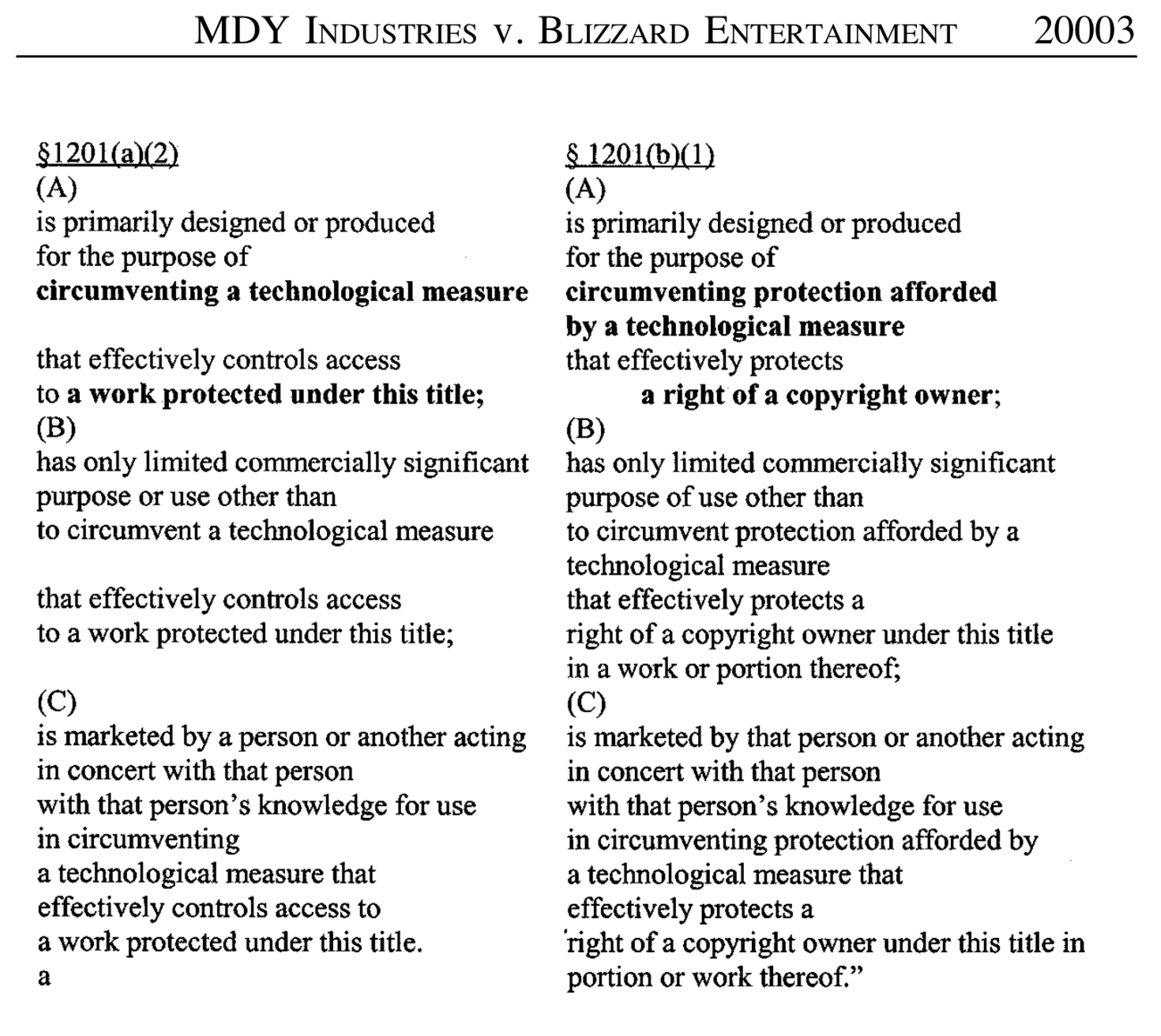
(emphasis added).
Image description: The court reproduced the operative provisions of the statute side by side with certain words bolded for emphasis. Section § 1201(a)(2)(A) (the access provision) and § 1201(b)(1)(A) (the control provision) begin with parallel language: “is primarily designed or produced for the purpose of” and then the access provision reads “circumventing a technological measure that effectively controls access to a work protected under this title” whereas the control provision reads “circumventing protection afforded by a technological measure that effectively protects a right of a copyright owner.” the remaining subsections (B) and (C) of the access provision and the control provision are fairly similar.
2. Our harmonization of the DMCA’s operative provisions
For the reasons set forth below, we believe that § 1201 is best understood to create two distinct types of claims. First, § 1201(a) prohibits the circumvention of any technological measure that effectively controls access to a protected work and grants copyright owners the right to enforce that prohibition. Second, and in contrast to § 1201(a), § 1201(b)(1) prohibits trafficking in technologies that circumvent technological measures that effectively protect “a right of a copyright owner.” Section 1201(b)(1)’s prohibition is thus aimed at circumventions of measures that protect the copyright itself: it entitles copyright owners to protect their existing exclusive rights under the Copyright Act. Those exclusive rights are reproduction, distribution, public performance, public display, and creation of derivative works. 17 U.S.C. § 106. Historically speaking, preventing “access” to a protected work in itself has not been a right of a copyright owner arising from the Copyright Act.
Our construction of § 1201 is compelled by the four significant textual differences between § 1201(a) and (b). First, § 1201(a)(2) prohibits the circumvention of a measure that “effectively controls access to a work protected under this title,” whereas § 1201(b)(1) concerns a measure that “effectively protects a right of a copyright owner under this title in a work or portion thereof.” (emphasis added). We read § 1201(b)(1)’s language — “right of a copyright owner under this title” — to reinforce copyright owners’ traditional exclusive rights under § 106 by granting them an additional cause of action against those who traffic in circumventing devices that facilitate infringement. Sections 1201(a)(1) and (a)(2), however, use the term “work protected under this title.” Neither of these two subsections explicitly refers to traditional copyright infringement under § 106. Accordingly, we read this term as extending a new form of protection, i.e., the right to prevent circumvention of access controls, broadly to works protected under Title 17, i.e., copyrighted works.
Second, as used in § 1201(a), to “circumvent a technological measure” means “to descramble a scrambled work, to decrypt an encrypted work, or otherwise to avoid, bypass, remove, deactivate, or impair a technological measure, without the authority of the copyright owner.” 17 U.S.C. § 1201(a)(3)(A). These two specific examples of unlawful circumvention under § 1201(a) — descrambling a scrambled work and decrypting an encrypted work — are acts that do not necessarily infringe or facilitate infringement of a copyright.6
Footnote 6: Perhaps for this reason, Congress did not list descrambling and decrypting as circumventing acts that would violate § 1201(b)(1). See 17 U.S.C. § 1201(b)(2)(A).
Descrambling or decrypting only enables someone to watch or listen to a work without authorization, which is not necessarily an infringement of a copyright owner’s traditional exclusive rights under § 106. Put differently, descrambling and decrypting do not necessarily result in someone’s reproducing, distributing, publicly performing, or publicly displaying the copyrighted work, or creating derivative works based on the copyrighted work.
The third significant difference between the subsections is that § 1201(a)(1)(A) prohibits circumventing an effective access control measure, whereas § 1201(b) prohibits trafficking in circumventing devices, but does not prohibit circumvention itself because such conduct was already outlawed as copyright infringement. The Senate Judiciary Committee explained:
This ... is the reason there is no prohibition on conduct in 1201(b) akin to the prohibition on circumvention conduct in 1201(a)(1). The prohibition in 1201(a)(1) is necessary because prior to this Act, the conduct of circumvention was never before made unlawful. The device limitation on 1201(a)(2) enforces this new prohibition on conduct. The copyright law has long forbidden copyright infringements, so no new prohibition was necessary.
Senate Report No. 105-90, at 11 (1998). This difference reinforces our reading of § 1201(b) as strengthening copyright owners’ traditional rights against copyright infringement and of § 1201(a) as granting copyright owners a new anti-circumvention right.
Fourth, in § 1201(a)(1)(B)-(D), Congress directs the Library of Congress (“Library”) to identify classes of copyrighted works for which “noninfringing uses by persons who are users of a copyrighted work are, or are likely to be, adversely affected, and the [anti-circumvention] prohibition contained in [§ 1201(a)(1)(A)] shall not apply to such users with respect to such classes of works for the ensuing 3-year period.” There is no analogous provision in § 1201(b). We impute this lack of symmetry to Congress’ need to balance copyright owners’ new anti-circumvention right with the public’s right to access the work. Sections 1201(a)(1)(B)-(D) thus promote the public’s right to access by allowing the Library to exempt circumvention of effective access control measures in particular situations where it concludes that the public’s right to access outweighs the owner’s interest in restricting access. In limiting the owner’s right to control access, the Library does not, and is not permitted to, authorize infringement of a copyright owner’s traditional exclusive rights under the copyright. Rather, the Library is only entitled to moderate the new anti-circumvention right created by, and hence subject to the limitations in, DMCA § 1201(a)(1).
Our reading of § 1201(a) and (b) ensures that neither section is rendered superfluous. A violation of § 1201(a)(1)(A), which prohibits circumvention itself, will not be a violation of § 1201(b), which does not contain an analogous prohibition on circumvention. A violation of § 1201(a)(2), which prohibits trafficking in devices that facilitate circumvention of access control measures, will not always be a violation of § 1201(b)(1), which prohibits trafficking in devices that facilitate circumvention of measures that protect against copyright infringement. Of course, if a copyright owner puts in place an effective measure that both (1) controls access and (2) protects against copyright infringement, a defendant who traffics in a device that circumvents that measure could be liable under both § 1201(a) and (b). Nonetheless, we read the differences in structure between § 1201(a) and (b) as reflecting Congress’s intent to address distinct concerns by creating different rights with different elements.
3. Our construction of the DMCA is consistent with the legislative history
Although the text suffices to resolve the issues before us, we also consider the legislative history in order to address the parties’ arguments concerning it. Our review of that history supports the view that Congress created a new anticircumvention right in § 1201(a)(2) independent of traditional copyright infringement and granted copyright owners a new weapon against copyright infringement in § 1201(b)(1). For instance, the Senate Judiciary Committee report explains that § 1201(a)(2) and (b)(1) are “not interchangeable”: they were “designed to protect two distinct rights and to target two distinct classes of devices,” and “many devices will be subject to challenge only under one of the subsections.” Senate Report No. 105-190, at 12 (1998). That is, § 1201(a)(2) “is designed to protect access to a copyrighted work,” while § 1201(b)(1) “is designed to protect the traditional copyright rights of the copyright owner.” Id. Thus, the Senate Judiciary Committee understood § 1201 to create the following regime:
If an effective technological protection measure does nothing to prevent access to the plain text of the work, but is designed to prevent that work from being copied, then a potential cause of action against the manufacturer of a device designed to circumvent the measure lies under § 1201(b)(1), but not under § 1201(a)(2). Conversely, if an effective technological protection measure limits access to the plain text of a work only to those with authorized access, but provides no additional protection against copying, displaying, performing or distributing the work, then a potential cause of action against the manufacturer of a device designed to circumvent the measure lies under § 1201(a)(2), but not under § 1201(b).
Id. The Senate Judiciary Committee proffered an example of § 1201(a) liability with no nexus to infringement, stating that if an owner effectively protected access to a copyrighted work by use of a password, it would violate § 1201(a)(2)(A)
To defeat or bypass the password and to make the means to do so, as long as the primary purpose of the means was to perform this kind of act. This is roughly analogous to making it illegal to break into a house using a tool, the primary purpose of which is to break into houses.
Id. at 12. The House Judiciary Committee similarly states of § 1201(a)(2), “The act of circumventing a technological protection measure put in place by a copyright owner to control access to a copyrighted work is the electronic equivalent of breaking into a locked room in order to obtain a copy of a book.” See House Report No. 105-551, pt. 1, at 17 (1998). We note that bypassing a password and breaking into a locked room in order to read or view a copyrighted work would not infringe on any of the copyright owner’s exclusive rights under § 106.
We read this legislative history as confirming Congress’s intent, in light of the current digital age, to grant copyright owners an independent right to enforce the prohibition against circumvention of effective technological access controls. In § 1201(a), Congress was particularly concerned with encouraging copyright owners to make their works available in digital formats such as “on-demand” or “pay-per-view,” which allow consumers effectively to “borrow” a copy of the work for a limited time or a limited number of uses. As the House Commerce Committee explained:
An increasing number of intellectual property works are being distributed using a “client-server” model, where the work is effectively “borrowed” by the user (e.g., infrequent users of expensive software purchase a certain number of uses, or viewers watch a movie on a pay-per-view basis). To operate in this environment, content providers will need both the technology to make new uses possible and the legal framework to ensure they can protect their work from piracy.
See House Report No. 105-551 pt. 2, at 23 (1998).
Our review of the legislative history supports our reading of § 1201: that section (a) creates a new anticircumvention right distinct from copyright infringement, while section (b) strengthens the traditional prohibition against copyright infringement.10
Footnote 10: The Copyright Office has also suggested that § 1201(a) creates a new access control right independent from copyright infringement, by expressing its view that the fair use defense to traditional copyright infringement does not apply to violations of § 1201(a)(1). U.S. Copyright Office, The Digital Millennium Copyright Act of 1998: U.S. Copyright Office Summary 4 (1998) (“Since the fair use doctrine is not a defense to the act of gaining unauthorized access to a work, the act of circumventing a technological measure in order to gain access is prohibited.”).
We now review the decisions of the Federal Circuit that have interpreted § 1201 differently.
4. The Federal Circuit’s decisions
The Federal Circuit has adopted a different approach to the DMCA. In essence, it requires § 1201(a) plaintiffs to demonstrate that the circumventing technology infringes or facilitates infringement of the plaintiff’s copyright (an “infringement nexus requirement”).
The seminal decision is Chamberlain Group, Inc. v. Skylink Techs., Inc., 381 F.3d 1178 (Fed.Cir.2004). In Chamberlain, the plaintiff sold garage door openers (“GDOs”) with a “rolling code” security system that purportedly reduced the risk of crime by constantly changing the transmitter signal necessary to open the door. Customers used the GDOs’ transmitters to send the changing signal, which in turn opened or closed their garage doors.
Plaintiff sued the defendant, who sold “universal” GDO transmitters for use with plaintiff’s GDOs, under § 1201(a)(2). The plaintiff alleged that its GDOs and transmitters both contained copyrighted computer programs and that its rolling code security system was a technological measure that controlled access to those programs. Accordingly, plaintiff alleged that the defendant — by selling GDO transmitters that were compatible with plaintiff’s GDOs — had trafficked in a technology that was primarily used for the circumvention of a technological measure (the rolling code security system) that effectively controlled access to plaintiff’s copyrighted works.
The Federal Circuit rejected the plaintiff’s claim, holding that the defendant did not violate § 1201(a)(2) because, inter alia, the defendant’s universal GDO transmitters did not infringe or facilitate infringement of the plaintiff’s copyrighted computer programs. The linchpin of the Chamberlain court’s analysis is its conclusion that DMCA coverage is limited to a copyright owner’s rights under the Copyright Act as set forth in § 106 of the Copyright Act. Id. at 1192-93. Thus, it held that § 1201(a) did not grant copyright owners a new anti-circumvention right, but instead, established new causes of action for a defendant’s unauthorized access of copyrighted material when it infringes upon a copyright owner’s rights under § 106. Id. at 1192, 1194. Accordingly, a § 1201(a)(2) plaintiff was required to demonstrate a nexus to infringement — i.e., that the defendant’s trafficking in circumventing technology had a “reasonable relationship” to the protections that the Copyright Act affords copyright owners. Id. at 1202-03. The Federal Circuit explained:
Defendants who traffic in devices that circumvent access controls in ways that facilitate infringement may be subject to liability under § 1201(a)(2). Defendants who use such devices may be subject to liability under § 1201(a)(1) whether they infringe or not. Because all defendants who traffic in devices that circumvent rights controls necessarily facilitate infringement, they may be subject to liability under § 1201(b). Defendants who use such devices may be subject to liability for copyright infringement. And finally, defendants whose circumvention devices do not facilitate infringement are not subject to § 1201 liability.
Id. at 1195 (emphasis added). Chamberlain concluded that § 1201(a) created a new cause of action linked to copyright infringement, rather than a new anti-circumvention right separate from copyright infringement, for six reasons.
First, Chamberlain reasoned that Congress enacted the DMCA to balance the interests of copyright owners and information users, and an infringement nexus requirement was necessary to create an anti-circumvention right that truly achieved that balance. Id. at 1196. Second, Chamberlain feared that copyright owners could use an access control right to prohibit exclusively fair uses of their material even absent feared foul use. Id. at 1201. Third, Chamberlain feared that § 1201(a) would allow companies to leverage their sales into aftermarket monopolies, in potential violation of antitrust law and the doctrine of copyright misuse. Fourth, Chamberlain viewed an infringement nexus requirement as necessary to prevent “absurd and disastrous results,” such as the existence of DMCA liability for disabling a burglary alarm to gain access to a home containing copyrighted materials. Id.
Fifth, Chamberlain stated that an infringement nexus requirement might be necessary to render Congress’s exercise of its Copyright Clause authority rational. Id. at 1200. The Copyright Clause gives Congress “the task of defining the scope of the limited monopoly that should be granted to authors ... in order to give the public appropriate access to their work product.” Id. (citing Eldred v. Ashcroft, 537 U.S. 186, 204-05 (2003) (internal citation omitted)). Without an infringement nexus requirement, Congress arguably would have allowed copyright owners in § 1201(a) to deny all access to the public by putting an effective access control measure in place that the public was not allowed to circumvent.
Finally, the Chamberlain court viewed an infringement nexus requirement as necessary for the Copyright Act to be internally consistent. It reasoned that § 1201(c)(1), enacted simultaneously, provides that “nothing in this section shall affect rights, remedies, limitations, or defenses to copyright infringement, including fair use, under this title.” The Chamberlain court opined that if § 1201(a) creates liability for access without regard to the remainder of the Copyright Act, it “would clearly affect rights and limitations, if not remedies and defenses.” Id.
Accordingly, the Federal Circuit held that a DMCA § 1201(a)(2) action was foreclosed to the extent that the defendant trafficked in a device that did not facilitate copyright infringement.
5. We decline to adopt an infringement nexus requirement
While we appreciate the policy considerations expressed by the Federal Circuit in Chamberlain, we are unable to follow its approach because it is contrary to the plain language of the statute. In addition, the Federal Circuit failed to recognize the rationale for the statutory construction that we have proffered. Also, its approach is based on policy concerns that are best directed to Congress in the first instance, or for which there appear to be other reasons that do not require such a convoluted construction of the statute’s language.
i. Statutory inconsistencies
Were we to follow Chamberlain in imposing an infringement nexus requirement, we would have to disregard the plain language of the statute. Moreover, there is significant textual evidence showing Congress’s intent to create a new anticircumvention right in § 1201(a) distinct from infringement. As set forth supra, this evidence includes: (1) Congress’s choice to link only § 1201(b)(1) explicitly to infringement; (2) Congress’s provision in § 1201(a)(3)(A) that descrambling and decrypting devices can lead to § 1201(a) liability, even though descrambling and decrypting devices may only enable non-infringing access to a copyrighted work; and (3) Congress’s creation of a mechanism in § 1201(a)(1)(B)-(D) to exempt certain non-infringing behavior from § 1201(a)(1) liability, a mechanism that would be unnecessary if an infringement nexus requirement existed.
Though unnecessary to our conclusion because of the clarity of the statute’s text, we also note that the legislative history supports the conclusion that Congress intended to prohibit even non-infringing circumvention and trafficking in circumventing devices. Moreover, in mandating a § 1201(a) nexus to infringement, we would deprive copyright owners of the important enforcement tool that Congress granted them to make sure that they are compensated for valuable non-infringing access — for instance, copyright owners who make movies or music available online, protected by an access control measure, in exchange for direct or indirect payment.
The Chamberlain court reasoned that if § 1201(a) creates liability for access without regard to the remainder of the Copyright Act, it “would clearly affect rights and limitations, if not remedies and defenses.” 381 F.3d at 1200. This perceived tension is relieved by our recognition that § 1201(a) creates a new anti-circumvention right distinct from the traditional exclusive rights of a copyright owner. It follows that § 1201(a) does not limit the traditional framework of exclusive rights created by § 106, or defenses to those rights such as fair use.12 We are thus unpersuaded by Chamberlain’s reading of the DMCA’s text and structure.
Footnote 12: Like the Chamberlain court, we need not and do not reach the relationship between fair use under § 107 of the Copyright Act and violations of § 1201. Chamberlain, 381 F.3d at 1199 n. 14. MDY has not claimed that Glider use is a “fair use” of WoW’s dynamic non-literal elements. Accordingly, we too leave open the question whether fair use might serve as an affirmative defense to a prima facie violation of § 1201. Id.
ii. Additional interpretive considerations
Though we need no further evidence of Congress’s intent, the parties, citing Chamberlain, proffer several other arguments, which we review briefly in order to address the parties’ contentions. Chamberlain relied heavily on policy considerations to support its reading of § 1201(a). As a threshold matter, we stress that such considerations cannot trump the statute’s plain text and structure. Even were they permissible considerations in this case, however, they would not persuade us to adopt an infringement nexus requirement. Chamberlain feared that § 1201(a) would allow companies to leverage their sales into aftermarket monopolies, in tension with antitrust law and the doctrine of copyright misuse.13
Footnote 13: Copyright misuse is an equitable defense to copyright infringement that denies the copyright holder the right to enforce its copyright during the period of misuse. Practice Mgmt. Info. Corp. v. Am. Med. Ass’n, 121 F.3d 516, 520 (9th Cir.1997). Since we have held that § 1201(a) creates a right distinct from copyright infringement, we conclude that we need not address copyright misuse in this case.
Concerning antitrust law, we note that there is no clear issue of anti-competitive behavior in this case because Blizzard does not seek to put a direct competitor who offers a competing role-playing game out of business and the parties have not argued this issue. If a § 1201(a)(2) defendant in a future case claims that a plaintiff is attempting to enforce its DMCA anti-circumvention right in a manner that violates antitrust law, we will then consider the interplay between this new anti-circumvention right and antitrust law.
Chamberlain also viewed an infringement nexus requirement as necessary to prevent “absurd and disastrous results,” such as the existence of DMCA liability for disabling a burglary alarm to gain access to a home containing copyrighted materials. 381 F.3d at 1201. In addition, the Federal Circuit was concerned that, without an infringement nexus requirement, § 1201(a) would allow copyright owners to deny all access to the public by putting an effective access control measure in place that the public is not allowed to circumvent. 381 F.3d at 1200. Both concerns appear to be overstated, but even accepting them, arguendo, as legitimate concerns, they do not permit reading the statute as requiring the imposition of an infringement nexus. As § 1201(a) creates a distinct right, it does not disturb the balance between public rights and the traditional rights of owners of copyright under the Copyright Act. Moreover, § 1201(a)(1)(B)-(D) allows the Library of Congress to create exceptions to the § 1201(a) anticircumvention right in the public’s interest. If greater protection of the public’s ability to access copyrighted works is required, Congress can provide such protection by amending the statute.
In sum, we conclude that a fair reading of the statute (supported by legislative history) indicates that Congress created a distinct anti-circumvention right under § 1201(a) without an infringement nexus requirement. Thus, even accepting the validity of the concerns expressed in Chamberlain, those concerns do not authorize us to override congressional intent and add a non-textual element to the statute. Accordingly, we reject the imposition of an infringement nexus requirement. We now consider whether MDY has violated § 1201(a)(2) and (b)(1).
E. Blizzard’s § 1201(a)(2) claim
1. WoW’s literal elements and individual non-literal elements
We agree with the district court that MDY’s Glider does not violate DMCA § 1201(a)(2) with respect to WoW’s literal elements and individual non-literal elements, because Warden does not effectively control access to these WoW elements. First, Warden does not control access to WoW’s literal elements because these elements — the game client’s software code — are available on a player’s hard drive once the game client software is installed. Second, as the district court found:
[WoW’s] individual nonliteral components may be accessed by a user without signing on to the server. As was demonstrated during trial, an owner of the game client software may use independently purchased computer programs to call up the visual images or the recorded sounds within the game client software. For instance, a user may call up and listen to the roar a particular monster makes within the game. Or the user may call up a virtual image of that monster.
Since a player need not encounter Warden to access WoW’s individual non-literal elements, Warden does not effectively control access to those elements.
Our conclusion is in accord with the Sixth Circuit’s decision in Lexmark International v. Static Control Components, 387 F.3d 522 (6th Cir.2004). In Lexmark, the plaintiff sold laser printers equipped with an authentication sequence, verified by the printer’s copyrighted software, that ensured that only plaintiff’s own toner cartridges could be inserted into the printers. The defendant sold microchips capable of generating an authentication sequence that rendered other manufacturers’ cartridges compatible with plaintiff’s printers.
The Sixth Circuit held that plaintiff’s § 1201(a)(2) claim failed because its authentication sequence did not effectively control access to its copyrighted computer program. Rather, the mere purchase of one of plaintiff’s printers allowed “access” to the copyrighted program. Any purchaser could read the program code directly from the printer memory without encountering the authentication sequence. The authentication sequence thus blocked only one form of access: the ability to make use of the printer. However, it left intact another form of access: the review and use of the computer program’s literal code. The Sixth Circuit explained:
Just as one would not say that a lock on the back door of a house “controls access” to a house whose front door does not contain a lock and just as one would not say that a lock on any door of a house “controls access” to the house after its purchaser receives the key to the lock, it does not make sense to say that this provision of the DMCA applies to otherwise-readily-accessible copyrighted works. Add to this the fact that the DMCA not only requires the technological measure to “control access” but requires the measure to control that access “effectively,” 17 U.S.C. § 1201(a)(2), and it seems clear that this provision does not naturally extend to a technological measure that restricts one form of access but leaves another route wide open.
Id. at 547.
Here, a player’s purchase of the WoW game client allows access to the game’s literal elements and individual non-literal elements. Warden blocks one form of access to these elements: the ability to access them while connected to a WoW server. However, analogously to the situation in Lexmark, Warden leaves open the ability to access these elements directly via the user’s computer. We conclude that Warden is not an effective access control measure with respect to WoW’s literal elements and individual non-literal elements, and therefore, that MDY does not violate § 1201(a)(2) with respect to these elements.
2. WoW’s dynamic non-literal elements
We conclude that MDY meets each of the six textual elements for violating § 1201(a)(2) with respect to WoW’s dynamic non-literal elements. That is, MDY (1) traffics in (2) a technology or part thereof (3) that is primarily designed, produced, or marketed for, or has limited commercially significant use other than (4) circumventing a technological measure (5) that effectively controls access (6) to a copyrighted work. See 17 U.S.C. § 1201(a)(2).
The first two elements are met because MDY “traffics in a technology or part thereof” — that is, it sells Glider. The third and fourth elements are met because Blizzard has established that MDY markets Glider for use in circumventing Warden, thus satisfying the requirement of § 1201(a)(2)(C).16
Footnote 16: To “circumvent a technological measure” under § 1201(a) means to “descramble a scrambled work, to decrypt an encrypted work, or otherwise to avoid, bypass, remove, deactivate, or impair a technological measure, without the authority of the copyright owner.” 17 U.S.C. § 1201(a)(3)(A) (emphasis added). A circuit split exists with respect to the meaning of the phrase “without the authority of the copyright owner.” The Federal Circuit has concluded that this definition imposes an additional requirement on a § 1201(a)(2) plaintiff: to show that the defendant’s circumventing device enables third parties to access the copyrighted work without the copyright owner’s authorization. See Chamberlain, 381 F.3d at 1193. The Second Circuit has adopted a different view, explaining that § 1201(a)(3)(A) plainly exempts from § 1201(a) liability those whom a copyright owner authorizes to circumvent an access control measure, not those whom a copyright owner authorizes to access the work. Corley, 273 F.3d at 444 & n. 15; see also 321 Studios v. MGM Studios, Inc., 307 F.Supp.2d 1085, 1096 (N.D.Cal.2004) (same).
We find the Second Circuit’s view to be the sounder construction of the statute’s language, and conclude that § 1201(a)(2) does not require a plaintiff to show that the accused device enables third parties to access the work without the copyright owner’s authorization. Thus, Blizzard has satisfied the “circumvention” element of a § 1201(a)(2) claim, because Blizzard has demonstrated that it did not authorize MDY to circumvent Warden.
Indeed, Glider has no function other than to facilitate the playing of WoW. The sixth element is met because, as the district court held, WoW’s dynamic non-literal elements constitute a copyrighted work. See, e.g., Atari Games Corp. v. Oman, 888 F.2d 878, 884-85 (D.C.Cir.1989) (the audiovisual display of a computer game is copyrightable independently from the software program code, even though the audiovisual display generated is partially dependent on user input).
The fifth element is met because Warden is an effective access control measure. To “effectively control access to a work,” a technological measure must “in the ordinary course of its operation, require[] the application of information, or a process or a treatment, with the authority of the copyright owner, to gain access to the work.” 17 U.S.C. § 1201(a)(3)(B). Both of Warden’s two components “require[] the application of information, or a process or a treatment ... to gain access to the work.” For a player to connect to Blizzard’s servers which provide access to WoW’s dynamic non-literal elements, scan.dll must scan the player’s computer RAM and confirm the absence of any bots or cheats. The resident component also requires a “process” in order for the user to continue accessing the work: the user’s computer must report portions of WoW code running in RAM to the server. Moreover, Warden’s provisions were put into place by Blizzard, and thus, function “with the authority of the copyright owner.” Accordingly, Warden effectively controls access to WoW’s dynamic non-literal elements.17
Footnote 17: The statutory definition of the phrase “effectively control access to a work” does not require that an access control measure be strong or circumvention-proof. Rather, it requires an access control measure to provide some degree of control over access to a copyrighted work. As one district court has observed, if the word “effectively” were read to mean that the statute protects “only successful or efficacious technological means of controlling access,” it would “gut” DMCA § 1201(a)(2), because it would “limit the application of the statute to access control measures that thwart circumvention, but withhold protection for those measures that can be circumvented.” See Universal City Studios v. Reimerdes, 111 F.Supp.2d 294, 318 (S.D.N.Y. 2000) (“Defendants would have the Court construe the statute to offer protection where none is needed but to withhold protection precisely where protection is essential.”).
We hold that MDY is liable under § 1201(a)(2) with respect to WoW’s dynamic non-literal elements. Accordingly, we affirm the district court’s entry of a permanent injunction against MDY to prevent future § 1201(a)(2) violations.19
Footnote 19: For the first time in its petition for rehearing, MDY raises the applicability of Section 1201(f) and the question whether Glider is an “independently created computer program” under that subsection and thus exempt from the coverage of Section 1201(a). Because this argument was not raised to the district court or presented in the parties’ briefs on appeal, we decline to reach it.
F. Blizzard’s § 1201(b)(1) claim
Blizzard may prevail under § 1201(b)(1) only if Warden “effectively protect[s] a right” of Blizzard under the Copyright Act. Blizzard contends that Warden protects its reproduction right against unauthorized copying. We disagree.
First, although WoW players copy the software code into RAM while playing the game, Blizzard’s EULA and ToU authorize all licensed WoW players to do so. We have explained that ToU § 4(B)’s bot prohibition is a license covenant rather than a condition. Thus, a Glider user who violates this covenant does not infringe by continuing to copy code into RAM. Accordingly, MDY does not violate § 1201(b)(1) by enabling Glider users to avoid Warden’s interruption of their authorized copying into RAM.
Second, although WoW players can theoretically record game play by taking screen shots, there is no evidence that Warden detects or prevents such allegedly infringing copying. This is logical, because Warden was designed to reduce the presence of cheats and bots, not to protect WoW’s dynamic non-literal elements against copying. We conclude that Warden does not effectively protect any of Blizzard’s rights under the Copyright Act, and MDY is not liable under § 1201(b)(1) for Glider’s circumvention of Warden.
[The court of appeals reversed the district court except as to MDY’s liability for violation of DMCA § 1201(a)(2) and remanded for trial on Blizzard’s claim for tortious interference with contract.]
Notes and questions
(1) What are the three main provisions of DMCA § 1201, and how do they differ from each other?
(2) Why does the court think that the anti-circumvention rules apply differently to WoW’s “literal elements,” “individual non-literal elements,” and its “dynamic non-literal elements”? Also, why did the court find that MDY violated § 1201(a)(2) but not § 1201(b)(1)?
(3) The Ninth Circuit rejected the Federal Circuit’s “infringement nexus requirement” from the Chamberlain case. What is this requirement, and why did the Ninth Circuit reject it?
(4) Under this court’s interpretation, would a company that sells devices to bypass Netflix’s password protection be liable under § 1201(a)(2)? What about a company that provides a password manager service so that people don’t need to remember their own Netflix password?
(5) Do you agree with the court’s interpretation that § 1201(a) creates liability even without any connection to copyright infringement? What are the potential benefits and dangers of this approach?
Copyright management information
In addition to the prohibitions against circumventing technological protection measures addressed above, the DMCA also introduced a new cause of action with respect to “Copyright Management Information.”
Under Section 1202(a) of the copyright act it is unlawful—subject to certain knowledge and intent requirements discussed below—to provide, distribute, or import for distribution, false copyright management information. Likewise, Section 1202(b) prohibits the removal or alteration of copyright management information, again subject to certain knowledge and intent requirements.
17 U.S. Code § 1202. Integrity of copyright management information
(a) False Copyright Management Information.—No person shall knowingly and with the intent to induce, enable, facilitate, or conceal infringement—
(1) provide copyright management information that is false, or
(2) distribute or import for distribution copyright management information that is false.
(b) Removal or Alteration of Copyright Management Information.—No person shall, without the authority of the copyright owner or the law—
(1) intentionally remove or alter any copyright management information,
(2) distribute or import for distribution copyright management information knowing that the copyright management information has been removed or altered without authority of the copyright owner or the law, or
(3) distribute, import for distribution, or publicly perform works, copies of works, or phonorecords, knowing that copyright management information has been removed or altered without authority of the copyright owner or the law,
knowing, or, with respect to civil remedies under section 1203, having reasonable grounds to know, that it will induce, enable, facilitate, or conceal an infringement of any right under this title.
(c) Definition.—As used in this section, the term “copyright management information” means any of the following information conveyed in connection with copies or phonorecords of a work or performances or displays of a work, including in digital form, except that such term does not include any personally identifying information about a user of a work or of a copy, phonorecord, performance, or display of a work:
(1) The title and other information identifying the work, including the information set forth on a notice of copyright.
(2) The name of, and other identifying information about, the author of a work.
(3) The name of, and other identifying information about, the copyright owner of the work, including the information set forth in a notice of copyright.
(4) With the exception of public performances of works by radio and television broadcast stations, the name of, and other identifying information about, a performer whose performance is fixed in a work other than an audiovisual work.
(5) With the exception of public performances of works by radio and television broadcast stations, in the case of an audiovisual work, the name of, and other identifying information about, a writer, performer, or director who is credited in the audiovisual work.
(6) Terms and conditions for use of the work.
(7) Identifying numbers or symbols referring to such information or links to such information.
(8) Such other information as the Register of Copyrights may prescribe by regulation, except that the Register of Copyrights may not require the provision of any information concerning the user of a copyrighted work.
Not surprisingly, the key interpretive questions relating to Section 1202 have centered on the breadth of the term copyright management information and the limits of the knowledge and intent requirements.
Stevens v. Corelogic, Inc., 899 F.3d 666 (9th Cir. 2018)
Circuit Judge Berzon,
Residential real estate sales today depend largely on online sites displaying properties for sale. Plaintiffs Robert Stevens and Steven Vandel (“the Photographers”) are professional real estate photographers who take photographs of listed properties and license them to real estate agents. The real estate agents, in turn, upload such photographs to Multiple Listing Services (“MLS”) — computerized databases of listed properties — using Defendant CoreLogic’s software.
In this action against CoreLogic, the Photographers allege that CoreLogic removed copyright management information from their photographs and distributed their photographs with the copyright management information removed, in violation of 17 U.S.C. § 1202(b)(1)-(3). We affirm the grant of summary judgment in favor of CoreLogic.
FACTS AND PROCEEDINGS BELOW
A. Metadata
Stevens and Vandel are hired by real estate agents to take digital photographs of houses for sale. The Photographers retain the copyright in those photographs and license them to the agents. Like most digital photographs, at least some of Stevens’ and Vandel’s photographs contain metadata — i.e., data about the image file itself. Metadata is not visible on the face of the image. Rather, it is either embedded in the digital file or stored outside the image file, such as in a “sidecar” file, and can be viewed using computer programs.
Some metadata is generated automatically by cameras. The Exchangeable Image File Format (“EXIF”) is used by virtually all digital cameras to store information about the settings used to capture a digital image. EXIF information can include the make, model, and serial number of the camera taking the photograph; the shutter speed; the aperture settings; light sensitivity; the focal length of the lens; and even, in some cases, the location at which the photo was captured. Essentially, EXIF metadata provides information about when the image was taken and under what technical conditions.
Other metadata may be added manually, either by programming the camera or by adding information after taking the picture, using photo editing software. Such metadata is often stored in IPTC format, named for the International Press Telecommunications Council, which developed metadata standards to facilitate the exchange of news. IPTC metadata can include, for example, the title of the image, a caption or description, keywords, information about the photographer, and copyright restrictions. It may be used to check copyright information, to sort images, and to provide accurate search results in an image database or search engine. A small number of fields such as Author/Creator, Copyright, and Caption/Description exist in both EXIF and IPTC formats.
Copyright law restricts the removal or alteration of copyright management information (“CMI”) — information such as the title, the author, the copyright owner, the terms and conditions for use of the work, and other identifying information set forth in a copyright notice or conveyed in connection with the work. See 17 U.S.C. § 1202(b)-(c). Both EXIF and IPTC metadata can contain “copyright management information.”
B. CoreLogic Software
CoreLogic is a California-based corporation that develops and provides software to Multiple Listing Services. Known as one of the “Big 3” real estate software vendors nationally, CoreLogic currently markets, or has previously marketed, several MLS software platforms, including Matrix, InnoVia, Fusion, MLXchange, Tempo 4, and Tempo 5. The Photographers allege that CoreLogic’s software removed CMI metadata from their photographs, in violation of 17 U.S.C. § 1202(b).
Because image files can be very large, CoreLogic’s MLS software resizes or “downsamples” images. Downsampling entails creating and saving a copy of an uploaded image in a smaller number of pixels and deleting the original image; the process reduces storage size, facilitates computer display, and helps images load faster on web pages.
The image processing aspect of CoreLogic’s software was not developed by CoreLogic entirely on its own. Like virtually all software, CoreLogic’s software incorporated “libraries” — pre-written code that can be used by a computer program and that enables software to develop in a modular fashion. These libraries are unable to read EXIF data from image files or to write EXIF data to image files. Thus, when images are copied or resized using the code from these pre-existing libraries, metadata attached to those images is not retained.1
Footnote 1: It is not uncommon for image processing software to fail to preserve metadata. Tests conducted by the Embedded Metadata Group in 2015 revealed that, of fifteen social media websites studied, eight preserved EXIF metadata and seven, including, Facebook, Instagram, and Twitter, did not. Some image-processing libraries, however, such as “ImageMagick,” do read and write EXIF data, and thus transfer EXIF metadata to the new image file when resizing.
The Photographers filed this action in May 2014. Significantly, the dispute is limited to metadata. The Photographers do not allege that CoreLogic’s software removed visible CMI, such as digital watermarks, from their photographs, and indeed, CoreLogic’s software does not detect, recognize, or remove visible CMI. Cf. Murphy v. Millennium Radio Grp. LLC, 650 F.3d 295, 305 (3d Cir. 2011) (imposing liability on a defendant who cropped out the photographer’s name from the “gutter” copyright credit before posting a photograph online).
After receiving the Photographers’ initial complaint, CoreLogic modified its software to ensure that EXIF metadata is copied and restored to images processed by CoreLogic’s MLS software. These modifications were made within a few months of receiving the initial complaint, although testing and installation of the revised version on all MLSs using CoreLogic software took several more months. The Photographers contend that, even after these changes, CoreLogic software continues to remove IPTC metadata.
In addition to providing MLS software — which, again, real estate agents use to share information about properties with other agents — CoreLogic also operates the Partner InfoNet program, which allows MLSs to license their aggregated real estate listing data to mortgage lenders and servicers, in exchange for a share of the licensees’ revenue. CoreLogic used photographs taken and owned by the Photographers on Partner InfoNet products.
[The district court granted summary judgment in favor of CoreLogic.]
DISCUSSION
A. Violation of 17 U.S.C. § 1202(b)
The Photographers allege that CoreLogic’s software removed CMI metadata, in violation of 17 U.S.C. § 1202(b)(1), and that CoreLogic distributed images knowing that copyright management information was removed, in violation of 17 U.S.C. § 1202(b)(3). Reviewing de novo the district court’s decision to grant summary judgment to CoreLogic, we affirm the grant of summary judgment.
1. Section 1202(b) Requires an Affirmative Showing That the Defendant Knew the Prohibited Act Would “Induce, Enable, Facilitate, or Conceal” Infringement
Section 1202(b)(1) provides: “No person shall, without the authority of the copyright owner or the law ... intentionally remove or alter any copyright management information ... knowing, or ... having reasonable grounds to know, that it will induce, enable, facilitate, or conceal an infringement of any” copyright. 17 U.S.C. § 1202(b)(1). Section 1202(b)(3) provides: “No person shall, without the authority of the copyright owner or the law ... distribute, import for distribution, or publicly perform works, copies of works, or phonorecords, knowing that copyright management information has been removed or altered without authority of the copyright owner or the law, knowing, or ... having reasonable grounds to know, that it will induce, enable, facilitate, or conceal an infringement of any” copyright. Id. § 1202(b)(3).3
Footnote 3: The Photographers’ complaint also alleges a violation of 17 U.S.C. § 1202(b)(2). Section 1202(b)(2) refers to the “distribution or import for distribution [of] copyright management information knowing that the copyright management information has been removed or altered without authority of the copyright owner or the law.” 17 U.S.C. § 1202(b)(2) (emphasis added). The Photographers do not specifically allege any instances involving the distribution of altered CMI separate from the distribution of the copyrighted photographs. As the elements of the two statutory provisions are otherwise indistinguishable, the Photographers have not plausibly stated a claim under Section 1202(b)(2) different from their claim under Section 1202(b)(3). We therefore discuss in the text only the Section 1202(b)(3) claim.
Both provisions thus require the defendant to possess the mental state of knowing, or having a reasonable basis to know, that his actions “will induce, enable, facilitate, or conceal” infringement.
The Photographers have not offered any evidence to satisfy that mental state requirement. Their primary argument is that, because one method of identifying an infringing photograph has been impaired, someone might be able to use their photographs undetected. That assertion rests on no affirmative evidence at all; it simply identifies a general possibility that exists whenever CMI is removed.
As we interpret Section 1202(b), this generic approach won’t wash. It is a fundamental principle of statutory interpretation that we must “give effect, if possible, to every clause and word of a statute,” Montclair v. Ramsdell, 107 U.S. 147, 152 (1883), “so that no part will be inoperative or superfluous, void or insignificant,” Corley v. United States, 556 U.S. 303 (2009). To avoid superfluity, the mental state requirement in Section 1202(b) must have a more specific application than the universal possibility of encouraging infringement; specific allegations as to how identifiable infringements “will” be affected are necessary.
At the same time, as the statute is written in the future tense, the Photographers need not show that any specific infringement has already occurred. Also, recognizing that “nothing is completely stable, no plan is beyond alteration,” we have previously observed that statutes requiring knowledge that a future action “will” occur do not “require knowledge in the sense of certainty as to a future act.” United States v. Todd, 627 F.3d 329, 334 (9th Cir. 2010). Rather, knowledge in the context of such statutes signifies “a state of mind in which the knower is familiar with a pattern of conduct” or “aware of an established modus operandi that will in the future cause a person to engage in” a certain act. Id. Applying that concept here, we hold that a plaintiff bringing a Section 1202(b) claim must make an affirmative showing, such as by demonstrating a past “pattern of conduct” or “modus operandi”, that the defendant was aware or had reasonable grounds to be aware of the probable future impact of its actions.
Our conclusion about the import of the “induce[d], enable[d], facilitate[d], or conceal[ed]” prong is supported by the legislative history of Section 1202. That provision was enacted to implement obligations of parties to the WIPO Copyright Treaty (“WCT”) and the WIPO Performances and Phonograms Treaty. See S. Rep. No. 105-190, at 5, 9 (1998). The initial draft of the WCT provision regarding CMI provided:
Contracting parties shall make it unlawful for any person knowingly ... (i) to remove or alter any electronic rights management information without authority; [or] (ii) to distribute, import for distribution or communicate to the public, without authority, copies of works from which electronic rights management information has been removed or altered without authority.
World Intellectual Property Organization [WIPO], Basic Proposal for the Substantive Provisions of the Treaty on Certain Questions Concerning the Protection of Literary and Artistic Works to Be Considered by the Diplomatic Conference, art. 14(1), WIPO Doc. CRNR/DC/4 (Aug. 30, 1996).
In response to requests from delegates that the provision be modified to require a connection to an infringing purpose, the provision was redrafted as follows:
Contracting Parties shall provide adequate and effective legal remedies against any person knowingly performing any of the following acts knowing or, with respect to civil remedies having reasonable grounds to know, that it will induce, enable, facilitate or conceal an infringement of any right covered by this Treaty or the Berne Convention: (i) to remove or alter any electronic rights management information without authority; (ii) to distribute, import for distribution, broadcast or communicate to the public, without authority, works or copies of works knowing that electronic rights management information has been removed or altered without authority.
WIPO Copyright Treaty art. 12, Dec. 20 1996 (emphasis added). The revision thus makes clear that the “induce, enable, facilitate or conceal” requirement is intended to limit liability in some fashion — specifically, to instances in which the defendant knows or has a reasonable basis to know that the removal or alteration of CMI or the distribution of works with CMI removed will aid infringement.
When Congress was considering the WIPO Copyright Treaties Implementation Act — a part of the Digital Millennium Copyright Act (“DMCA”) that included the new Section 1202 — the Register of Copyrights emphasized that Section 1202’s provisions “do not apply to those who act innocently.... Liability for the removal or alteration of information requires the actor to know or have reason to know that his acts ‘will induce, enable, facilitate or conceal’ infringement.” WIPO Copyright Treaties Implementation Act, and Online Copyright Liability Limitation Act: Hearing Before the House Subcommittee on Courts and Intellectual Property of the House Committee on the Judiciary, 105th Cong. 51 (1997) (statement of Marybeth Peters, Register of Copyrights, Copyright Office of the United States).
In short, to satisfy the knowledge requirement, a plaintiff bringing a Section 1202(b)(1) claim must offer more than a bare assertion that “when CMI metadata is removed, copyright infringement plaintiffs... lose an important method of identifying a photo as infringing.” Instead, the plaintiff must provide evidence from which one can infer that future infringement is likely, albeit not certain, to occur as a result of the removal or alteration of CMI.
2. The Photographers Have Failed to Make the Required Affirmative Showing
The Photographers have not offered any specific evidence that removal of CMI metadata from their real estate photographs will impair their policing of infringement. There are no allegations, for example, of a “pattern of conduct” or “modus operandi” involving policing infringement by tracking metadata. Todd, 627 F.3d at 334. Indeed, the evidence presented cuts against any inference that CMI metadata is of any practical significance to the Photographers in policing copyright infringement of their images.
The Photographers have not, for example, averred that they have ever used CMI metadata to prevent or detect copyright infringement, much less how they would do so. Vandel testified that, before this lawsuit began, he had never “looked at any metadata information on any photograph in an MLS system.” On the only two occasions Vandel became aware of unauthorized use of his photographs, he learned about the unauthorized use from the real estate agent who commissioned the photographs. The agent saw the image elsewhere and contacted Vandel to ask if he had permitted the use. Stevens similarly testified that he had “never tried to download a photo off an MLS listing ... and look at its properties, its metadata,” that he “didn’t think you can pull up metadata off of an MLS listing,” and that he “didn’t even realize you could click on a picture off the Internet, right-click it, and get metadata off of it.” The testimony of both Stevens and Vandel undermines any ostensible relationship between the removal of CMI metadata and their policing of infringement.
Nor have the Photographers brought forward any evidence indicating that CoreLogic’s distribution of real estate photographs ever “induce[d], enable[d], facilitate[d], or conceal[ed]” any particular act of infringement by anyone, let alone a pattern of such infringement likely to recur in the future. They identify no instance in which the removal of CMI metadata from any photograph “induce[d], enable[d], facilitate[d] or conceal[ed] an infringement.” Moreover, a party intent on using a copyrighted photograph undetected can itself remove any CMI metadata, precluding detection through a search for the metadata. So on the record here, one cannot plausibly say that removal by a third party “will” make it easier to use a copyrighted photograph undetected, using “will” in the predictive sense we have indicated.
Because the Photographers have not put forward any evidence that CoreLogic knew its software carried even a substantial risk of inducing, enabling, facilitating, or concealing infringement, let alone a pattern or probability of such a connection to infringement, CoreLogic is not liable for violating 17 U.S.C. § 1202(b).
Notes and questions
(1) What kind of mental state is required to bring a Section 1202(b) claim? How strong does the link to future infringement need to be?
(2) What specific type of evidence did the Ninth Circuit require plaintiffs to provide to satisfy the mental state requirement? Why did the court reject the photographers’ argument that removing CMI metadata automatically satisfies this requirement?
(3) In Mango v. BuzzFeed, Inc., 970 F.3d 167 (2d Cir. 2020), freelance photographer Gregory Mango licensed a photo of Raymond Parker to the New York Post, which published it with proper credit. Three months later, BuzzFeed journalist Michael Hayes used the same photo in an article without seeking Mango’s permission and replaced Mango’s credit with that of Parker’s attorneys’ law firm. Hayes had downloaded the image from the Post’s website, claimed he was told by an attorney to use it (which the attorney disputed), and knew from industry practice that permission was required. Mango sued under the DMCA for removal or alteration of copyright management information, and the district court found BuzzFeed liable and awarded statutory damages. The Second Circuit held that § 1202(b)(3) of the DMCA does not require proof that a defendant knew its conduct would cause future third-party infringement; knowledge that the removal or alteration of copyright management information would conceal the defendant’s own infringement is sufficient. Applying this standard, the court affirmed the district court’s finding that BuzzFeed, through journalist Michael Hayes, knowingly removed Mango’s attribution and replaced it with false credit in a way that concealed its unauthorized use of the photograph, thereby violating the DMCA.
CMI Claims in Relation to Training Generative AI
Andersen v. Stability AI Ltd., 700 F. Supp. 3d 853 (N.D. Cal. 2023)
William H. Orrick, United States District Judge
Artists Sarah Anderson, Kelly McKernan, and Karla Ortiz filed this putative class action on behalf of themselves and other artists to challenge the defendants’ creation or use of Stable Diffusion, an artificial intelligence (“AI”) software product. Plaintiffs allege that Stable Diffusion was “trained” on plaintiffs’ works of art to be able to produce Output Images “in the style” of particular artists. The three sets of defendants Stability AI Ltd. and Stability AI, Inc. (“Stability”); DeviantArt, Inc.; and Midjourney, Inc. have each filed separate motions to dismiss …
Plaintiffs allege that Stability created and released in August 2022 a “general-purpose” software program called Stable Diffusion under a “permission open-source license.” Stability is alleged to have “downloaded of otherwise acquired copies of billions of copyrighted images without permission to create Stable Diffusion,” known as “training images,” Over five billion images were scraped (and thereby copied) from the internet for training purposes for Stable Diffusion through the services of an organization (LAION, Large-Scale Artificial Intelligence Open Network) paid by Stability. Stability’s founder and CEO “publicly acknowledged the importance of using licensed training images, saying that future versions of Stable Diffusion would be based on ‘fully licensed’ training images. But for the current version, he took no steps to obtain or negotiate suitable licenses.”
Stable Diffusion is alleged to be a “software library” providing “image-generating services” to products produced and maintained by the defendants including “DreamStudio, DreamUp, and on information and belief, the Midjourney Product.” Consumers use these products by entering text prompts into the programs to create images “in the style” of artists. The new images are created “through a mathematical process” that are based entirely on the training images and are “derivative” of the training images. Plaintiffs admit that “in general, none of the Stable Diffusion output images provided in response to a particular Text Prompt is likely to be a close match for any specific image in training data.” This stands to reason: the use of conditioning data to interpolate multiple latent images means that the resulting hybrid image will not look exactly like any of the Training Images that have been copied into these latent images.
[Plaintiff asserted various claims including violation of the Digital Millennium Copyright Act, 17 U.S.C. §§ 1201-1205 (“DMCA”).]
I. MOTIONS TO DISMISS … DMCA
Section 1202(b) of the Digital Millennium Copyright Act (“DMCA”) provides that:
No person shall, without the authority of the copyright owner or the law—
1. intentionally remove or alter any copyright management information;
2. distribute or import for distribution any copyright management information knowing that the copyright management information has been removed or altered without authority of the copyright owner ... or
3. distribute, import for distribution ... works [or] copies of works ... knowing that copyright management information has been removed or altered without authority of the copyright owner ...
knowing or having reasonable grounds to know that it will induce, enable, facilitate or conceal an infringement of any right under this title.
17 U.S.C. § 1202(b).
Section 1202(c) defines copyright management information (CMI) to include the following: “[the] title and other information identifying the work, including the information set forth on a notice of copyright;” “[the] name of, and other identifying information about, the author of a work;” and “[the] name of, and other identifying information about, the copyright owner of the work, including the information set forth in a notice of copyright.” 17 U.S.C. § 1202(c).
In the Ninth Circuit, to establish knowing or having reasonable grounds to know that conduct will “induce, enable, facilitate or conceal,” a plaintiff “must make an affirmative showing, such as by demonstrating a past ‘pattern of conduct’ or ‘modus operandi,’ that the defendant was aware or had reasonable grounds to be aware of the probable future impact of its actions.” Stevens v. Corelogic, Inc., 899 F.3d 666, 674 (9th Cir. 2018). At the summary judgment stage, this claim requires providing evidence that the alleged infringer knew that the removal of the CMI would “induce, enable, facilitate, or conceal” copyright infringement. At the pleading stage, the claimant must plead facts plausibly showing that the alleged infringer had this required mental state. While “[a]t the pleading stage, mental conditions generally need not be alleged with specificity,” a plaintiff must still “allege sufficient facts to support the reasonable inference that the defendant ‘knew or had a reasonable basis to know that the removal or alteration of CMI would aid infringement.’” Doe 1 v. GitHub, Inc., 2023 WL 3449131, at *12 (N.D. Cal. May 11, 2023).
Stability moves to dismiss the DMCA claim because plaintiffs fail to allege that Stability removed any “copyright management information” (“CMI”) from any particular work of the plaintiffs. It contends that there are no allegations in the Complaint that any of the plaintiffs included identified CMI in particular works that were available online, or facts plausibly showing that when the images were scraped and included in training datasets plaintiffs’ CMI was removed. Finally, it claims that there are no facts alleged that could plausibly show it – as opposed to LAION or others–had the requisite “double-scienter”: in other words, facts plausibly supporting that each defendant knew CMI was being scraped from plaintiffs’ works and knowing that conduct would “induce, enable, facilitate, or conceal an infringement.” 17 U.S.C. § 1202(b); Stevens, 899 F.3d at 674–75 (“the ‘induce, enable, facilitate or conceal’ requirement is intended to limit liability in some fashion — specifically, to instances in which the defendant knows or has a reasonable basis to know that the removal or alteration of CMI or the distribution of works with CMI removed will aid infringement.”). DeviantArt and Midjourney make similar arguments, albeit from a stronger position because there are no allegations that either of them was involved with LAION or directly with the training of Stable Diffusion where, presumably, the removal or alteration of the CMI occurred.
In response, plaintiffs point to paragraphs 180 and 191 of their Complaint, where they allege generally that plaintiffs and “others” in the putative class included various categories of CMI in their works and the “removal or alteration” of that CMI by defendants, including “the creator’s name” and “the form of artist’s signatures.” These allegations are wholly conclusory. In order to state this claim, each plaintiff must identify the exact type of CMI included in their online works that were online and that they have a good faith belief were scraped into the LAION datasets or other datasets used to train Stable Diffusion. At the hearing, plaintiffs argued that it is key for the development of generative AI models to capture not only images but any accompanying text because that accompanying text is necessary to the models’ ability to “train” on key words associated with those images. But there is nothing in the Complaint about text CMI present in the images the named plaintiffs included with their online images that they contend was stripped or altered in violation of the DMCA during the training of Stable Diffusion or the use of the end-products. Plaintiffs must, on amendment, identify the particular types of their CMI from their works that they believe were removed or altered.
In addition, plaintiffs must clarify and then allege plausible facts regarding which defendants they contend did the stripping or altering in violation of the DMCA and when that occurred. The Complaint pleads facts which put the responsibility for the initial scrapping of images on LAION and/or Stability. While Complaint attempts to place responsibility for stripping or altering of CMI at the time when the “Defendants” “trained Stable Diffusion,” there are no facts at all regarding DeviantArt’s or Midjourney’s training of Stable Diffusion.
The DMCA claim is DISMISSED as to each defendant with leave to amend. Plaintiffs shall identify the specific CMI each named plaintiff included in the images that each plaintiff contends was used to training Stable Diffusion. Plaintiffs shall not allege violations of the DMCA by “defendants,” but shall instead identify with specificity the theory of DMCA liability for each defendant and plausible facts in support with respect to each defendant.
The Andersen plaintiffs did not revive these claims. On the amended complaint the § 1202(b) claims were dismissed again, this time without leave to amend, and they form no part of the case as it now stands.
Tremblay v. OpenAI, Inc., 2024 WL 557720 (N.D. Cal. Feb. 12, 2024)
Araceli Martínez-Olguín, United States District Judge
Before the Court are two nearly identical putative class complaints in Tremblay et al. v. OpenAI, Inc. et al., 23-cv-3223 and Silverman et al. v. OpenAI, Inc. et al., 23-cv-3416. Plaintiffs are authors of books who allege that their books were used to train OpenAI language models that operate the artificial intelligence (“AI”) software ChatGPT. Plaintiffs Paul Tremblay, Sarah Silverman, Christopher Golden, and Richard Kadrey (collectively, “Plaintiffs”) hold registered copyrights in their books (The Cabin at the End of the World (Tremblay)); (The Bedwetter (Silverman); Ararat (Golden), and Sandman Slim (Kadrey)).
Defendant OpenAI creates and sells certain AI software known as large language models (or “LLM”). These language models are “trained” by inputting large amounts of texts known as the “training dataset.” The language models copy text from the training dataset and extract “expressive information.” ChatGPT is an OpenAI language model that allows paying users to enter text prompts to which ChatGPT will respond and “simulate human reasoning,” including answering questions or summarizing books. ChatGPT generates its output based on “patterns and connections” from the training data.
OpenAI copied Plaintiffs’ copyrighted books and used them in its training dataset. When prompted to summarize books written by each of the Plaintiffs, ChatGPT generated accurate summaries of the books’ content and themes.
Plaintiffs seek to represent a class of all people in the U.S. who own a copyright in any work that was used as training data for OpenAI language models during the class period. Tremblay Plaintiffs assert six causes of action against various OpenAI entities [including direct copyright infringement, vicarious infringement, and violation of Section 1202(b) of the Digital Millennium Copyright Act (“DMCA”).
ANALYSIS
… B. Section 1202(b) of the DMCA
In addition to protecting against vicarious and direct infringement, “copyright law restricts the removal or alteration of copyright management information (‘CMI’) – information such as the title, the author, the copyright owner, the terms and conditions for use of the work, and other identifying information set forth in a copyright notice or conveyed in connection with the work.” Stevens v. Corelogic, Inc., 899 F.3d 666, 671 (9th Cir. 2018). Section 1202(b) of the Digital Millennium Copyright Act (DMCA) provides that one cannot, without authority, (1) “intentionally remove or alter any” CMI, (2) “distribute ... [CMI] knowing that the [CMI] has been removed or altered,” or (3) “distribute ... copies of works ... knowing that [CMI] has been removed or altered.” 17 U.S.C. § 1202(b). To state a Section 1202 claim for removal or alteration of CMI, plaintiffs must first identify “what the removed or altered CMI was.” Free Speech Sys., LLC v. Menzel, 390 F.Supp.3d 1162, 1175 (N.D. Cal. 2019). Plaintiffs must also show the requisite mental state, as each of the three forms of Section 1202(b) violations requires “knowing, or ... having reasonable grounds to know, that [intentionally removing CMI] will induce, enable, facilitate, or conceal” infringement. 17 U.S.C. § 1202(b).
OpenAI argues that the Section 1202(b)(1) claim fails because Plaintiffs do not plausibly allege that OpenAI intentionally removed CMI during the training process or intended to conceal or induce infringement, and the Section 1202(b)(3) claim fails because Plaintiffs do not allege that Defendant distributed the copyrighted works or copies. The Court begins by analyzing the 1202(b)(1) claim.
1. Section 1202(b)(1) – Intentionally Remove or Alter CMI
Section 1202(b) requires knowledge or “reasonable grounds to know” that the CMI removal would “induce, enable, facilitate, or conceal an infringement.” In the Ninth Circuit, a plaintiff “must make an affirmative showing, such as by demonstrating a past ‘pattern of conduct’ or ‘modus operandi,’ that the defendant was aware or had reasonable grounds to be aware of the probable future impact of its actions.” Stevens, 899 F.3d at 674. At the pleading stage, this requires pleading facts “plausibly showing that the alleged infringer had this required mental state.” Andersen v. Stability AI Ltd., (N.D. Cal. Oct. 30, 2023).
Plaintiffs allege that “by design,” Defendants remove CMI from the copyrighted books used during the training process. However, Plaintiffs provide no facts supporting this assertion. Indeed, the Complaints include excerpts of ChatGPT outputs that include multiple references to Plaintiffs’ names, suggesting that OpenAI did not remove all references to “the name of the author.” See, e.g., Tremblay Complaint Ex. B at 3 (“Throughout these chapters, Tremblay masterfully maintains the suspense and psychological terror”); Silverman Complaint Ex B. at 1 (“Silverman uses her sharp wit to lend a comedic touch”). Moreover, there are no facts to support the assertion that “by design, the training process does not preserve any CMI.” In Doe 1 v. GitHub, Inc., (N.D. Cal. May 11, 2023), plaintiffs alleged where the CMI typically appeared, that defendants were aware that the CMI appeared repeatedly, and that defendants subsequently “trained these programs to ignore or remove CMI and therefore stop producing it.” That was sufficient to support a “reasonable inference that Defendants intentionally designed the programs to remove CMI ...” By contrast, Plaintiffs here only make conclusory allegations that “by design, the training process does not preserve any CMI.”
Even if Plaintiffs provided facts showing Defendants’ knowing removal of CMI from the books during the training process, Plaintiffs have not shown how omitting CMI in the copies used in the training set gave Defendants reasonable grounds to know that ChatGPT’s output would induce, enable, facilitate, or conceal infringement. See Stevens, 899 F.3d at 673 (finding that allegations that “someone might be able to use [the copyrighted work] undetected ... simply identifies a general possibility that exists whenever CMI is removed,” and fails to show the necessary mental state). Plaintiffs argue that OpenAI’s failure to state which internet books it uses to train ChatGPT shows that it knowingly enabled infringement, because ChatGPT users will not know if any output is infringing. However, Plaintiffs do not point to any caselaw to suggest that failure to reveal such information has any bearing on whether the alleged removal of CMI in an internal database will knowingly enable infringement. Plaintiffs have failed to state a claim under Section 12(b)(1).
2. Section 1202(b)(3) – Distribute Works or Copies
Plaintiffs also allege that Defendants violated Section 1202(b)(3) because OpenAI created derivative works - ChatGPT outputs - and distributed those outputs without the CMI included. The DMCA does not prohibit merely omitting CMI from an infringing work. While it may be unlawful to recreate another’s work (e.g., under the Copyright Act), this conduct does not necessarily implicate the DMCA. See, e.g., Kirk Kara Corp. v. W. Stone & Metal Corp., 2020 WL 5991503, at *6 (C.D. Cal. Aug. 14, 2020) (emphasis in original) (dismissing claim because “while the works may be substantially similar, Defendant did not make identical copies of Plaintiff’s works and then remove the engraved CMI”).
Under the plain language of the statute, liability requires distributing the original “works” or “copies of [the] works.” 17 U.S.C. § 1202(b)(3). Plaintiffs have not alleged that Defendants distributed their books or copies of their books. Instead, they have alleged that “every output from the OpenAI Language Models is an infringing derivative work” without providing any indication as to what such outputs entail – i.e., whether they are the copyrighted books or copies of the books. That is insufficient to support this cause of action under the DMCA.
Plaintiffs compare their claim to that in Doe 1, however, the plaintiffs in Doe 1 alleged that the defendants “distributed copies of [plaintiff’s licensed] code knowing that CMI had been removed or altered.” The Doe 1 plaintiffs alleged that defendants knew that the programs “reproduced training data,” such as the licensed code, as output. Id. Plaintiffs here have not alleged that ChatGPT reproduces Plaintiffs copyrighted works without CMI.
Accordingly, the Court dismisses the DMCA claims with leave to amend.
Notes and questions
(1) One reason that CMI claims in relation to unauthorized training of Generative AI models appeal to class action lawyers is that violations of the CMI provisions qualify plaintiffs for awards of statutory damages without any need to register copyright claims. The awardable damages range from a minimum of $2500 to a maximum of $25,000 per violation. 17 U.S.C. § 1203(c)(3)(B). With millions or billions of works alleged to violate § 1202 in the Generative AI cases, the potential statutory damages would be staggering.
(2) Generative AI models very rarely produce complete copies of works in the training data. This is by design, the point of training a Generative AI model to enable the creation of new digital artifacts that are implied by the latent features of the training data, not to simply recreate the training data. Accordingly, another difficulty for the plaintiffs in Generative AI cases is that the text of § 1202 refers to removal or alteration being from “copies” of protected works, suggesting that § 1202 violations must involve identical copies, not derivative works. See, e.g., Robert L. Stark Enter., Inc. v. Neptune Design Group, LLC, 2017 WL 1345195 (N.D. Ohio) (§ 1202 not violated by new architectural plans alleged to infringe that do not include CMI).
However, in December 2024, the US Court of Appeals for the Ninth Circuit granted leave to appeal on this very issue in Doe 1 v. GitHub, Inc., 9th Cir., No. 24-7700, a case relating to how OpenAI Inc., Microsoft Corp. and Microsoft subsidiary GitHub used open source software to train AI coding assistants. The programmers sued the AI developers alleging CMI violations, but these claims were dismissed because the district court held that the programmers needed to show that the output of the Copilot tool was an identical match to their own copyrighted code used to train the tool.
(3) In The New York Times Co. v. Microsoft Corp., 777 F. Supp. 3d 283 (S.D.N.Y. 2025), Judge Stein held that a § 1202(b)(3) claim requires the underlying work to have been “substantially or entirely reproduced,” drawing on Fischer v. Forrest, 286 F. Supp. 3d 590, 609 (S.D.N.Y. 2018). Since generative models are not designed to reproduce their training data, and only rarely do, that requirement will defeat most output-side CMI claims before any question of scienter arises.
(4) The double mental state requirement of Section 1202.
Section 1202(a) and (b) each involve a double mental state. Section 1202(a) states that no person shall provide or distribute false CMI “knowingly and with the intent to induce, enable, facilitate, or conceal infringement.” The three parts of Section 1202(b) also require deliberate actions coupled with “knowing, or, … having reasonable grounds to know, that it will induce, enable, facilitate, or conceal an infringement of any right under this title.” Those deliberate actions are either intentionally removing or altering CMI, or knowingly distributing a product with removed or altered CMI, depending on the subsection.
Under the first knowledge requirement it is clear that the defendant must know and intend that its actions will cause removal/alteration of CMI or the distribution of a work with altered or removed CMI. Accidental or inadvertent removal of any form of CMI is not knowing or intentional. But even if the action is deliberate, it seems clear from the text that some kind of nexus to copyright infringement is required: there is really no other way to read the words: “knowing or having reasonable grounds to know, that it will induce, enable, facilitate, or conceal an infringement.”
(5) How direct must the relationship between CMI removal/alteration and infringement be? The nexus to infringement need not be causal, however. Removal of CMI could be after the event so as to lower the risk of detection, but there has to be a direct relationship between the removal/alteration of the CMI and copyright infringement. The words “induce, enable, facilitate, or conceal” all describe a proximate and tangible connection to copyright infringement that either has occurred or will likely occur. The use of “will” rather than “may” or “might” seems to demand that the underlying copyright infringement is not a matter of speculation.
(6) Can there be a violation of Section 1202(b) without an underlying copyright violation?
Yes, but it requires either an actual violation or a planned or attempted violation. The statute requires a critical nexus between the removal/alteration of the CMI and copyright infringement. The use of the word “will” could be read as requiring an actual underlying copyright infringement, but it could also be read broadly enough to include attempted infringement that the remover planned to “induce, enable, facilitate, or conceal,” even if it never transpired. Removal of CMI in pursuit of a scheme or conspiracy to infringe copyright would be enough to violate Section 1202(b).
(7) What is the significance of the second knowledge requirement, that the defendant has “reasonable grounds to know” that the removal/alteration will “induce, enable, facilitate, or conceal” copyright infringement? A defendant who intentionally removes CMI for some reason other than to “induce, enable, facilitate, or conceal” copyright infringement cannot be liable under Section 1202(b). So, intentional removal that leads to copyright infringement is not enough—the defendant must have “reasonable grounds to know” that one will lead to the other. “Reasonable grounds to know” means a specific and direct connection, not just marginal propensity.
These limitations are important because CMI is regularly altered/removed for perfectly good reasons. The intentionality requirement, the critical nexus to actual infringement and the defendant’s knowledge thereof are essential to ensure that harmless, innocent and productive actions are not criminalized or made the subject of civil penalties.
(8) Who has standing to bring an action under Section 1202?
17 U.S. Code § 1203. Civil remedies
(a) Civil actions. Any person injured by a violation of section 1201 or 1202 may bring a civil action in an appropriate United States district court for such violation.
There are several cases holding that an entity which controls access to the copyright material has standing under Section 1203 as a “person injured” by a violation of the anti-circumvention provisions of Section 1201. However, it does not follow automatically that standing to bring a claim for violation of 1202 should be extended so liberally because the interests at stake in Section 1202 are quite different. Courts should be cautious before granting non-copyright owners a remedy for alleged violations of provisions designed to ensure the integrity of copyright management information.
There is an interesting division of opinion within the Southern District of New York as to whether these kinds of CMI claims even present the case or controversy required for Article III standing. In Raw Story Media, Inc. v. OpenAI, Inc., Judge McMahon held that the plaintiffs lacked Article III standing for either retrospective or injunctive relief: a bare statutory violation is not a concrete injury. Three months later, in The Intercept Media, Inc. v. OpenAI, Inc., 2025 WL 556019 (S.D.N.Y. Feb. 20, 2025), Judge Rakoff held that the plaintiff had pleaded a concrete injury “of the kind long protected by American courts,” and allowed both the removal and the scienter elements to proceed. Judge Stein took the same view in New York Times v. Microsoft, reasoning that a DMCA claim protects interests closely analogous to those protected by an infringement claim, both being grounded in property rights. Three judges of the same court, three different answers on whether the statutory right Congress created is one a federal court can vindicate.
(9) Three of these cases are now before the courts of appeals, and they are not asking quite the same question. Doe 1 v. GitHub is about whether § 1202(b) requires the copies to be identical to the originals — the “identicality” requirement the district court applied; it was argued in the Ninth Circuit on 11 February 2026 and remains undecided. Raw Story is about Article III standing, and was argued in the Second Circuit on 18 March 2026. Intercept, which came out the other way on standing in the same district, is proceeding. A run of appellate decisions is therefore likely in the near future, which may bring clarity or may simply relocate the disagreement from the district courts to the circuits.
(10) The most consequential recent CMI ruling arguably took place in a different generative AI copyright litigation. Two days after granting Meta summary judgment on fair use in Kadrey v. Meta Platforms, Inc., Judge Chhabria disposed of the plaintiffs’ § 1202(b)(1) claim in a separate order, and the reasoning was very short: “The plaintiffs’ DMCA claim fails because, as held in the previous order, Meta’s copying must be deemed fair use as a matter of law based on the evidence presented at summary judgment.” Section 1202(b)(1) requires that the defendant know or have reason to know that removing CMI will “induce, enable, facilitate, or conceal an infringement.” If the copying is fair use, there is no infringement to induce, enable, facilitate or conceal, and the claim collapses.
(11) Kadrey confirms the position argued above. Pleading a CMI violation does not let a plaintiff work around the fair use question at the heart of the AI training dispute. If the training is fair use, then axiomatically there is no CMI violation. One might go further: even where the training is not fair use, a defendant who genuinely believed it would be should not be said to have known, or to have had reasonable grounds to know, that stripping CMI would facilitate an infringement. The CMI provisions were introduced into the DMCA to deal with knowing bad actors, not to punish technology companies for inadvertently crossing over the line separating fair use from infringement.
(12) Relatedly, the treatment of technological access controls in recent scraping cases may depend heavily on how the relevant technology actually operates. In In re OpenAI, Inc. Copyright Infringement Litigation, No. 25-md-3143 (S.D.N.Y. Dec. 15, 2025), Ziff Davis alleged that its robots.txt files were technological measures controlling access to its websites and that OpenAI circumvented them. Judge Stein dismissed the claim, holding that the complaint did not plausibly allege either an “effective” technological measure controlling access to a copyrighted work or circumvention of such a measure. The result reflects the nature of robots.txt: it ordinarily communicates a machine-readable request that compliant crawlers refrain from accessing specified pages, but it does not itself prevent a noncompliant crawler from requesting and receiving those pages. Ignoring the instruction is therefore different from bypassing a technological barrier.
Google LLC v. SerpApi, LLC, No. 4:25-cv-10826 (N.D. Cal. July 20, 2026), involved a materially different system. Google alleged that its “SearchGuard” technology subjected suspected automated users to JavaScript challenges and blocked access when those challenges were not successfully completed. SerpApi allegedly evaded the system by disguising automated requests as human traffic and by reusing authorization obtained through other browser sessions. Judge Gonzalez Rogers held those allegations sufficient to plead circumvention of a technological measure; Google’s § 1201 claims were nevertheless dismissed on other grounds. As to some search results, Google had not identified any copyrighted work to which access was controlled. As to third-party copyrighted material appearing in Knowledge Panels, Google had not adequately alleged that the copyright owners had authorized Google to deploy SearchGuard as an access control over their works. The latter dismissal was with leave to amend. SerpApi thus suggests that defeating a genuine anti-bot gate can constitute circumvention even when the § 1201 claim fails because the requisite connection between the measure and a protected work has not been adequately pleaded.
A third architecture was at issue in UMG Recordings, Inc. v. Uncharted Labs, Inc., No. 24 Civ. 4777 (S.D.N.Y. Apr. 15, 2026). There, record companies alleged that Udio had used stream-ripping software to obtain recordings from YouTube by defeating its “rolling cipher” and related protections. Judge Hellerstein denied the motion to dismiss, concluding that whether those measures qualified as access controls under § 1201 required a fuller factual record. The central difficulty was functional: if the cipher conditions access to the encrypted media itself, defeating it resembles the circumvention of encryption traditionally covered by § 1201(a); if, however, ordinary users already have access to the work and the measure merely impedes copying or extraction, the analysis may be different.
Taken together, the cases are not necessarily inconsistent. They instead illustrate a spectrum of technological measures. A robots.txt file may function principally as a request for voluntary compliance; an anti-bot challenge may condition delivery on successful authentication or verification; and an encryption-based system may regulate access to the underlying media, copying of that media, or both. Section 1201 analysis therefore turns not simply on whether a defendant disregarded a website owner’s restrictions, but on what the measure actually does, what copyrighted work it protects, whether it was deployed with the copyright owner’s authority, and how the defendant allegedly defeated it.
Web Scraping
Web scraping is a technique used to extract large amounts of data from websites for other uses. Web scraping is essential for comparing prices offered at different websites, collecting data from social media websites such as X and Bluesky, gathering large sets of training data for machine learning and large language models, tracking news and popular sentiment online, and many other activities. Web scraping is used by legitimate businesses and academic researchers, technology companies of all sorts, unscrupulous copycats, and nefarious criminals alike. Internet search engines rely on web scraping to routinely copy billions of webpages without express permission. You might think that this would expose companies like Google and Microsoft to massive copyright liability. It doesn’t. Partly because this kind of nonexpressive use is generally regarded as fair use (see the chapter on non-expressive use). And partly because all of the major search engine companies go out of their way to respect opt out notices found in website better data. These opt-out notices come in the form of a robots.txt file.
As a matter of basic copyright law, assuming the material being copied is copyrightable in the first place, web scraping almost invariably involves making a copy and thus requires express or implied permission, or justification under the fair use doctrine. One exception worth noting here is that if a computer program is set up to copy small chunks of data, evaluate those chunks in real-time, and then delete the chunks, the copying may be too fragmentary and too temporary to meet the copyright act definition of a copy. See Cartoon Network LP v. CSC Holdings, Inc., 536 F.3d 121 (2d Cir. 2008).
If web scraping modifies or deletes Copyright Management Information that could also violate the Copyright Act, see Section 1202, but as discussed above, only if there is a nexus to copyright infringement. Furthermore, web scraping that involves defeating or circumventing technological protection measures may violate the DMCA’s anti-circumvention provisions, see Section 1201. We addressed these issues earlier in this chapter.
However, the legal issues in relation to web scraping go well beyond the Copyright Act. The main issues relating to web scraping arise under privacy laws, breach of contract claims and the Computer Fraud and Abuse Act. But note that, in the right circumstances, web scraping could also give rise to a claim sounding in unfair competition, unfair and deceptive trade practices, trespass to chattels, conversion, trade secret claims, tortious interference with a contract, tortious interference with a prospective economic advantage, unjust enrichment, and misappropriation.
Web scraping can implicate people’s privacy rights. There is no broadly applicable federal privacy law and many of the relevant state statutes are relatively new. At least ten states have enacted comprehensive approaches to governing the use of personal information. Most notably, the California Consumer Privacy Act as amended by the California Privacy Rights Act, the Colorado Privacy Act.
Web scraping is often a violation of the terms of service of the relevant site. Whether terms of service are enforceable contracts is a question of state law. There is some doubt as to the enforceability of terms that are merely posted on a website without requiring some express affirmation or agreement. Moreover, as ML Genius Holdings LLC v. Google LLC, No. 20-3113 (2d Cir. 2022) illustrates, terms of service claims may be preempted by the Copyright Act. That question is contested rather than settled: in Reddit, Inc. v. Anthropic PBC, 826 F. Supp. 3d 1059 (N.D. Cal. 2026), extracted in the chapter on state law rights, the court held that none of Reddit’s five state law claims against an AI developer that had scraped its platform was preempted, and remanded the case to state court. Whether a scraping defendant faces state law liability may now depend a good deal on which court it finds itself in. (Preemption is addressed in a different chapter of this book.)
There has been some uncertainty as to how the Computer Fraud and Abuse Act applies to web scraping. The CFAA provides criminal and civil penalties for accessing a computer without authorization or in excess of authorization, but courts have disagreed as to how broadly or narrowly to interpret those provisions. In particular it was unclear until relatively recently whether merely violating a website’s terms of service was enough for civil and criminal liability under the CFAA to attach.
hiQ Labs, Inc. v. LinkedIn Corp., 31 F.4th 1180 (9th Cir. 2022)
[hiQ Labs was a data analytics company that used web scraping to collect publicly available information from LinkedIn profiles to predict employee behavior, such as when an employee might quit their job. LinkedIn sent a cease-and-desist letter to hiQ Labs and several rounds of litigation followed. The Ninth Circuit initially decided this case in hiQ Labs, Inc. v. LinkedIn Corp., 938 F.3d 985 (9th Cir. 2019), however the Supreme Court granted LinkedIn’s petition for writ of certiorari, vacated the court of appeals judgment, and remanded this case for further consideration in light of Van Buren v. United States, 141 S. Ct. 1648 (2021), a case where the Court addressed the interpretation of the CFAA.]
… The CFAA states that “whoever ... intentionally accesses a computer without authorization or exceeds authorized access, and thereby obtains ... information from any protected computer ... shall be punished” by fine or imprisonment. 18 U.S.C. § 1030(a)(2)(C). The term “protected computer” refers to any computer “used in or affecting interstate or foreign commerce or communication,” 18 U.S.C. § 1030(e)(2)(B)—effectively any computer connected to the Internet,—including servers, computers that manage network resources and provide data to other computers. LinkedIn’s computer servers store the data members share on LinkedIn’s platform and provide that data to users who request to visit its website. Thus, to scrape LinkedIn data, hiQ must access LinkedIn servers, which are “protected computers.”
The pivotal CFAA question here is whether once hiQ received LinkedIn’s cease-and-desist letter, any further scraping and use of LinkedIn’s data was “without authorization” within the meaning of the CFAA and thus a violation of the statute. 18 U.S.C. § 1030(a)(2). If so, LinkedIn maintains, hiQ could have no legal right of access to LinkedIn’s data and so could not succeed on any of its state law claims, including the tortious interference with contract claim we have held otherwise sufficient for preliminary injunction purposes.
We have held in another context that the phrase “‘without authorization’ is a non-technical term that, given its plain and ordinary meaning, means accessing a protected computer without permission.” United States v. Nosal (Nosal II), 844 F.3d 1024, 1028 (9th Cir. 2016). Nosal II involved an employee accessing without permission an employer’s private computer for which access permissions in the form of user accounts were required. Id. at 1028-29. Nosal II did not address whether access can be “without authorization” under the CFAA where, as here, prior authorization is not generally required, but a particular person—or bot—is refused access. HiQ’s position is that Nosal II is consistent with the conclusion that where access is open to the general public, the CFAA “without authorization” concept is inapplicable. At the very least, we conclude, hiQ has raised a serious question as to this issue.
First, the wording of the statute, forbidding “access[ ] ... without authorization,” 18 U.S.C. § 1030(a)(2), suggests a baseline in which access is not generally available and so permission is ordinarily required. “Authorization” is an affirmative notion, indicating that access is restricted to those specially recognized or admitted. See, e.g., Black’s Law Dictionary (11th ed. 2019) (defining “authorization” as “official permission to do something; sanction or warrant”). Where the default is free access without authorization, in ordinary parlance one would characterize selective denial of access as a ban, not as a lack of “authorization.” Cf. Blankenhorn v. City of Orange, 485 F.3d 463, 472 (9th Cir. 2007) (characterizing the exclusion of the plaintiff in particular from a shopping mall as “banning”).
Second, even if this interpretation is debatable, the legislative history of the statute confirms our understanding. “If a statute’s terms are ambiguous, we may use... legislative history and the statute’s overall purpose to illuminate Congress’s intent.” Jonah R. v. Carmona, 446 F.3d 1000, 1005 (9th Cir. 2006).
The CFAA was enacted to prevent intentional intrusion onto someone else’s computer—specifically, computer hacking. See United States v. Nosal (Nosal I), 676 F.3d 854, 858 (9th Cir. 2012) (citing S. Rep. No. 99-432, at 9 (1986) (Conf. Rep.)).
The 1984 House Report on the CFAA explicitly analogized the conduct prohibited by section 1030 to forced entry: “It is noteworthy that section 1030 deals with an ‘unauthorized access’ concept of computer fraud rather than the mere use of a computer. Thus, the conduct prohibited is analogous to that of ‘breaking and entering’ ....’” H.R. Rep. No. 98-894, at 20 (1984); see also id. at 10 (describing the problem of “‘hackers’ who have been able to access (trespass into) both private and public computer systems”). Senator Jeremiah Denton similarly characterized the CFAA as a statute designed to prevent unlawful intrusion into otherwise inaccessible computers, observing that “the bill makes it clear that unauthorized access to a Government computer is a trespass offense, as surely as if the offender had entered a restricted Government compound without proper authorization.” 132 Cong. Rec. 27639 (1986). And when considering amendments to the CFAA two years later, the House again linked computer intrusion to breaking and entering. See H.R. Rep. No. 99-612, at 5-6 (1986) (describing “the expanding group of electronic trespassers,” who trespass “just as much as if they broke a window and crawled into a home while the occupants were away”).
In recognizing that the CFAA is best understood as an anti-intrusion statute and not as a “misappropriation statute,” Nosal I, 676 F.3d at 857-58, we rejected the contract-based interpretation of the CFAA’s “without authorization” provision adopted by some of our sister circuits. Compare Facebook, Inc. v. Power Ventures, Inc., 844 F.3d 1058, 1067 (9th Cir. 2016) (“A violation of the terms of use of a website— without more—cannot establish liability under the CFAA.”); Nosal I, 676 F.3d at 862 (“We remain unpersuaded by the decisions of our sister circuits that interpret the CFAA broadly to cover violations of corporate computer use restrictions or violations of a duty of loyalty.”), with EF Cultural Travel BV v. Explorica, Inc., 274 F.3d 577, 583-84 (1st Cir. 2001) (holding that violations of a confidentiality agreement or other contractual restraints could give rise to a claim for unauthorized access under the CFAA); United States v. Rodriguez, 628 F.3d 1258, 1263 (11th Cir. 2010) (holding that a defendant “exceeds authorized access” when violating policies governing authorized use of databases). Van Buren, interpreting the CFAA’s “exceeds authorized access” clause, approved of Nosal I and abrogated EF Cultural Travel and Rodriguez. 141 S. Ct. at 1653-54 & n.2.
We therefore look to whether the conduct at issue is analogous to “breaking and entering.” H.R. Rep. No. 98-894, at 20. Significantly, the version of the CFAA initially enacted in 1984 was limited to a narrow range of computers—namely, those containing national security information or financial data and those operated by or on behalf of the government. None of the computers to which the CFAA initially applied were accessible to the general public; affirmative authorization of some kind was presumptively required.
When section 1030(a)(2)(C) was added in 1996 to extend the prohibition on unauthorized access to any “protected computer,” the Senate Judiciary Committee explained that the amendment was designed “to increase protection for the privacy and confidentiality of computer information.” S. Rep. No. 104-357, at 7. The legislative history of section 1030 thus makes clear that the prohibition on unauthorized access is properly understood to apply only to private information—information delineated as private through use of a permission requirement of some sort. As one prominent commentator has put it, “an authentication requirement, such as a password gate, is needed to create the necessary barrier that divides open spaces from closed spaces on the Web.” Orin S. Kerr, Norms of Computer Trespass, 116 Colum. L. Rev. 1143, 1161 (2016). Moreover, elsewhere in the statute, password fraud is cited as a means by which a computer may be accessed without authorization, see 18 U.S.C. § 1030(a)(6), bolstering the idea that authorization is only required for password-protected sites or sites that otherwise prevent the general public from viewing the information.
We therefore conclude that hiQ has raised a serious question as to whether the reference to access “without authorization” limits the scope of the statutory coverage to computers for which authorization or access permission, such as password authentication, is generally required. Put differently, the CFAA contemplates the existence of three kinds of computer systems: (1) computers for which access is open to the general public and permission is not required, (2) computers for which authorization is required and has been given, and (3) computers for which authorization is required but has not been given (or, in the case of the prohibition on exceeding authorized access, has not been given for the part of the system accessed). Public LinkedIn profiles, available to anyone with an Internet connection, fall into the first category. With regard to websites made freely accessible on the Internet, the “breaking and entering” analogue invoked so frequently during congressional consideration has no application, and the concept of “without authorization” is inapt.
The reasoning of Van Buren reinforces our interpretation of the CFAA, although it did not directly address the statute’s “without authorization” clause. Van Buren held that a police sergeant did not violate the CFAA when he “ran a license-plate search in a law enforcement computer database in exchange for money.” 141 S. Ct. at 1652. Interpreting the “exceeds authorized access” clause of section 1030(a)(2), the Court held that the CFAA “covers those who obtain information from particular areas in the computer—such as files, folders, or databases—to which their computer access does not extend. It does not cover those who, like Van Buren, have improper motives for obtaining information that is otherwise available to them.” Id.
Van Buren found the “interplay between the ‘without authorization’ and ‘exceeds authorized access’ clauses of subsection (a)(2) ... particularly probative.” Id. at 1658. “The without authorization clause ... protects computers themselves by targeting so-called outside hackers—those who access a computer without any permission at all.” Id. The “‘exceeds authorized access’ clause ... provide[s] complementary protection for certain information within computers ... by targeting so-called inside hackers— those who access a computer with permission, but then ‘exceed’ the parameters of authorized access by entering an area of the computer to which [that] authorization does not extend.’” Id. (quoting United States v. Valle, 807 F.3d 508, 524 (2d Cir. 2015)). “Liability under both clauses stems from a gates-up-or-down inquiry—one either can or cannot access a computer system, and one either can or cannot access certain areas within the system.” Id. at 1658-59.
Van Buren’s “gates-up-or-down inquiry” is consistent with our interpretation of the CFAA as contemplating three categories of computer systems. Discussing the “without authorization” clause, Van Buren explained that a computer user who has “authorization” is one who “can ... access a computer system,” 141 S. Ct. at 1658, where “access” means “the act of entering a computer ‘system itself,’” id. at 1657 (citation omitted). In other words, a user with “authorization” is not subject to “limitations on access,” whether those limitations are “code-based” or “contained in contracts or policies.” Id. at 1659 n.8. Van Buren stated that the CFAA’s password-trafficking provision, section 1030(a)(6), which also uses the word “authorization,” “contemplates a ‘specific type of authorization—that is, authentication,’ which turns on whether a user’s credentials allow him to proceed past a computer’s access gate, rather than on other, scope-based restrictions.” Id. at 1659 n.9.
Van Buren’s distinction between computer users who “can or cannot access a computer system,” id. at 1658, suggests a baseline in which there are “limitations on access” that prevent some users from accessing the system (i.e., a “gate” exists, and can be either up or down). The Court’s “gates-up-or-down inquiry” thus applies to the latter two categories of computers we have identified: if authorization is required and has been given, the gates are up; if authorization is required and has not been given, the gates are down. As we have noted, however, a defining feature of public websites is that their publicly available sections lack limitations on access; instead, those sections are open to anyone with a web browser. In other words, applying the “gates” analogy to a computer hosting publicly available webpages, that computer has erected no gates to lift or lower in the first place.17 Van Buren therefore reinforces our conclusion that the concept of “without authorization” does not apply to public websites.
Footnote 17: Of course, even computers and servers hosting public websites may contain areas that require authorization to access. Accessing those areas “without authorization” would violate the CFAA. 18 U.S.C. § 1030(a)(2)(C).
Additionally, neither of the cases LinkedIn principally relies upon casts doubt on our interpretation of the statute. LinkedIn first cites Nosal II, 844 F.3d 1024. As we have already stated, Nosal II held that a former employee who used current employees’ login credentials to access company computers and collect confidential information had acted “‘without authorization’ in violation of the CFAA.” 844 F.3d at 1038. The computer information the defendant accessed in Nosal II was thus plainly one which no one could access without authorization.
So too with regard to the system at issue in Power Ventures, 844 F.3d 1058, the other precedent upon which LinkedIn relies. In that case, Facebook sued Power Ventures, a social networking website that aggregated social networking information from multiple platforms, for accessing Facebook users’ data and using that data to send mass messages as part of a promotional campaign. Id. at 1062-63. After Facebook sent a cease-and-desist letter, Power Ventures continued to circumvent IP barriers and gain access to password-protected Facebook member profiles. Id. at 1063. We held that after receiving an individualized cease-and-desist letter, Power Ventures had accessed Facebook computers “without authorization” and was therefore liable under the CFAA. Id. at 1067-68. But we specifically recognized that “Facebook has tried to limit and control access to its website” as to the purposes for which Power Ventures sought to use it. Id. at 1063. Indeed, Facebook requires its users to register with a unique username and password, and Power Ventures required that Facebook users provide their Facebook username and password to access their Facebook data on Power Ventures’ platform. Facebook, Inc. v. Power Ventures, Inc., 844 F. Supp. 2d 1025, 1028 (N.D. Cal. 2012). While Power Ventures was gathering user data that was protected by Facebook’s username and password authentication system, the data hiQ was scraping was available to anyone with a web browser.
In sum, Nosal II and Power Ventures control situations in which authorization generally is required and has either never been given or has been revoked. As Power Ventures indicated, the two cases do not control the situation present here, in which information is “presumptively open to all comers.” Power Ventures, 844 F.3d at 1067 n.2. As to the computers at issue in those cases, the authorization gate was “down.”
Our understanding that the CFAA is premised on a distinction between information presumptively accessible to the general public and information for which authorization is generally required is consistent with our interpretation of a provision of the Stored Communications Act (“SCA”), 18 U.S.C. § 2701 et seq., nearly identical to the CFAA provision at issue. … Both the legislative history of section 1030 of the CFAA and the legislative history of section 2701 of the SCA, with its similar “without authorization” provision, then, support the district court’s distinction between “private” computer networks and websites, protected by a password authentication system and “not visible to the public,” and websites that are accessible to the general public.
Finally, the rule of lenity favors our narrow interpretation of the “without authorization” provision in the CFAA. The statutory prohibition on unauthorized access applies both to civil actions and to criminal prosecutions—indeed, § 1030 is primarily a criminal statute. “Because we must interpret the statute consistently, whether we encounter its application in a criminal or noncriminal context, the rule of lenity applies.” Leocal v. Ashcroft, 543 U.S. 1, 11 n.8 (2004). As we explained in Nosal I, we therefore favor a narrow interpretation of the CFAA’s “without authorization” provision so as not to turn a criminal hacking statute into a “sweeping Internet-policing mandate.” 676 F.3d at 858; see also id. at 863.19
Footnote 19: Van Buren identified similar concerns, stating that “[i]f the ‘exceeds authorized access’ clause criminalizes every violation of a computer-use policy, then millions of otherwise law-abiding citizens are criminals.” 141 S. Ct. at 1661.
For all these reasons, it appears that the CFAA’s prohibition on accessing a computer “without authorization” is violated when a person circumvents a computer’s generally applicable rules regarding access permissions, such as username and password requirements, to gain access to a computer. It is likely that when a computer network generally permits public access to its data, a user’s accessing that publicly available data will not constitute access without authorization under the CFAA. The data hiQ seeks to access is not owned by LinkedIn and has not been demarcated by LinkedIn as private using such an authorization system. HiQ has therefore raised serious questions about whether LinkedIn may invoke the CFAA to preempt hiQ’s possibly meritorious tortious interference claim.
Entities that view themselves as victims of data scraping are not without resort, even if the CFAA does not apply: state law trespass to chattels claims may still be available.21
Footnote 21: LinkedIn’s cease-and-desist letter also asserted a state common law claim of trespass to chattels. Although we do not decide the question, it may be that web scraping exceeding the scope of the website owner’s consent gives rise to a common law tort claim for trespass to chattels, at least when it causes demonstrable harm. Compare eBay, Inc. v. Bidder’s Edge, Inc., 100 F. Supp. 2d 1058, 1070 (N.D. Cal. 2000) (finding that eBay had established a likelihood of success on its trespass claim against the auction-aggregating site Bidder’s Edge because, although eBay’s “site is publicly accessible,” “eBay’s servers are private property, conditional access to which eBay grants the public,” and Bidder’s Edge had exceeded the scope of any consent, even if it did not cause physical harm); Register.com, Inc. v. Verio, Inc., 356 F.3d 393, 437-38 (2d Cir. 2004) (holding that a company that scraped a competitor’s website to obtain data for marketing purposes likely committed trespass to chattels, because scraping could—although it did not yet—cause physical harm to the plaintiff’s computer servers); Sw. Airlines Co. v. Farechase, Inc., 318 F. Supp. 2d 435, 442 (N.D. Tex. 2004) (holding that the use of a scraper to glean flight information was unauthorized as it interfered with Southwest’s use and possession of its site, even if the scraping did not cause physical harm or deprivation), with Ticketmaster Corp. v. Tickets.Com, Inc., No. 2:99-cv-07654-HLH-VBK, 2003 WL 21406289, at *3 (C.D. Cal. Mar. 7, 2003) (holding that the use of a web crawler to gather information from a public website, without more, is insufficient to fulfill the harm requirement of a trespass action); Intel Corp. v. Hamidi, 30 Cal. 4th 1342, 1364, 1 Cal.Rptr.3d 32, 71 P.3d 296 (2003) (holding that “trespass to chattels is not actionable if it does not involve actual or threatened injury” to property and the defendant’s actions did not damage or interfere with the operation of the computer systems at issue).
And other causes of action, such as copyright infringement, misappropriation, unjust enrichment, conversion, breach of contract, or breach of privacy, may also lie. See, e.g., Associated Press v. Meltwater U.S. Holdings, Inc., 931 F. Supp. 2d 537, 561 (S.D.N.Y. 2013) (holding that a software company’s conduct in scraping and aggregating copyrighted news articles was not protected by fair use).
Notes and questions
(1) Why does the court think that people who violate terms of services on public-facing websites shouldn’t be liable under the Computer Fraud and Abuse Act? Note also that even where the CFAA does apply, a private plaintiff must clear a threshold that has nothing to do with authorization. Section 1030(g) permits a civil action only where the conduct involves one of the factors in § 1030(c)(4)(A)(i), and in scraping cases the only realistic candidate is loss “aggregating at least $5,000 in value” over a one-year period. In Ryanair DAC v. Booking.com B.V., No. 1:20-cv-01191 (D. Del. 2025), a jury found for Ryanair and awarded exactly $5,000; the court then granted judgment as a matter of law for Booking.com, holding the evidence insufficient to establish the statutory loss. The CFAA is a poor instrument for policing scraping even when its access provisions are satisfied.
(2) Note that hiQ Labs won the battle and lost the war. LinkedIn won its summary judgment motion against hiQ Labs on its breach of contract claim, with the court finding that “LinkedIn’s User Agreement unambiguously prohibits scraping and the unauthorized use of scraped data.” The parties settled, and hiQ Labs agreed to a permanent injunction that it would never again access LinkedIn data.
Comparative: Anti-circumvention Rules in International Agreements
The 1996 WIPO Copyright Treaty and the 1996 WIPO Performances and Phonograms Treaty (collectively, the WIPO Internet Treaties) marked a significant change in the international landscape of copyright. These treaties mandated legal protection, not just for copyright works themselves, but also for the digital locks on copyrighted works—technological measures that can be used to restrict access to, and use of copyrighted works.
Article 11 of the WIPO Copyright Treaty sets out the obligation to provide legal protection for rightsholders’ technological protection measures (or TPMs). Article 11 of the WCT provides:
WIPO Copyright Treaty. Article 11. Obligations concerning Technological Measures
Contracting Parties shall provide adequate legal protection and effective legal remedies against the circumvention of effective technological measures that are used by authors in connection with the exercise of their rights under this Treaty or the Berne Convention and that restrict acts, in respect of their works, which are not authorized by the authors concerned or permitted by law.
Article 18 of the WIPO Performances and Phonograms Treaty contains a similar obligation for phonograms (sound recordings) and performances (related rights).
The United States Digital Millennium Copyright Act (DMCA) protects TPMs used to control access to a work and TPMs used to control the copying of a work. The terms “access control” and “copy control” do not appear in either the WIPO Internet Treaties, however, the United States has made the effective protection of both access and copy control TPMs a key part of various bilateral and regional trade agreements that came into effect since the mid-1990s. The requirements of these bilateral and regional free-trade agreements in relation to the effective protection of TPMs often exceed those of the WIPO Treaties.