Part 3 · Chapter 24
Secondary Liability for Copyright Infringement
Copyright law has long recognized two branches of secondary liability, both borrowed from tort: contributory infringement, which has traditionally been understood as turning on a defendant’s knowledge of, and contribution to, the infringing activity; and also vicarious liability, which turns on a defendant’s financial stake in, and control over, that activity. A recent Supreme Court decision, Cox Communications v. Sony, 146 S. Ct. 959 (2026), has sharply narrowed at least one of those routes. To see what Cox changed, it is helpful to establish a baseline. We begin with Gershwin.
The Gershwin Era
Gershwin Pub. Corp. v. Columbia Artists Management, Inc., 443 F.2d 1159 (2d Cir. 1971)
Circuit Judge Anderson
The American Society of Composers, Authors, and Publishers (ASCAP) brought this copyright infringement action against Columbia Artists Management, Inc. (CAMI) to determine whether CAMI is liable for and can be compelled to pay license fees when musical compositions in the ASCAP repertory are performed at concerts sponsored by local community concert associations promoted by CAMI. In this test litigation CAMI concedes that on January 9, 1965 concert artists managed by it performed “Bess, You Is My Woman Now” publicly for profit at a concert sponsored by the Port Washington Community Concert Association without the permission of plaintiff Gershwin Publishing Company, the copyright proprietor, and that the performing artists and local association are, therefore, liable for infringement under the Copyright Act, 17 U.S.C. §§ 1(e), 101 (1964). CAMI takes the position that its participation in that infringing performance did not render it jointly and severally liable for copyright infringement. The district court granted summary judgment for the plaintiff upon its finding that CAMI had caused the copyright infringement by “organizing, supervising and controlling” the local organization and by “knowingly participating” in its infringement. We affirm.
The relevant facts and circumstances out of which the issue of law has arisen are the following.
CAMI engages in two business enterprises. One of them is acting as manager for concert artists, including booking them with professional impressarios. The other has to do with creating local organizations which produce the audiences for these artists in communities too small to support a commercial promoter. Its Community Concert Division, which is responsible for CAMI’s second enterprise, organizes, nurtures and maintains hundreds of local non-profit organizations, called “Community Concert Associations,” which sponsor annual concert series at which CAMI-managed artists appear.
The formation and operation of the unincorporated associations follow the same pattern throughout the country. After it is determined that community demand is sufficient to support at least three concerts each season, a CAMI field representative contacts local citizens and engineers the formation of an association. As each concert season approaches, the field representative reviews with association officers a proposed budget, assists their tentative selection of artists, and helps to plan and carry through a one-week membership campaign during which memberships entitling the purchaser to attend the concert series are sold to the public. With local officials he also compiles a report of the campaign’s proceeds, and prepares the actual budget and the artists’ contracts. CAMI’s involvement with the Port Washington association followed this pattern in 1964.
CAMI is compensated for its “audience creation” in two ways. Artists performing at community concerts, whether managed by CAMI or not, pay a “differential,” which may amount to as much as twenty-five per cent of their gross fee, for services rendered by CAMI in the formation and direction of local associations. In addition artists managed by CAMI pay it a management charge of fifteen per cent of the artist’s fee after deducting the “differential.” CAMI therefore makes money through the reimbursement of its expenses, plus a percentage for profit for the nurturing of local associations; and artists who perform before the association’s audiences pay a commission to CAMI for management.
Once an artist’s community concert season has been so arranged, CAMI’s “program girl” contacts him and obtains the titles of the musical compositions to be performed that season. CAMI then commissions the printing of concert programs, with its name prominently displayed on the cover, and sells them to the local associations on the artist’s tour. CAMI stipulated that it deliberately made no effort to obtain copyright clearance for musical compositions included in the programs and performed at community concerts. Such clearance was, in its view, unnecessary because it claims no responsibility for any infringement which might occur.
Section 1(e) of the Copyright Act bestows upon the copyright proprietor “the exclusive right to perform the copyrighted work publicly for profit,” an interest which is protected by § 101 of the Act which holds accountable “any person [who] shall infringe the copyright.” Although the Act does not specifically delineate what kind or degree of participation in an infringement is actionable, it has long been held that one may be liable for copyright infringement even though he has not himself performed the protected composition.
[The court discussed Shapiro, Bernstein & Co. v. H. L. Green Co., holding that even in the absence of an employer-employee relationship one may be vicariously liable if he has the right and ability to supervise the infringing activity and also has a direct financial interest in such activities.]
Similarly, one who, with knowledge of the infringing activity, induces, causes or materially contributes to the infringing conduct of another, may be held liable as a “contributory” infringer.
The district court properly held CAMI liable as a “vicarious” and a “contributory” infringer. With knowledge that its artists included copyrighted compositions in their performances, CAMI created the Port Washington audience as a market for those artists. CAMI’s pervasive participation in the formation and direction of this association and its programming of compositions presented amply support the district court’s finding that it “caused this copyright infringement.” Although CAMI had no formal power to control either the local association or the artists for whom it served as agent, it is clear that the local association depended upon CAMI for direction in matters such as this, that CAMI was in a position to police the infringing conduct of its artists, and that it derived substantial financial benefit from the actions of the primary infringers. CAMI knew that copyrighted works were being performed at the Port Washington concert and that neither the local association nor the performing artists would secure a copyright license. It was, therefore, responsible for, and vicariously liable as the result of, the infringement by those primary infringers.
Notes and questions
(1) The terms “contributory infringement” and “vicarious infringement” do not appear to have been used in a consistent way prior to Gershwin. Contributory liability is usually said to have roots in the tort-law concepts of enterprise liability and imputed intent. In contrast, vicarious liability is said to be derived from the agency principle of respondeat superior. However, if contributory copyright infringement is rooted in tort law concepts of enterprise liability and imputed intent, why doesn’t it look more like those doctrines in modern tort law?
(2) As formulated in Gershwin, the basic test for contributory copyright infringement is a two-part requirement that the defendant (1) has knowledge of a third party’s infringing activity, and (2) induces, causes, or materially contributes to the infringing conduct. Thus, contributory copyright infringement requires knowledge and material contribution, but knowledge of what exactly, and what degree of contribution qualifies as material?
(3) As formulated in Shapiro, vicarious liability requires the right and ability to supervise the infringing activity and also a direct financial interest in such activities. If an employee infringes copyright while acting within the scope of her employment it is clear that the employer has (1) the right and ability to supervise the infringing conduct and (2) a direct financial interest in the infringing activity. However, it is unclear outside that context how broadly the elements of vicarious liability should be stretched to render non-infringers liable for the infringing actions of others.
(4) The Second Circuit’s expansion of the scope of liability in Shapiro makes sense—it found the policies of the copyright law would be best effectuated if Green were held liable for its failure to police the conduct of the primary infringer. But if that is the rule that emerges from Shapiro, it is hard to see a clear limiting principle on the failure to police rationale. In Shapiro, the department store had a very close relationship to the concessionaire and it had a “strong concern for [its] financial success.” It is not clear from Shapiro where either of these lines should be drawn in future cases.
Liability of device manufacturers and service providers
The Sony Safe Harbor
Sony Corporation of America v. Universal City Studios, Inc., 464 U.S. 417 (1984)
Justice Stevens delivered the opinion of the Court
Petitioners manufacture and sell home video tape recorders. Respondents own the copyrights on some of the television programs that are broadcast on the public airwaves. Some members of the general public use video tape recorders sold by petitioners to record some of these broadcasts, as well as a large number of other broadcasts. The question presented is whether the sale of petitioners’ copying equipment to the general public violates any of the rights conferred upon respondents by the Copyright Act.
…
The respondents and Sony both conducted surveys of the way the Betamax machine was used by several hundred owners during a sample period in 1978. Although there were some differences in the surveys, they both showed that the primary use of the machine for most owners was “time-shifting” — the practice of recording a program to view it once at a later time, and thereafter erasing it. Time-shifting enables viewers to see programs they otherwise would miss because they are not at home, are occupied with other tasks, or are viewing a program on another station at the time of a broadcast that they desire to watch. Both surveys also showed, however, that a substantial number of interviewees had accumulated libraries of tapes.
The Copyright Act does not expressly render anyone liable for infringement committed by another. In contrast, the Patent Act expressly brands anyone who “actively induces infringement of a patent” as an infringer, 35 U.S. C. § 271(b), and further imposes liability on certain individuals labeled “contributory” infringers, § 271(c). The absence of such express language in the copyright statute does not preclude the imposition of liability for copyright infringements on certain parties who have not themselves engaged in the infringing activity.17
Footnote 17: As the District Court correctly observed, however, “the lines between direct infringement, contributory infringement and vicarious liability are not clearly drawn.” The lack of clarity in this area may, in part, be attributable to the fact that an infringer is not merely one who uses a work without authorization by the copyright owner, but also one who authorizes the use of a copyrighted work without actual authority from the copyright owner.
We note the parties’ statements that the questions of Sony’s liability under the “doctrines” of “direct infringement” and “vicarious liability” are not nominally before this Court. We also observe, however, that reasoned analysis of respondents’ unprecedented contributory infringement claim necessarily entails consideration of arguments and case law which may also be forwarded under the other labels, and indeed the parties to a large extent rely upon such arguments and authority in support of their respective positions on the issue of contributory infringement.
For vicarious liability is imposed in virtually all areas of the law, and the concept of contributory infringement is merely a species of the broader problem of identifying the circumstances in which it is just to hold one individual accountable for the actions of another.
[Justice Stevens noted that in Kalem Co. v. Harper Brothers, 222 U.S. 55 (1911) the Court held the producer of an unauthorized film dramatization of the copyrighted book Ben Hur liable for his sale of the motion picture to jobbers, who in turn arranged for the commercial exhibition of the film.] Respondents argue that Kalem stands for the proposition that supplying the “means” to accomplish an infringing activity and encouraging that activity through advertisement are sufficient to establish liability for copyright infringement. This argument rests on a gross generalization that cannot withstand scrutiny. The producer in Kalem did not merely provide the “means” to accomplish an infringing activity; the producer supplied the work itself, albeit in a new medium of expression. Sony in the instant case does not supply Betamax consumers with respondents’ works; respondents do. Sony supplies a piece of equipment that is generally capable of copying the entire range of programs that may be televised: those that are uncopyrighted, those that are copyrighted but may be copied without objection from the copyright holder, and those that the copyright holder would prefer not to have copied. The Betamax can be used to make authorized or unauthorized uses of copyrighted works, but the range of its potential use is much broader than the particular infringing use of the film Ben Hur involved in Kalem. Kalem does not support respondents’ novel theory of liability.
Justice Holmes stated that the producer had “contributed” to the infringement of the copyright, and the label “contributory infringement” has been applied in a number of lower court copyright cases involving an ongoing relationship between the direct infringer and the contributory infringer at the time the infringing conduct occurred. In such cases, as in other situations in which the imposition of vicarious liability is manifestly just, the “contributory” infringer was in a position to control the use of copyrighted works by others and had authorized the use without permission from the copyright owner. This case, however, plainly does not fall in that category. The only contact between Sony and the users of the Betamax that is disclosed by this record occurred at the moment of sale.
If vicarious liability is to be imposed on Sony in this case, it must rest on the fact that it has sold equipment with constructive knowledge of the fact that its customers may use that equipment to make unauthorized copies of copyrighted material. There is no precedent in the law of copyright for the imposition of vicarious liability on such a theory. The closest analogy is provided by the patent law cases to which it is appropriate to refer because of the historic kinship between patent law and copyright law.
In the Patent Act both the concept of infringement and the concept of contributory infringement are expressly defined by statute. The prohibition against contributory infringement is confined to the knowing sale of a component especially made for use in connection with a particular patent. There is no suggestion in the statute that one patentee may object to the sale of a product that might be used in connection with other patents. Moreover, the Act expressly provides that the sale of a “staple article or commodity of commerce suitable for substantial noninfringing use” is not contributory infringement. 35 U.S.C. § 271(c).
When a charge of contributory infringement is predicated entirely on the sale of an article of commerce that is used by the purchaser to infringe a patent, the public interest in access to that article of commerce is necessarily implicated. A finding of contributory infringement does not, of course, remove the article from the market altogether; it does, however, give the patentee effective control over the sale of that item. Indeed, a finding of contributory infringement is normally the functional equivalent of holding that the disputed article is within the monopoly granted to the patentee.
For that reason, in contributory infringement cases arising under the patent laws the Court has always recognized the critical importance of not allowing the patentee to extend his monopoly beyond the limits of his specific grant. These cases deny the patentee any right to control the distribution of unpatented articles unless they are “unsuited for any commercial noninfringing use.” Dawson Chemical Co. v. Rohm & Haas Co., 448 U.S. 176, 198 (1980). Unless a commodity “has no use except through practice of the patented method,” the patentee has no right to claim that its distribution constitutes contributory infringement.
We recognize there are substantial differences between the patent and copyright laws. But in both areas the contributory infringement doctrine is grounded on the recognition that adequate protection of a monopoly may require the courts to look beyond actual duplication of a device or publication to the products or activities that make such duplication possible. The staple article of commerce doctrine must strike a balance between a copyright holder’s legitimate demand for effective — not merely symbolic — protection of the statutory monopoly, and the rights of others freely to engage in substantially unrelated areas of commerce. Accordingly, the sale of copying equipment, like the sale of other articles of commerce, does not constitute contributory infringement if the product is widely used for legitimate, unobjectionable purposes. Indeed, it need merely be capable of substantial noninfringing uses.
[Justice Stevens concluded that time-shifting broadcast television was fair use] The Betamax is, therefore, capable of substantial noninfringing uses. Sony’s sale of such equipment to the general public does not constitute contributory infringement of respondents’ copyrights.
Notes and questions
(1) In Sony v. Universal City Studios, 464 U.S. 417 (1984) the Supreme Court addressed the liability of a technology manufacturer for foreseeable infringement by users of the technology. The Sony majority concluded:
Accordingly, the sale of copying equipment, like the sale of other articles of commerce, does not constitute contributory infringement if the product is widely used for legitimate, unobjectionable purposes. Indeed, it need merely be capable of substantial noninfringing uses.
The substantial noninfringing use test is commonly referred to as the “Sony safe harbor.”
(2) The problem with the Sony safe harbor from the perspective of some copyright holders is that, once a substantial noninfringing use has been established, technology providers have no further incentive to discourage infringing uses. On the other hand, any other threshold of liability would be unworkable from the point of view of many technology developers.
(3) The advantage of the Sony safe harbor is that it is a clear rule that provides technology developers with an ex ante assurance that, as long as the substantial noninfringing use threshold has been met, distribution of their product will not trigger massive copyright liability.
Illustration of Sony Safe Harbor
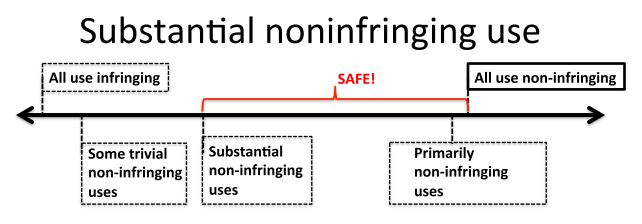
Image description: A horizontal spectrum showing different categories of use from left to right. On the far left: “All use infringing.” Next: “Some trivial non-infringing uses.” In the middle: “Substantial non-infringing uses,” marked as “SAFE!” in red. Further right: “Primarily non-infringing uses.” On the far right: “All use non-infringing.” The diagram illustrates a continuum from infringing to non-infringing uses, with safety lying in the middle-to-right range.
Like every other concept in law, the exact boundary of the substantial noninfringing use test is debatable. However, not all uncertainties are created equal. New technology will almost inevitably pose unknowable future harms and benefits; any test requiring a technology developer to mitigate the former while maximizing the latter creates not just uncertainty, but profound uncertainty. In contrast, while the borderlands of the substantial noninfringing use test may be disputed, in most cases there is a clear field beyond the border where the legality of a new device cannot be seriously disputed. Who knows what the optimal design of the iPod was when it was launched in late 2001? There was no iTunes Music Store at the time and a large amount of music filling people’s iPods probably was downloaded illegally. Perhaps Apple could have done more to make the iPod incompatible with music illegally downloaded from peer to peer filesharing sites, perhaps not. Under the substantial noninfringing use standard that exact calculation is immaterial; all that matters is that there was substantial noninfringing use. In the case of the iPod, the ability of consumers to play music ripped from their own legally purchased CDs met that standard. In practice, technology developers may have to over-shoot the substantial noninfringing use mark to be completely confident that they are on solid legal ground, but the point is that such confidence is possible.
(4) The Sony decision has significant implications for copyright policy and innovation policy. If the Supreme Court had held the Sony Corporation liable for user infringement, it could have given content owners an effective veto over the development of the VCR. The Court would have, in effect, asked potential new entrants to make their product design decisions as though they were vertically integrated subsidiaries of the entertainment industry.
(5) Justices Breyer and Ginsburg undertake an extended discussion of the merits and demerits of the Sony safe harbor in their concurring opinions in Metro-Goldwyn-Mayer Studios Inc. v. Grokster, Ltd., 545 U.S. 913 (2005), the main holding of which is discussed below.
A&M Records v. Napster, Inc., 239 F.3d 1004 (9th Cir. 2001)
Napster was an online peer-to-peer file-sharing service launched in 1999 that enabled users to search for, download, and share digital audio files—primarily MP3s—directly from each other’s computers through a central index maintained on Napster’s servers. Napster was extraordinarily popular in its brief peak period (1999–2001). Within months of its launch, it attracted millions of users—by early 2001, estimates placed its active user base at around 60 million worldwide, making it one of the fastest-growing internet services in history at the time. It became a cultural phenomenon among college students and music fans, who could access vast libraries of songs for free, often within minutes, at a time when legal digital music distribution was almost nonexistent.
Major record companies, including A&M Records, alleged that Napster facilitated and encouraged widespread unauthorized copying and distribution of copyrighted sound recordings, resulting in massive infringement of their works.
The plaintiffs contended that Napster’s system, which required user registration, maintained directories of available files, and provided technical support, was designed to exploit and promote access to infringing material, while Napster argued that its service was capable of substantial noninfringing uses and that it did not directly host or copy the files at issue.
The Ninth Circuit held that Napster was liable for contributory copyright infringement because it knew or had reason to know of infringing activity on its system and materially contributed to that infringement, and for vicarious copyright infringement because it had the right and ability to supervise the infringing conduct and derived a direct financial benefit from it. Specifically, the court of appeals said:
… if a computer system operator learns of specific infringing material available on his system and fails to purge such material from the system, the operator knows of and contributes to direct infringement. Conversely, absent any specific information which identifies infringing activity, a computer system operator cannot be liable for contributory infringement merely because the structure of the system allows for the exchange of copyrighted material. To enjoin simply because a computer network allows for infringing use would, in our opinion, violate Sony and potentially restrict activity unrelated to infringing use.
We nevertheless conclude that sufficient knowledge exists to impose contributory liability when linked to demonstrated infringing use of the Napster system. The record supports the district court’s finding that Napster has actual knowledge that specific infringing material is available using its system, that it could block access to the system by suppliers of the infringing material, and that it failed to remove the material.
The court rejected Napster’s defenses—including fair use and the Sony “substantial noninfringing use” doctrine—finding that the record supported preliminary injunctive relief to stop Napster from facilitating the exchange of copyrighted music without authorization.
Napster indicates that the Sony safe harbor may not be as effective for companies providing ongoing services rather than selling standalone products. The Napster decision also illustrates how important a technical architecture can be. Napster brokered direct file exchange between Napster users, however it maintained a centralized index of the files being exchanged. This led the District Court to conclude that Napster had reasonable knowledge of specific infringing files. In contrast, later generation file sharing services used a decentralized index, and thus, did not have the knowledge required to establish contributory liability according to the Ninth Circuit in Grokster. But that is far from the end of the story.
Metro-Goldwyn-Mayer Studios Inc. v. Grokster, Ltd., 545 U.S. 913 (2005)
JUSTICE SOUTER delivered the opinion of the Court.
The question is under what circumstances the distributor of a product capable of both lawful and unlawful use is liable for acts of copyright infringement by third parties using the product. We hold that one who distributes a device with the object of promoting its use to infringe copyright, as shown by clear expression or other affirmative steps taken to foster infringement, is liable for the resulting acts of infringement by third parties.
I
Respondents, Grokster, Ltd., and StreamCast Networks, Inc., defendants in the trial court, distribute free software products that allow computer users to share electronic files through peer-to-peer networks, so called because users’ computers communicate directly with each other, not through central servers. The advantage of peer-to-peer networks over information networks of other types shows up in their substantial and growing popularity. Because they need no central computer server to mediate the exchange of information or files among users, the high-bandwidth communications capacity for a server may be dispensed with, and the need for costly server storage space is eliminated. Since copies of a file (particularly a popular one) are available on many users’ computers, file requests and retrievals may be faster than on other types of networks, and since file exchanges do not travel through a server, communications can take place between any computers that remain connected to the network without risk that a glitch in the server will disable the network in its entirety. Given these benefits in security, cost, and efficiency, peer-to-peer networks are employed to store and distribute electronic files by universities, government agencies, corporations, and libraries, among others.
Other users of peer-to-peer networks include individual recipients of Grokster’s and StreamCast’s software, and although the networks that they enjoy through using the software can be used to share any type of digital file, they have prominently employed those networks in sharing copyrighted music and video files without authorization. A group of copyright holders (MGM for short, but including motion picture studios, recording companies, songwriters, and music publishers) sued Grokster and StreamCast for their users’ copyright infringements, alleging that they knowingly and intentionally distributed their software to enable users to reproduce and distribute the copyrighted works in violation of the Copyright Act, 17 U. S. C. § 101 et seq. (2000 ed. and Supp. II). MGM sought damages and an injunction.
[During litigation, it was revealed that Grokster’s software, using licensed FastTrack technology, and StreamCast’s Morpheus, using Gnutella technology, enabled peer-to-peer file sharing without central servers intercepting search requests or transfers. In FastTrack, file searches are routed through “supernodes” that index available files, while in Gnutella, peers may connect directly without supernodes. Both systems allow downloaded files to be shared in designated folders. Although Grokster and StreamCast claim substantial potential for lawful uses, MGM’s commissioned study found that nearly 90% of files on FastTrack were copyrighted, suggesting that most downloads were infringing. The parties dispute these figures and note instances of authorized distribution, but evidence indicates large-scale infringement, with over 100 million copies of the software downloaded and billions of files shared monthly.]
[Grokster and StreamCast acknowledged that most downloads via their software were infringing and were aware of this use, sometimes directly assisting users seeking to play copyrighted material. Evidence showed both companies actively sought to capture Napster’s user base after its legal troubles, using OpenNap networks, targeted advertising, and search engine tactics to attract those looking for copyrighted content. StreamCast’s campaigns explicitly marketed Morpheus as the “#1 alternative to Napster” and monitored copyrighted song availability to appeal to infringing users, while Grokster used similar tactics, including its own Napster-like service. Their ad-driven business models depended on maximizing users—especially those seeking copyrighted works—and neither company implemented meaningful measures to block or filter such content, with StreamCast even obstructing monitoring efforts.]
[After discovery, both sides sought summary judgment. The District Court found that Grokster and StreamCast’s users directly infringed MGM’s copyrights but ruled the companies not liable for distributing their then-current software, as they lacked actual knowledge of specific infringements due to its decentralized design. The Ninth Circuit affirmed, applying Sony to hold that products capable of substantial noninfringing uses could not give rise to contributory liability absent such knowledge, and finding no material contribution since users—not the companies—initiated and carried out the infringing acts. It also rejected vicarious liability, noting the companies neither controlled nor had a duty to police use of their software. The Supreme Court granted certiorari.]
II
A
MGM and many of the amici fault the Court of Appeals’ holding for upsetting a sound balance between the respective values of supporting creative pursuits through copyright protection and promoting innovation in new communication technologies by limiting the incidence of liability for copyright infringement. The more artistic protection is favored, the more technological innovation may be discouraged; the administration of copyright law is an exercise in managing the tradeoff.
The tension between the two values is the subject of this case, with its claim that digital distribution of copyrighted material threatens copyright holders as never before, because every copy is identical to the original, copying is easy, and many people (especially the young) use file-sharing software to download copyrighted works. This very breadth of the software’s use may well draw the public directly into the debate over copyright policy, and the indications are that the ease of copying songs or movies using software like Grokster’s and Napster’s is fostering disdain for copyright protection. As the case has been presented to us, these fears are said to be offset by the different concern that imposing liability, not only on infringers but on distributors of software based on its potential for unlawful use, could limit further development of beneficial technologies.
The argument for imposing indirect liability in this case is, however, a powerful one, given the number of infringing downloads that occur every day using StreamCast’s and Grokster’s software. When a widely shared service or product is used to commit infringement, it may be impossible to enforce rights in the protected work effectively against all direct infringers, the only practical alternative being to go against the distributor of the copying device for secondary liability on a theory of contributory or vicarious infringement.
One infringes contributorily by intentionally inducing or encouraging direct infringement, see Gershwin v. Columbia Artists Management, and infringes vicariously by profiting from direct infringement while declining to exercise a right to stop or limit it, Shapiro v. H. L. Green Co.9
Footnote 9: We stated in Sony v. Universal (1984), that “the lines between direct infringement, contributory infringement and vicarious liability are not clearly drawn. Reasoned analysis of the plaintiffs’ contributory infringement claim necessarily entails consideration of arguments and case law which may also be forwarded under the other labels, and indeed the parties rely upon such arguments and authority in support of their respective positions on the issue of contributory infringement.” In the present case MGM has argued a vicarious liability theory, which allows imposition of liability when the defendant profits directly from the infringement and has a right and ability to supervise the direct infringer, even if the defendant initially lacks knowledge of the infringement. Because we resolve the case based on an inducement theory, there is no need to analyze separately MGM’s vicarious liability theory.
Although the Copyright Act does not expressly render anyone liable for infringement committed by another, these doctrines of secondary liability emerged from common law principles and are well established in the law.
B
Despite the currency of these principles of secondary liability, this Court has dealt with secondary copyright infringement in only one recent case, and because MGM has tailored its principal claim to our opinion there, a look at our earlier holding is in order. In Sony Corp. v. Universal City Studios, this Court addressed a claim that secondary liability for infringement can arise from the very distribution of a commercial product. There, the product, novel at the time, was what we know today as the videocassette recorder or VCR. Copyright holders sued Sony as the manufacturer, claiming it was contributorily liable for infringement that occurred when VCR owners taped copyrighted programs because it supplied the means used to infringe, and it had constructive knowledge that infringement would occur. At the trial on the merits, the evidence showed that the principal use of the VCR was for “time-shifting,” or taping a program for later viewing at a more convenient time, which the Court found to be a fair, not an infringing, use. There was no evidence that Sony had expressed an object of bringing about taping in violation of copyright or had taken active steps to increase its profits from unlawful taping. Although Sony’s advertisements urged consumers to buy the VCR to “record favorite shows” or “build a library” of recorded programs, neither of these uses was necessarily infringing.
On those facts, with no evidence of stated or indicated intent to promote infringing uses, the only conceivable basis for imposing liability was on a theory of contributory infringement arising from its sale of VCRs to consumers with knowledge that some would use them to infringe. But because the VCR was “capable of commercially significant noninfringing uses,” we held the manufacturer could not be faulted solely on the basis of its distribution.
This analysis reflected patent law’s traditional staple article of commerce doctrine, now codified, that distribution of a component of a patented device will not violate the patent if it is suitable for use in other ways. 35 U.S.C. § 271(c); Aro Mfg. Co. v. Convertible Top Replacement Co., 377 U. S. 476, 485 (1964) (noting codification of cases). The doctrine was devised to identify instances in which it may be presumed from distribution of an article in commerce that the distributor intended the article to be used to infringe another’s patent, and so may justly be held liable for that infringement. “One who makes and sells articles which are only adapted to be used in a patented combination will be presumed to intend the natural consequences of his acts; he will be presumed to intend that they shall be used in the combination of the patent.” New York Scaffolding Co. v. Whitney, 224 F. 452, 459 (CA8 1915).
In sum, where an article is “good for nothing else” but infringement, Canda v. Michigan Malleable Iron Co., at 489, there is no legitimate public interest in its unlicensed availability, and there is no injustice in presuming or imputing an intent to infringe, see Henry v. A. B. Dick Co., 224 U.S. 1, 48 (1912), overruled on other grounds, Motion Picture Patents Co. v. Universal Film Mfg. Co., 243 U. S. 502 (1917). Conversely, the doctrine absolves the equivocal conduct of selling an item with substantial lawful as well as unlawful uses, and limits liability to instances of more acute fault than the mere understanding that some of one’s products will be misused. It leaves breathing room for innovation and a vigorous commerce. See Sony Corp. v. Universal City Studios, 464 U. S., at 442; Dawson Chemical Co. v. Rohm & Haas Co., 448 U.S. 176, 221 (1980); Henry v. A. B. Dick Co., at 48.
The parties and many of the amici in this case think the key to resolving it is the Sony rule and, in particular, what it means for a product to be “capable of commercially significant noninfringing uses.” Sony Corp. v. Universal City Studios, at 442. MGM advances the argument that granting summary judgment to Grokster and StreamCast as to their current activities gave too much weight to the value of innovative technology, and too little to the copyrights infringed by users of their software, given that 90% of works available on one of the networks was shown to be copyrighted. Assuming the remaining 10% to be its noninfringing use, MGM says this should not qualify as “substantial,” and the Court should quantify Sony to the extent of holding that a product used “principally” for infringement does not qualify. As mentioned before, Grokster and StreamCast reply by citing evidence that their software can be used to reproduce public domain works, and they point to copyright holders who actually encourage copying. Even if infringement is the principal practice with their software today, they argue, the noninfringing uses are significant and will grow.
We agree with MGM that the Court of Appeals misapplied Sony, which it read as limiting secondary liability quite beyond the circumstances to which the case applied. Sony barred secondary liability based on presuming or imputing intent to cause infringement solely from the design or distribution of a product capable of substantial lawful use, which the distributor knows is in fact used for infringement. The Ninth Circuit has read Sony’s limitation to mean that whenever a product is capable of substantial lawful use, the producer can never be held contributorily liable for third parties’ infringing use of it; it read the rule as being this broad, even when an actual purpose to cause infringing use is shown by evidence independent of design and distribution of the product, unless the distributors had “specific knowledge of infringement at a time at which they contributed to the infringement, and failed to act upon that information.” 380 F. 3d, at 1162 (internal quotation marks and brackets omitted). Because the Circuit found the StreamCast and Grokster software capable of substantial lawful use, it concluded on the basis of its reading of Sony that neither company could be held liable, since there was no showing that their software, being without any central server, afforded them knowledge of specific unlawful uses.
This view of Sony, however, was error, converting the case from one about liability resting on imputed intent to one about liability on any theory. Because Sony did not displace other theories of secondary liability, and because we find below that it was error to grant summary judgment to the companies on MGM’s inducement claim, we do not revisit Sony further, as MGM requests, to add a more quantified description of the point of balance between protection and commerce when liability rests solely on distribution with knowledge that unlawful use will occur. It is enough to note that the Ninth Circuit’s judgment rested on an erroneous understanding of Sony and to leave further consideration of the Sony rule for a day when that may be required.
C
Sony’s rule limits imputing culpable intent as a matter of law from the characteristics or uses of a distributed product. But nothing in Sony requires courts to ignore evidence of intent if there is such evidence, and the case was never meant to foreclose rules of fault-based liability derived from the common law. Sony Corp. v. Universal City Studios, at 439 (“If vicarious liability is to be imposed on Sony in this case, it must rest on the fact that it has sold equipment with constructive knowledge” of the potential for infringement). Thus, where evidence goes beyond a product’s characteristics or the knowledge that it may be put to infringing uses, and shows statements or actions directed to promoting infringement, Sony’s staple-article rule will not preclude liability.
The classic case of direct evidence of unlawful purpose occurs when one induces commission of infringement by another, or “entic[es] or persuad[es] another” to infringe, Black’s Law Dictionary 790 (8th ed. 2004), as by advertising. Thus at common law a copyright or patent defendant who “not only expected but invoked [infringing use] by advertisement” was liable for infringement “on principles recognized in every part of the law.” Kalem Co. v. Harper Brothers, 222 U. S., at 62-63 (copyright infringement). See also Henry v. A. B. Dick Co., 224 U. S., at 48-49 (contributory liability for patent infringement may be found where a good’s “most conspicuous use is one which will coöperate in an infringement when sale to such user is invoked by advertisement” of the infringing use); Thomson-Houston Electric Co. v. Kelsey Electric R. Specialty Co., 75 F. 1005, 1007-1008 (CA2 1896) (relying on advertisements and displays to find defendant’s “willingness . . . to aid other persons in any attempts which they may be disposed to make towards [patent] infringement”); Rumford Chemical Works v. Hecker, 20 F. Cas. 1342, 1346 (No. 12,133) (CC NJ 1876) (demonstrations of infringing activity along with “avowals of the [infringing] purpose and use for which it was made” supported liability for patent infringement).
The rule on inducement of infringement as developed in the early cases is no different today. Evidence of “active steps . . . taken to encourage direct infringement,” Oak Industries, Inc. v. Zenith Electronics Corp., 697 F. Supp. 988, 992 (ND Ill. 1988), such as advertising an infringing use or instructing how to engage in an infringing use, show an affirmative intent that the product be used to infringe, and a showing that infringement was encouraged overcomes the law’s reluctance to find liability when a defendant merely sells a commercial product suitable for some lawful use, see, e. g., Water Technologies Corp. v. Calco, Ltd., 850 F. 2d 660, 668 (CA Fed. 1988) (liability for inducement where one “actively and knowingly aid[s] and abet[s] another’s direct infringement”); Fromberg, Inc. v. Thornhill, 315 F. 2d 407, 412-413 (CA5 1963) (demonstrations by sales staff of infringing uses supported liability for inducement); Haworth Inc. v. Herman Miller Inc., 37 USPQ 2d 1080, 1090 (WD Mich. 1994) (evidence that defendant “demonstrate[d] and recommend[ed] infringing configurations” of its product could support inducement liability); Sims v. Mack Trucks, Inc., 459 F. Supp. 1198, 1215 (ED Pa. 1978) (finding inducement where the use “depicted by the defendant in its promotional film and brochures infringes the . . . patent”), overruled on other grounds, 608 F. 2d 87 (CA3 1979). Cf. W. Keeton, D. Dobbs, R. Keeton, & D. Owen, Prosser and Keeton on Law of Torts 37 (5th ed. 1984) (“There is a definite tendency to impose greater responsibility upon a defendant whose conduct was intended to do harm, or was morally wrong”).
For the same reasons that Sony took the staple-article doctrine of patent law as a model for its copyright safe-harbor rule, the inducement rule, too, is a sensible one for copyright. We adopt it here, holding that one who distributes a device with the object of promoting its use to infringe copyright, as shown by clear expression or other affirmative steps taken to foster infringement, is liable for the resulting acts of infringement by third parties. We are, of course, mindful of the need to keep from trenching on regular commerce or discouraging the development of technologies with lawful and unlawful potential. Accordingly, just as Sony did not find intentional inducement despite the knowledge of the VCR manufacturer that its device could be used to infringe, 464 U.S., at 439, n. 19, mere knowledge of infringing potential or of actual infringing uses would not be enough here to subject a distributor to liability. Nor would ordinary acts incident to product distribution, such as offering customers technical support or product updates, support liability in themselves. The inducement rule, instead, premises liability on purposeful, culpable expression and conduct, and thus does nothing to compromise legitimate commerce or discourage innovation having a lawful promise.
III
A
The only apparent question about treating MGM’s evidence as sufficient to withstand summary judgment under the theory of inducement goes to the need on MGM’s part to adduce evidence that StreamCast and Grokster communicated an inducing message to their software users. The classic instance of inducement is by advertisement or solicitation that broadcasts a message designed to stimulate others to commit violations. MGM claims that such a message is shown here. It is undisputed that StreamCast beamed onto the computer screens of users of Napster-compatible programs ads urging the adoption of its OpenNap program, which was designed, as its name implied, to invite the custom of patrons of Napster, then under attack in the courts for facilitating massive infringement. Those who accepted StreamCast’s OpenNap program were offered software to perform the same services, which a factfinder could conclude would readily have been understood in the Napster market as the ability to download copyrighted music files. Grokster distributed an electronic newsletter containing links to articles promoting its software’s ability to access popular copyrighted music. And anyone whose Napster or free file-sharing searches turned up a link to Grokster would have understood Grokster to be offering the same file-sharing ability as Napster, and to the same people who probably used Napster for infringing downloads; that would also have been the understanding of anyone offered Grokster’s suggestively named Swaptor software, its version of OpenNap. And both companies communicated a clear message by responding affirmatively to requests for help in locating and playing copyrighted materials.
In StreamCast’s case, of course, the evidence just described was supplemented by other unequivocal indications of unlawful purpose in the internal communications and advertising designs aimed at Napster users (“When the lights went off at Napster . . . where did the users go?”. Whether the messages were communicated is not to the point on this record. The function of the message in the theory of inducement is to prove by a defendant’s own statements that his unlawful purpose disqualifies him from claiming protection (and incidentally to point to actual violators likely to be found among those who hear or read the message). Proving that a message was sent out, then, is the preeminent but not exclusive way of showing that active steps were taken with the purpose of bringing about infringing acts, and of showing that infringing acts took place by using the device distributed. Here, the summary judgment record is replete with other evidence that Grokster and StreamCast, unlike the manufacturer and distributor in Sony, acted with a purpose to cause copyright violations by use of software suitable for illegal use.
Three features of this evidence of intent are particularly notable. First, each company showed itself to be aiming to satisfy a known source of demand for copyright infringement, the market comprising former Napster users. StreamCast’s internal documents made constant reference to Napster, it initially distributed its Morpheus software through an OpenNap program compatible with Napster, it advertised its OpenNap program to Napster users, and its Morpheus software functions as Napster did except that it could be used to distribute more kinds of files, including copyrighted movies and software programs. Grokster’s name is apparently derived from Napster, it too initially offered an OpenNap program, its software’s function is likewise comparable to Napster’s, and it attempted to divert queries for Napster onto its own Web site. Grokster and StreamCast’s efforts to supply services to former Napster users, deprived of a mechanism to copy and distribute what were overwhelmingly infringing files, indicate a principal, if not exclusive, intent on the part of each to bring about infringement.
Second, this evidence of unlawful objective is given added significance by MGM’s showing that neither company attempted to develop filtering tools or other mechanisms to diminish the infringing activity using their software. While the Ninth Circuit treated the defendants’ failure to develop such tools as irrelevant because they lacked an independent duty to monitor their users’ activity, we think this evidence underscores Grokster’s and StreamCast’s intentional facilitation of their users’ infringement.12
Footnote 12: Of course, in the absence of other evidence of intent, a court would be unable to find contributory infringement liability merely based on a failure to take affirmative steps to prevent infringement, if the device otherwise was capable of substantial noninfringing uses. Such a holding would tread too close to the Sony safe harbor.
Third, there is a further complement to the direct evidence of unlawful objective. It is useful to recall that StreamCast and Grokster make money by selling advertising space, by directing ads to the screens of computers employing their software. As the record shows, the more the software is used, the more ads are sent out and the greater the advertising revenue becomes. Since the extent of the software’s use determines the gain to the distributors, the commercial sense of their enterprise turns on high-volume use, which the record shows is infringing.13
Footnote 13: Grokster and StreamCast contend that any theory of liability based on their conduct is not properly before this Court because the rulings in the trial and appellate courts dealt only with the present versions of their software, not “past acts . . . that allegedly encouraged infringement or assisted . . . known acts of infringement.” This contention misapprehends the basis for their potential liability. It is not only that encouraging a particular consumer to infringe a copyright can give rise to secondary liability for the infringement that results. Inducement liability goes beyond that, and the distribution of a product can itself give rise to liability where evidence shows that the distributor intended and encouraged the product to be used to infringe. In such a case, the culpable act is not merely the encouragement of infringement but also the distribution of the tool intended for infringing use.
This evidence alone would not justify an inference of unlawful intent, but viewed in the context of the entire record its import is clear.
The unlawful objective is unmistakable.
B
In addition to intent to bring about infringement and distribution of a device suitable for infringing use, the inducement theory of course requires evidence of actual infringement by recipients of the device, the software in this case. As the account of the facts indicates, there is evidence of infringement on a gigantic scale, and there is no serious issue of the adequacy of MGM’s showing on this point in order to survive the companies’ summary judgment requests. Although an exact calculation of infringing use, as a basis for a claim of damages, is subject to dispute, there is no question that the summary judgment evidence is at least adequate to entitle MGM to go forward with claims for damages and equitable relief.
* * *
In sum, this case is significantly different from Sony and reliance on that case to rule in favor of StreamCast and Grokster was error. Sony dealt with a claim of liability based solely on distributing a product with alternative lawful and unlawful uses, with knowledge that some users would follow the unlawful course. The case struck a balance between the interests of protection and innovation by holding that the product’s capability of substantial lawful employment should bar the imputation of fault and consequent secondary liability for the unlawful acts of others.
MGM’s evidence in this case most obviously addresses a different basis of liability for distributing a product open to alternative uses. Here, evidence of the distributors’ words and deeds going beyond distribution as such shows a purpose to cause and profit from third-party acts of copyright infringement. If liability for inducing infringement is ultimately found, it will not be on the basis of presuming or imputing fault, but from inferring a patently illegal objective from statements and actions showing what that objective was.
There is substantial evidence in MGM’s favor on all elements of inducement, and summary judgment in favor of Grokster and StreamCast was error. On remand, reconsideration of MGM’s motion for summary judgment will be in order.
Notes and questions
(1) How did the Ninth Circuit interpret Sony in relation to the requirement of “specific knowledge” for contributory liability? Why did the Supreme Court reject this reading of Sony? Does the Court’s approach narrow or broaden Sony’s safe harbor in practice?
(2) Why is “mere knowledge” of infringing uses insufficient to establish inducement liability? What kinds of conduct or expression did the Court identify as sufficient to prove purposeful intent to foster infringement? How does Footnote 12 limit the role of a defendant’s failure to prevent infringement?
Summary of the pre-Cox landscape
Before Cox, a plaintiff suing an intermediary for the infringements of its users could draw on a well-developed body of doctrine. Under the principle of contributory copyright infringement, a service provider could be held responsible for user infringement if it had knowledge of, and made a material contribution to, a user’s infringement. The main issue in applying this standard was always what counts as knowledge? As exemplified by the Supreme Court’s decision in Sony v. Universal, general knowledge that a product might be used to infringe copyright falls well short of the mark. In Sony, the Court held that the manufacturer of a video cassette recorder was not liable for infringing recordings made by consumers because at least some of the uses of the VCR were lawful. The Court said it was enough that the copying equipment was “merely … capable of substantial noninfringing uses.”
As the Napster case indicates, even having a substantial non-infringing use might not be enough. Recall that in Napster as the service grew, record companies gave Napster detailed notices of sound recordings not authorized for online sharing. According to the Ninth Circuit, this took Napster outside the rule in Sony because there was no need to impute its knowledge of infringement from the circumstances—Napster had actual knowledge. The court held that control over the index, combined with concrete notice and a failure to remove identified works, satisfied the knowledge requirement, notwithstanding the system’s potential for non-infringing use.
Another path to liability based on Ninth Circuit precedent, which we have not addressed thus far, is the doctrine of “simple measures.” In the online-services context, courts in the Ninth Circuit sometimes evaluated material contribution by asking whether the defendant, after obtaining knowledge of specific infringement, could have taken “simple measures” or other reasonable and feasible steps to withhold its assistance yet continued providing access to the infringing activity. See Perfect 10, Inc. v. Amazon.com, Inc., 508 F.3d 1146, 1172 (9th Cir. 2007); see also VHT, Inc. v. Zillow Group, Inc., 918 F.3d 723, 745 (9th Cir. 2019).
The post-Gershwin Era
Cox Communications, Inc. v. Sony Music Entertainment, 607 U.S. 583 (2026)
Justice THOMAS delivered the opinion of the Court.
Countless people use the Internet for legal activities, but some use it to illegally share copyrighted works, such as songs and movies. The Copyright Act authorizes copyright owners to sue these copyright infringers. 17 U.S.C. §§ 501(a), 504(a). In this case, however, instead of suing those infringers, the copyright owners sued petitioners, Cox Communications, Inc., and its subsidiary, who provided the Internet connections that the infringers used. They contended that Cox was itself liable for copyright infringement because it continued to provide known infringers with Internet access.
Based on this theory of infringement, respondents, Sony Music Entertainment and other major copyright owners, secured a billion-dollar verdict against Cox. The United States Court of Appeals for the Fourth Circuit agreed that because Cox provided Internet service to known infringers, it was a willful infringer itself.
Under our precedents, a company is not liable as a copyright infringer for merely providing a service to the general public with knowledge that it will be used by some to infringe copyrights. Accordingly, we reverse.
I
A
Under the Copyright Act, copyright owners have the exclusive rights to copy, distribute, and digitally transmit their copyrighted works. § 106. So, for example, if a musician has a copyright for a song recording, others generally cannot copy and share that recording without the musician’s permission. The Copyright Act provides that “[a]nyone who violates any of the exclusive rights of the copyright owner... is an infringer of the copyright.” § 501(a). A willful infringer faces statutory damages of up to $150,000 per work. § 504(c)(2).
This Court has also recognized two categories of secondary copyright liability, which means liability for the copyright infringement of another. Those two categories are “contributory” liability and “vicarious” liability. Metro-Goldwyn-Mayer Studios Inc. v. Grokster, Ltd., 545 U.S. 913, 930 (2005). This case concerns contributory liability.
The provider of a service is contributorily liable for a user’s infringement if it intended its service to be used for infringement. To establish that a provider intended its service to be used for infringement, a copyright owner must show one of two things. First, it can show that a party affirmatively “induced” the infringement. Ibid. Or, second, it can show that the party sold a service tailored to infringement. Id., at 942 (Ginsburg, J., concurring). Patent law, with which copyright law has a “historic kinship,” Sony Corp. of America v. Universal City Studios, Inc., 464 U.S. 417, 439 (1984), tracks these two requirements. See 35 U.S.C. §§ 271(b), (c).
In 1998, Congress passed the Digital Millennium Copyright Act, 17 U.S.C. § 1201 et seq., which gave service providers a safe-harbor defense to secondary copyright liability. Under the DMCA safe-harbor defense, service providers cannot be secondarily liable for certain forms of copyright infringement if they have implemented “a policy that provides for the termination in appropriate circumstances of subscribers and account holders” who “are repeated infringers.” § 512(i)(1)(A). At the same time, the DMCA specifies that failure to qualify for the safe-harbor defense “shall not bear adversely upon the consideration of a defense by the service provider that the service provider’s conduct is not infringing.” § 512(l).
B
Cox Communications, Inc., is an Internet service provider that serves about 6 million subscribers. Each subscriber’s account is associated with a unique Internet Protocol, or “IP,” address. Many users can share a particular IP address. For example, a household, coffee shop, or college dormitory ordinarily has one IP address, but has multiple individual users.
Internet service providers, such as Cox, have limited knowledge about how their Internet services are used and who uses them. They do know which IP address corresponds to which subscriber’s account, but they cannot distinguish one individual user from another. For instance, if an Internet service provider learns that someone illegally downloaded music from a coffee shop’s IP address, the Internet service provider cannot determine which individual at the coffee shop infringed the copyright. And, more generally, Internet service providers also cannot directly control how their Internet services are used.
Sony Music Entertainment and the other plaintiffs in this case are major music copyright owners. They have struggled to protect their copyrights in the age of online music sharing. Today, anyone with an Internet connection and easily obtained software can upload digital copies of copyrighted music and make them available for others to download. This practice often infringes the owners’ exclusive rights to copy and distribute their works. §§ 106(1), (3). Copyright owners can, and do, sue the individuals who infringe their copyrights in this manner. See, e.g., Sony BMG Music Entertainment v. Tenenbaum, 660 F.3d 487, 490 (1st Cir. 2011). However, because online infringement is so widespread, pursuing each individual infringer does little to stem the tide.
Given the difficulty of pursuing individual infringers, Sony attempted to enlist Internet service providers such as Cox to help it enforce its copyrights. It enlisted the services of an entity called MarkMonitor to track infringement of its copyrights across the Internet. MarkMonitor’s software can detect when copyrighted works are illegally uploaded or downloaded and trace the infringing activity to a particular IP address. It can also identify the Internet service provider for the infringing IP address. When MarkMonitor detects apparently infringing activity, it sends notices to the Internet service provider, identifying the IP address at which the infringement occurred. In the roughly 2-year period at issue here, MarkMonitor sent Cox 163,148 such notices.
Cox states that it took steps to limit copyright infringement by those using its Internet services. According to Cox, it created a system of responding to the notices that it received from MarkMonitor. After the second MarkMonitor notice for a subscriber’s account, Cox sent a warning to that subscriber. After additional notices, Cox terminated Internet access to that subscriber’s IP address until the subscriber responded to the warning. If it continued to receive notices for that IP address, Cox suspended service until the subscriber called and received a warning over the phone. After 13 notices, the subscriber was subject to termination of all Internet service. Cox also contractually prohibits its subscribers from using their connection “to post, copy, transmit, or disseminate any content that infringes the patents, copyrights... or proprietary rights of any party.”
The parties disagree about how to characterize Cox’s efforts to protect Sony’s copyrights. Sony points out that Cox terminated only 32 subscribers for infringement during the claim period, even as it terminated hundreds of thousands of subscribers for nonpayment during the same period. Sony also points to statements from Cox employees expressing frustration with the notices and an unwillingness to act on them in favor of protecting revenue from subscriber payments. Cox resists this characterization by pointing out that its warning and suspension system ended 98% of identified infringement.
C
Sony sued Cox in the United States District Court for the Eastern District of Virginia. It advanced two theories of secondary copyright liability.
First, Sony alleged that Cox was contributorily liable for its users’ infringement. Sony argued that Cox contributed to its users’ infringement by continuing to provide Internet service to subscribers whose IP addresses it knew were associated with infringement. Second, Sony alleged that Cox was vicariously liable for its users’ infringement. On Sony’s telling, Cox “profited directly from the infringement and had a right and ability to supervise the direct infringers,” Grokster, 545 U.S., at 930, n. 9, because it provided paying subscribers with Internet service that was then used to infringe. According to Sony’s allegations, Cox was liable for willfully infringing 10,017 copyrighted works, subjecting it to up to $1.5 billion in statutory damages.
In the District Court, Sony prevailed as to both contributory and vicarious liability. The jury found in favor of Sony on both theories. It also found that Cox’s infringement was willful, awarding $1 billion in statutory damages. The District Court denied Cox’s post-trial motion for judgment as a matter of law in relevant part.
Cox could not invoke the DMCA safe-harbor defense based on its efforts to reduce infringement because an earlier decision had foreclosed that defense for the relevant period. See BMG Rights Mgmt. (US) LLC v. Cox Communications, Inc., 881 F.3d 293, 301-305 (4th Cir. 2018).
The Fourth Circuit affirmed in part and reversed in part. It affirmed as to contributory liability because Cox continued to provide Internet service to known infringers. Applying Circuit precedent, it reasoned that “supplying a product with knowledge that the recipient will use it to infringe copyrights is exactly the sort of culpable conduct sufficient for contributory infringement.” See BMG Rights Mgmt. (US) LLC v. Cox Communications, Inc., 881 F.3d 293, 308 (4th Cir. 2018). The Fourth Circuit reversed as to vicarious liability because it concluded that Cox did not “receive a direct financial benefit from its subscribers’ infringement.” The court then vacated the damages award and remanded for the jury to reassess damages based on contributory liability alone.
We granted Cox’s petition for a writ of certiorari as to contributory liability. 606 U. S. 930 (2025). We denied Sony’s petition for a writ of certiorari regarding vicarious liability. 606 U. S. 931 (2025).
II
A
“The Copyright Act does not expressly render anyone liable for infringement committed by another.” Sony, 464 U.S., at 434. Ordinarily, when Congress intends to impose secondary liability, it does so expressly. See Central Bank of Denver, N. A. v. First Interstate Bank of Denver, N. A., 511 U.S. 164, 176-177 (1994). Although our precedents have recognized specific forms of secondary copyright liability that predated the Copyright Act, we are loath to expand such liability beyond those precedents.
B
The provider of a service is contributorily liable for the user’s infringement only if it intended that the provided service be used for infringement. The intent required for contributory liability can be shown only if the party induced the infringement or the provided service is tailored to that infringement. Grokster, 545 U.S., at 930; Sony, 464 U.S., at 440-441.
A provider induces infringement if it actively encourages infringement through specific acts. Grokster, 545 U.S., at 942 (Ginsburg, J., concurring). For example, in Grokster, we held that a jury could find two file-sharing software companies liable for inducement. Id., at 941 (majority opinion). The companies promoted and marketed their software as a tool to infringe copyrights. Id., at 926. The “principal object” of their business models “was use of their software to download copyrighted works.” Ibid. Other decisions have held providers liable for similar conduct. See Kalem Co. v. Harper Brothers, 222 U.S. 55, 62-63 (1911) (finding liability where “The defendant not only expected but invoked by advertisement the use of its films” for infringement of an author’s copyright); Henry v. A. B. Dick Co., 224 U.S. 1, 49 (1912) (finding liability because the sale was made “with the purpose and intent” that the object be used for patent infringement), overruled on other grounds, Motion Picture Patents Co. v. Universal Film Mfg. Co., 243 U.S. 502, 518 (1917).
A service is tailored to infringement if it is “not capable of ‘substantial’ or ‘commercially significant’ noninfringing uses.” Grokster, 545 U.S., at 942 (Ginsburg, J., concurring) (quoting Sony, 464 U.S., at 442). In Sony, copyright owners sued the maker and the retailers of the Betamax video tape recorder. Id., at 422. The tape recorder could be used to record copyrighted television programs for later personal viewing, which would not constitute infringement. Id., at 449. On the other hand, it could also be used to reproduce and sell copyrighted television programming, which would constitute infringement. Ibid. The lower court found the Betamax maker liable because the tape recorder was “not suitable for any substantial noninfringing use” and infringement “was either the most conspicuous use or the major use of the Betamax product.” Id., at 428 (internal quotation marks omitted). This Court reversed, concluding that “The Betamax is ... capable of substantial noninfringing uses”—like personal use—so “sale of such equipment to the general public does not constitute contributory infringement.” Id., at 456.
These two forms of contributory infringement track patent law. See Grokster, 545 U.S., at 942 (Ginsburg, J., concurring). Under 35 U.S.C. § 271(b), “whoever actively induces infringement of a patent shall be liable as an infringer.” Such liability requires that the party express “an affirmative intent that the product be used to infringe.” Grokster, 545 U.S., at 936. Under § 271(c), a party is liable when it sells a product used for infringement “knowing the same to be especially made or especially adapted for use in an infringement of such patent.”
This Court has repeatedly made clear that mere knowledge that a service will be used to infringe is insufficient to establish the required intent to infringe. In Kalem Co., the Court explained that “mere indifferent supposition or knowledge on the part of the seller” that the buyer will use the product unlawfully is “not enough” to make the seller liable for the buyer’s conduct. 222 U.S., at 62. In Sony, the Court explained that “There is no precedent in the law of copyright” for liability based only “on the fact that the defendant has sold equipment with constructive knowledge of the fact that its customers may use that equipment to make unauthorized copies of copyrighted material.” 464 U.S., at 439. And, in Grokster, the Court confirmed that “a court would be unable to find contributory infringement liability merely based on a failure to take affirmative steps to prevent infringement.” 545 U.S., at 939, n. 12.
III
Thus, Cox is not contributorily liable for the infringement of Sony’s copyrights. Cox provided Internet service to its subscribers, but it did not intend for that service to be used to commit copyright infringement. Holding Cox liable merely for failing to terminate Internet service to infringing accounts would expand secondary copyright liability beyond our precedents.
Cox neither induced its users’ infringement nor provided a service tailored to infringement. As for inducement, Cox did not “induce” or “encourage” its subscribers to infringe in any manner. Sony provided no “evidence of express promotion, marketing, and intent to promote” infringement. And, Cox repeatedly discouraged copyright infringement by sending warnings, suspending services, and terminating accounts. As for providing a service tailored to infringement, Cox’s Internet service was clearly “capable of ‘substantial’ or ‘commercially significant’ non-infringing uses.” Id., at 942 (Ginsburg, J., concurring). Cox did not tailor its service to make copyright infringement easier. Cox simply provided Internet access, which is used for many purposes other than copyright infringement.
The Fourth Circuit found otherwise based only on its Circuit precedent establishing a new form of contributory liability. The court did not suggest that Cox induced its users to infringe. And, it did not deny that Cox’s service was “capable of substantial lawful use and not designed to promote infringement.” Rather, the court held that “supplying a product with knowledge that the recipient will use it to infringe copyrights is ... sufficient for contributory infringement.” The Fourth Circuit’s holding thus went beyond the two forms of liability recognized in Grokster and Sony. It also conflicted with this Court’s repeated admonition that contributory liability cannot rest only on a provider’s knowledge of infringement and insufficient action to prevent it. See Kalem Co., 222 U.S., at 62; Sony, 464 U.S., at 439; Grokster, 545 U.S., at 939, n. 12.
IV
Finally, Sony argues that the DMCA safe harbor would have no effect if Internet service providers are not liable for providing Internet service to known infringers. The DMCA safe harbor protects Internet service providers that terminate repeat infringers “in appropriate circumstances.” 17 U.S.C. § 512(i)(1)(A). Sony argues that Congress must have enacted the DMCA on the presumption that Internet service providers could be held liable in cases such as these.
Sony overreads the DMCA. Sony does not contend that the DMCA expressly imposes liability for Internet service providers who serve known infringers. It does not. The DMCA merely creates new defenses from liability for such providers. And, the DMCA made clear that failure to comply with the safe-harbor rules “shall not bear adversely upon ... a defense by the service provider that the service provider’s conduct is not infringing.” § 512(l).
V
The judgment of the Court of Appeals for the Fourth Circuit is reversed, and the case is remanded for further proceedings consistent with this opinion.
It is so ordered.
Notes and questions
(1) Cox was argued on 1 December 2025 and decided on 25 March 2026. Justice Thomas delivered the opinion of the Court, joined by Chief Justice Roberts and Justices Alito, Kagan, Gorsuch, Kavanaugh and Barrett. Justice Sotomayor, joined by Justice Jackson, concurred in the judgment. Justice Sotomayor agreed that Cox should not be liable on the record presented to the Court, but she objected that the majority had unnecessarily narrowed contributory liability further than the case required and had foreclosed common law theories, such as aiding and abetting, that the Court’s earlier decisions had left open. Justice Sotomayor also noted the tension between the majority’s reasoning and the requirements of the DMCA safe harbors. The Section 512 safe harbors are conditioned on adopting and reasonably implementing a program to terminate repeat infringers in appropriate circumstances. If the majority is right that supplying a service to known infringers is not enough for contributory infringement, why would a provider bother with the safe harbor at all? The chapter on internet safe harbors takes this up in more detail.
(2) In Copyright’s Jagged Frontier, Duke Law Journal (forthcoming 2026), Matthew Sag summarized the implications of Cox as follows:
Justice Thomas’s opinion makes three interventions in copyright’s approach to secondary liability. First, it changes the mental state required for contributory liability from knowledge to intent. The standard formulation, traceable to the Second Circuit’s 1971 decision in Gershwin Publishing v. Columbia Artists and quoted in countless cases since, was that contributory liability attaches to “one who, with knowledge of the infringing activity, induces, causes, or materially contributes to the infringing conduct of another.” Rather than addressing the specificity of knowledge required to ground secondary liability, the majority decision in Cox implies that knowledge is, at best, evidence of intent and not a sufficient element by itself. Perhaps this was always the law—in the same way that the state could confidently declare in George Orwell’s 1984 that “Oceania had always been at war with Eastasia”—but it is definitely not what many of us understood the law to be. Second, it effectively reads Grokster’s inducement holding as a ceiling rather than a floor. Most lower courts and commentators had read Grokster as expanding the reach of secondary liability by adding inducement to capture bad actors who might have escaped under the Sony safe harbor. Thomas reads it the other way: Outside of inducement and tailoring, there is nothing. That reading is textually plausible, it’s just surprising to those of us who read Grokster as adding to, rather than displacing, lower court precedents such as Gershwin. Third, the opinion forecloses the entire line of cases in which courts had imposed liability based on a defendant’s failure to act on specific notices of infringement. That means that arguments premised on Napster or the failure to take “simple measures” discussed in the previous subsection are now likely unavailing.
Do you agree with this assessment? Which one of these changes do you think is most consequential? Consider also what Cox does to decisions handed down before it. In New York Times Co. v. Microsoft Corp., 777 F. Supp. 3d 283 (S.D.N.Y. 2025), Judge Stein denied motions to dismiss contributory infringement claims against Microsoft and OpenAI, applying the Second Circuit’s objective standard — knew or had reason to know — and expressly noting the circuit split with the Ninth Circuit’s requirement of actual knowledge of specific acts. He reasoned that Sony and Grokster had addressed inducement but not material contribution, and so had left the latter theory open. That reading of Sony is difficult to sustain after Cox.
(3) Is it possible that lower courts will apply Cox Communications more narrowly than it is written, in an effort to preserve something of the Gershwin-era landscape?
There is, of course, the possibility that lower courts will interpret Cox more narrowly. In Michael Grecco Productions v. Twitter, 2026 WL 917606 (C.D. Cal. Mar. 31, 2026) the Court distinguished the situation in Cox on the grounds that “Sony provided no evidence of promotion, marketing, or intent to promote infringement, and Cox ‘repeatedly discouraged copyright infringement by sending warnings, suspending services, and terminating accounts.’” In contrast, in the Grecco case, the plaintiff had submitted “numerous DMCA takedown requests, which included the copyright and infringing material information” and Twitter had taken “no action to remove the infringing materials.” This was a decision on a motion for judgment on the pleadings under Rule 12(c), and the court relegated its discussion of Cox to a footnote. It also held that inducement had not been adequately pleaded, and yet sustained the contributory claim anyway — which is only possible if something survives Cox beyond the two routes the Supreme Court described. This is not very convincing. If the point of the majority opinion in Cox was that affirmative steps to prevent infringement are not legally required, their absence cannot be evidence of intent, can it?
(4) The first substantial application of Cox points the other way. In Nazemian v. NVIDIA Corp., No. 4:24-cv-01454 (N.D. Cal. May 5, 2026), authors alleged that NVIDIA had distributed scripts to customers designed to download and pre-process The Pile, an open-source dataset of English text created to train large language models that includes material from shadow libraries. Judge Tigar allowed the contributory claim to proceed under both of Cox’s routes. On inducement, he held that “[a]dvertising or promotion … is an example of an inducing act, not a pre-requisite for alleging inducement.” On tailoring, the question was what to measure: NVIDIA argued that its framework as a whole had substantial non-infringing uses, but the court looked instead at the specific component supplied, observing that the scripts “are alleged to have no other purpose than to speed up the process of infringement, unlike the digital video recorder systems at issue in Sony Corp. or the internet service provided in Cox.” The vicarious claim was dismissed: the plaintiffs identified no legal right by which NVIDIA could prevent customers from obtaining The Pile elsewhere. If the unit of analysis is the component rather than the product, how much of the Sony safe harbor is left for a company that ships a general-purpose toolkit with one purpose-built piece inside it?
(5) Applied straight, Cox is a powerful defense. In Barnes v. Sanchez, 2026 WL 1912085 (N.D. Cal. July 2, 2026), a pro se plaintiff sued YouTube over videos posted by another user. The court dismissed both the contributory and the vicarious claims, finding no allegation that YouTube intended its service to be used for infringement, induced infringement, or tailored its service to it; on vicarious liability it required allegations that users came to YouTube specifically because the infringing material was there. Note that YouTube won without relying on the § 512(c) safe harbor, exactly as Justice Sotomayor predicted.
(6) The practical consequences arrived quickly. On 6 April 2026 the Supreme Court granted certiorari in Grande Communications Networks, LLC v. UMG Recordings, Inc., 146 S. Ct. 2152 (2026), vacated the Fifth Circuit’s judgment and remanded for reconsideration in light of Cox. The labels then told the Fifth Circuit that they did not intend to litigate the merits further under the new standard, abandoning a judgment of some $46.8 million. That was of a piece with what they had already done elsewhere: in April 2026 they stipulated to dismissal with prejudice of their suits against Verizon, in which some $2.6 billion was claimed, and against Altice. See Murray Stassen, Record Labels’ $2B+ Copyright Lawsuit Against Verizon Jointly Dismissed in Wake of Supreme Court’s Cox Ruling, Music Bus. Worldwide (Apr. 23, 2026). A campaign that had produced a billion-dollar verdict was effectively over within four months, and it was ended by the plaintiffs rather than by a court.
Significant Secondary Liability Cases
The court in Perfect 10, Inc. v. Visa International Service Association, 494 F.3d 788 (9th Cir. 2007) warned that “viewed in isolation, the language of the tests [for secondary liability] described is quite broad, but when one reviews the details of the actual “cases and controversies” before the relevant court in each of the test-defining cases and the actual holdings in those cases, it is clear that the factual circumstances in this case are not analogous.” In that spirit, it is important to be familiar with those test-defining cases.
Fonovisa, Inc. v. Cherry Auction, Inc., 76 F.3d 259 (9th Cir. 1996)
Fonovisa, a music recording company, alleged that Cherry Auction operated a swap meet at which vendors regularly sold counterfeit recordings infringing Fonovisa’s copyrights and trademarks. Cherry Auction did not sell counterfeit records, but it owned the premises, charged vendors for booth space, and collected admission fees from customers. Fonovisa claimed Cherry Auction knew about the infringing activity, had been notified by law enforcement, and continued to provide facilities and services such as parking, advertising, and utilities that facilitated the sales. Fonovisa argued that these actions constituted contributory and vicarious copyright infringement.
The Ninth Circuit held that Fonovisa had adequately stated claims for contributory and vicarious infringement. It reasoned that knowingly providing the site and facilities for infringing sales, coupled with direct financial benefit and the right and ability to supervise the infringing conduct, was sufficient to support secondary liability. The court reversed the district court’s dismissal and allowed the case to proceed, emphasizing that a flea market operator could be held liable for infringing sales by vendors.
Perfect 10, Inc. v. Amazon.com, Inc., 508 F.3d 1146 (9th Cir. 2007)
Perfect 10 operated a subscription-based website offering copyrighted photographs of nude models. It sued Amazon.com and Google, alleging that Google’s “Image Search” displayed infringing thumbnail images of Perfect 10’s photos and linked to full-size infringing copies hosted by third-party websites. Perfect 10 claimed Google both directly and secondarily infringed its copyrights by creating and displaying the thumbnails and by linking to infringing material. Amazon was sued as the operator of A9.com, which incorporated Google’s image search technology.
The Ninth Circuit held that Google’s creation and display of thumbnail images constituted a prima facie case of direct infringement but that Google’s linking to full-size images on third-party websites did not constitute direct infringement under the “server test.” We discuss the “server test” in a later chapter. Note that the court also held the creation and display of thumbnail images was fair use. So the only issue that remained was the defendants’ secondary liability for the infringements made by the third-party websites. The court found that Perfect 10 had raised triable issues of fact on contributory infringement because Google had knowledge of specific infringements and provided links that facilitated access. It remanded for further proceedings but rejected Perfect 10’s vicarious liability claim due to insufficient evidence of a direct financial benefit tied to the infringing activity.
Perfect 10, Inc. v. Visa International Service Association, 494 F.3d 788 (9th Cir. 2007)
As noted above, Perfect 10 operated a subscription-based website offering copyrighted photographs of nude models. By the time this case was decided, Perfect 10 already had a long history of copyright litigation against search engines and this lawsuit was in some senses the logical next step. Perfect 10 sued Visa International Service Association, MasterCard International Inc., and several affiliated banks and data processing services, alleging secondary liability under federal copyright and trademark law, among other things. Perfect 10 argued that the credit card companies continued to process credit card payments to websites that it says infringe Perfect 10’s intellectual property rights after being notified by Perfect 10 of infringement by those websites. By continuing to process payments after being told that the websites were infringing its copyright and trademark rights, Perfect 10 argued that the credit card companies were indirectly liable for those copyright and trademark infringements.
The Ninth Circuit held that Perfect 10 failed to state a claim for secondary copyright infringement. The court reasoned that processing payments did not constitute “material contribution” to infringement because the infringement would still occur regardless of the payment system. Nor did defendants have the requisite right and ability to supervise infringing activity. The essence of the court’s decision was that the defendants lacked a sufficiently direct connection to infringement to satisfy the requirement of material contribution under the standard test for contributory liability or the requirement for the right and ability to supervise the infringing activity under a theory of vicarious liability. The court emphasized that providing financial services, without more direct involvement in the infringing acts themselves, is insufficient for contributory or vicarious copyright liability.
Perfect 10, Inc. v. Giganews, Inc., 847 F.3d 657 (9th Cir. 2017)
Perfect 10 (yes the same one!) sued Giganews, a Usenet service provider, alleging that Giganews hosted and distributed infringing copies of its copyrighted images on its servers. Giganews provided subscribers with access to Usenet newsgroups and stored copies of articles and binaries posted there. Perfect 10 argued that Giganews was directly and secondarily liable because it continued to store and transmit infringing material despite being notified. Giganews countered that it merely provided infrastructure for users’ postings and took down material when given proper notice.
The Ninth Circuit affirmed judgment for Giganews, holding that Perfect 10 failed to show volitional conduct necessary for direct infringement—merely providing an automated system to store and transmit user content is not enough. The court also rejected the contributory infringement claim because Perfect 10 had not shown Giganews had knowledge of specific infringing material and intentionally encouraged or induced infringement. On vicarious liability, the court found no evidence that infringing content drew subscribers or that Giganews profited directly from infringement.
One of the key aspects of the decision related to Perfect 10’s argument that Giganews could be held liable for contributory infringement because it failed to take “simple measures” to prevent infringement. The court explained that under Perfect 10 v. Amazon.com and Napster, a defendant with knowledge of specific infringements may be liable if it fails to take “simple measures” to prevent further harm. But it stressed that this duty only arises when the defendant has knowledge of specific infringing material and the ability to take action to remove or block it. Perfect 10 had not provided Giganews with valid, DMCA-compliant takedown notices identifying specific infringing articles on its servers. Without such specific knowledge, Giganews had no obligation to act, and its failure to adopt broader filtering or monitoring systems did not amount to a failure to take “simple measures.” The court emphasized that copyright law does not impose a general duty to monitor or affirmatively seek out infringement.
Cobbler Nevada, LLC v. Gonzales, 901 F.3d 1142 (9th Cir. 2018)
Cobbler Nevada, owner of the film The Cobbler, traced repeated unauthorized BitTorrent downloads and distributions of the movie to a single IP address in Oregon. That address was registered to Thomas Gonzales, who operated an adult foster care home where residents and visitors had internet access. Cobbler Nevada’s counsel learned during the investigation that Gonzales was unlikely to be the infringer, but Gonzales refused to identify residents or staff without a court order. Although Gonzales received over 400 infringement notices, Cobbler Nevada’s only factual allegation was that he was the account holder for the IP address used in the infringing activity and had failed to secure his connection. Gonzales testified that he attempted to stop the infringement after learning of it. The district court dismissed the direct infringement claim without prejudice and the contributory claim with prejudice, finding no facts connecting Gonzales to the infringement and no evidence of inducement or material contribution.
The Ninth Circuit affirmed. For direct infringement, the court held that merely being the registered subscriber of an IP address associated with infringing activity is insufficient to create a reasonable inference that the subscriber committed the infringement; plaintiffs must plead additional facts linking the defendant to the infringing acts. For contributory infringement, the court held that liability requires intentional inducement or material contribution to infringement, not mere inaction. Gonzales’s alleged failure to “secure, police, and protect” his internet connection—without affirmative steps to foster infringement—could not support liability, especially given that providing internet access is capable of substantial noninfringing uses. The court rejected Cobbler Nevada’s theory as one that would improperly impose an affirmative monitoring duty on all internet subscribers.
The Ninth Circuit’s ruling in Cobbler Nevada was widely anticipated, but the case is important because it is the first federal court of appeals to hold that being the registered internet subscriber and receiving infringement notices does not establish that the account holder was (a) the infringer or (b) secondarily liable for infringement.
Sony Music Entertainment v. Cox Communications, Inc., 93 F.4th 222 (4th Cir. 2024), rev’d, 607 U.S. 583 (2026)
Sony Music Entertainment and other copyright holders sued Cox Communications for secondary copyright infringement, alleging that from 2013 to 2014 Cox’s internet subscribers engaged in large-scale music piracy using peer-to-peer networks. Because Cox had previously been found ineligible for the DMCA safe harbor, the plaintiffs pursued two theories: vicarious liability—requiring proof that Cox profited directly from infringement and had the right and ability to supervise it—and contributory liability—requiring proof that Cox knew of specific infringement and materially contributed to it. A jury found Cox liable on both theories, determined the infringement was willful, and awarded $1 billion in statutory damages for 10,017 works. The district court denied Cox’s post-trial motions, including efforts to reduce damages based on derivative works or compilations.
On appeal, the Fourth Circuit reversed the vicarious liability verdict, holding that plaintiffs failed to show Cox profited directly from subscriber infringement. Flat-fee revenue from all customers was not a financial benefit flowing from the infringement itself, and there was no evidence that piracy attracted or retained customers or led them to pay higher rates. The court affirmed contributory liability, finding Cox had forfeited a new appellate argument on the knowledge standard and that evidence supported the jury’s conclusion that Cox knowingly continued service to repeat infringers, materially enabling further infringement. Because the jury issued a single “global” damages figure for both liability theories, the court vacated the $1 billion award and remanded for a new damages trial limited to contributory liability.
The Supreme Court reversed on 25 March 2026, holding that supplying a service to the public with knowledge that some will use it to infringe is not enough for contributory liability, and that a plaintiff must show either inducement or a service tailored to infringement. The full decision is extracted above. Two questions the case might have settled were left open. The Court did not reach whether “willful” infringement requires proof that the defendant knew its own conduct was unlawful, which is taken up in the chapter on remedies. Nor did it reach vicarious liability: Sony had cross-petitioned on the Fourth Circuit’s reversal of that verdict, and the cross-petition was denied.
Tertiary liability?
Where does the chain of responsibility for copyright infringement end? In a handful of cases, plaintiffs have asserted that management advisors, investors, executives, and the like can be held liable for copyright infringement that is at least two steps removed from their actions. In In re Napster Inc., 2001 WL 36593841 (N.D. Cal. July 9, 2001), Matthew Katz, a music producer, alleged copyright infringement by Napster, Inc. (“Napster”), and individual defendants including Napster’s CEO Hank Barry and its co-founder Sean Fanning. The court rejected what it characterized as a theory of tertiary liability:
Katz asks this court to adopt what is best described as a “tertiary theory” of liability for contributory infringement. He argues that defendants are liable for contributory infringement on the basis of their relationship to Napster. Katz does not allege that Napster is a direct infringer, but would hold Napster liable for contributory infringement on the basis of the service Napster provides to its users. Under this formulation, Napster users are the direct infringers, Napster is the secondary infringer and the individual defendants are tertiary infringers. The court finds no support for this legal proposition. Rather, courts have consistently held that liability for contributory infringement requires substantial participation in a specific act of direct infringement. See e.g., Cable/Home Communication Corp. v. Network Prod., Inc., 902 F.2d 829, 845 (11th Cir.1990) (“Contributory infringement necessarily must follow a finding or direct or primary infringement.”); Gershwin Publ’g Corp. v. Columbia Artists Mgmt., Inc., 443 F.2d 1159, 1162–63 (2nd Cir.1971); see also 3 Nimmer on Copyright § 12.04[A][2][a] at 12–73 (“in order to be deemed a contributory infringer, the authorization or assistance must bear some direct relationship to the infringing acts, and the person rendering such assistance or giving such authorization must be acting in concert with the infringer”).
Another case in the Napster saga also raised the issue of tertiary liability, this time in relation to investors. In UMG Recordings v. Bertelsmann AG, 222 F.R.D. 408, 409 (N.D. Cal. 2004) the plaintiffs argued that Bertelsmann AG and the Venture Capital firm Hummer Winblad were contributorily and vicariously liable for copyright infringement through their relationship with Napster. The claims survived a motion to dismiss and were not assessed on the merits because Bertelsmann and Hummer Winblad settled. Remarkably, Bertelsmann agreed to pay approximately $60 million as part of that settlement.
UMG Recordings, Inc. v. Shelter Capital Partners, 718 F.3d 1006 (9th Cir. 2013)
[UMG, and other record labels, sued a video sharing platform, Veoh, for copyright infringement with respect to user-generated content. The plaintiffs argued that Veoh’s investors were also liable for these infringements. The court held that the application of the DMCA safe harbors to Veoh did not necessarily preclude secondary liability for the unshielded investors. The court agreed “that this would create an anomalous result,” but it assumed without deciding that the suit against the investor defendants could properly proceed even though Veoh was protected from monetary liability by the DMCA.]
… UMG acknowledges that funding alone cannot satisfy the material assistance requirement. It thus argues that the Investor Defendants “provided Veoh’s necessary funding and directed its spending” on “basic operations including ... hardware, software, and employees”—“elements” UMG argues “form ‘the site and facilities’ for Veoh’s direct infringement.” UMG thus attempts to liken its case to UMG Recordings, Inc. v. Bertelsmann AG et al., 222 F.R.D. 408 (N.D.Cal.2004), where the district court denied an investor’s motion to dismiss claims of contributory infringement. In Bertelsmann, however, the investor was Napster’s “only available source of funding,” and thus “held significant power and control over Napster’s operations.” Here, by contrast, there were multiple investors, and none of the Investor Defendants could individually control Veoh. Accordingly, UMG hinges its novel theory of secondary liability on the contention that the three Investor Defendants together took control of Veoh’s operations by obtaining three of the five seats on Veoh’s Board of Directors, and effectively provided the “site and facilities” for direct infringement by wielding their majority power to direct spending.
Even assuming that such joint control, not typically an element of contributory infringement, could satisfy Fonovisa’s site and facilities requirement, UMG’s argument fails on its own terms, because the complaint nowhere alleged that the Investor Defendants agreed to work in concert to this end. UMG suggests that it did allege that the Investor Defendants agreed to operate Veoh jointly—UMG alleged that the Investor Defendants operated Veoh by seeking and obtaining seats on Veoh’s Board of Directors as a condition of their investments. But three investors individually acquiring one seat apiece is not the same as agreeing to operate as a unified entity to obtain and leverage majority control. Unless the three independent investors were on some level working in concert, then none of them actually had sufficient control over the Board to direct Veoh in the way UMG contends. This missing allegation is critical because finding secondary liability without it would allow plaintiffs to sue any collection of directors making up 51 percent of the board on the theory that they constitute a majority, and therefore together they control the company. Without this lynchpin allegation, UMG’s claim that the Investor Defendants had sufficient control over Veoh to direct its spending and operations in a manner that might theoretically satisfy the “site and facilities” test falls apart. We therefore affirm the dismissal of UMG’s contributory infringement claim.
This missing allegation likewise requires us to affirm the district court’s dismissal of UMG’s vicarious liability and inducement of infringement claims. Inducement liability is proper where “one distributes a device with the object of promoting its use to infringe copyright, as shown by clear expression or other affirmative steps taken to foster infringement.” Grokster, 545 U.S. at 936–37. Vicarious liability is warranted if “the defendant profits directly from the infringement and has a right and ability to supervise the direct infringer.” Grokster, 545 U.S. at 930 n. 9; see also Visa, 494 F.3d at 802. UMG’s arguments that the Investor Defendants “distributed” Veoh’s services and had the right and ability to supervise the infringing users are premised on the unalleged contention that the Investor Defendants agreed to act in concert, and thus together they held a majority of seats on the Board and “maintained operational control over the company.” We therefore affirm the dismissal of the complaint against the Investor Defendants.
Notes and questions
(1) Holding investors liable for the copyright infringements by the entities they invest in seems like an end-run around limited liability. Cases like UMG Recordings, Inc. v. Shelter Capital Partners, 718 F.3d 1006 (9th Cir. 2013) have rejected this circumvention on particular facts, but the courts should probably reject it in theory as well.
(2) There is more support for holding key executives liable and thus piercing the corporate veil. In Arista Records LLC v. Lime Grp. LLC, 784 F.Supp.2d 398, 437–38 (S.D.N.Y.2011), the district court held that an individual defendant can be held personally liable for claims of direct and secondary liability of a corporation. See also, Capitol Records, Inc. v. Wings Digital Corp., 218 F.Supp.2d 280, 284–85 (E.D.N.Y.2002). In EMI Christian Music Group, Incorporated v. MP3tunes, LLC., 844 F.3d 79 (2d Cir. 2016), the Second Circuit upheld a jury verdict that MP3tunes’s CEO, Michael Robertson, was liable for the copyright infringements of the users of MP3tunes.com. The controversial feature offered by MP3tunes was the “sideload” plug-in which enabled users to download music directly to their MP3tunes storage lockers from other sources on the Internet.
Songs sideloaded into users’ lockers were then added to sideload.com’s index of searchable songs. This meant that the more songs users sideloaded from the internet, the more free music became available for sideload.com users to stream, download, or sideload into their own lockers.
The court of appeals held (at 99)
… here there was ample evidence to support the jury’s finding, … that Robertson was vicariously liable for copyright infringement. Among other things, an MP3tunes employee testified that she and other employees “used Sideload marketing efforts to try to get people to sign up for lockers” and emphasized the availability of free music on sideload.com “in connection with trying to get users to purchase lockers.” Meanwhile, Robertson sought to use sideload.com to attract free users to MP3tunes whom MP3tunes could thereafter “upsell” to premium lockers. There was also evidence that Robertson, through a trust, was the near-exclusive funder of MP3tunes and thus had an “obvious and direct financial interest” in infringement that drew subscribers to MP3tunes.com. The jury thus had sufficient evidence to find Robertson vicariously liable in this case.
The court continued (at 99-100):
Robertson’s challenge to the jury’s contributory liability finding fares no better. … Based on our review of the trial record, we reject Robertson’s challenge to the jury’s verdict finding him liable for contributory infringement based on the infringing activities of both MP3tunes executives and MP3tunes users. Robertson personally encouraged his employees to sideload songs to add to the index. Many of those songs were from sites that contained “pirated material.” The entire point of sideloading to the index was to make more music available for user download—even though Robertson knew the music was generally not available for free in MP3 form. This, in turn, aided and abetted infringement by sideload.com users.
Nor are we persuaded by Robertson’s argument that the District Court should have instructed the jury that his participation needed to be substantial and to have had a direct relationship to the infringement in order to find him liable for contributory infringement. The District Court instructed the jury as follows: “A defendant is liable for contributory infringement if, one, with knowledge of the infringing activity, two, that defendant introduces, causes, or materially contributes to the infringing conduct of another.” … We conclude that the District Court’s use of the phrase “materially contributes” rather than “substantially contributes” was not misleading and adequately informed the jury of the law. We also think that the District Court was not required to instruct the jury specifically that there had to be a “direct relationship” between the contributor’s activities and the infringement. We have never held that such an instruction was necessary. In any event, the District Court’s instruction adequately captured the necessary relationship when it reminded the jury that a defendant “materially contributes to the infringing conduct of another if the defendant engages in personal conduct that is part of, encourages, or assists the infringement.”
(3) The Ninth Circuit has held that a parent corporation can be held liable for the infringing acts of its subsidiary if there is a “substantial and continuing connection between the two with respect to infringing acts.” Frank Music Corp. v. Metro-Goldwyn-Mayer Inc., 886 F.2d 1545, 1553 (9th Cir. 1989). Frank Music does not hold that a parent company is per se vicariously liable for the infringing acts of its subsidiary. As the District Court for the Southern District of New York held in Banff Ltd. v. Limited, Inc., 869 F.Supp. 1103 (S.D.N.Y. 1994), it must be shown, the parent
has a direct financial interest in the infringing activity and that the parent has the right and ability to supervise the subsidiary, which is evidenced by some continuing connection between the two in regard to the infringing activity.
The court in Banff Ltd., found that connection lacking where the subsidiary made its own day-to-day decisions linked to the infringement and because the parent had no “continuing connection” with the activities or people involved in the alleged infringement.