Part 3 · Chapter 23
Public Performance, Display & Transmission
Performance and Display
Copyright was originally limited to rights of reproduction and distribution because by controlling the making and sale of copies, authors and publishers could control the primary channels through which their works were enjoyed by the public. The making and/or sale of copies were the main tolling points that allowed authors to achieve some reward for their labors, and publishers some reward for their investments. In the era of the printing press, an actual copy, once sold, became its own freestanding commodity, to be bought and sold, lent and used without further consultation to the copyright owner, so long as it was not copied. However, as the economic significance of performance and display unconnected to reproduction increased, copyright owners began to press for a broader scope of rights that would encompass these activities. Performance rights are particularly important in relation to audio-visual works and in the music industry.
As a result, Section 106 of the Copyright Act provides copyright owners with three different versions of what you could think of as a right to communicate to the public without making new copies: (1) a general public performance right, (2) a public display right, and (3) a narrowly tailored public performance “by means of a digital audio transmission” right.
17 U.S. Code § 106 - Exclusive rights in copyrighted works
Subject to sections 107 through 122, the owner of copyright under this title has the exclusive rights to do and to authorize any of the following:
(4) in the case of literary, musical, dramatic, and choreographic works, pantomimes, and motion pictures and other audiovisual works, to perform the copyrighted work publicly;
(5) in the case of literary, musical, dramatic, and choreographic works, pantomimes, and pictorial, graphic, or sculptural works, including the individual images of a motion picture or other audiovisual work, to display the copyrighted work publicly; and
(6) in the case of sound recordings, to perform the copyrighted work publicly by means of a digital audio transmission.
However, the public performance right and the public display right can be implicated in two very different ways because of the two-part definition of what it means to perform or display a work publicly.
17 U.S. Code § 101 - Definitions
To perform or display a work “publicly” means—
(1) to perform or display it at a place open to the public or at any place where a substantial number of persons outside of a normal circle of a family and its social acquaintances is gathered; or
(2) to transmit or otherwise communicate a performance or display of the work to a place specified by clause (1) or to the public, by means of any device or process, whether the members of the public capable of receiving the performance or display receive it in the same place or in separate places and at the same time or at different times.
The upshot of this two-part definition is that you can perform a work publicly by playing or reciting it live in front of a room full of strangers, or by transmitting it to the public even if those members of the public receive it one at a time, in separate places. So it might be more accurate to say that we have five different performance and display rights:
a general public performance right for live in-person performance,
a general public performance right for transmissions that amount to performances,
a public display right for live in-person displays,
a public display right for transmissions that amount to displays, and
a narrowly tailored public performance “by means of a digital audio transmission” right.
The display right
Section 106(5) gives the copyright owner the exclusive right of public display for certain classes of works. The list of works includes almost every kind of work that would be worth displaying (literary, musical, dramatic, and choreographic works, pantomimes, and pictorial, graphic, or sculptural works, including the individual images of a motion picture or other audiovisual work), but not architectural works.
By and large the concept of display by itself is not hard to understand. The Copyright Act defines it in the following terms:
17 U.S. Code § 101 - Definitions
To “display” a work means to show a copy of it, either directly or by means of a film, slide, television image, or any other device or process or, in the case of a motion picture or other audiovisual work, to show individual images nonsequentially.
But of course, it takes more than a display to infringe Section 106(5), the display must be public as that term is defined in the Act. We will consider the implications of what it means to perform or display a work “publicly” in the context of the performance right.
Like the distribution right addressed in a previous chapter, the display right is also limited by the first sale doctrine. Section 109(c) gives the owner or authorized possessor of a particular copy of a work the right to display that copy publicly to viewers present at the place where the copy is located. Although in the absence of a written assignment, an artist retains copyright when she sells her painting, no license or permission is required to display that painting, either publicly or privately.
17 U.S. Code § 109(c)
Notwithstanding the provisions of section 106(5), the owner of a particular copy lawfully made under this title, or any person authorized by such owner, is entitled, without the authority of the copyright owner, to display that copy publicly, either directly or by the projection of no more than one image at a time, to viewers present at the place where the copy is located.
The display right is also subject to various other statutory exemptions such as the Section 110(1) exemption for face-to-face teaching activities.
17 U.S. Code § 110 - Limitations on exclusive rights: Exemption of certain performances and displays
Notwithstanding the provisions of section 106, the following are not infringements of copyright:
(1) performance or display of a work by instructors or pupils in the course of face-to-face teaching activities of a nonprofit educational institution, in a classroom or similar place devoted to instruction, unless, in the case of a motion picture or other audiovisual work, the performance, or the display of individual images, is given by means of a copy that was not lawfully made under this title, and that the person responsible for the performance knew or had reason to believe was not lawfully made;
(2) [a rather complicated provision amounting to a distance learning exception]
(3) performance of a nondramatic literary or musical work or of a dramatico-musical work of a religious nature, or display of a work, in the course of services at a place of worship or other religious assembly; …
The display right has very limited independent economic significance. There are two reasons: first, for displays without technological assistance, i.e., live displays, Section 109(c) is an exception that virtually swallows the rule; second, most technologically enabled displays are also reproductions, so the display right does not add anything unless the right to reproduce and the right to display are owned or licensed separately.
The performance right
Understanding the Section 106(4) performance right in terms of live in-person performances is also fairly easy. If you recite a poem, act out a play, dance a choreographic work, play a musical work or a film, you perform those works. Do those things in public, and you publicly perform them.
17 U.S. Code § 101 - Definitions
To “perform” a work means to recite, render, play, dance, or act it, either directly or by means of any device or process or, in the case of a motion picture or other audiovisual work, to show its images in any sequence or to make the sounds accompanying it audible.
There is no equivalent to Section 109(c) for performances. As a result, there is much more caselaw on how to delineate between public and non-public performances than there is for public and non-public displays. For the most part, the definition of what it means to perform or display a work “publicly” (quoted in full at the beginning of this chapter) is self-explanatory with respect to live, in-person performances and displays. The key words that flesh out what Congress meant by public are, “at a place open to the public or at any place where a substantial number of persons outside of a normal circle of a family and its social acquaintances is gathered.” So, a birthday party in your own home is not public, but a Rotary Club meeting is public.
What is not self-explanatory is the remainder of the Section 101 definition dealing with the transmission of performances or displays. Transmission rights are discussed below.
Section 106(4) applies to most categories of works that could be performed—i.e., “literary, musical, dramatic, and choreographic works, pantomimes, and motion pictures and other audiovisual works”—but this list does not include sound recordings. Sound recordings only get the narrower public performance right under section 106(6) relating to digital audio transmissions.
Performance rights for sound recordings and musical works are different
Two distinct copyrights are implicated when music is publicly performed: whether that performance is live, over the radio, or via a digital stream.
Although a person listening to the Jimi Hendrix recording of Bob Dylan’s All Along the Watchtower probably thinks that she is listening to a singular piece of music, copyright law treats the rights in “musical works” (words and composition) and rights in relation to “sound recordings” (the particular recorded performance) as two distinct things. Almost invariably, ownership of the musical work and ownership of the sound recording are held by different entities. Because musical works and sound recordings are separate things as far as copyright law is concerned, they get separate treatment in terms of the public performance right.
Under 17 U.S.C. § 106(4), the owner of a musical work has the exclusive right to perform the work publicly. That means the songwriter (and typically their music publisher) receives royalties when the song is publicly performed. Bob Dylan gets paid royalties for the public performance of All Along the Watchtower regardless of who sings it or who owns the copyright in the sound recording. These royalties are typically collected and distributed through performing rights organizations (PROs) such as ASCAP, BMI, and SESAC.
By contrast, sound recordings—the fixed performances of those compositions—are not covered by § 106(4). Traditionally, the public performance right did not extend to sound recordings at all. Indeed, sound recordings were not protected by federal copyright law until 1972, and even then, they were treated quite differently to musical works. Thus, terrestrial radio stations that broadcast recorded music pay royalties to songwriters and publishers, but not to the record labels or performing artists who own the sound recording. This means that not only do American record labels and performing artists miss out on revenue they could be collecting from radio stations here, but because of the way international copyright agreements work, they also miss out on revenues (in the hundreds of millions) they would otherwise earn overseas.
Congress partially changed this in 1995 with the Digital Performance Right in Sound Recordings Act (DPRA), codified at 17 U.S.C. § 106(6). This provision grants owners of sound recordings a limited public performance right “by means of a digital audio transmission.” In practical terms, that means record labels and performing artists can earn royalties when their recordings are streamed digitally.
However, the scope of this right depends on the type of digital audio transmission. Certain “noninteractive” digital audio services—such as Internet radio streams that function more like traditional radio—qualify for a statutory (compulsory) license under 17 U.S.C. § 114(d). These services pay set rates, determined by the Copyright Royalty Board, to an organization called SoundExchange. SoundExchange, which is similar in many ways to ASCAP but with a different origin story, then distributes royalties to the recording copyright owners (typically record labels) and performing artists.
The Copyright Royalty Board sets these rates in five-year cycles. The most recent proceeding, known as Web VI (Docket 23-CRB-0012-WR), fixed the rates for 1 January 2026 through 31 December 2030; the determination was published in December 2025. For commercial broadcasters streaming their over-the-air signal, the rate rises from $0.0028 per performance in 2026 to $0.0032 in 2030, the product of a settlement negotiated between the National Association of Broadcasters and SoundExchange rather than a litigated determination.
A performance, for these purposes, is one listener hearing one recording once. Rates expressed in hundredths of a cent look trivial, and for any individual play they are. The point is the aggregate. SoundExchange distributed about $1.05 billion in 2024 and passed $13 billion in cumulative distributions in 2025, paid out to more than 800,000 recording artists and rights owners.
Other forms of digital transmission, such as interactive (on-demand) streaming or direct webcasts, fall outside the statutory license. These services must negotiate licenses directly with copyright owners, and payments go directly to those owners rather than through SoundExchange.
Performance Rights Organizations (PROs)
The 1909 Copyright Act included a provision that extended the relatively new public performance right to non-dramatic musical works. By 1913, prominent composers and songwriters had begun talking about organizing in order to collect royalties based on this new right. The composers maintained their concern about new media cutting into sales of sheet music. In 1914, the American Society of Composers, Authors, and Publishers (“ASCAP”) was officially incorporated and over the next few years, the new organization used the judicial system to establish the meaning and extent of the public performance right. The earliest cases concerned hotels, restaurants, and cabarets, but ASCAP quickly moved on to target the movie industry, and then the radio and television broadcasting industries when they emerged.
Performance rights organizations (PROs) play an important role in the administration of copyright law. PROs such as ASCAP, BMI, and SESAC, offer blanket public performance licenses for vast catalogs of musical works to radio stations, stadiums, concert venues, bars, restaurants, etc. Copyright owners opt in to organizations such as these by granting them a nonexclusive license. The arrangement is efficient for copyright owners and it provides something close to a one-stop shop for broadcasting networks and music venues. ASCAP and BMI are private organizations, but they have been subject to various antitrust law consent decrees for over half a century. Issues with the current consent decree are beyond the scope of this chapter, but it is important to note that licensees who believe that ASCAP is not offering reasonable terms can take their dispute to the federal District Court in the Southern District of New York.
To see the jurisdiction of the district court in action, consider Broadcast Music, Inc. v. North American Concert Promoters Association, 168 F.4th 86 (2d Cir. 2026). In that case, BMI and an association of concert promoters could not agree on a blanket license fee for live concerts, and BMI petitioned the rate court. The Second Circuit vacated the fee the district court had set and remanded. The rate court’s task, it held, is to find the fair market value of the music rights on a “willing buyer-willing seller” basis. The court held that consent-decree rate courts were created because the PROs aggregate monopoly power over the works they license, so benchmarks drawn from what licensees have previously agreed to pay, or from rates in music-intensive industries such as commercial radio, cannot simply be transposed to a different kind of licensee.
ASCAP does not collect royalties for digital audio transmissions of sound recordings; these are administered by SoundExchange. SoundExchange plays a very similar role to ASCAP, except that it plays by a set of rules established under the statutory licensing scheme in the copyright act rather than an antitrust consent decree.
The parallel is not exact, however. SoundExchange’s role is created by statute, and a statutory designation to collect and distribute is not the same thing as a right to sue. In SoundExchange, Inc. v. Sirius XM Radio Inc., 796 F. Supp. 3d 1 (S.D.N.Y. 2025), SoundExchange sued Sirius XM for roughly $10 million in unpaid royalties and lost on the pleadings. The Copyright Act does not expressly give SoundExchange standing to sue for unpaid royalties because it is not the owner of an exclusive right. The court declined to create one by implication, noting that Congress provided other means of enforcing the statutory license, and that it has expressly created causes of action elsewhere in the Act where it wanted them. The court also held that SoundExchange could not sue on behalf of its members as an association. On this ruling SoundExchange may collect and distribute, but when a licensee simply does not pay, the right to sue belongs to the copyright owners rather than to the collective that administers their royalties. An appeal is pending in the Second Circuit.
Note that the Music Modernization Act of 2018 changed a number of details about how the statutory licenses under the Copyright Act are determined. Most of these changes do not impact the core functions of ASCAP et al. in relation to collecting public performance royalties.
Transmission rights
As noted in the introduction to this chapter, the Section 101 definition of “to perform or display a work ‘publicly’” has two components. The first refers to the ordinary meaning of public performance, i.e., performing “at a place open to the public” etc., the second is a separate concept related to transmission. As a reminder, part (2) of the definition of “to perform or display a work ‘publicly’” reads as follows:
To perform or display a work “publicly” means … (2) to transmit or otherwise communicate a performance or display of the work to a place specified by clause (1) or to the public, by means of any device or process, whether the members of the public capable of receiving the performance or display receive it in the same place or in separate places and at the same time or at different times. (emphasis added)
What does this mean? Section 101 also expands on what it means to “transmit” a performance: to “transmit” a performance is “to communicate it by any device or process whereby images or sounds are received beyond the place from which they are sent.” Does that make it any clearer?
Transmission and public performance under the 1909 Act
Three key Supreme Court cases decided in the twilight of the 1909 Act will help you understand the transmission component of the public performance right in the Copyright Act of 1976: Fortnightly, Teleprompter, and Aiken. These cases are discussed in the Aereo extract below, but it helps to unpack them a bit before diving into that case.
In the late 1960s and early 1970s, community antenna television (CATV) systems challenged the incumbent television broadcasters by retransmitting television signals to CATV subscribers. The CATV provider in Fortnightly Corp. v. United Artists Television, Inc., 392 U.S. 390 (1968) placed antennas on hills above certain cities and used coaxial cables to carry the signals received by the antennas to the home television sets of its subscribers. The CATV provider in Teleprompter Corp. v. Columbia Broadcasting System, Inc., 415 U.S. 394 (1974) carried broadcast television programming into subscribers’ homes from hundreds of miles away. In both these cases, the Supreme Court held that the CATV systems were more like a viewer than a broadcaster and thus were not themselves engaged in a public performance.
Illustration of Cable Rebroadcast Decisions Under the 1909 Act
Image description: A flowchart showing how TV signals are transmitted by cable. A TV signal, labeled “Public Performance,” sends arrows to an aerial receiver/CATV company. From there, the signal travels via cable to multiple households. A note below explains that in Fortnightly and Teleprompter, the Supreme Court ruled cable transmissions were not considered a public performance.
In Twentieth Century Music Corp. v. Aiken, 422 U.S. 151 (1975), the Supreme Court addressed whether the reception of a radio broadcast of a copyrighted musical composition can constitute copyright infringement, when the copyright owner has licensed the broadcaster to perform the composition publicly for profit. The defendant in this case was George Aiken, owner/operator of “George Aiken’s Chicken” in downtown Pittsburgh, Pennsylvania. Aiken’s usual practice was to have the radio on all day. It is unlikely that his customers gave it a second thought as even those who ate in usually spent no more than 15 minutes in the store. The station that broadcast the petitioners’ songs was licensed by ASCAP to broadcast them to Aiken, however, did not hold a license from ASCAP.
The Copyright Act of 1909 §1(e) gave the copyright owner the exclusive right “to perform the copyrighted work publicly for profit.” It had long been established that the public performance right applied not only to musicians employed at dance halls, but also to the commercial radio broadcast. However, as it had done in Fortnightly and Teleprompter the Supreme Court drew a distinction between listening and performing:
If, by analogy to a live performance in a concert hall or cabaret, a radio station “performs” a musical composition when it broadcasts it, the same analogy would seem to require the conclusion that those who listen to the broadcast through the use of radio receivers do not perform the composition.
The Court believed that
to hold that Aiken “performed” the copyrighted works “would result in a regime of copyright law that would be both wholly unenforceable and highly inequitable.”
The Court described the “futility of any evenhanded effort on the part of copyright holders to license even a substantial percentage of” the countless bars, beauty shops, cafeterias, car washes, dentists’ offices, and drive-ins with radio or television sets on their premises.
The Court was concerned that even if people like Aiken had an ASCAP license they might still infringe if a radio station broadcast anything outside the ASCAP catalog—he would “have no sure way of protecting himself from liability for copyright infringement except by keeping his radio set turned off.” The Court also saw the attempt to extract payment from the broadcaster and the receiver as “multiple tribute” going “far beyond what is required for the economic protection of copyright owners.”
*
Congress disagreed. The definition of what it means to perform or display a work publicly under the 1976 Act seemed designed to contradict the holdings of Fortnightly, Teleprompter, and Aiken. However, the language Congress adopted to that end is anything but clear.
Cablevision
To fully appreciate Aereo, it is helpful to review the Cablevision case that preceded it. Sony began selling video-cassette recorders (“VCR”) for home use in 1975 and in 1999 the first digital video recorders (“DVR”) entered the market. Although a DVR is easier to program and more versatile than a VCR, both are essentially recording devices owned and operated by consumers in the privacy of their own homes. In Cartoon Network LP v. CSC Holdings, Inc., 536 F.3d 121 (2d Cir. 2008), the court addressed the implications of a different version of the DVR, the remote storage digital video recorder system (“RS-DVR”). Today we would call this a cloud-based DVR. The defendant CSC Holdings was the parent company to the cable television broadcaster, Cablevision. Cablevision was licensed to transmit and thus perform various television networks under the Section 111 statutory license, however Cablevision had no license to operate any kind of DVR service.
Cablevision’s RS-DVR allowed its customers to record cable programming on central hard drives housed and maintained by Cablevision at a remote location. This technology was more efficient because customers did not need a stand-alone DVR in their own homes. RS-DVR customers could then receive playback of those programs through their home television sets, using only a remote control and standard cable box equipped with the RS-DVR software.
The television networks argued that although Cablevision had a statutory license to retransmit their television broadcasts through a cable system, the operation of the RS-DVR directly infringed their copyrights both by making unauthorized reproductions, and by engaging in public performances, of their copyrighted works. For tactical reasons the parties in the Cablevision case agreed that the defendant would not raise a defense of fair use and that the plaintiffs would not allege secondary liability. Thus, the only question in Cablevision was whether the defendant was liable as a direct infringer.
Plaintiffs argued that Cablevision infringed in three ways: (i) when it made temporary buffer copies of their works as part of the process of initiating copies at the direction of Cablevision’s users (all works were buffered as they were received, but only those designated for recording survived for more than 1.2 seconds); (ii) when works were reproduced for later viewing at the direction of Cablevision’s users; and (iii) when works were transmitted to Cablevision’s users.
The Second Circuit disagreed. It held that Cablevision’s RS-DVR service did not violate the Copyright Act because: (i) the transitory buffering of a data-stream did not “reproduce the work in copies” because under the terms of the Copyright Act to qualify as a copy a work must be fixed for more than a transitory duration; (ii) Cablevision was not a direct infringer of the reproduction right because it was not the ‘maker’, in the sense of the ‘volitional copy’ doctrine, of the fixed copies; (iii) Cablevision did not publicly perform the works within the meaning of the ‘transmit clause’ of the public performance right. These second two holdings seemed very much in question when the Supreme Court granted certiorari in Aereo.
Illustration of Remote DVR in Cablevision
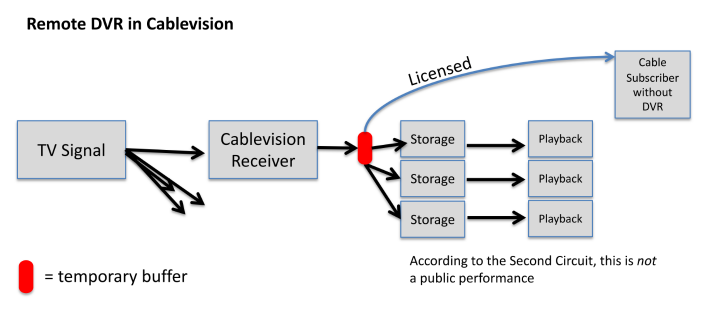
Image description: A flowchart illustrating Cablevision’s system. A TV signal goes to a Cablevision receiver, then through a temporary buffer (marked in red) into storage units. Each storage unit links to playback for subscribers. A licensed path also connects the receiver to cable subscribers without DVR. A note explains that the Second Circuit ruled this process is not a public performance.
American Broadcasting Companies v. Aereo, Inc., 134 S.Ct. 2498 (2014)
Justice Breyer delivered the opinion of the Court.
I
The Copyright Act of 1976 gives a copyright owner the exclusive right to “perform the copyrighted work publicly.” 17 U.S.C. § 106(4). The Act’s Transmit Clause defines that exclusive right as including the right to “transmit or otherwise communicate a performance ... of the [copyrighted] work ... to the public, by means of any device or process, whether the members of the public capable of receiving the performance ... receive it in the same place or in separate places and at the same time or at different times.” § 101. We must decide whether respondent Aereo, Inc., infringes this exclusive right by selling its subscribers a technologically complex service that allows them to watch television programs over the Internet at about the same time as the programs are broadcast over the air. We conclude that it does.
For a monthly fee, Aereo offers subscribers broadcast television programming over the Internet, virtually as the programming is being broadcast. Much of this programming is made up of copyrighted works. Aereo neither owns the copyright in those works nor holds a license from the copyright owners to perform those works publicly.
Aereo’s system is made up of servers, transcoders, and thousands of dime-sized antennas housed in a central warehouse. It works roughly as follows: First, when a subscriber wants to watch a show that is currently being broadcast, he visits Aereo’s website and selects, from a list of the local programming, the show he wishes to see.
Second, one of Aereo’s servers selects an antenna, which it dedicates to the use of that subscriber (and that subscriber alone) for the duration of the selected show. A server then tunes the antenna to the over-the-air broadcast carrying the show. The antenna begins to receive the broadcast, and an Aereo transcoder translates the signals received into data that can be transmitted over the Internet.
Third, rather than directly send the data to the subscriber, a server saves the data in a subscriber-specific folder on Aereo’s hard drive. In other words, Aereo’s system creates a subscriber-specific copy — that is, a “personal” copy — of the subscriber’s program of choice.
Fourth, once several seconds of programming have been saved, Aereo’s server begins to stream the saved copy of the show to the subscriber over the Internet. (The subscriber may instead direct Aereo to stream the program at a later time, but that aspect of Aereo’s service is not before us.) The subscriber can watch the streamed program on the screen of his personal computer, tablet, smart phone, Internet-connected television, or other Internet-connected device. The streaming continues, a mere few seconds behind the over-the-air broadcast, until the subscriber has received the entire show. See A Dictionary of Computing 494 (6th ed. 2008) (defining “streaming” as “[t]he process of providing a steady flow of audio or video data so that an Internet user is able to access it as it is transmitted”).
Aereo emphasizes that the data that its system streams to each subscriber are the data from his own personal copy, made from the broadcast signals received by the particular antenna allotted to him. Its system does not transmit data saved in one subscriber’s folder to any other subscriber. When two subscribers wish to watch the same program, Aereo’s system activates two separate antennas and saves two separate copies of the program in two separate folders. It then streams the show to the subscribers through two separate transmissions — each from the subscriber’s personal copy.
Petitioners are television producers, marketers, distributors, and broadcasters who own the copyrights in many of the programs that Aereo’s system streams to its subscribers. They brought suit against Aereo for copyright infringement in Federal District Court. They sought a preliminary injunction, arguing that Aereo was infringing their right to “perform” their works “publicly,” as the Transmit Clause defines those terms.
The District Court denied the preliminary injunction. Relying on prior Circuit precedent, a divided panel of the Second Circuit affirmed. WNET, Thirteen v. Aereo, Inc., 712 F.3d 676 (2013) (citing Cartoon Network LP, LLLP v. CSC Holdings, Inc., 536 F.3d 121 (2008)). In the Second Circuit’s view, Aereo does not perform publicly within the meaning of the Transmit Clause because it does not transmit “to the public.” Rather, each time Aereo streams a program to a subscriber, it sends a private transmission that is available only to that subscriber. The Second Circuit denied rehearing en banc, over the dissent of two judges. We granted certiorari.
II
This case requires us to answer two questions: First, in operating in the manner described above, does Aereo “perform” at all? And second, if so, does Aereo do so “publicly”? We address these distinct questions in turn.
Does Aereo “perform”? See § 106(4) (The owner of a copyright has the exclusive right to perform the copyrighted work publicly); § 101 (“To perform ... a work ‘publicly’ means [among other things] to transmit... a performance ... of the work ... to the public ...”). Phrased another way, does Aereo “transmit... a performance” when a subscriber watches a show using Aereo’s system, or is it only the subscriber who transmits? In Aereo’s view, it does not perform. It does no more than supply equipment that emulates the operation of a home antenna and digital video recorder (DVR). Like a home antenna and DVR, Aereo’s equipment simply responds to its subscribers’ directives. So it is only the subscribers who “perform” when they use Aereo’s equipment to stream television programs to themselves.
Considered alone, the language of the Act does not clearly indicate when an entity “perform[s]” (or “transmit[s]”) and when it merely supplies equipment that allows others to do so. But when read in light of its purpose, the Act is unmistakable: An entity that engages in activities like Aereo’s performs.
A
History makes plain that one of Congress’ primary purposes in amending the Copyright Act in 1976 was to overturn this Court’s determination that community antenna television (CATV) systems (the precursors of modern cable systems) fell outside the Act’s scope. In Fortnightly Corp. v. United Artists Television, Inc., 392 U.S. 390, (1968), the Court considered a CATV system that carried local television broadcasting, much of which was copyrighted, to its subscribers in two cities. The CATV provider placed antennas on hills above the cities and used coaxial cables to carry the signals received by the antennas to the home television sets of its subscribers. The system amplified and modulated the signals in order to improve their strength and efficiently transmit them to subscribers. A subscriber “could choose any of the ... programs he wished to view by simply turning the knob on his own television set.” The CATV provider “neither edited the programs received nor originated any programs of its own.”
Asked to decide whether the CATV provider infringed copyright holders’ exclusive right to perform their works publicly, the Court held that the provider did not “perform” at all. The Court drew a line: “Broadcasters perform. Viewers do not perform.” And a CATV provider “falls on the viewer’s side of the line.”
The Court reasoned that CATV providers were unlike broadcasters:
Broadcasters select the programs to be viewed; CATV systems simply carry, without editing, whatever programs they receive. Broadcasters procure programs and propagate them to the public; CATV systems receive programs that have been released to the public and carry them by private channels to additional viewers.
Instead, CATV providers were more like viewers, for “the basic function [their] equipment serves is little different from that served by the equipment generally furnished by” viewers. “Essentially,” the Court said, “a CATV system no more than enhances the viewer’s capacity to receive the broadcaster’s signals [by] provid[ing] a well-located antenna with an efficient connection to the viewer’s television set.” Viewers do not become performers by using “amplifying equipment,” and a CATV provider should not be treated differently for providing viewers the same equipment.
In Teleprompter Corp. v. Columbia Broadcasting System, Inc., 415 U.S. 394 (1974), the Court considered the copyright liability of a CATV provider that carried broadcast television programming into subscribers’ homes from hundreds of miles away. Although the Court recognized that a viewer might not be able to afford amplifying equipment that would provide access to those distant signals, it nonetheless found that the CATV provider was more like a viewer than a broadcaster. It explained: “The reception and rechanneling of [broadcast television signals] for simultaneous viewing is essentially a viewer function, irrespective of the distance between the broadcasting station and the ultimate viewer.”
The Court also recognized that the CATV system exercised some measure of choice over what to transmit. But that fact did not transform the CATV system into a broadcaster. A broadcaster exercises significant creativity in choosing what to air, the Court reasoned. In contrast, the CATV provider makes an initial choice about which broadcast stations to retransmit, but then “simply carries, without editing, whatever programs it receives.”
B
In 1976 Congress amended the Copyright Act in large part to reject the Court’s holdings in Fortnightly and Teleprompter. Congress enacted new language that erased the Court’s line between broadcaster and viewer, in respect to “perform[ing]” a work. The amended statute clarifies that to “perform” an audiovisual work means “to show its images in any sequence or to make the sounds accompanying it audible.” § 101; see ibid. (defining “audiovisual works” as “works that consist of a series of related images which are intrinsically intended to be shown by the use of machines..., together with accompanying sounds”). Under this new language, both the broadcaster and the viewer of a television program “perform,” because they both show the program’s images and make audible the program’s sounds.
Congress also enacted the Transmit Clause, which specifies that an entity performs publicly when it “transmit[s] ... a performance ... to the public.” § 101; see ibid. (defining “[t]o ‘transmit’ a performance” as “to communicate it by any device or process whereby images or sounds are received beyond the place from which they are sent”). Cable system activities, like those of the CATV systems in Fortnightly and Teleprompter, lie at the heart of the activities that Congress intended this language to cover. The House Report on the 1976 Act says that “a cable television system is performing when it retransmits [a network] broadcast to its subscribers” and that “the concept of public performance ... covers not only the initial rendition or showing, but also any further act by which that rendition or showing is transmitted or communicated to the public.” The Clause thus makes clear that an entity that acts like a CATV system itself performs, even if when doing so, it simply enhances viewers’ ability to receive broadcast television signals.
Congress further created a new section of the Act to regulate cable companies’ public performances of copyrighted works. Section 111 creates a complex, highly detailed compulsory licensing scheme that sets out the conditions, including the payment of compulsory fees, under which cable systems may retransmit broadcasts. House Report at 88 (Section 111 is primarily “directed at the operation of cable television systems and the terms and conditions of their liability for the retransmission of copyrighted works”).
Congress made these three changes to achieve a similar end: to bring the activities of cable systems within the scope of the Copyright Act.
C
This history makes clear that Aereo is not simply an equipment provider. Rather, Aereo, and not just its subscribers, “perform[s]” (or “transmit[s]”). Aereo’s activities are substantially similar to those of the CATV companies that Congress amended the Act to reach. See id., at 89 (“Cable systems are commercial enterprises whose basic retransmission operations are based on the carriage of copyrighted program material”). Aereo sells a service that allows subscribers to watch television programs, many of which are copyrighted, almost as they are being broadcast. In providing this service, Aereo uses its own equipment, housed in a centralized warehouse, outside of its users’ homes. By means of its technology (antennas, transcoders, and servers), Aereo’s system “receive[s] programs that have been released to the public and carr[ies] them by private channels to additional viewers.” Fortnightly, 392 U.S., at 400. It “carr[ies] ... whatever programs [it] receive[s],” and it offers “all the programming” of each over-the-air station it carries.
Aereo’s equipment may serve a “viewer function”; it may enhance the viewer’s ability to receive a broadcaster’s programs. It may even emulate equipment a viewer could use at home. But the same was true of the equipment that was before the Court, and ultimately before Congress, in Fortnightly and Teleprompter.
We recognize, and Aereo and the dissent emphasize, one particular difference between Aereo’s system and the cable systems at issue in Fortnightly and Teleprompter. The systems in those cases transmitted constantly; they sent continuous programming to each subscriber’s television set. In contrast, Aereo’s system remains inert until a subscriber indicates that she wants to watch a program. Only at that moment, in automatic response to the subscriber’s request, does Aereo’s system activate an antenna and begin to transmit the requested program.
This is a critical difference, says the dissent. It means that Aereo’s subscribers, not Aereo, select the copyrighted content that is performed, and for that reason they, not Aereo, “transmit” the performance. Aereo is thus like “a copy shop that provides its patrons with a library card.” A copy shop is not directly liable whenever a patron uses the shop’s machines to “reproduce” copyrighted materials found in that library. See § 106(1) (“exclusive right ... to reproduce the copyrighted work”). And by the same token, Aereo should not be directly liable whenever its patrons use its equipment to “transmit” copyrighted television programs to their screens.
In our view, however, the dissent’s copy shop argument, in whatever form, makes too much out of too little. Given Aereo’s overwhelming likeness to the cable companies targeted by the 1976 amendments, this sole technological difference between Aereo and traditional cable companies does not make a critical difference here. The subscribers of the Fortnightly and Teleprompter cable systems also selected what programs to display on their receiving sets. Indeed, as we explained in Fortnightly, such a subscriber “could choose any of the ... programs he wished to view by simply turning the knob on his own television set.” The same is true of an Aereo subscriber. Of course, in Fortnightly the television signals, in a sense, lurked behind the screen, ready to emerge when the subscriber turned the knob. Here the signals pursue their ordinary course of travel through the universe until today’s “turn of the knob” — a click on a website — activates machinery that intercepts and reroutes them to Aereo’s subscribers over the Internet. But this difference means nothing to the subscriber. It means nothing to the broadcaster. We do not see how this single difference, invisible to subscriber and broadcaster alike, could transform a system that is for all practical purposes a traditional cable system into “a copy shop that provides its patrons with a library card.”
In other cases involving different kinds of service or technology providers, a user’s involvement in the operation of the provider’s equipment and selection of the content transmitted may well bear on whether the provider performs within the meaning of the Act. But the many similarities between Aereo and cable companies, considered in light of Congress’ basic purposes in amending the Copyright Act, convince us that this difference is not critical here. We conclude that Aereo is not just an equipment supplier and that Aereo “perform[s].”
III
Next, we must consider whether Aereo performs petitioners’ works “publicly,” within the meaning of the Transmit Clause. Under the Clause, an entity performs a work publicly when it “transmit[s]... a performance ... of the work ... to the public.” § 101. Aereo denies that it satisfies this definition. It reasons as follows: First, the “performance” it “transmit[s]” is the performance created by its act of transmitting. And second, because each of these performances is capable of being received by one and only one subscriber, Aereo transmits privately, not publicly. Even assuming Aereo’s first argument is correct, its second does not follow.
We begin with Aereo’s first argument. What performance does Aereo transmit? Under the Act, “to ‘transmit’ a performance... is to communicate it by any device or process whereby images or sounds are received beyond the place from which they are sent.” And “to ‘perform’” an audiovisual work means “to show its images in any sequence or to make the sounds accompanying it audible.”
Petitioners say Aereo transmits a prior performance of their works. Thus when Aereo retransmits a network’s prior broadcast, the underlying broadcast (itself a performance) is the performance that Aereo transmits. Aereo, as discussed above, says the performance it transmits is the new performance created by its act of transmitting. That performance comes into existence when Aereo streams the sounds and images of a broadcast program to a subscriber’s screen.
We assume arguendo that Aereo’s first argument is correct. Thus, for present purposes, to transmit a performance of (at least) an audiovisual work means to communicate contemporaneously visible images and contemporaneously audible sounds of the work. Cf. United States v. American Soc. of Composers, Authors and Publishers, 627 F.3d 64, 73 (2nd Cir. 2010) (holding that a download of a work is not a performance because the data transmitted are not “contemporaneously perceptible”). When an Aereo subscriber selects a program to watch, Aereo streams the program over the Internet to that subscriber. Aereo thereby “communicate[s]” to the subscriber, by means of a “device or process,” the work’s images and sounds. § 101. And those images and sounds are contemporaneously visible and audible on the subscriber’s computer (or other Internet-connected device). So under our assumed definition, Aereo transmits a performance whenever its subscribers watch a program.
But what about the Clause’s further requirement that Aereo transmit a performance “to the public”? As we have said, an Aereo subscriber receives broadcast television signals with an antenna dedicated to him alone. Aereo’s system makes from those signals a personal copy of the selected program. It streams the content of the copy to the same subscriber and to no one else. One and only one subscriber has the ability to see and hear each Aereo transmission. The fact that each transmission is to only one subscriber, in Aereo’s view, means that it does not transmit a performance “to the public.”
In terms of the Act’s purposes, these differences do not distinguish Aereo’s system from cable systems, which do perform “publicly.” Viewed in terms of Congress’ regulatory objectives, why should any of these technological differences matter? They concern the behind-the-scenes way in which Aereo delivers television programming to its viewers’ screens. They do not render Aereo’s commercial objective any different from that of cable companies. Nor do they significantly alter the viewing experience of Aereo’s subscribers. Why would a subscriber who wishes to watch a television show care much whether images and sounds are delivered to his screen via a large multisubscriber antenna or one small dedicated antenna, whether they arrive instantaneously or after a few seconds’ delay, or whether they are transmitted directly or after a personal copy is made? And why, if Aereo is right, could not modern CATV systems simply continue the same commercial and consumer-oriented activities, free of copyright restrictions, provided they substitute such new technologies for old? Congress would as much have intended to protect a copyright holder from the unlicensed activities of Aereo as from those of cable companies.
The text of the Clause effectuates Congress’ intent. Aereo’s argument to the contrary relies on the premise that “to transmit ... a performance” means to make a single transmission. But the Clause suggests that an entity may transmit a performance through multiple, discrete transmissions. That is because one can “transmit” or “communicate” something through a set of actions. Thus one can transmit a message to one’s friends, irrespective of whether one sends separate identical e-mails to each friend or a single e-mail to all at once. So can an elected official communicate an idea, slogan, or speech to her constituents, regardless of whether she communicates that idea, slogan, or speech during individual phone calls to each constituent or in a public square.
The fact that a singular noun (“a performance”) follows the words “to transmit” does not suggest the contrary. One can sing a song to his family, whether he sings the same song one-on-one or in front of all together. Similarly, one’s colleagues may watch a performance of a particular play — say, this season’s modern-dress version of “Measure for Measure” — whether they do so at separate or at the same showings. By the same principle, an entity may transmit a performance through one or several transmissions, where the performance is of the same work.
The Transmit Clause must permit this interpretation, for it provides that one may transmit a performance to the public “whether the members of the public capable of receiving the performance ... receive it ... at the same time or at different times.” § 101. Were the words “to transmit ... a performance” limited to a single act of communication, members of the public could not receive the performance communicated “at different times.” Therefore, in light of the purpose and text of the Clause, we conclude that when an entity communicates the same contemporaneously perceptible images and sounds to multiple people, it transmits a performance to them regardless of the number of discrete communications it makes.
We do not see how the fact that Aereo transmits via personal copies of programs could make a difference. The Act applies to transmissions “by means of any device or process.” Ibid. And retransmitting a television program using user-specific copies is a “process” of transmitting a performance. A “copy” of a work is simply a “material object ... in which a work is fixed ... and from which the work can be perceived, reproduced, or otherwise communicated.” Ibid. So whether Aereo transmits from the same or separate copies, it performs the same work; it shows the same images and makes audible the same sounds. Therefore, when Aereo streams the same television program to multiple subscribers, it “transmit[s] ... a performance” to all of them.
Moreover, the subscribers to whom Aereo transmits television programs constitute “the public.” Aereo communicates the same contemporaneously perceptible images and sounds to a large number of people who are unrelated and unknown to each other. This matters because, although the Act does not define “the public,” it specifies that an entity performs publicly when it performs at “any place where a substantial number of persons outside of a normal circle of a family and its social acquaintances is gathered.” The Act thereby suggests that “the public” consists of a large group of people outside of a family and friends.
Neither the record nor Aereo suggests that Aereo’s subscribers receive performances in their capacities as owners or possessors of the underlying works. This is relevant because when an entity performs to a set of people, whether they constitute “the public” often depends upon their relationship to the underlying work. When, for example, a valet parking attendant returns cars to their drivers, we would not say that the parking service provides cars “to the public.” We would say that it provides the cars to their owners. We would say that a car dealership, on the other hand, does provide cars to the public, for it sells cars to individuals who lack a pre-existing relationship to the cars. Similarly, an entity that transmits a performance to individuals in their capacities as owners or possessors does not perform to “the public,” whereas an entity like Aereo that transmits to large numbers of paying subscribers who lack any prior relationship to the works does so perform.
Finally, we note that Aereo’s subscribers may receive the same programs at different times and locations. This fact does not help Aereo, however, for the Transmit Clause expressly provides that an entity may perform publicly “whether the members of the public capable of receiving the performance ... receive it in the same place or in separate places and at the same time or at different times.” Ibid. In other words, “the public” need not be situated together, spatially or temporally. For these reasons, we conclude that Aereo transmits a performance of petitioners’ copyrighted works to the public, within the meaning of the Transmit Clause.
IV
Aereo and many of its supporting amici argue that to apply the Transmit Clause to Aereo’s conduct will impose copyright liability on other technologies, including new technologies, that Congress could not possibly have wanted to reach. We agree that Congress, while intending the Transmit Clause to apply broadly to cable companies and their equivalents, did not intend to discourage or to control the emergence or use of different kinds of technologies. But we do not believe that our limited holding today will have that effect.
For one thing, the history of cable broadcast transmissions that led to the enactment of the Transmit Clause informs our conclusion that Aereo “perform[s],” but it does not determine whether different kinds of providers in different contexts also “perform.” For another, an entity only transmits a performance when it communicates contemporaneously perceptible images and sounds of a work. See Brief for Respondent 31 (“If a distributor ... sells [multiple copies of a digital video disc] by mail to consumers, ... [its] distribution of the DVDs merely makes it possible for the recipients to perform the work themselves — it is not a ‘device or process’ by which the distributor publicly performs the work” (emphasis in original)).
Further, we have interpreted the term “the public” to apply to a group of individuals acting as ordinary members of the public who pay primarily to watch broadcast television programs, many of which are copyrighted. We have said that it does not extend to those who act as owners or possessors of the relevant product. And we have not considered whether the public performance right is infringed when the user of a service pays primarily for something other than the transmission of copyrighted works, such as the remote storage of content. See Brief for United States as Amicus Curiae 31 (distinguishing cloud-based storage services because they “offer consumers more numerous and convenient means of playing back copies that the consumers have already lawfully acquired” (emphasis in original)). In addition, an entity does not transmit to the public if it does not transmit to a substantial number of people outside of a family and its social circle.
We also note that courts often apply a statute’s highly general language in light of the statute’s basic purposes. Finally, the doctrine of “fair use” can help to prevent inappropriate or inequitable applications of the Clause. See Sony Corp. of America v. Universal City Studios, Inc., 464 U.S. 417 (1984).
We cannot now answer more precisely how the Transmit Clause or other provisions of the Copyright Act will apply to technologies not before us. We agree with the Solicitor General that questions involving cloud computing, remote storage DVRs, and other novel issues not before the Court, as to which Congress has not plainly marked the course, should await a case in which they are squarely presented. And we note that, to the extent commercial actors or other interested entities may be concerned with the relationship between the development and use of such technologies and the Copyright Act, they are of course free to seek action from Congress.
* * *
In sum, having considered the details of Aereo’s practices, we find them highly similar to those of the CATV systems in Fortnightly and Teleprompter. And those are activities that the 1976 amendments sought to bring within the scope of the Copyright Act. Insofar as there are differences, those differences concern not the nature of the service that Aereo provides so much as the technological manner in which it provides the service. We conclude that those differences are not adequate to place Aereo’s activities outside the scope of the Act.
For these reasons, we conclude that Aereo “perform[s]” petitioners’ copyrighted works “publicly,” as those terms are defined by the Transmit Clause. We therefore reverse the contrary judgment of the Court of Appeals, and we remand the case for further proceedings consistent with this opinion.
It is so ordered.
Notes and questions
(1) The Supreme Court’s decision in American Broadcasting Companies v. Aereo, Inc. is consequential but confusing. Aereo built a system that allowed subscribers to watch broadcast television over the Internet by assigning each user an individual antenna and making an individualized copy of each program. The Second Circuit, relying on Cablevision, held that Aereo’s transmissions were private, not public. The Supreme Court reversed, holding that Aereo “performed publicly” because its operation was functionally indistinguishable from a cable system—the very type of enterprise Congress intended to bring within the Act’s reach when it added the Transmit Clause in 1976. Justice Breyer’s majority opinion reads the Transmit Clause broadly in light of congressional purpose, not narrowly in light of technological architecture. The Court’s reasoning blurred the line between technical design and functional equivalence, emphasizing practical effect over formal structure. Justice Scalia’s dissent, by contrast, accused the majority of adopting a “looks-like-cable-TV” test that abandoned the statutory text and the volitional conduct principles that ordinarily limit direct liability. The decision left several questions unresolved. What role does volition play in direct infringement after Aereo? How far does the analogy to cable systems extend in an age of cloud storage, remote DVRs, and peer-to-peer streaming? And how should courts interpret “to the public” in a digital environment where transmission, storage, and access are fluid and individualized?
(2) Both the Supreme Court majority and the dissenting opinion in the Court of Appeals below seemed to believe that if Aereo were not directly liable under the public performance right, it would fall through a loophole in copyright law. In fact, Aereo could only avoid public performance liability by infringing reproduction rights with each recorded copy, though the studios avoided that claim for fear a court might deem such time-shifting fair use under Sony. While a remote DVR arguably extends Sony’s logic that technology enabling authorized viewing in a more convenient way is fair use, Aereo’s “Rube Goldberg-like” design to evade the Copyright Act’s retransmission rules undermined its position. Congress added those rules in 1976 to close precisely such loopholes, and fair use—rooted in purposive statutory interpretation—should not protect a service built to subvert the statute’s clear purpose.
(3) Although the question of the “volitional conduct” doctrine seemed unavoidable in Aereo, Justice Breyer managed to avoid it. Justice Scalia, in dissent (joined by Thomas and Alito), argued that Aereo did not perform at all since it lacked the requisite volition. Scalia distinguished video-on-demand services from services like Aereo because, in the former case, the service provider chose the content and in Aereo’s case the users chose the content. Scalia argued that the conduct of service providers like Aereo would be better regulated through doctrines of secondary liability. The majority in Aereo did not engage with the distinction between direct and contributory copyright liability, nor did it directly address the cases on the ‘volitional conduct doctrine’. It simply held that (i) cable systems perform, (ii) Aereo is like a cable system, thus (iii) Aereo performs. We discuss the “volitional conduct” doctrine in detail in a later chapter.
Questions
(1) The Aereo Court analogized Aereo’s service to a traditional cable system, concluding that Congress intended the 1976 Act’s Transmit Clause to cover functionally equivalent technologies. How persuasive is this analogy? Should courts assess technological “likeness” by form, function, or market impact?
(2) The Court insists its holding is “limited” to Aereo-like services yet gives little guidance on where the line lies for other technologies (e.g., remote DVRs or cloud storage). What factors might future courts use to distinguish those cases? Does Aereo suggest that technological architecture is less important than commercial purpose?
(3) Did Aereo lose because it lost the battle of analogies? Aereo’s system was intentionally designed to mimic user-specific recording and streaming, to fit within the Cablevision precedent. Should courts look past such formal design choices to the overall function of a service? If so, how does that affect predictability for innovators?
(4) The Transmit Clause. The Aereo decision turns on what it means to “transmit a performance ... to the public.” How does the Court interpret this phrase, and how does that interpretation differ from the Second Circuit’s in Cablevision? Why does the Court treat separate individualized transmissions as nonetheless “public”?
(5) Justice Breyer emphasized that Aereo’s subscribers were members of “the public” because they lacked any “prior relationship” to the works. What kinds of relationships might remove a transmission from the “public” category? Consider cloud storage, personal backups, or in-home streaming across one’s own devices.
(6) The majority assumes that only contemporaneously perceptible transmissions—i.e., streams—are performances, not downloads. Why might the law distinguish between the two? How would this distinction apply to hybrid technologies (for example, buffering or progressive downloads)?
(7) Who Performs? Aereo claimed it merely supplied equipment under user control—just as a home antenna or DVR does—while the Court found that Aereo “performs” by transmitting content to subscribers. What criteria might distinguish “performing” from “supplying equipment”? Does user initiation of a transmission (who clicks the play button) matter?
(8) TechCo develops “CableShare,” a service that allows users to “gift” access to their home cable subscriptions to friends and family. When User A gifts access to User B, CableShare creates a virtual machine that mirrors A’s cable box, allowing B to watch whatever A could watch, but only one person can watch at a time. Each stream is created from a separate temporary copy made for that session. Apply Aereo to determine: (i) Does CableShare “perform” the works? (ii) If so, are these performances “public”? (iii) What additional facts would you need to make this determination?
The “Homestyle” and other exceptions to the public performance right
The Copyright Act contains a number of specific exceptions to the performance right. There is an exception for performances by teachers or students in the classroom during the course of face-to-face teaching activities—Section 110(1). Performances during the course of services at a place of religious worship do not infringe the performance right—Section 110(3).
The copyright act also contains a broad exemption for public performances of nondramatic literary and musical works provided the performance is not made for the purpose of commercial advantage, the performers are not paid, and there is no admission charge etc. Section 110(4).
Although Congress overturned the court’s reading of the performance right in Aiken, the ability of certain small businesses to play the radio for their customers is preserved under what is generally called the Homestyle Exception—Section 110(5). The European Union successfully challenged this exception in a WTO proceeding against the United States. The Homestyle Exception was found to be excessively broad, but remains part of U.S. law nonetheless.
Cable & satellite licenses
Just like in the aftermath to White-Smith v. Apollo, in the aftermath of the CATV cases discussed above Congress created a new section of the Act to regulate cable companies’ public performances of copyrighted works. Section 111 creates a complex, highly detailed compulsory licensing scheme that sets out the conditions, including the payment of compulsory fees, under which cable systems may retransmit broadcasts. There is also an analogous compulsory license available to satellite carriers in Section 119 of the Copyright Act.
Section 118 of the copyright act gives noncommercial educational broadcast stations an antitrust exemption to bargain with copyright owners to determine royalty rates for the use of copyrighted works in their programming. Section 118 also provides a mechanism for determining a compulsory license for certain categories of work if no agreement is reached.
Note that the retransmission of broadcast television signals over the Internet has been held not to be a secondary transmission eligible for the compulsory license for secondary transmissions by cable systems under Section 111(c) of the Copyright Act.
This issue arose as a question of first impression in WPIX, Inc. v. ivi, Inc., 691 F.3d 275 (2d Cir. 2012) and was answered in the negative by the Second Circuit. One district court held to the contrary but was overruled in Fox Television Stations, Inc. v. Aereokiller, LLC, 851 F.3d 1002 (9th Cir. 2017) (Internet-based retransmission service was not cable system, and thus it was ineligible for compulsory license for retransmission of broadcast television networks’ copyrighted works). In May 2017, FilmOn settled with the broadcasters and withdrew its appeals in the Seventh Circuit and the DC Circuit.
Comparative: The Performance, Display and Transmission Rights in International Copyright Agreements
The Berne Convention contains a hodgepodge of provisions relating to what can loosely be termed public performance and communication to the public. Article 11 of the Berne Convention gives the authors of dramatic, dramatic-musical, and musical works the exclusive right to publicly perform their works “by any means or process”, and, in a separate subsection, the exclusive right of communicating the performance of their works to the public.
Berne Convention Article 11. Certain Rights in Dramatic and Musical Works:
(1) Authors of dramatic, dramatico-musical and musical works shall enjoy the exclusive right of authorizing:
(i) the public performance of their works, including such public performance by any means or process;
(ii) any communication to the public of the performance of their works.
(2) Authors of dramatic or dramatico-musical works shall enjoy, during the full term of their rights in the original works, the same rights with respect to translations thereof.
Berne Article 11bis gives the authors of literary and artistic works the exclusive right to broadcast their works, and to communicate the work to the public “by wire or rebroadcasting”. For good measure, Article 11bis, adds a reference to the public communication by loudspeaker or any other analogous instrument transmitting the broadcast of the work. Article 11bis(2) specifically authorizes a system of compulsory licensing. This is common for cable retransmission.
Berne Convention Article 11bis. Broadcasting and Related Rights:
(1) Authors of literary and artistic works shall enjoy the exclusive right of authorizing:
(i) the broadcasting of their works or the communication thereof to the public by any other means of wireless diffusion of signs, sounds or images;
(ii) any communication to the public by wire or by rebroadcasting of the broadcast of the work, when this communication is made by an organization other than the original one;
(iii) the public communication by loudspeaker or any other analogous instrument transmitting, by signs, sounds or images, the broadcast of the work.
(2) It shall be a matter for legislation in the countries of the Union to determine the conditions under which the rights mentioned in the preceding paragraph may be exercised, but these conditions shall apply only in the countries where they have been prescribed. They shall not in any circumstances be prejudicial to the moral rights of the author, nor to his right to obtain equitable remuneration which, in the absence of agreement, shall be fixed by competent authority.
For the authors of literary works, Article 11ter adds a right of public recitation and communication to the public of recitation.
Berne Convention Article 11ter. Certain Rights in Literary Works:
(1) Authors of literary works shall enjoy the exclusive right of authorizing:
(i) the public recitation of their works, including such public recitation by any means or process;
(ii) any communication to the public of the recitation of their works.
(2) Authors of literary works shall enjoy, during the full term of their rights in the original works, the same rights with respect to translations thereof.
Finally, Article 14 provides a specific provision for cinematographic adaptations. The author of a literary or artistic work that has been adapted into cinematographic work shall enjoy the exclusive right of authorizing “the public performance and communication to the public by wire of the works thus adapted or reproduced.”
Berne Convention Article 14 Cinematographic and Related Rights
(1) Authors of literary or artistic works shall have the exclusive right of authorizing:
(i) the cinematographic adaptation and reproduction of these works, and the distribution of the works thus adapted or reproduced;
(ii) the public performance and communication to the public by wire of the works thus adapted or reproduced.
The Berne Convention does not require member nations to recognize a distinct right of public display, although in Article 17, the convention clearly leaves that option open to the states. More importantly, although the Berne Convention requires the provision of various rights of public performance and public communication, it makes no attempt to define what is meant by public.
TRIPs Article 14(1) deals with what are generally referred to as anti-bootlegging laws. The right to prevent bootlegging is of great interest to performers, but it is not exactly a performance right.
Articles 14(3) suggests to member nations that “broadcasting organizations” should have the right to prevent rebroadcasting of broadcasts by wireless means, as well as more general “communication to the public of television broadcasts.” However, the broadcaster rights in 14(3) are not mandatory under TRIPs if owners of copyright in the subject matter of broadcasts are given those rights instead. This is the approach taken by the United States.
TRIPs Article 14 - Protection of Performers, Producers of Phonograms (Sound Recordings) and Broadcasting Organizations
- In respect of a fixation of their performance on a phonogram, performers shall have the possibility of preventing the following acts when undertaken without their authorization: the fixation of their unfixed performance and the reproduction of such fixation. Performers shall also have the possibility of preventing the following acts when undertaken without their authorization: the broadcasting by wireless means and the communication to the public of their live performance.
- Broadcasting organizations shall have the right to prohibit the following acts when undertaken without their authorization: the fixation, the reproduction of fixations, and the rebroadcasting by wireless means of broadcasts, as well as the communication to the public of television broadcasts of the same. Where Members do not grant such rights to broadcasting organizations, they shall provide owners of copyright in the subject matter of broadcasts with the possibility of preventing the above acts, subject to the provisions of the Berne Convention (1971).