Part 1 · Chapter 3
Copyright in AI-Generated and AI-Assisted Works
The Human Authorship Requirement
The monkey selfie
In 2011 wildlife photographer, David Slater, was working to capture a closeup photo of a crested black macaque monkey in Indonesia’s Sulawesi jungle. Rather than approaching the monkey with his camera in hand—an approach that would scare off the animal—Slater positioned the camera, adjusted the settings, and waited in the hopes that a curious monkey would grab the camera and take its own photo. Slater was quite involved with the taking of the photo: according to his own account, “I put my camera on a tripod with a very wide angle lens, settings configured such as predictive autofocus, motorwind, even a flashgun, to give me a chance of a facial close up if they were to approach again for a play ... I had one hand on the tripod when this was going on, …” On his account, Slater also did some important preparatory work by befriending monkeys to make them receptive to playing with the camera. Eventually, a crested black macaque took a series of apparent selfies using Slater’s camera.
One of the “monkey selfie” photos
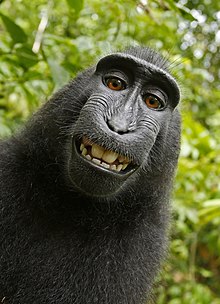
Image description: A close-up of a crested black macaque against a backdrop of green foliage. The monkey appears to be smiling, showing its teeth, and looks directly at the camera with bright eyes.
Naturally, a copyright dispute soon followed.
Slater claimed copyright in the photo and sent a takedown request to Wikipedia, who had posted a copy to the online encyclopedia. Wikipedia argued that the photo was in the public domain because there was no author. In December 2014, the United States Copyright Office stated that works created by a non-human, such as a photograph taken by a monkey, are not copyrightable.
Slater, sensibly, decided to let the matter go, but PETA (People for the Ethical Treatment of Animals) sued Slater on behalf of the monkey, who PETA named as Naruto. The Ninth Circuit held that the monkey lacked statutory standing under the Copyright Act. Naruto v. Slater, 888 F.3d 418 (9th Cir. 2018).
The Copyright Office’s position is reflected in U.S. Copyright Office, Compendium of U.S. Copyright Office Practices § 306 (3d ed. 2021).
The Human Authorship Requirement
The U.S. Copyright Office will register an original work of authorship, provided that the work was created by a human being. The copyright law only protects “the fruits of intellectual labor” that “are founded in the creative powers of the mind.” Trade-Mark Cases, 100 U.S. 82, 94 (1879). Because copyright law is limited to “original intellectual conceptions of the author,” the Office will refuse to register a claim if it determines that a human being did not create the work. Burrow-Giles Lithographic Co. v. Sarony, 111 U.S. 53, 58 (1884). …
In § 313.2 of the Compendium, the Copyright Office specifically notes that a photograph taken by a monkey is an example of works that lack human authorship.
Works That Lack Human Authorship
… The U.S. Copyright Office will not register works produced by nature, animals, or plants. Likewise, the Office cannot register a work purportedly created by divine or supernatural beings, although the Office may register a work where the application or the deposit copy(ies) state that the work was inspired by a divine spirit.
Examples:
• A photograph taken by a monkey
• A mural painted by an elephant.
• A claim based on the appearance of actual animal skin.
• A claim based on driftwood that has been shaped and smoothed by the ocean.
• A claim based on cut marks, defects, and other qualities found in natural stone.
• An application for a song naming the Holy Spirit as the author of the work.
Similarly, the Office will not register works produced by a machine or mere mechanical process that operates randomly or automatically without any creative input or intervention from a human author. The crucial question is “whether the ‘work’ is basically one of human authorship, with the computer [or other device] merely being an assisting instrument, or whether the traditional elements of authorship in the work (literary, artistic, or musical expression or elements of selection, arrangement, etc.) were actually conceived and executed not by man but by a machine.”
In Naruto v. Slater, No. 16-15469 (9th Cir. 2018) the Ninth Circuit affirmed the district court’s dismissal of copyright infringement claims brought by a monkey over selfies he took on a wildlife photographer’s unattended camera. The court held that a monkey lacked standing as a copyright plaintiff because the Copyright Act does not envision animals (non-humans) as authors or owners of copyright.
Oddly enough, the case of the “monkey selfie” raises the same questions as generative AI. Can an AI system like ChatGPT be an author? If not, how much does a human need to contribute to be an author?
AI has no claim of authorship
Thaler v. Perlmutter, 130 F. 4th 1039 (D.C. Cir. 2025)
Millett, Circuit Judge:
This case presents a question made salient by recent advances in artificial intelligence: Can a non-human machine be an author under the Copyright Act of 1976? … Dr. Thaler is a computer scientist who creates and works with artificial intelligence systems, and who invented the Creativity Machine. On May 19, 2019, Dr. Thaler submitted a copyright registration application to the Copyright Office for an artwork titled “A Recent Entrance to Paradise.” On the application, Dr. Thaler listed the “Author” of that work as the “Creativity Machine.” Under “Copyright Claimant,” Dr. Thaler provided his own name. In the section labeled “Author Created,” Dr. Thaler wrote “2-D artwork, Created autonomously by machine.”
[The Copyright Office denied Dr. Thaler’s application because “a human being did not create the work,” and the district court affirmed the Copyright Office’s denial of registration.] Based on the caselaw and the Copyright Act’s text, the district court concluded that “human authorship is a bedrock requirement of copyright.” The court also held that Dr. Thaler could not rely on the work-made-for-hire provision because that provision “presupposes that an interest exists to be claimed.” The “image autonomously generated” by the Creativity Machine was not such an interest because it “was never eligible for copyright,” so the Machine had no copyright to transfer to Dr. Thaler even if he were the Creativity Machine’s employer. Finally, the court found that Dr. Thaler waived his argument that he should own the copyright because he created and used the Creativity Machine. The court stressed that, “on the record designed by plaintiff from the outset of his application for copyright registration,” the case had presented “only the question of whether a work generated autonomously by a computer system is eligible for copyright.” …
III
As a matter of statutory law, the Copyright Act requires all work to be authored in the first instance by a human being. Dr. Thaler’s copyright registration application listed the Creativity Machine as the work’s sole author, even though the Creativity Machine is not a human being. As a result, the Copyright Office appropriately denied Dr. Thaler’s application.
A
Authors are at the center of the Copyright Act. A copyright “vests initially in the author or authors of the work.” 17 U.S.C. § 201(a). And copyright protection only “subsists * * * in original works of authorship[.]” Id. § 102(a).
The Copyright Act does not define the word “author.” But traditional tools of statutory interpretation show that, within the meaning of the Copyright Act, “author” refers only to human beings. To start, the text of multiple provisions of the statute indicates that authors must be humans, not machines. In addition, the Copyright Office consistently interpreted the word author to mean a human prior to the Copyright Act’s passage, and we infer that Congress adopted the agency’s longstanding interpretation of the word “author” when it reenacted that term in the 1976 Copyright Act.
Numerous Copyright Act provisions both identify authors as human beings and define “machines” as tools used by humans in the creative process rather than as creators themselves. Because many of the Copyright Act’s provisions make sense only if an author is a human being, the best reading of the Copyright Act is that human authorship is required for registration.
First, the Copyright Act’s ownership provision is premised on the author’s legal capacity to hold property. A copyright “vests initially in the author.” 17 U.S.C. § 201(a). This means an author gains ‘exclusive rights’ in her work immediately upon the work’s creation. Because a copyright is fundamentally a property right created by Congress, and Congress specified that authors immediately own their copyrights, an entity that cannot own property cannot be an author under the statute.
Second, the Copyright Act limits the duration of a copyright to the author’s lifespan or to a period that approximates how long a human might live. A copyright generally “endures for a term consisting of the life of the author and 70 years after the author’s death.” 17 U.S.C. § 302(a). The Copyright Office maintains “current records of information relating to the death of authors of copyrighted works” so that it can determine when copyrights expire. Id. § 302(d). If the author’s death is unknown, the Copyright Act presumes death after “a period of 95 years from the year of first publication of a work, or a period of 120 years from the year of its creation.” Id. § 302(e). And even when a corporation owns a copyright under the work-made-for-hire provision, the copyright endures for the same amount of time—“95 years from the year of first publication” or “120 years from the year of its creation.” Id. § 302(c). Of course, machines do not have “lives” nor is the length of their operability generally measured in the same terms as a human life.
Third, the Copyright Act’s inheritance provision states that, when an author dies, that person’s “termination interest is owned, and may be exercised” by their “widow or widower,” or their “surviving children or grandchildren,” 17 U.S.C. § 203(a)(2), (A). Machines, needless to say, have no surviving spouses or heirs.
Fourth, copyright transfers require a signature. To transfer copyright ownership, there must be “an instrument of conveyance” that is “signed by the owner[.]” 17 U.S.C. § 204(a). Machines lack signatures, as well as the legal capacity to provide an authenticating signature.
Fifth, authors of unpublished works are protected regardless of the author’s “nationality or domicile.” 17 U.S.C. § 104(a). Machines do not have domiciles, nor do they have a national identity.
Sixth, authors have intentions. A joint work is one “prepared by two or more authors with the intention that their contributions be merged into inseparable or interdependent parts of a unitary whole.” 17 U.S.C. § 101. Machines lack minds and do not intend anything.
Seventh, and by comparison, every time the Copyright Act discusses machines, the context indicates that machines are tools, not authors. For example, the Copyright Act defines a “computer program” as “a set of statements or instructions to be used directly or indirectly” to “bring about a certain result.” 17 U.S.C. § 101. The word “machine” is given the same definition as the words “device” and “process,” id., and those terms are consistently used in the statute as mechanisms that assist authors, rather than as authors themselves, id. §§ 102(a); 108(c)(2); 109(b)(1)(B)(i); 116(d)(1); 117(a)(1), (c); 401(a); 1001(2), (3). In addition, when computer programs and machines are referenced in the statute, the statute presumes they have an “owner,” id. § 117(a), (c), who can perform “maintenance,” “service,” or “repair” on them, id. § 117(d)(1), (2).
All of these statutory provisions collectively identify an “author” as a human being. Machines do not have property, traditional human lifespans, family members, domiciles, nationalities, mentes reae, or signatures. By contrast, reading the Copyright Act to require human authorship comports with the statute’s text, structure, and design because humans have all the attributes the Copyright Act treats authors as possessing. The human-authorship requirement, in short, eliminates the need to pound a square peg into a textual round hole by attributing unprecedented and mismatched meanings to common words in the Copyright Act.
To be clear, we do not hold that any one of those statutory provisions states a necessary condition for someone to be the author of a copyrightable work. An author need not have children, nor a domicile, nor a conventional signature. Even the ability to own property has not always been required for copyright authorship. Married women in the nineteenth century authored work that was eligible for copyright protection even though coverture laws forbade them from owning copyrights. See Melissa Homestead, American Women Authors And Literary Property, 1822-1869, at 21-62 (2005); Belford, Clarke & Co. v. Scribner, 144 U.S. 488, 504 (1892) (recognizing Mrs. Terhune’s authorship when her book’s copyright was infringed, even though, as a married woman, she could not own property).
The point, instead, is that the current Copyright Act’s text, taken as a whole, is best read as making humanity a necessary condition for authorship under the Copyright Act. That is the reading to which “the provisions of the whole law” point.
*
The Copyright Office’s longstanding rule requiring a human author reinforces the natural meaning of those statutory terms.
The Copyright Office first addressed whether machines could be authors in 1966—ten years before the Copyright Act of 1976 was passed. That year, the Register of Copyrights wrote in the Copyright Office’s annual report to Congress that, as “computer technology develops and becomes more sophisticated, difficult questions of authorship are emerging. * * * The crucial question appears to be whether the ‘work’ is basically one of human authorship, with the computer merely being an assisting instrument[.]” Copyright Office, Sixty-Eighth Annual Report of the Register of Copyrights at 5 (1966).
The Copyright Office formally adopted the human authorship requirement in 1973. That year, the Copyright Office updated its regulations to state explicitly that works must “owe their origin to a human agent[.]” Compendium First Edition § 2.8.3(I)(a)(1)(b).
In 1974, Congress created the National Commission on New Technological Uses of Copyrighted Works (“CONTU”) to study how copyright law should accommodate “the creation of new works by the application or intervention of such automatic systems or machine reproduction.” CONTU assembled copyright experts from the government, academia, and the private sector to make recommendations to Congress. Prior to the Copyright Act’s passage, the Library of Congress published summaries of CONTU’s meetings, several of which focused on copyright law and computer technology. In none of these meetings did members of CONTU suggest that computers were authors rather than tools used by authors to create original work.
This understanding of authorship and computer technology is reflected in CONTU’s final report:
On the basis of its investigations and society’s experience with the computer, the Commission believes that there is no reasonable basis for considering that a computer in any way contributes authorship to a work produced through its use. The computer, like a camera or a typewriter, is an inert instrument, capable of functioning only when activated either directly or indirectly by a human. When so activated it is capable of doing only what it is directed to do in the way it is directed to perform.
Although CONTU’s final report was not published until 1978, its conclusion that machines cannot be authors reflects the state of play at the time Congress enacted the Copyright Act in 1976. And when Congress amended the Copyright Act’s provision governing computer programs shortly following CONTU’s final report, Congress preserved the Act’s provisions governing authorship and the language describing machines as devices used by authors. Pub. L. No. 96-517, 94 Stat. 3015, 3028 (1980) (stating it is not infringement to copy a computer program if the copy “is created as an essential step in the utilization of the computer program in conjunction with a machine.”).
In short, at the time the Copyright Act was passed and for at least a decade before, computers were not considered to be capable of acting as authors, but instead served as “inert instruments” controlled “directly or indirectly by a human” who could be an author. CONTU, Final Report at 44 (1978). We infer Congress adopts an agency’s interpretation of a term “when a term’s meaning was well-settled.” Sackett v. Environmental Prot. Agency, 598 U.S. 651, 683 (2023). And that rule applies with double force here where the commission Congress designated to study the issue, CONTU, came to the same conclusion. Given all that, the interpretation of “author” as requiring human authorship was well-settled at the time the 1976 Copyright Act was enacted.
*
Dr. Thaler’s contrary reading of the statutory text fails. Dr. Thaler argues first that the natural meaning of “author” is not confined to human beings. Dr. Thaler points to a 2023 dictionary definition defining “author” as “one that originates or creates something.”
But statutory construction requires more than just finding a sympathetic dictionary definition. We “do not read statutes in little bites,” or words in isolation from their statutory context. The judicial task when interpreting statutory language, instead, is to discern how Congress used a word in the law.
That process includes a natural presumption that identical words used in different parts of the same act are intended to have the same meaning. Here, the Copyright Act makes no sense if an “author” is not a human being. If “machine” is substituted for “author,” the Copyright Act would refer to a machine’s “children,” 17 U.S.C. § 203(a)(2), a machine’s “widow,” id., a machine’s “domicile,” id. § 104(a), a machine’s mens rea, id. § 101, and a machine’s “nationality,” id. Problematic questions would arise about a machine’s “life” and “death[.]” Id. § 302(a). And “machine” would inconsistently mean both an author and a tool used by authors. Id. § 117(d)(1); see id. §§ 102(a); 108(c)(2); 116(d)(1); 117(c); 1001(2), (3).
Dr. Thaler points out that the Copyright Act’s work-made-for-hire provision allows those who hire creators to be “considered the author” under the Act. 17 U.S.C. § 201(b). That is why corporations, and governments, can be legally recognized as authors.
But the word “considered” in the work-made-for-hire provision does the critical work here. It allows the copyright and authorship protections attaching to a work originally created by a human author to transfer instantaneously, as a matter of law, to the person who hired the creator. Congress, in other words, was careful to avoid using the word “author” by itself to cover non-human entities. For if Congress had intended otherwise, the work-made-for-hire provision would say straightforwardly that those who hire creators “are the author for purposes of this title,” not that they are “considered the author for purposes of this title.”
Dr. Thaler also argues that the human-authorship requirement wrongly prevents copyright law from protecting works made with artificial intelligence.
But the Supreme Court has long held that copyright law is intended to benefit the public, not authors. Copyright law “makes reward to the owner a secondary consideration. The primary object in conferring the monopoly lies in the general benefits derived by the public from the labors of authors.” United States v. Loew’s, Inc., 371 U.S. 38, 46-47 (1962) (quoting Fox Film Co. v. Doyal, 286 U.S. 123 (1932)).
To that public-benefit end, the law of copyright has developed in response to significant changes in technology. Photography, sound recordings, video recordings, and computer programs are all technologies that were once novel, but which copyright law now protects. Importantly, that evolution in copyright protection has been at Congress’s direction, not through courts giving new meaning to settled statutory terms.
Contrary to Dr. Thaler’s assumption, adhering to the human-authorship requirement does not impede the protection of works made with artificial intelligence.
First, the human authorship requirement does not prohibit copyrighting work that was made by or with the assistance of artificial intelligence. The rule requires only that the author of that work be a human being—the person who created, operated, or used artificial intelligence— and not the machine itself. The Copyright Office, in fact, has allowed the registration of works made by human authors who use artificial intelligence. See Copyright Registration Guidance: Works Containing Material Generated by Artificial Intelligence, 88 Fed. Reg. 16,190, 16,192 (March 16, 2023) (Whether a work made with artificial intelligence is registerable depends “on the circumstances, particularly how the AI tool operates and how it was used to create the final work.”).
To be sure, the Copyright Office has rejected some copyright applications based on the human-authorship requirement even when a human being is listed as the author. See Copyright Office, Re: Zarya of the Dawn (Registration # VAu001480196) (Feb. 21, 2023) (denying copyright registration for a comic book’s images made with generative artificial intelligence). Some have disagreed with these decisions. See Motion Picture Association, Comment Letter on Artificial Intelligence and Copyright at 5 (Oct. 30, 2023), (This “very broad definition of ‘generative AI’ has the potential to sweep in technologies that are not new and that members use to assist creators in making motion pictures.”); 2 W. PATRY, COPYRIGHT § 3:60.52 (2024); Legal Professors Amicus Br. 36-37 (“The U.S. Copyright Office guidelines are somewhat paradoxical: human contributions must be demonstrated within the creative works generated by AI.”).
Those line-drawing disagreements over how much artificial intelligence contributed to a particular human author’s work are neither here nor there in this case. That is because Dr. Thaler listed the Creativity Machine as the sole author of the work before us, and it is undeniably a machine, not a human being. Dr. Thaler, in other words, argues only for the copyrightability of a work authored exclusively by artificial intelligence. Contrast Rearden LLC v. Walt Disney Co., 293 F. Supp. 3d 963 (N.D. Cal. 2018) (holding that companies may copyright work made with motion capture software).
Second, Dr. Thaler has not explained how a ban on machines being authors would result in less original work because machines, including the Creativity Machine, do not respond to economic incentives.
Dr. Thaler worries that the human-authorship requirement will disincentivize creativity by the creators and operators of artificial intelligence. That argument overlooks that the requirement still incentivizes humans like Dr. Thaler to create and to pursue exclusive rights to works that they make with the assistance of artificial intelligence.
Of course, the Creativity Machine does not represent the limits of human technical ingenuity when it comes to artificial intelligence. Humans at some point might produce creative non-humans capable of responding to economic incentives. Science fiction is replete with examples of creative machines that far exceed the capacities of current generative artificial intelligence. For example, Star Trek’s Data might be worse than ChatGPT at writing poetry, but Data’s intelligence is comparable to that of a human being. See Star Trek: The Next Generation: Schism (Paramount television broadcast Oct. 19, 1992) (“Felis catus is your taxonomic nomenclature, an endothermic quadruped, carnivorous by nature”). There will be time enough for Congress and the Copyright Office to tackle those issues when they arise.
Third, Congress’s choice not to amend the law since 1976 to allow artificial-intelligence authorship might well be taken to be an acquiescence in the judicial construction given to the copyright laws. The human-authorship requirement is not new and has been the subject of multiple judicial decisions. The Seventh Circuit has squarely held that authors “of copyrightable works must be human.” Kelley v. Chicago Park Dist., 635 F.3d 290, 304 (7th Cir. 2011). And the Ninth Circuit has strongly implied the same when deciding that an author must be a “worldly entity,” Urantia Foundation v. Maaherra, 114 F.3d 955, 958 (9th Cir. 1997), and cannot be an animal, Naruto v. Slater, 888 F.3d 418, 426 (9th Cir. 2018).
Finally, even if the human authorship requirement were at some point to stymy the creation of original work, that would be a policy argument for Congress to address.
This court’s job, by contrast, is to apply the statute as it is written, not to wade into technologically uncharted copyright waters and try to decide what might accord with good policy. Accommodating new technology is for Congress. Congress and the Copyright Office are the proper audiences for Dr. Thaler’s policy and practical arguments.
*
Because the Copyright Act itself requires human authorship, we need not and do not address the Copyright Office’s argument that the Constitution’s Intellectual Property Clause requires human authorship.
IV
Dr. Thaler raises two alternative arguments in support of his copyright application. Neither succeeds.
First, Dr. Thaler argues that the Copyright Act’s work-made-for-hire provision allows him to be “considered the author” of the work at issue because the Creativity Machine is his employee. 17 U.S.C. § 201(b).
That argument misunderstands the human authorship requirement. The Copyright Act only protects “original works of authorship.” 17 U.S.C. § 102(a). The authorship requirement applies to all copyrightable work, including work-made-for-hire. The word “authorship,” like the word “author,” refers to a human being. As a result, the human-authorship requirement necessitates that all “original works of authorship” be created in the first instance by a human being, including those who make work for hire.
Second, Dr. Thaler argues that he is the work’s author because he made and used the Creativity Machine. We cannot reach that argument. The district court held that Dr. Thaler forwent any such argument before the Copyright Office. And in his opening brief, Dr. Thaler did not challenge the district court’s finding of waiver. Dr. Thaler offered only a single sentence in his opening brief, in which he describes the district court’s conclusion as “based on a misunderstanding of the record below.” That “bare and conclusory assertion” is insufficient to preserve an argument for resolution on the merits.
V
For the foregoing reasons, the district court’s denial of Dr. Thaler’s copyright application is affirmed.
The Supreme Court denied certiorari in March 2026.
Notes and questions
(1) Do you agree with the court that the term “author” is best understood to refer only to humans in light of the statute’s structure and context? Why or why not? If aliens visited us from another planet and were recognized as legal persons, would they also be recognized as authors?
(2) If the goal of copyright is to “promote the progress of science and the useful arts,” how does recognizing/not recognizing AI authorship help advance that goal?
(3) The Copyright Office strongly defends what it describes as the traditional requirement that copyright protects only human-generated works. The majority of copyright scholars agree, arguing that the Copyright Act reserves copyright for “original works of authorship.” See Section 102(a). As one copyright expert told the U.S. Senate Judiciary Committee in testimony in 2023:
As the Supreme Court explained in Burrow-Giles Lithographic Co. v. Sarony 111 U.S. 53, 57–59 (1884) authorship entails “original intellectual conception[].” An AI can’t produce a work that reflects its own “original intellectual conception” because it has none.
Very few people seriously argue that when AI models produce content with little or no human intervention, there should be copyright in those outputs. However, humans using AI as a tool of expression may try to claim authorship on the theory that the final form of the work reflects their “original intellectual conception” in sufficient detail. How much human involvement with an AI process is enough to make the work copyrightable is a difficult question. Thaler was an easy case where the human contribution had been disclaimed, but it does not really answer the question of what it takes for a human using AI to be recognized as the author of the work that results.
The U.S. Copyright Office Position: Prompts Alone Are Not Enough
U.S. Copyright Office Copyright and Artificial Intelligence, Part 2: Copyrightability (2025)
… The Office concludes that, given current generally available technology, prompts alone do not provide sufficient human control to make users of an AI system the authors of the output. Prompts essentially function as instructions that convey unprotectible ideas. While highly detailed prompts could contain the user’s desired expressive elements, at present they do not control how the AI system processes them in generating the output.
Cases regarding joint authorship support this conclusion. These cases address the amount of control that is necessary to claim authorship. The provision of detailed directions, without influence over how those directions are executed, is insufficient. [As the Supreme Court noted in Community for Creative Non-Violence v. Reid, 490 U.S. 730, 737 (1989) “As a general rule, the author is the party who actually creates the work, that is, the person who translates an idea into a fixed, tangible expression entitled to copyright protection.”] As the Third Circuit explained, when a person hires someone to execute their expression, “that process must be rote or mechanical transcription that does not require intellectual modification or highly technical enhancement” for the delegating party to claim copyright authorship in the final work. [See, Andrien v. Southern Ocean County Chamber of Commerce, 927 F.2d 132 (3d Cir. 1991)] Although entering prompts into a generative AI system can be seen as similar to providing instructions to an artist commissioned to create a work, there are key differences. In a human-to-human collaboration, the hiring party is able to oversee, direct, and understand the contributions of a commissioned human artist. Depending on the nature of each party’s contributions, the artist may be the sole author, or the outcome may be a joint work or work made for hire. In theory, AI systems could someday allow users to exert so much control over how their expression is reflected in an output that the system’s contribution would become rote or mechanical. The evidence as to the operation of today’s AI systems indicates that this is not currently the case. Prompts do not appear to adequately determine the expressive elements produced, or control how the system translates them into an output.
The gaps between prompts and resulting outputs demonstrate that the user lacks control over the conversion of their ideas into fixed expression, and the system is largely responsible for determining the expressive elements in the output. In other words, prompts may reflect a user’s mental conception or idea, but they do not control the way that idea is expressed. This is even clearer in the case of generative AI systems that modify or rewrite prompts internally. That process recasts the human contribution—however detailed it may be—into a different form.
The following image, which the Office generated by entering a prompt into a popular commercially available AI system, illustrates this point:
Prompt
professional photo, bespectacled cat in a robe reading the Sunday newspaper and smoking a pipe, foggy, wet, stormy, 70mm, cinematic, highly detailed wood, cinematic lighting, intricate, sharp focus, medium shot, (centered image composition), (professionally color graded), ((bright soft diffused light)), volumetric fog, hdr 4k, 8k, realistic
Output
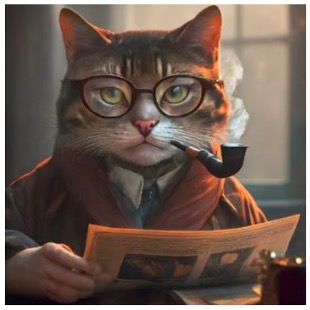
Image description: A digitally created anthropomorphic tabby cat wearing round glasses, a scarf, and a coat, smoking a pipe. The cat is seated indoors, holding a newspaper, with soft light streaming through a window in the background.
This prompt describes the subject matter of the desired output, the setting for the scene, the style of the image, and placement of the main subject. The resulting image reflects some of these instructions (e.g., a bespectacled cat smoking a pipe), but not others (e.g., a highly detailed wood environment). Where no instructions were provided, the AI system filled in the gaps.
For instance, the prompt does not specify the cat’s breed or coloring, size, pose, any attributes of its facial features or expression, or what clothes, if any, it should wear beneath the robe. Nothing in the prompt indicates that the newspaper should be held by an incongruous human hand.
The fact that identical prompts can generate multiple different outputs further indicates a lack of human control. As one popular system explains on its website, “no matter how detailed . . . the same text describes an infinite number of possible” outputs. In these circumstances, the black box of the AI system is providing varying interpretations of the user’s directions.
Repeatedly revising prompts does not change this analysis or provide a sufficient basis for claiming copyright in the output. First, the time, expense, or effort involved in creating a work by revising prompts is irrelevant, as copyright protects original authorship, not hard work or “sweat of the brow.” Second, inputting a revised prompt does not appear to be materially different in operation from inputting a single prompt. By revising and submitting prompts multiple times, the user is “re-rolling” the dice, causing the system to generate more outputs from which to select, but not altering the degree of control over the process. No matter how many times a prompt is revised and resubmitted, the final output reflects the user’s acceptance of the AI system’s interpretation, rather than authorship of the expression it contains.
Some commenters drew analogies to a Jackson Pollock painting or to nature photography taken with a stationary camera, which may be eligible for copyright protection even if the author does not control where paint may hit the canvas or when a wild animal may step into the frame. However, these works differ from AI-generated materials in that the human author is principally responsible for the execution of the idea and the determination of the expressive elements in the resulting work. Jackson Pollock’s process of creation did not end with his vision of a work. He controlled the choice of colors, number of layers, depth of texture, placement of each addition to the overall composition—and used his own body movements to execute each of these choices. In the case of a nature photograph, any copyright protection is based primarily on the angle, location, speed, and exposure chosen by the photographer in setting up the camera, and possibly post-production editing of the footage. As one commenter explained, “some element of randomness does not eliminate authorship,” but “the putative author must be able to constrain or channel the program’s processing of the source material.” The issue is the degree of human control, rather than the predictability of the outcome.
The Office also agrees that authorship by adoption does not in itself provide a basis for claiming copyright in AI-generated outputs. As commenters noted, providing instructions to a machine and selecting an output does not equate to authorship. Selecting an AI-generated output among uncontrolled options is more analogous to curating a “living garden,” than applying splattered paint. As the Kernochan Center observed, “selection among the offered options” produced by such a system cannot be considered copyrightable authorship, because the “selection of a single output is not itself a creative act.”
There may come a time when prompts can sufficiently control expressive elements in AI-generated outputs to reflect human authorship. If further advances in technology provide users with increased control over those expressive elements, a different conclusion may be called for. On the other hand, technological advancements that facilitate increased automation and optimization may bolster our current conclusions. For example, if generative AI systems integrate or further improve automated prompt optimization, users’ control may be diminished.
Notes and questions
(1) The Copyright Office report extracted above takes the position that most prompt-engineering fails the originality test because users don’t control the expressive elements. See also Library of Congress, Copyright Office, Copyright Registration Guidance: Works Containing Material Generated by Artificial Intelligence, 88 Fed. Reg. 16190 (March 16, 2023). Simple prompts like “draw a sunset in Van Gogh’s style” don’t amount to authorship, that much seems obvious. But many argue that iterative prompting and curation can reflect sufficient human creativity, akin to using a camera or editing software. Do you agree? How does the Copyright Office report extracted above address that argument? Consider this question in light of the following case studies.
Registration Case Study: Zarya of the Dawn
In February 2023, the Copyright Office revoked Kristina Kashtanova’s registration of an 18-page comic book, Zarya of the Dawn, when it learned that the illustrations in Zarya had been created using the text-to-image platform Midjourney.
Zarya of the Dawn, pages 1-2
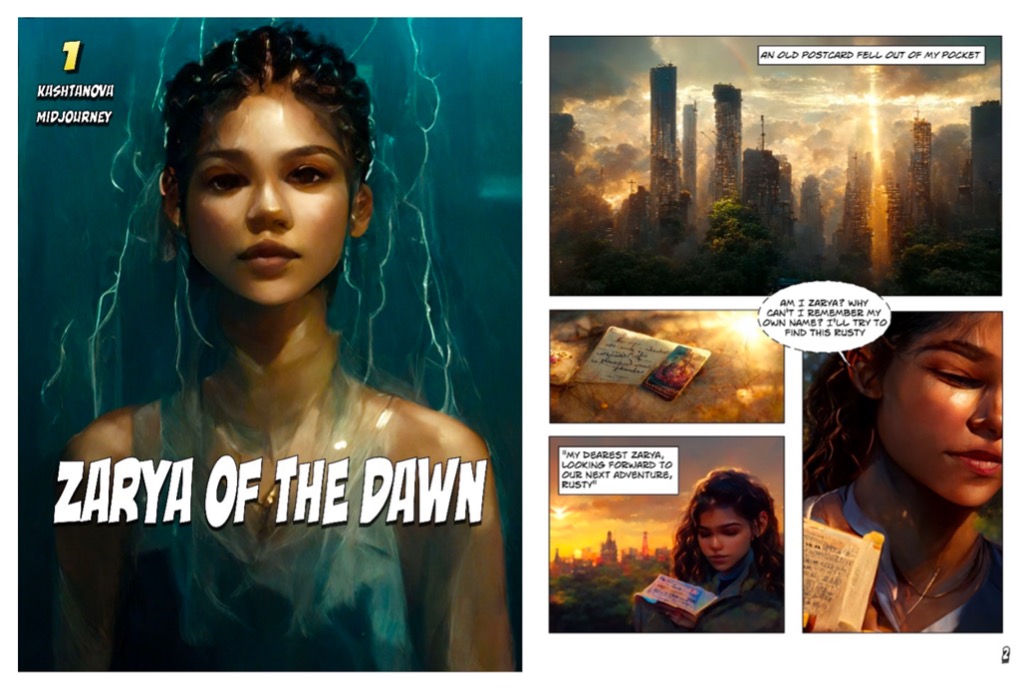
Image description: A digital comic book cover and first page titled Zarya of the Dawn. The cover shows a young woman with braided hair and glowing blue streaks against a dark, misty background. Inside, panels depict a post-apocalyptic cityscape with tall, crumbling skyscrapers, a close-up of a postcard, and the woman reading it. Captions narrate her thoughts about remembering her own name and finding “Rusty.”
The Office initially issued a copyright registration, then upon review clarified it would limit the registration to the portions of the work that were human-authored (the text and the selection, coordination, and arrangement of text and images), excluding the AI-generated images themselves.
The Copyright Office conceded that Kashtanova was entitled to copyright protection for the text she had written, the overall story she had created and the selection and arrangement of images in the comic. However, the Copyright Office concluded that there was no copyright in the individual images produced by the Midjourney AI because those images were “produced by a machine or mere mechanical process that operates randomly or automatically without any creative input or intervention from a human author.” The Copyright Office saw no evidence that Kashtanova controlled or directed the final form of the images, rather she merely chose which ones to adopt and which to refine with further instructions.
The decision analogized the use of Midjourney to a photographer using a camera – but with an important distinction: a photographer exercises concrete control over a photo’s composition (lighting, pose, framing, etc.), whereas a prompt-based AI user does not predictably control the final image. Because “Midjourney users...cannot truly control what the AI creates,” the Office found the images lacked the required human creative control and originality. By contrast, Kashtanova’s overall arrangement of panels was deemed a creative compilation and remained protected. See Copyright Office correspondence Re: Zarya of the Dawn (Registration # VAu001480196), dated February 21, 2023.
Registration Case Study: Théâtre D’opéra Spatial
In September 2023, the Copyright Office Review Board affirmed the refusal of Jason M. Allen’s AI-assisted digital artwork “Théâtre D’opéra Spatial,” despite Allen’s description of his extensive prompt engineering and edits.
The decision states that under U.S. copyright law, only works with “traditional elements of authorship” created by a human are eligible for copyright protection. The Board concluded that the core image generated by Midjourney did not meet this criterion, despite Allen’s arguments that his detailed text prompts and subsequent edits using software like Adobe Photoshop constituted sufficient human authorship. The Board acknowledged that some of Allen’s edits might contain original authorship but stated that they lacked enough information to determine if those edits were independently copyrightable. The decision emphasized that AI-generated material, when it constitutes more than a minor portion of a work, must be explicitly disclaimed in any copyright application.
Allen was invited to disclaim the AI-generated portions and claim any human modifications, but he declined that compromise and was ultimately denied registration. Allen has since sued the Copyright Office in the District of Colorado seeking review of the Review Board’s refusal, Allen v. Perlmutter, No. 1:24-cv-2665 (D. Colo.); no substantive decision has yet issued in that case.
Théâtre D’opéra Spatial by Jason Allen/Midjourney
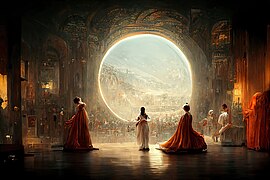
Image description: A grand, ornate hall opens to a massive circular window revealing a sunlit mountainous city beyond. Figures in flowing robes, some in white and others in deep orange, stand facing the view, their posture reverent. The scene is bathed in warm, golden light.
Registration Case Study: Suryast
In December 2023, the Copyright Office Review Board refused to register a work titled “Suryast” created by Ankit Sahni using an AI tool called RAGHAV.
Original Photo, Starry Night, and Suryast
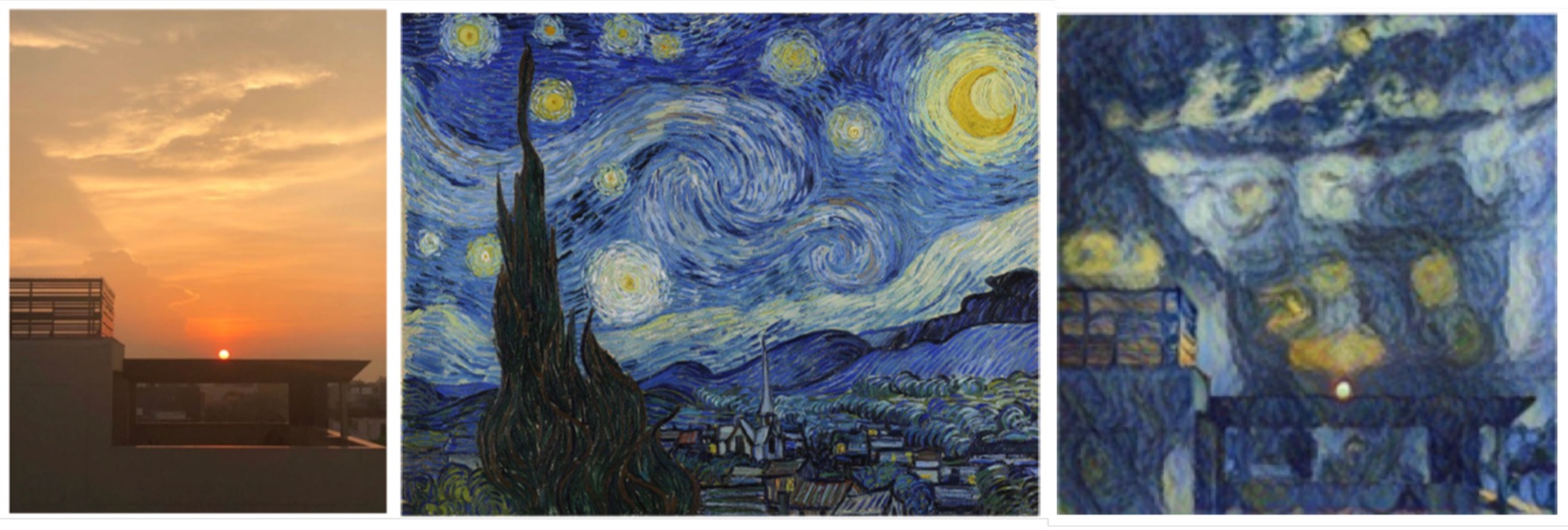
Image description: Three side-by-side images. Left: A photograph of an orange sunset behind a modern rooftop with railings. Center: Vincent van Gogh’s The Starry Night, showing swirling blue skies and a moon over a village. Right: The sunset photograph rendered in the swirling, textured style of The Starry Night, with blue tones and bright yellow orbs in the sky.
Sahni’s work involved taking an original photograph he had taken and applying the style of Vincent Van Gogh’s The Starry Night to it through RAGHAV. Sahni argued that his creative input—choosing the base image, selecting the style, and setting the degree of style transfer—qualified him as the author of the final work. The Review Board disagreed in reasoning that parallels the Jason Allen refusal discussed above.
Registration Case Study: Rose Enigma
In March 2023, the U.S. Copyright Office granted a limited registration for Rose Enigma, a digital artwork by Kris Kashtanova that combined a hand-drawn illustration with generative AI techniques. See Rose Enigma, VAu001528922 (Mar. 21, 2023).
Kashtanova, author of Zarya of the Dawn, submitted a registration application disclosing that they had created the initial illustration by hand, input it into an AI system along with a detailed prompt, and used the resulting output as the final image. The Office determined that the hand-drawn illustration qualified as a human-authored work and was clearly perceptible in the output, including specific visual elements like the mask’s outline and the arrangement of facial features and floral motifs.
Rose Enigma Prompt, Input and Output
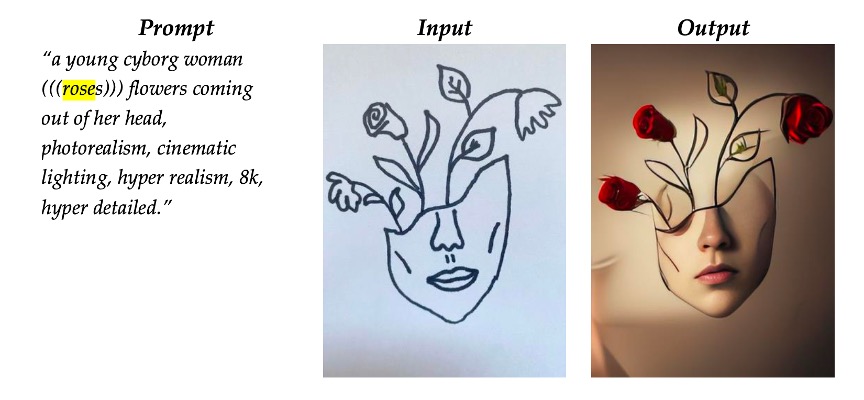
Image description: Three labeled panels. Left, “Prompt”: text describing “a young cyborg woman” with roses growing from her head, rendered in photorealistic cinematic style. Center, “Input”: a simple black-line drawing of a face outline with flowers sprouting upward. Right, “Output”: a hyper-realistic digital image of a young woman’s partial face, with red roses and green stems emerging from the top, against a softly lit background.
Although the AI system had added photorealistic lighting, shadows, and dimensionality, Kashtanova expressly disclaimed those non-human elements. The Copyright Office granted a registration with an annotation stating: “Registration limited to unaltered human pictorial authorship that is clearly perceptible in the deposit and separable from the non-human expression that is excluded from the claim.”
Case Study: A Single Piece of American Cheese
As seen above, the Copyright Office had consistently denied registration to works created via AI prompt-based generation alone on the theory that they lacked meaningful human authorship. In August 2024, Invoke, an Atlanta-based AI creation platform, submitted an artwork titled “A Single Piece of American Cheese” for registration. The Office initially refused the application, but granted registration on reconsideration after receiving a video documenting the process by which the artwork had been made. See A Single Piece of American Cheese, Reg. No. VAu 1-543-942 (effective date of registration August 5, 2024; registration decision date January 30, 2025).
A Single Piece of American Cheese (2024)
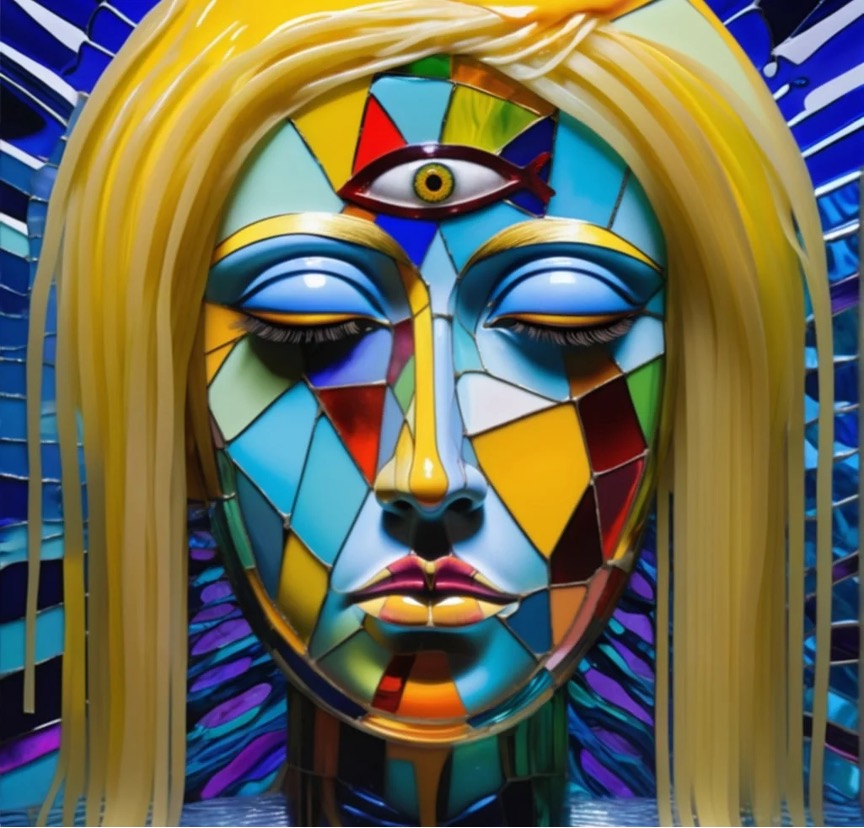
Image description: A colorful stained-glass style artwork of a human face with closed eyes and long yellow hair. The face is made of geometric shards in blue, red, yellow, and green tones. A third eye, with a bright iris, is set in the forehead. The background radiates blue and purple streaks, enhancing the spiritual and surreal atmosphere.
A Single Piece of American Cheese was created through a multi-step, human-guided process. The artist, Kent Keirsey, first generated three 1024×1024 images with a fine-tuned diffusion model from a detailed prompt. From these, he selected the most compelling output and then expanded it on a digital canvas, manually brushing in additional colors, textures, and compositional refinements. This process of iterative inpainting, editing and arranging was repeated about 35 times and took about 10 minutes. The result was a unified composition as seen above.
Mr. Keirsey has described the piece as deliberately minimalistic and somewhat absurd and as a deliberate attempt to probe the “floor” of human creativity necessary for copyright protection.
The Copyright Office found that this selection, coordination, and arrangement of AI-generated fragments into an expressive whole was sufficient human authorship to support a registration. As recorded in the registration, the copyright is limited to:
New material included in claim: Selection, coordination, and arrangement of material generated by artificial intelligence.
Material excluded from this claim: 2-D artwork, AI generated image components.
The key difference between this registration and Zarya of the Dawn, is that the selection, coordination, and arrangement registration, although it is thin, is still thick enough to cover the final image.
Notes and questions
(1) In the cases discussed above, who had the better claim to copyright, Slater, Thaler, Kashtanova in Zarya of the Dawn, Allen, Sahni, Kashtanova in Rose Enigma, or the monkey (or Thaler’s computer)? How are these cases like, or unlike, A Single Piece of American Cheese?
(2) The Copyright Office noted in its 2025 report that it has registered hundreds of works containing AI material where applicants properly identified the AI-generated parts and claimed only the human-authored aspects. How is that possible in light of the above?
(3) Not every jurisdiction is as withholding as the U.S. In November 2023, the Beijing Internet Court held in Li v. Liu, (2023) Jing 0491 Min Chu No. 11279, that prompting a Generative AI tool such as Stable Diffusion can indeed result in authorship, so long as the image “reflect[ed] the original intellectual input of [that] person.” The practical reach of that holding is narrower than it first appears. In September 2025 the same court publicized an upheld ruling requiring a claimant who asserts rights in AI-generated output to explain the creative thinking behind the work, the content of the input commands, and the process of selecting and modifying the output, and to submit evidence supporting each. See Beijing Internet Court Requires Evidence of Creative Effort to Claim Copyright Protection, National Law Review, https://natlawreview.com/article/beijing-internet-court-requires-evidence-creative-effort-claim-copyright-protection. Protection is available, in other words, but the evidentiary burden is real. Nor is the direction of travel uniformly away from the U.S. position: in February 2026 a German local court refused protection to three AI-generated logos on the ground that the prompts were too generic to imprint the claimant’s personality on the output, holding that the model was “closer to a mere tool than to an independent instrument of creation,” and that selecting among generated options or making minor technical adjustments was not enough. AG München, Case No. 142 C 9786/25 (13 February 2026). Note that an Amtsgericht is the lowest tier of the German court system, so the decision is illustrative rather than authoritative.
Where does the creativity in generative AI come from?
The puzzle of generative AI is that a soulless mechanical process can lead to the creation of new expression, seemingly out of nothing, or if not nothing, very little. Understanding where the apparent creativity in generative AI outputs comes from will shed some light on how copyright applies to AI-generated works.
The image below was created by one LLM (Google Gemini) using a long prompt written by another LLM (Anthropic’s Claude) following the instruction “draft a prompt for an arresting image of a beagle on skateboard.”
AI generated “arresting image of a beagle on skateboard”
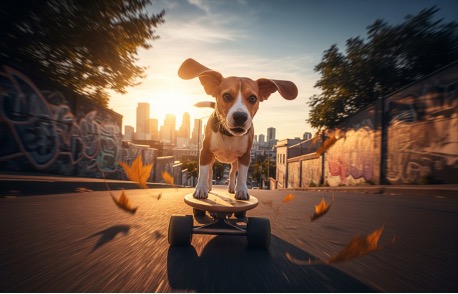
Image description: From a low angle, a joyful beagle with ears flying expertly rides a skateboard down a steep urban hill during a cinematic, “golden hour” sunset. A city skyline is backlit by the setting sun.
If you took this photo, you would be recognized as the author and be entitled to copyright protection for your entire life, plus an additional 70 years. Likewise, if you painted it as a picture. But because the image was created by a software process with very little human contribution, it is uncopyrightable. For many people, this creates a puzzle.
How can an image that looks creative not be recognized as copyrightable simply because it was created with AI rather than an iPhone camera or a set of water-based paints? Surely, if the AI itself is not creative because it lacks any desire or intention to express, then the person who writes the prompts should be credited with the resulting expression. After all, skater-beagle exhibits all the tell-tale signs of subjective creative authorship and that creativity must come from somewhere? The problem with this line of thinking is that it fails to understand that generative AI does not create something from nothing. If you want to think of all of the details of the skater-beagle picture as expression, that expression does not magically appear from the ether, it comes from the collective efforts of all of the authors of all of the works in the training data. But not in the sense of a simple remix or cut-and-paste job.
Generative AI systems come in different kinds, GANs, diffusion models, multimodal large language models, and more. The common feature of all these systems is that they are trained on a large volume of prior works, and that through what is at its core a mathematical process, they are able to produce new works with no or limited additional human input.
One of the most common misconceptions about generative AI is that the digital artifacts produced are just a remix of the training data. Although generative AI models are data dependent, they don’t just remix the training data, they produce genuinely new outputs. Perhaps the best way to think about this is that generative AI models learn an abstract model of the training data. But that model is much more than the sum of its parts. When you prompt a model, you are not querying a database, you are navigating a latent space implied by the training data.
What do I mean by “navigating a latent space implied by the training data”? Let’s start with a simple analogy. When you fit a linear regression to a handful of data points you generate a line of best fit implied by the data as seen in the figure below.
Illustration of fitting a line to scattered data
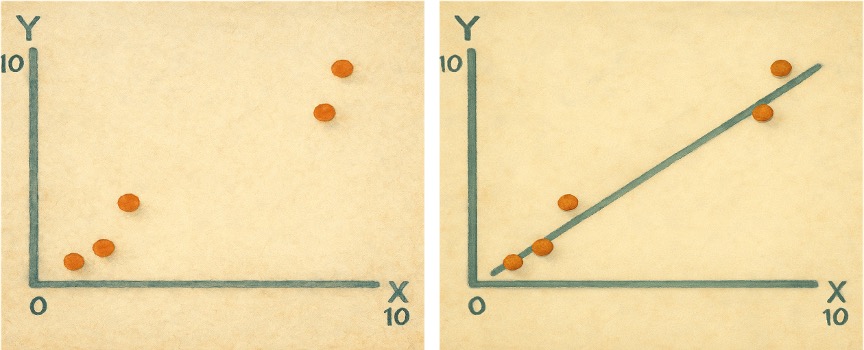
Image description: Two side-by-side scatter plots on a beige background. Left: Five orange data points scattered in an upward trend without a line. Right: The same points with a straight diagonal line drawn from bottom left to top right, representing a best-fit line. Both axes are labeled X and Y, ranging from 0 to 10.
That yields an equation that you can use to answer the question, “if y is 6, what is x?” The point 6,6 is not in the data, but it is implied by the data and the model we used to fit the data. When you plug y=6 into the model you are navigating to a point implied by the data that tells you x=6, as seen in the figure below. That is what I mean by navigating the latent space.
Illustration of navigating to point implied by linear regression
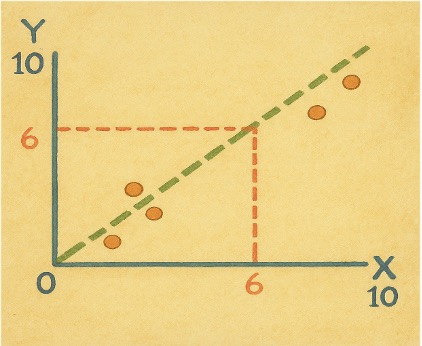
Image description: A scatter plot with five orange data points, a green dashed diagonal line representing a trend, and red dashed lines intersecting at the point (6,6). Axes are labeled X and Y, ranging from 0 to 10, on a beige background.
But of course, if we used a different model, the data would imply a slightly different latent space, as illustrated in the figure below.
Illustration of fitting a different model to the data
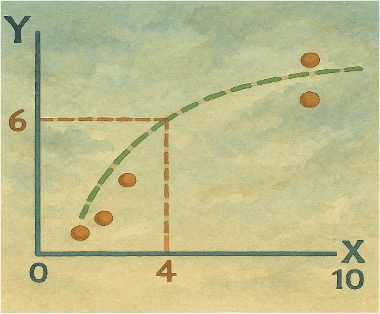
Image description: A scatter plot with five orange data points on a textured blue-and-beige background. A green dashed curve rises steeply before leveling off, intersecting red dashed lines at the point (4,6). Axes are labeled X and Y, ranging from 0 to 10.
Generative AI models are much more complicated than a two-dimensional regression model because they have more dimensions, thousands of dimensions (which is very hard to conceptualize), and they construct a much richer latent space, but the analogy holds.
Now that you understand that generative AI models don’t just plagiarize the works they are trained on, but that they don’t create something from nothing either, it is easier to see how Gemini can produce a seemingly creative image like skater beagle without anyone being able to claim authorship (or infringement for that matter).
*
But wait, if I can get copyright for just pointing my iPhone at a beagle on skateboard and pressing a button, why can’t I get copyright in an image of a beagle on skateboard that I created using generative AI?
This seems inconsistent at first blush, but only because the question overlooks the difference between the thin copyright that attaches to photos based in reality and the thick copyright that typically attaches to illustrations drawn from imagination.
The Supreme Court in Burrow-Giles Lithographic Co. v. Sarony (1884) recognized that a photograph could be copyrighted, but only because the photographer’s creative choices made the image an “original intellectual conception[] of the author” rather than a mere mechanical capture. But in practice, it seems like almost any photo will pass muster when it comes to copyright registration.
When you take a photo, you are making a copyrightable selection and arrangement from reality. You get no rights in the underlying reality, just a specific photographic representation therein. In most copyrightable photos there is only a small jump between idea and expression and so the resulting copyright is limited to that jump. Taking a photo does not give you exclusive rights on the underlying ideas, subjects, locations, etc. Rentmeester v. Nike, Inc., 883 F.3d 1111 (9th Cir. 2018) illustrates this point nicely. In that case, the Ninth Circuit held that Nike did not infringe photographer Jacobus Rentmeester’s copyright when it created a similar photo of Michael Jordan. Both photos featured Michael Jordan in a mid-air, ballet-like leap, legs spread, ball overhead, against a clean sky background. Nike did not infringe Rentmeester’s copyright because the ideas and basic elements it copied were not protectable and the more specific details that would have been copyrightable were not the same.
There are two critical differences between the typical iPhone snap and an image generated with AI. The first difference is that there is a much more significant jump between idea and expression in the transition from text prompt to final image than there is from scene to photo capturing the scene. The second difference is that in photography, a human still makes some minimal creative decisions (framing, timing, composition) that manifest in the look of the resulting image. In AI generation, the algorithm fills in the details that transform the prompt into a specific visual expression.
There is no copyright in the skater-beagle image Gemini made for me because all the work to bridge the gap from abstract concept into a concrete image was done by an algorithm trained on millions of photos. The details that we might think of as expression here didn’t come from nothing, but they don’t reflect the free and creative choices of any human mind either. They are details implied by a model trained on millions of photos, but those details don’t really come from those photos so much as the universe of possibilities those photos imply.
The Impact of AI Creativity
Software: Vibe Coding
Writing computer software has long been synonymous with precision. But with AI tools, a person with little or no coding experience can describe a program in plain English and have the system produce functional code. No deep understanding of the underlying logic required. Former OpenAI researcher Andrej Karpathy dubbed this approach “vibe coding.” Andrej Karpathy’s post on X has 4 million views and reads as follows:
There’s a new kind of coding I call “vibe coding”, where you fully give in to the vibes, embrace exponentials, and forget that the code even exists. It’s possible because the LLMs (e.g. Cursor Composer w Sonnet) are getting too good. Also I just talk to Composer with SuperWhisper so I barely even touch the keyboard. I ask for the dumbest things like “decrease the padding on the sidebar by half” because I’m too lazy to find it. I “Accept All” always, I don’t read the diffs anymore. When I get error messages I just copy paste them in with no comment, usually that fixes it. The code grows beyond my usual comprehension, I’d have to really read through it for a while. Sometimes the LLMs can’t fix a bug so I just work around it or ask for random changes until it goes away. It’s not too bad for throwaway weekend projects, but still quite amusing. I’m building a project or webapp, but it’s not really coding – I just see stuff, say stuff, run stuff, and copy paste stuff, and it mostly works.
See Benj Edwards, Will the Future of Software Development Run on Vibes?, Ars Technica (Mar. 5, 2025), https://arstechnica.com/ai/2025/03/is-vibe-coding-with-ai-gnarly-or-reckless-maybe-some-of-both/.
Vibe coding refers to an AI-assisted software development style in which a programmer uses a conversational large language model (LLM) to generate code based on high-level descriptions or “vibes” rather than writing everything manually.
In a typical vibe coding workflow, the developer describes a project or task in natural language to an AI chatbot, which then produces candidate source code. The developer evaluates the AI’s output, provides feedback or refinements in plain English, and iterates, often accepting the AI’s suggestions verbatim. Vibe coding isn’t just a way of reducing typing. Often the user can accept the code because it works without understanding what was done or how it was done.
U.S. copyright law only protects works of human authorship. This leaves AI-produced code in the same position as AI-produced images: it is uncopyrightable. You might argue that by testing snippets of code to see if they work or more generally by choosing between different solutions to a problem, the human developer is doing enough to establish themselves as the author. But as we have already seen, the Copyright Office does not accept that selection of a single AI output is a creative act. In addition, simply providing high level project descriptions or functional requirements will not be enough to satisfy the authorship requirement because of the idea-expression distinction.
If a programmer is working interactively with a coding agent, editing its output, integrating the output into a larger whole, the human’s modifications and the overall structure may reflect original expressive choices that would be enough to establish copyright protection. To register such a work the applicant would need to disclaim the AI written parts of the work.
Competition from AI music
As of October 2025, Suno and Udio are two text-to-music AI platforms that let users create full songs—including lyrics, vocals, and artwork—simply by entering text prompts. Some of this music is unappealing, even to its protagonists, but music scene insiders have assured your author that some of the music emanating from these platforms is good enough to provoke a wistful, “I wish I had written that.” It is also becoming popular. A 2025 article in The Economist (of all places) recounts the viral success of “Country Girls Make Do,” a raunchy parody country song generated by artificial intelligence under the pseudonym Beats By AI. The song apparently features on TikTok where users prank the unsuspecting by playing it under false pretenses.
This is more than a one off. Acts such as Aventhis and The Velvet Sundown, also AI-based, have attracted hundreds of thousands of monthly listeners on Spotify. These tools allow for rapid and prolific production: Beats By AI reportedly releases a new song every day. This is not simply a case of streaming fraud where AI slop steals music plays from real artists by adopting confusing names—Spotify recently removed 75 million such tracks, citing “bad actors” flooding the platform with low-quality content. Some people at least, like some AI music. The Economist reports a Luminate survey finding that one-third of Americans accept AI-written instrumentals, nearly 30% are fine with AI lyrics, and over a quarter do not mind AI vocals.
No music stands alone, but AI music arguably even less so. The appeal of these tracks lies partly in their mimicry of established genres and tropes, with a dash of irony and experimentation thrown in. Whether this portends a consumer-driven revolution in content creation where listeners generate their own entertainment rather than relying on record labels, remains to be seen. For more, see The Economist, X-rated, AI-generated country songs are taking over the internet, Oct. 9, 2025.
What does this mean for copyright law? Although the Copyright Office would not regard works of The Velvet Sundown or Beats By AI as copyrightable, Spotify seems happy to pay royalties for AI music, provided the works themselves (as opposed to the copying that fed the AI process that created the works) don’t infringe on other artists’ songs. AI music may destabilize entrenched business models at the fringes, but it might also foster broader participation and new forms of cultural expression. Does AI pose the same threat to the economic and cultural standing of musicians as it does to stock photography and digital art? Or will AI-generated music remain a hybrid layer within popular culture that feeds off and refers back to mainstream music without replacing the central role of human creation?
Note that in late 2025, both Udio and Suno resolved their respective lawsuits with major labels (Universal Music Group and Warner Music Group, respectively) and entered into licensing agreements that integrate their generative-AI systems into the music industry under “artist-controlled,” “rights-respecting” frameworks. Sony Music has not settled with either platform and its claims continue.